Metaskills Series - Alignment | LIVE One Day Workshop
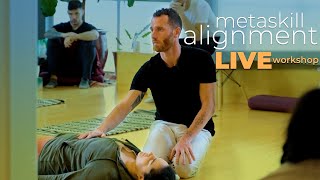
Daniel Borschel teaches alignment as a trainable skill for somatic practitioners: a dynamic state of presence and congruence that lets you show up as an empathetic witness. The workshop covers breath work for nervous-system regulation, somatic awareness check-ins, and how alignment means your thoughts, words, and actions actually match.
Chapters
I've been lost now for so long so long I've been starting to want Miles and miles Miles and miles I've been lost so long so long I've been. Welcome. Welcome, everyone. Thank you so much for joining us on this beautiful Wednesday. We're going to be diving into a topic that is near and dear to my heart, which is meta skills. Let us know where you're tuning in from if you haven't already. Let us know what you are the most curious about or perhaps what's the most alive for you right now in your. In your life. I'm going to give just a couple more moments. We still got some people rolling in. This workshop will probably be in total about 75 minutes. But if you've done my workshops before, you know that sometimes I like to stay on and answer questions and hang out with y' all for a little while after. So definitely write down any questions towards the end or write down any questions and I'll be sure to answer them towards the end. Definitely. Make sure you have a notebook to take some notes. We'll be doing some practices towards the end. And yeah, I'm excited to. I'm excited to hold this for you all. This is a. This is a newer presentation that I have put together, something that I've been teaching inside of Somatic Breathwork for a while, but I've just done done some work on really defining, defining these skills. I'm going to give just maybe two or three more minutes for people to hop on. Go ahead, use the restroom if you need to. Make sure you're in a comfortable place and you know. Yeah. We'll begin here in just a moment. Foreign. Okay, let's dive in. Welcome, everyone. Thank you so much for joining us today. I know there's plenty of things that you could be doing on your Wednesday. I'm excited to bring this to you all. Let's see here. Just need to make sure everyone's muted. We're good. This music down for a moment. All right, so I'm curious if anybody has heard the concept of meta skills before. Let me know in the chat. It's not something that I created. It is a term that's been around for a while, but it really showcases these subtle, energetic, masterful skills that really take a practitioner to the next level. It doesn't matter what type of practitioner you are, and, and even if you're not a practitioner, these are just skills that allow us to really, when I sit with it, it's to deepen connection. I look at my Life in general. And I think about what, what really matters at the end of the day. And to me it is the quality of relationships that I've created in my life. It's the quality of connections that I've made in my life. Why do we do somatic Breath Work? For those of you that have done somatic breath work with us, which this workshop will actually be something outside of somatic breath work, we will be holding a three day workshop where I will be guiding you through a somatic Breath work session in March. But I really asked myself, why do we do this? Why do we do healing work? To begin with, in general, it is to develop a deeper relationship with ourself, a deeper connection with ourselves so that we can connect to other people. And through these meta skills, which unfortunately we're not necessarily taught them in school. I wish we were. They really are the foundation of being a practitioner. Whether you are working from the mind side of things, you're a coach, you're a counselor, you're a, you're a therapist, or if you come from the body side of things, if you are a, you know, a body worker, a chiropractor, a physical therapist. For those of you that don't know my background necessarily, I was a neuromuscular therapist for a while, specifically working on getting people out of pain and dealing with injuries. I also studied a lot of different energetic types of body work, Somatic based body work, emotional release body work. I, you know, I taught a lot of the science classes as well. Anatomy, kinesiology, physiology. And basically what I was doing for a while was helping people align their physical body and realizing that it, it's much more than just aligning the physical body. I would watch people come back to me over and over and over again after I align their physical body and they come back with the same things. And through studying, you know, a lot of Eastern traditional body work and. Sorry about that, let's turn that off, make sure everyone's muted here. Well, that definitely shocked my nervous system a little bit. Sorry about that guys. If Jess or Fish can just make sure that we got everyone muted, that'd be great. Basically. So was aligning people's physical bodies and realizing that there's so much more there. And a lot of the times there's some an emotional component, there's a mental component, and that is really what began my journey with somatics and breath work and really wanting to understand the nervous system at a deep level. And breath work is the thing that, you know, allowed me to take Control of the state of my nervous system more than any other modality. And it also allowed me to understand how our nervous systems interact with each other. Our nervous systems are the way in which we communicate beyond words. It is our electrical system. When we're in the presence of each other, we are in the care of each other's nervous systems. And really what these meta skills are, are how do we develop the skills to be able to communicate and connect with each other beyond words and really create a sense of safety within another person's nervous system beyond whatever modality you are using, if you're working with people or beyond whatever type of relationship that you have, whether it's romantic or whether it's friendship, safety and being able to communicate safety to another person's nervous system is literally the most important thing I, I've had, I've talked to a lot of people that have had sessions, whether it's emdr, whether it's acupuncture, whether it's body work, whatever it is, and anybody that's had a, you know, quote unquote, like negative experience, I usually ask them if they felt safe, if they felt seen and heard by the practitioner and usually it's, usually it's a no. Before we get into today's meta skill, this is going to be a series, it's completely free. It's just something that we wanted to put out to just be able to give back to such an incredible community that supported us along this journey. It's been such a journey of growth and you know, for those of you that don't know, we've just been newly accredited as an accredited institution from Arizona State University. So we're offering continuing education credits to, you know, licensed health professionals, which is absolutely incredible and I never would have thought it would have grown to this capacity, but it just, it showcases that the world is asking for this, this type of work and, and people are looking for a new way for their own, for their own healing. And not, not to say that this is a new way, but a lot of this is my spin on, on, you know, ancient, ancient techniques. It's a modern spin on a lot of ancient techniques. So that being said, today we are going to be diving into the meta skill of alignment. And then through the following months we'll be diving into some of the other meta skills such as attunement, such as holding space and such as range cultivating range, range within yourself capacity, resilience. There are a numerous amount of meta skills out there, there are so many. But the four main ones for somatic practitioners is alignment and we'll talk about what that is. Oh yes, love that. I don't know how to turn that off. Oh, I think I froze. See, for some reason it freezes when I do the little thumbs up thing. We're going to be going over alignment today. Next month we'll do our three day workshop. I'll guide you through. We'll talk more about somatics trauma stress. That's our bigger workshop. We'll do a full somatic breath work journey. Then we'll get it back into the meta skills. We'll be doing attunement, how to attune, how to really create rapport with somebody on a nervous system level. Then we'll be diving into holding space and then range. So today is going to be all about alignment and yeah, I'm excited. Let's go ahead and take just a minute or two break before I pull up today's curriculum. Make sure you stick around to the end. I'm going to be taking you through some practices for yourself and also you can utilize this practice these practices with other people. If you have any interest in learning more about our somatic breathwork practitioner training, I'll have my team drop a link in the chat, reach out to us. You can, you know, schedule a call with us, ask any questions whatsoever. But yeah, take a moment, use the restroom, get a notepad if you need it, make yourself comfortable. I'm going to pull up the curriculum and we will dive in. For today. It Sam foreign. So before we begin, if you all could just do me a massive favor and just please make sure that your microphone is muted. Part of the meta skill of alignment is learning boundaries and we'll dive into that. So I'm going to flex this boundary on you all. If you do end up unmuting yourself multiple times when I have to kick you out. I'm sorry, but that's part of developing the meta skill of alignment. So would love to hear, for those of you that are joining in, would love to know how many practitioners are out there. Whether you've taken somatic breath work before or if you are a practitioner of other modalities, let us know in the chat. We would love to. We would love to hear. So let's dive in. So let's talk a little bit about alignment in general. For me, when I'm going through these meta skills, part of my process for creating curriculum is defining words. One of my favorite quotes, you've probably heard me say it before, but you know, wisdom Begins at the definition of terms. It's so important for us to define language. Words, words really control our paradigm. They're, you know, one of the main ways that we, that we communicate. And a lot of times we use words, but we don't necessarily know what they mean. And for me, sitting in meditation with a word is, is really, really helpful when it comes to alignment. I was sitting with, is this a, is this a state of being or is this actually a skill that you learn and when it comes to your physical body? A lot of times I like to use metaphors when it comes to the physical body because that is, you know, my background as a neuromuscular therapist. There is no such thing as perfect alignment. There's no such thing as perfect alignment for yourself and your life. Because we. Life is dynamic. Life is movement. Life is a process of ups and downs. And your alignment, your. The skill set of alignment, especially if you're a practitioner, is, are you connected enough to yourself to be able to bring yourself back to yourself? Do you lose yourself and other people? I'm going to talk about alignment, developing alignment, not just from the perspective of being a practitioner. Obviously that's kind of my focus as I teach practitioners. But I'm going to try to speak to this from a way of how does this actually benefit you as a human in your life? Because obviously we are all humans first as well. So alignment, developing alignment within yourself is, is the foundational meta skill before we get into attunement, how to connect to other people, how to, you know, actually hold space, like the application of holding space which is thrown around so much. But there is an application to, you know, there is a technique to actually holding space and there's a skill set that needs to be developed. But alignment is, is the straight line of energy that is you, is your spine, it's your posture, it's the way you, it's not just your physical body, it's the way that you carry yourself in the world. And one of my, one of my mantras for this year has been strong spine, open heart. It's so important for us to develop this, develop this duality of having a strong spine within yourself, knowing who you are feeling very connected to yourself, not afraid to tell other people your truth, not afraid to speak your truth. For those of you that have issues with the meta skill of alignment, some of the things that you might find that, that you do perhaps is, you know, telling other people what they want to hear, perhaps people pleasing, perhaps being afraid to actually express your truth in the world. How many of you have ever experienced that or deal with that? Especially if you are a sensitive human, if you are an empath and you take on a lot of people's stuff? For myself, you know, growing up in a, in a household that was very dysregulated, a lot of the times you become hypersensitive. You, you know, you're picking up on everyone else's energy around you, and so you want to make sure that your environment is, is, is in a regulated place. So you start to cater to everyone around you and you start to lose your own alignment and connection to yourself, especially of those of us that are in helping professions. If we, if you are a practitioner and you're working with other people, the shadow archetype of the healer is to help everyone else and, and, and not take care of ourself. And so I've been there, I know multiple of you, probably multiple of you on here have done that before. And so what. How do we develop this skill set of bringing ourselves back to ourselves, which we're going to dive into? So alignment is the foundational meta skill, being so deeply connected to yourself, so grounded in yourself that you're able to go to the depths with other people. I get a lot of messages from people that have seen maybe videos of people having emotional release or, you know, it's, it looks really intense. A person's yelling, crying, screaming, like, I'm going to get into that probably in the next workshop of, you know, for those of you that haven't taken workshops before and understand what a, what a somatic discharge is or an expression is. But how, how can myself or another practitioner go to the depths with another person without losing ourselves? How do you connect so deeply to another person and go to the depths with them, but you don't lose yourself in that. I'm curious, how many of you have ever felt like you've been enmeshed with another person, probably within a romantic relationship? Probably because we spend the most time with those people. With those people, we start to lose ourselves within another person. It happens, we become enmeshed. But being able to bring ourselves back, back to our own alignment, to what our truth is, is probably one of the most important skills you could learn in your life. And before we can we continue, you know, I just heard a quote from Jordan Peterson, which, you know, love him or hate him, there's things I agree with him, there's things I don't. But he said the truth will be the greatest journey that you ever take. Your truth will Be the greatest journey that you ever take. Make sure everyone's muted here. Think about that for a second. How many times have you found yourself in a place where you actually were not being honest with yourself and it got you into a situation where caused a lot of pain for yourself or maybe for other people? Oftentimes. Speaking our truth, stating our truth, speaking from a place of alignment, it might. It might cause pain to other people, it might not please other people. It might, you know, cause things to erupt around you. But if it's your truth, it'll absolutely be worth it. And that will be the greatest journey that you ever take in your life. I've been trying to delve into the practice of radical honesty. Just telling everyone exactly what I'm feeling, exactly what's going on within myself. And that has gotten me in some interesting situations. But I'll tell you that it's the most liberated I have ever felt, and it's the most congruent I've ever felt. And it's the most healthy my nervous system has ever felt. So let's move on. So let's. Let's dive into the actual definition. My. My definition of this. Developing this meta skill of alignment. Alignment is a dynamic state of presence and congruence that enables us to be in right relation with ourselves and show up as an empathetic witness for others, but also ourselves. And so I know this is a wordy definition, but part of this process is we're going to be breaking down some of the words in here, such as presence, congruence. What does it mean to be in right relation? What does it mean to be an empathetic witness? So when you think about alignment right now, just think about your posture, your physical posture. Alignment is a dynamic state. There is no such thing as perfect posture because life is going to push you in one direction and then it's going to push you in the other direction and you're there. There is no such thing as a perfect posture because life is movement, life is change. When you have a highly developed skill of alignment, it's not that you're in this perfect position all the times. It's that you have enough connection to your center that when you get off balance, you can bring yourself back your alignment quickly. Part of this is minimizing the time in between. Me getting sucked into somebody else's stuff. Can I minimize the time between I'm going to get sucked into other people's stuff. I'm going to get disregulated. I'm going to get Stressed out. But can I bring myself back? And how quickly can I bring myself back? It's not a perfect, it's not about a perfect state. It's not about being in balance all the time. There actually is no such thing as perfect balance. Every like I've worked on thousands and thousands of bodies. I'll tell you this, no one is symmetrical, no one has perfect posture. Everyone is just a little bit off, just a little bit perfectly imperfect. And so really when it comes to cultivating this skill of alignment, it's about, it's about awareness. Awareness is the first step in, in healing anything and becoming resourced in our awareness. A lot of, a lot of, you know, masters in the realms of somatics, whether or healing modalities, they talk about how resourced you are, how resource can you become, how many tools do you have, how many resources do you have to be able to bring yourself back into center? How many resources do you have to be able to channel stress? I talk a lot about expression in somatic breath work and you know, stress and trauma are guaranteed in our life. And how do we find ways to move through stress out of our, out of our system? We have to find ways to express. The more resources I have to express myself, the more routes that I have to express myself, the more opportunity I have to move that stress through my system. And so it's the same thing with alignment. The more resources I have, the more tools, practices that I've developed, the more tools and practices that I've given my client to actually bring themselves back is how resourced they are. When you are in a state of alignment, when you have this meta skill that's highly developed in your ability to be yourself fully, it you become, you become. Well, it creates authenticity and authenticity is felt by everyone else's nervous systems around you and it creates a felt sense of safety. It's truly a meta, a magnetic state. You can look at people on Instagram even or social media, or maybe you're around people and they're not in alignment and you probably don't want to spend time around them because maybe you don't even know it consciously, but your body is saying something is off, something is off with this person. Not everything that they're communicating is like, is coming from them. And so you pro, your nervous system is going to be in a state of picking up on like signals of, of threat. So the more aligned that you can become, the more authentic that you can become, the more that you're going to create a space that people will Just feel safe around you, they're going to be drawn towards, you know, when it comes to like marketing and business and all of that, like alignment within yourself and being able to communicate from that place is truly the most magnetic thing that you can do. When you are afraid of your own preference, when you are afraid of showcasing your full expression to the world, people feel that you're holding back. And when you're holding something back, it means that, that there's not a deep level of trust. Authenticity, vulnerability and trust are the foundations of true connection of right relation. When I am in a stressed state, when I'm maybe sad, when I'm angry, and I can showcase that to another person, it actually creates a deep sense of trust because the other person knows that I'm not holding anything back. How many of you have dealt with or have felt like passive aggressiveness from other people? Isn't that the worst? For me, I like to poke at them. I'm like, you're holding something in there. Like, just get it out. Like, just say what you want to say. Passive aggressiveness is a great example of this because there's something that's bottled inside that wants to come out, but they're not actually letting it come out. So it's finding leaky ways, it's finding sneaky ways to come up and out versus when a person's connected to themselves and they're able to be authentic and they're, they're able to be in right relationship to themselves, well then they can be in right relationship to another person because they're able to showcase all of themselves. I think the, one of the biggest epidemics in our world is that we don't trust each other. We don't, we don't trust each other, we don't trust our neighbor. We. And why is that? Because we're not able to be authentic and vulnerable. We're not able to be seen and heard by each other. One, because maybe we don't have the capacity to be able to actually listen and receive a person or the other. Maybe we're repressed and we're actually not connected to ourselves and we don't have outlets and we're not resourced to be able to actually tell other people how we're feeling. And so I truly believe that a lot of these practices, it regains connection, trust between each other. So we'll continue on this. So let's talk a little bit about presence. So as we continue into this definition, if you think about the world that we live in right now, when was the last time you felt like a person was fully present with you and you could actually feel that there was nothing else pulling at this person's presence, There wasn't like, I got to pick up groceries, I got to answer my emails. I gotta, like, do all these different things. When was the last time you were, like, completely present with another person? It's a very rare thing in our world because we have a million things going on at one time. But if you've read Body Keeps the Score, which is an incredible book, one of my favorite quotes in there is healing happens in the presence of an empathetic witness that being able to be fully present with someone is the greatest gift you could ever give somebody. And, and because your attention, your attention is the greatest resource you have beyond your money, beyond anything else, you have your attention where you put your attention. Now, as cliche as it sounds, that quote, you know, energy flows where attention, where attention goes. You only have so much attention in your life. You only have so much bandwidth. And if you want to learn things, if you want to, you know, build something, you better get really good at becoming present and being able to hone your presence. And so developing presence is a massive part of, of being in alignment with yourself because you don't have other things pulling at you. And a lot of the times the pathway in, in. In developing a deeper presence is, you know, the pathway of developing all these meta skills is, is. Has a lot to do with our own healing journey. But most of us are stuck in either the future or the past. Let's think about the past for a second. The past is not what happened to you yesterday or the day before or last week or months ago. The past is not the things that happened to you previously. The past is what stayed with you into now, not just in your mind, but also in your body. And most of the time, when we go through something stressful, when we go through something traumatic, it stays with us and it starts to steal our presence. It pulls at our presence. Past is not what happened yesterday. It's what stayed with you into the present moment. And trauma is. It is a disorder of not being able to be present. Like if I have different traumatic defense systems, and I apologize if this is a little bit deeper than, than what some of you have gone into. But trauma is a disorder of not being able to be in the present moment, because the past, whatever I went through in the past, has frozen into my present moment. And then it starts to create my future from that place. And so it's. It's like that. Carl Jungku Until I make the, the conscious or the unconscious conscious, it will control my life and I will call it fate. When people have different traumatic defense systems that are locked into their present moment, well, that's not in their mind, it's in their body. And it's going to start creating their reality for them. You might be reactive, you might be making choices that, that you know are not in, in alignment with yourself. And then you, you know, you spend years, 15, 20 years in that place and then you wake up and you ask yourself, holy, this is not the reality that I'm wanting. And so part of developing presence is integrating the past is, is, is, is healing the past. And the past is remember not what happened yesterday, it's what stayed in your body. That's why somatic breath work is such a powerful modality because it allows you to digest the things that have been stored from the past into the present moment. And therefore you can have a way to discharge it. And therefore it stops to create your future, you create more space for you to have conscious choice, for you to have more presence. I'll say one other thing. You could think of human beings like a memory card. You only have so much capacity, you only have so much attention, you only have so much presence that you can give somebody. When we have different wounds that have happened in our life, different, you know, traumatic instances, maybe people wounded us emotionally, it starts to fill up our memory card and then we have like this much left on our memory card for us to actually be present with another person. And I always use the example of, you know, how many of you have ever been on your last nerve before or you're about to have a nervous breakdown? Well, what that is is that your memory card is filled up with undigested past and therefore you only have this much capacity. And if somebody gets, if somebody takes over that little bit of capacity, well, you're probably going to have a nervous breakdown or you're probably going to have an involuntary expression on someone else. And so part of developing presence is really being able to process and digest our past not just on a mental level, but on a physical level and an emotional level. And we're going to be, I'm going to be taking you through a couple exercises today. They're not as intense and not as, you know, in depth as a full somatic breath work session, but they are really good practices for you to just do on a day to day basis. So we'll continue with presence. Let's continue though with our definition make sure you're writing any questions down. I will definitely take some time at the end to answer your questions. So, presence and congruence. You could think of these as intention and attention. If presence is your attention, congruence is your intention. If presence is your ability to focus your attention to give someone your full presence, to. To give whatever it is your. The thing that you love to do, to be fully in the present moment, to be captivated by the rapture of being alive. Maybe it's with your lover, maybe it's with a client, maybe it's with, you know, for me, it's playing a musical instrument. Can I give this thing my full attention? Congruence, on the other hand, is your internal state. If, if attention is my ability to focus my, my awareness, my presence congruence is. Is my, my inner tension. What is my driving force? If someone is congruent, it means that their thoughts, words and actions are all speaking the same thing. And we have all been in a place where we're not congruent. Where you've been in a relationship where you're like, I don't know if this is the best idea for me, or I've been in a job where it's like, this is not in alignment with my soul, but it pays the bills, right? When you're congruent, you are speaking the same thing as your mind is thinking, as the same thing as your actions are doing. And what that communicates is a deep level of safety and trust to another person and also a deep level of safety and trust yourself. You know, anything that I'm speaking about, working with another person, it's. It's absolutely for your. It's for yourself as well. You have to. One of the biggest challenges of my journey has been to learn how to trust myself. And learning this meta skill of alignment is how you start to learn how to trust yourself, how you learn to regain the trust of your body. A lot of times our body doesn't necessarily trust ourselves. I could go down a rabbit hole there, but we'll continue. So congruence, if you are congruent, is the alignment of your thoughts, words and actions. And we're all going to be in places where we're not necessarily congruent. But can you. Do you have the resources, do you have the skills to bring yourself back? Because that creates authenticity, that creates magnetism, that creates safety from. For you and your own body. Therefore, it's felt and, and communicated to another person. Everything that you are being inside is being communicated to another person. Let Me know in the chat if this is resonating with you, if you're enjoying this. Amazing. Thank you all. Definitely write down your questions. All right, so we are, you know, obviously we're in the mind right now. We're, we're going through definitions, we're, you know, talking about words. It's a whole other thing to have this, you know, embedded within your, your soma, your body. The embodied practice of this is a whole different thing. And you know, if you really want to deepen that, I, you know, would, would love to have you reach out to the team if you are interested in, in the practitioner training. And we have a lot of other stuff coming up as well too, so I'm excited for that. So let's talk about some of the benefits of developing this meta skill of alignment. So these are just some of them, these are some of the ones I wrote down earlier. An unshakable sense of self. This is something that has been so crucial in my, in my life. Whether it comes to building a business, whether it comes to being in a relationship, whether it comes to being a practitioner with another person. What I call this is mountain energy. This is the best way to, to explain this. If you think about a mountain, a mountain is going to be the same. It's going to be itself. No matter what the weather is. If it's raining outside, if it's snowing, if it's lightning, if it's thunder, if it's, if it's on fire, it's going to be the same. Mountain energy allows another person to, to co regulate with you. Co regulation is the way in which our nervous systems communicate with each other. When I'm able to maintain my sense of self, when I'm able to maintain a regulated state, when I'm able to maintain an align state, a lot of the times other people will co regulate to me. This is an interesting kind of thought experiment for you all and maybe, maybe as your week continues, notice when you're around other people, do you co regulate to them or do they co regulate to you? Think about that. It's kind of like you could, you could kind of think about it as like the war of our nervous systems. It's not necessarily a war, but it's more of a negotiation. Our nervous systems are negotiating with each other and most of the time people connect to each other over dysregulation. If you look at the general population, I, you know, I go back and sometimes visit my family and, and you know, they want to connect over a lot of the things that stress them out. Like, oh my God, did you see what happened on the news yesterday? Oh yeah, that's terrible. Oh my God, I saw what happened on the news. Like, did you see what happened in our neighborhood the other day? It's so scary. Yeah, I knew I, I saw what happened. And a lot of the times people will co regulate with each other over stress and dysregulation versus co regulate co they co disregulate versus co regulate. And so when you're able to maintain your own alignment, sometimes, like a lot of times people will actually come into that relaxed state of congruency with you. It's a reminder. And as a practitioner, no one is healing another person. Like, they're like, I get kind of triggered and maybe there's some stuff there for me when people call me necessarily a healer because I'm not healing anyone. I, I am creating a space for a person to remember, to put the, put the pieces back together, to put the themselves back together, to remember themselves, to reintegrate. And a lot of that's happening on an energetic level, on a nervous system level. If my nervous system can maintain my state of my sense of self, my own alignment, their nervous system's picking up on that. And that gives them a reminder that they can do that too. They can do that too. They have access to it too. It's like the other cliche quote is be the change you want to see, right? That's a lot of what, what being a practitioner is. If you can embody the change that you want to see, someone else will be able to tune into that. And it, and it. You don't have to say anything to them because it's felt, it's felt on a deeper level. So let's go into, we'll continue somatic awareness and somatic literacy. We're going to be diving into this. We're going to go through the somatic awareness practice today. But it's unfortunate that we're not taught the language of our emotions. We're not taught the language of our body. When I first started taking classes in anatomy and kinesiology and learning about my body, I'm like, why are we not taught this from a young age? We're never given an owner's manual to our body, our physical body, our emotional body, our spiritual body. Why are we not taught this? This is foundational. And I almost went down a journey of like, let's before somatic breath work, it was like, let's get basic anatomy and kinesiology and, and Somatic awareness into school systems and into elementary school. And whoever you know is doing that, I am so thankful for them. So cultivating somatic awareness within yourself, being able to know how you're feeling. We're going to go into this. If I ask you how you're. Most people think their feelings, they don't actually have connection. They're, they're, they're talking heads. Most people are living from the neck up. They know what's going on in their mind. They don't have anything that they don't under. They're not occupying themselves. They're not occupying their heart space, they're not occupying their physical body. And so when it comes to somatic literacy, somatic awareness and somatic literacy are probably some of the most important skills that we can learn in this lifetime. And basically what that is is knowing how I feel, knowing what's going on inside my body, and being able to communicate that to another person. Like, can you actually tune in what, what's going on in your heart right now? What is your heart telling you? And can you put that into words? I struggled as a child for a long time being able to tell people how I feel. I still do sometimes. How many of you have a hard time telling people how you feel? And maybe it comes from the place of not being able to put it into words. Sometimes I feel like I feel so deeply that I'm not able to necessarily put it into words. Or maybe that no one else cared about it. I saw that come through. Well, when you start to develop this skill, you start to, like, be able to. We're going to dive deeper into this. So I don't want to say too much. You start to be able to become aware of what's going on in your system. And having the somatic literacy to be able to tell other people. It is the opposite of numbness. Right. We live in a culture that is. We're trained to be numb. And imagine if we lived in a world where we knew what was going on inside of ourselves. We knew what our heart was telling us, we knew what our gut was telling us, and we were able to actually tell other people that we're able to be real with each other. We're going to dive deeper into that. What a world that would be. Right? Okay. So self regulation, resiliency, quick bounce back. Like I was talking about, with alignment being a dynamic state. Hi, Pat. Okay, we need to mute them. Thank you. Hi. Like, I was talking about alignment being a dynamic state because you're, you're always Going to be pushed in different directions. You're always going to be in, in negotiation with other people's nervous systems around you. But can you bring yourself back? One of the things that I have struggled with specifically when it comes to the relationships around me is being able to minimize the time in between me feeling something and then communicating it to another person. Usually pain happens for you and another person when you leave a long, a lot amount of, a longer amount of time between you knowing something and communicating it to another person. Part of this is minimizing the time between being off your center and being able to bring yourself back. Your boundaries start to present themselves. Boundaries are in a way sort of a little bit of an archaic idea. And just listen to me for a second because boundaries help those who, who don't know themselves. And sometimes when you are in a transitional phase in your life and when you're having to, you know, you know, test and explore, boundaries can really help you. But when you are aligned with yourself, when you know yourself, your boundaries present themselves. A lot of the times we actually just don't want to listen to them. When we're aligned in ourselves, we know where our yes is and where I know is. And so our boundary, your boundaries start to present themselves when you're, when you're connected to yourself. You don't have to think about what boundaries do I need to have. When you're living from that place of congruence, your boundaries are already there. You just have to abide by them. And part of that is actually living your alignment. You know, obviously your capacity to hold space for other people is a massive part of this. We already talked about, you know, developing this magnetic authenticity of becoming your own unique expression. You know, part of my journey and I've watched a lot of other people in this and we go through this, this healing journey of healing our trauma and of, of deeply like self inquiring within ourselves. And maybe we need to move through a lot of the shadow parts of ourselves, a lot of the parts that we've cut off, a lot of the emotions we haven't let ourselves feel. And we need to figure out ways to express that and to be able to put it into words and move it through our body and, and be able to re pattern the, the story in our mind. But after a while it becomes, how do I turn that into my uniqueness? How do I turn that into my own art form in a world that's we're starting to see, you know, AI like really popularized right now. Well, what makes a Human. What can a human do better than anybody else, Better than any sort of machine or computer? And a human can connect emotionally. And one of the ways that we connect emotionally is through art, is through music, is through, through dance, is through storytelling. It's through finding our own authenticity, our own uniqueness and being able to just communicate that and express that into the world. It's what we all crave, all of life. I look outside at all of these trees and every tree has its own unique expression. Every body, all of your bodies have its own unique expression. It's expressing itself outward and that's what we're all craving. And so finding our own, you know, authenticity, our own unique expression is a massive part of developing our own alignment within ourselves. We've talked about safety and trust with ourself and other. And you know, I already talked about this as well, but you're able to co regulate with other people without losing yourself. So we talked a little bit about the impact on, on clients and relationships. It when you start to develop this like safety is the number one modality over anything. If you have studied the nervous system at all, you know that it's number one function is to keep you safe. And how does it do that? It does that through communication. It's picking up on everything, all minute details around you so that it can measure your environment whether you're safe or not. It is like your nervous system is ancient. You are not your chronological age. You are living in a body that is ancient. It's taken thousands and thousands of years to develop these very intelligent processes that have kept us alive and have allowed us to actually survive and thrive. And so beyond any modality that you're using, being able to communicate safety to another person's nervous system is the most important thing. And if you are not in alignment, if you're not able to be fully present, if you're not able to be congruent, then their nervous system is going to not feel safe. And then at that point the session's over, the relationship is over. There's a lot to go in on that. But think about this for a second. When your parents came together, basically what happened is your mom combined the DNA with your dad and they combine their DNA together. And what happens is they are giving the greatest gift possible. And that is the gift of your nervous system, your body. Really what's happening on a biological level is that we, they're, they're, they're giving the gift of your nervous system and they're saying, hey, take this, take this gift and make it better. Here you're gonna have to deal with all the ancestral trauma, all the undigested stuff that we. That we didn't deal with. You're also probably going to get a lot of the strengths and a lot of the things that we, you know, we developed. But really what they're doing is they're passing it down to the child and they're saying, hey, take this and make it better and then pass it down. Imagine if we lived in a culture that looked at it that way. Like, how do we continue to take care of each other's nervous systems to allow each other to feel safe? One of the most important things. We've already talked a lot about trust. Trust is the. Is the glue, right? They say in a romantic relationship that trust is the thing that. That is, number one. If you don't have trust, you don't have anything. And what is trust? Trust is the glue that allows us to be connected. It is the integration. From a somatic perspective, healing and integration mean the same thing. It's the same thing. A lot of the times, people think that integration is what happens after your session. Integration is your. Is actually what happens during a session or during whatever event, whatever healing event that you just went through. Because a healing event means that you're connecting to yourself. A healing event just means that you are becoming reconnected. You are reconnecting to parts of yourself. And a lot of us think about it as like, you know, a healing event is, you know, us processing some of the. The undigested emotions, the defense systems, or some of the negative things that we've gone through. But our. Our all. Like a healing event can also be. We're reconnecting to our power, to our purpose. How many of you have ever felt really, really scared? Or perhaps, yeah, you could say scared. When you connect to how powerful you are, It's a lot of responsibility. It's a lot of responsibility to have a healing experience of connecting to your power and how much potential you have in your life, I think. I don't know about you, but one of my greatest fears in life is that I. I'm not going to live up to the potential that I. That I had during this lifetime. I'm not going to bring forth into the world my uniqueness, my authenticity. It can be really scary. And so when we start to integrate, when we start to reconnect to all the parts of ourselves, we start to trust ourselves more. And that's what we're doing for clients as well. We're creating A space for them to integrate, for them to reconnect to themselves. And so they start to develop a deep level of trust to themselves. A deep level of trust to the innate intelligence in their body. That is what like if you just peel back the layers on what somatics is, you know, Peter Levine, one of the, one of the go. One of the greats, the goats, I was going to say of, of somatic psychology. When we look at somatics in general, what is it doing? It's helping you align to the innate intelligence of nature, to the innate intelligence of your nature, to the innate intelligence of your body. There is more intelligence in my cells than my mind could ever even fathom because my mind can't even understand what it takes to digest my food, what it takes to repair this little cut that's going on on my forehead right here. My mind can't even fathom that. And so when I start to reconnect to myself the intelligence of my body, when I start to listen to when my body feels off, when I feel tired, when I feel stressed, when I feel sad, I start to develop a deep level of trust in myself. And therefore your clients and the other people are going to feel that from you. And you know, I could continue going down this, but you get the point here. So let's see where we're at here. Let's take like a little five minute break here. I'm definitely talking a lot so we're going to be on here for at least another 45 minutes. So sorry for those of you that might have not have enough time, you will get a replay as well. So don't worry about that. I need some water. So let's take a little break for a moment. Go ahead. And I would love to see in the chat what your main takeaway is so far. It would mean so much to me to know that some of this stuff is landing for, for you. Make sure you write down your questions. Let's take like a three minute break and then we're going to continue down the pathway and we're going to end it off with some practices and, and just some connection and I would love to answer some of yalls questions. So thank you. Okay, we'll start to come back. Just gonna look through some of the chat here. You will definitely get a replay of this. Yeah, we'll send that out. Give us at least a day or so to get uploaded and edited. We'll send it out to you all as well. Yeah, you know these we've been wanting to do These one day workshops for a while, there's so many different things that we could do these on and, and you know, I didn't necessarily know if meta skills was the thing that y' all were interested in, but it's the thing that I'm the most interested in and have, have been. The thing that have helped me probably the most is looking at these as, as, as, as skills. Another one of my mentors once said to me, if you, if you replace the word discipline, a lot of us, when I hear the word discipline, it's like, oof, that feels a little like, like I'm going to be scolded or something. Or my disciplines in my life. If you replace the word discipline in your life with skill, we all want to feel like we're skilled at different things. Skills are what truly create our happiness, is what give us meaning in our life. And so developing skills will, will, will and developing these meta skills, one of the most important things that, that I personally think you could do. So let's, let's continue, let's talk about the pathway and obviously there is a multitude of different pathways that one can take to develop, you know, alignment within yourself. But let's talk about a couple different things. So when it comes to the practices that we're going to do here in a moment is we're going to be doing a somatic awareness exercise and self awareness resiliency and healing, your own healing journey. And I'll, I'll kind of talk about these on a deeper level, but these are the pathway to bring yourself back into alignment. Curiosity is one of the most important things that you can have, is to continue to be curious. When I think about my own healing journey, I get this image inside of myself of this little Stephen that is inside of me and is walking around with a flashlight and it's like, let's look around and see what's down there. Let's look around into the past and see what happened. Let's shine this light on, you know, the things that I've, the things that I've pushed down. Let's also shine the light on all the strengths and the things that you're good at. Continuing to be committed to your own curiosity of yourself, it is beyond important. And if you are a practitioner and you're working with other people, and I would say if you're just a human in general, your own, like your own healing journey is, is part of your job. It's part of your job because people are co regulating to you. And the more you up Level yourself. Like, the more you spend money on your own healing and, and get different modalities, like that's a tax write off for you, my friend, because you are a practitioner and you should be spending just as much time on your own healing as you are working with other people. And that's going to allow you to create more safety and more trust with another person. As far as the practice that we're going to go into, it's so important to develop a level of honesty with yourself, being objective with yourself. Where are you actually at if like, notice when you walk, when you're walking out in the world and someone asks you like, hey, how are you doing? And you're like, I'm fine, great, thank you. We ask each other this all the time, but we actually don't. We're not honest. And maybe that's a timing or a capacity thing, but like, are you able to be fully honest where you are at? One of, you know, this quote is so simple, but it just lands so much is, you know, stress is, is wanting to be over there when I'm actually right here. How much pressure do you put on yourself? I put so much pressure on myself to want to, to want to be somewhere that I'm not. If I'm tired and I'm around other people, like, oftentimes I'll be like, I, I want to be energetic right now. I want to be able to like meet people where they're at. But actually my body is tired right now. And so you're putting more pressure, more stress on yourself when you're not actually allowing yourself to be where you are at. And when it comes to your body, if you're not honest with yourself, if you're not able to actually objectively see where you are at, if you're not honest in your life, then you can't actually make any sort of change. You can't make any change if you don't. If you're not honest where you're at. And so developing this. I heard another quote by Rick Rubin, who's one of my favorites when it comes to creativity and channeling your art. If, if you're creating art, like art should be, if you're creating anything, it should be an honest representation of where you are at in the moment. A lot of the times we don't put things out into the world. I know for myself, like I've been diving into music lately. I don't want to put it out because it's not as good as I want it to be. How Many. How many times do you. Do you hold yourself from putting something out into the world because it's not at the level that you want it to be at? But if, if you don't do that, then you'll never get to version 10, you'll never get to version 15. If you look at cultivating the relationship with your body, if you look at cultivating the relationship with your soulmate, if you look at cultivating the relationship with your expression, looking at it as if it's an honest representation of where you are at right now, because you're probably not going to be in this place ever again. It's a journal entry. You wouldn't lie to yourself in your journal, would you? It wouldn't do anything for you. Hopefully you don't lie to yourself in your journal. That'd be kind of weird. Let's continue. So, resiliency, I'll tell you this, is that you're. You don't grow from staying in perfect posture and perfect alignment all the time. You grow from actually dysregulation. You grow from stress. You grow from trauma. Stress is the thing that causes us, is the thing that weakens us, but it's also the thing that allows us to grow. You will know when you're growing, when you become dysregulated, when you've taken on more things than you could handle before, when you've pushed yourself past your limits, and then you find a way to regulate yourself within that. That's how you grow. That's how you develop resiliency. Remember that trauma and stress, they are stress responses. They are trauma responses from within our being. And they're. They're subjective, meaning that you know what's stressful to me, it might not be stressful to you based on how much resilience you have. And so when you find yourself in a dysregulated state, know that that's your opportunity to like, okay, how do I find a way to regulate myself within this new capacity? And that's how you grow. How do I find a way? Like, I'm so off my center right now, but how do I find a way back to my center? Remember, it's a dynamic state. How do I find myself back to my center right now while in this new capacity? There are no wrong postures, just ones that we have forgotten how to come out of. That woman is amazing. Bonnie Bainbridge Cohen. There is no such thing as bad posture. It's just postures that we've forgotten how to come out of. There is no such thing as not being aligned. It's just staying in a position that we are, that that's not honoring ourselves. We're going to get pushed from our center. But do you have the resources to bring yourself back and with your, your healing journey, processing our past, we talked a lot about that. Having a commitment to yourself, especially as a practitioner, is to maintain, maintain. And within that, there is a certain level of relaxation that happens within your nervous system when you start to realize that your healing journey is never going to end. It's not going to end until you're done. Like, you are going to go through, you're going to go through profound integrations, reconnecting to yourself. And then some. Someone's going to come into your life and they're going to mess it all up and they're going to throw you for a loop. And then you're like, well, okay, we got more to work on here. And so there's a certain level of relaxation when you take the pressure off yourself to be healed. You're healing, you're dying, and you're healing at the same time. And that's not going to end. And therefore there's a certain level of grace that you have to give yourself. The thing that stifles people in their own, in their own. And when I say healing journey, I would say also in your own, like growth and evolution. Because it's not just healing, it's how do I grow and evolve and how do I become this unique expression, this authentic version of myself? Is that the thing that blocks most people is putting pressure on yourself not being, not allowing you to be where you are at. And if you look at yourself as a verb, as a process, well, there's a certain sort of grace that happens. There's a certain level of, of objective self awareness that allows you to be honest where you are at and know that, wow, I am, I am not showing up as the best version of myself right now. And therefore I have the opportunity to get better. So I think we're going to actually skip this because I've been talking a lot, I think let's get into some practices actually. So the first practice that I'm going to take you all through, and maybe you've done this before, if you've, if you've joined any of our other workshops or if you're a practitioner, we're going to go through one of my favorite, just the daily somatic breath work practice. And so right now you should, you know, find a comfortable position. You can do this seated. And I'm going to give a little bit of a deeper understanding for those. I'm going to stop sharing here. For those of you that have not done this daily breath work, practice with us. The way that it's designed is to spike your nervous system first to take yourself into a little bit of a dysregulated state so that I can come back down into a relaxed state. Right. That last quote that I just shared was there are no wrong postures, just ones that we've forgotten how to come out of. This daily practice is to let's take oursel into a stress state and then let's bring oursel back into a relaxed state. So I'm showing the nervous system resilience. I'm showing the nervous system how to fluctuate and flow. Most of our issues come from when we get stuck. And so this daily practice is powerful for you to roll through this and develop this bounce back. How quickly can you actually elevate yourself and then bring yourself back down into a relaxed state? And for those of you that have done our longer somatic breathwork session, it's a very similar. It's a very similar model. But so right now, go ahead and find a comfortable position. You can do this seated, you can do this laying down. If you have headphones, it probably is the best to do it with headphones, but if not, no worries. If you're in the car, you probably don't want to do this as well. I'm going to share a little bit of music here. Just start to start to bring yourself into a posture that feels the most aligned for you right now. If there is something, if there's something in your life that you're wanting to embody, whatever's like when I say the word alignment for you, what, what comes up? What comes up? What do you need more of? What do you want to connect to? And so start to take the posture, the physical posture of what alignment means for you or what you want to align to. So bringing your awareness inward. Someone said they want to embody a warrior princess. I love that. Take the posture of a warrior princess. All right, so starting to deepen our presence. Let's take one breath in through the nose, let it out through the mouth. Part of this practice is to reclaim your attention. You have the ability to rec. To reclaim all of your presence back to yourself, all of your attention back to yourself. Can you bring it all back in from all of the things on your to do list? Are you able bring it all back to your center, reclaim your attention, bring it inwards, noticing your physical alignment, your posture, noticing your spine, your antenna, that is you. So through this daily practice, we're going to go for two rounds. The first round is going to be deep breaths in and out of the mouth. Going to be pulling the breath as deep as you can into your, not just your belly, but into your sides, into your lower back, expanding yourself in 360 degrees. And within this first round, as you're breathing in and out of the mouth, the emphasis is on clearing. Clearing your field, clearing your body, clearing your inner space of anything that is not in alignment for you, anything that you're carrying that is not yours. And so as we start this first round in a moment, with each exhale, just imagine that you are kind of washing, you're washing your system. So with this first round, I am going to push you a little bit. It'll be for about two to three minutes. I'm going to have you take one breath hold in between. And then for the second round, we're going to switch to in through the nose. We're going to start to elongate our exhale and see how quickly you can bring yourself back down into a relaxed state. How much choice do you have over your nervous system? How much bounce back do you have? So let's spike ourselves during that first round. We'll do a breath hold and then we'll, we'll see how quickly we can bring ourselves back to a relaxed state. And for those of you that have more questions on like the breath, just breath is your driving force. You can't do it wrong. Find your own rhythm and stay with it. What feels good for you? Stay with that. So let's all take one deep breath in. Let it go, let it out. And let's begin. In and out through the mouth. In and out through the mouth. Pull it down as deep as you can. Hear your field each exhale. Find your own rhythm and push yourself a little bit in this. Designed to be a little uncomfortable. Keep going. Find your own rhythm. Close your eyes if there's that feels good for you. Bring your awareness inward. See if you can identify where you're carrying stress, where you're carrying tension in your body. Try to take the breath to that area. If your body wants to move, let it move. If there's a sound that wants to come out on the exhale, let out your sound. Deep breaths. Keep going. Notice if you want to quit, if you want to stop, if your attention goes elsewhere, bring yourself back to you. SA 30 more seconds. Deep breaths. Let's do three more deep breath in all together. Let it go. Let it out. Deep breath in. Let it go. Let it out. One more deep breath in. Hold it at the top. Hold it at the top and connect to connect to your own alignment. What is most in alignment for you? Maybe it's where you've been out of alignment. Maybe it's trust. I mean it's presence. Maybe it's congruence. Go ahead. When you're ready, let's let the breath go. Recommit to the breath going to go in through the nose this time. Go out through the mouth or to elongate your exhale in through the nose. Deep breaths or to elongate each exhale with the can you bring yourself back relaxed state in through the nose. Each breath breathing all of the parts of yourself back in. Reclaiming all of your energy back into yourself. Your own alignment you through the nose, out through the mouth. Slow it down and I do 10 more at your own pace. Find your own rhythm through the nose. How long and how slow can you exhale? Save your attention by it. Three more deep breaths in together in through the nose. Last one deep breath in. Let all your air out as slow as you can. Hold it out. I'm empty. Foreign. Whenever you're ready, you can start to return to normal breathing. Maybe keeping your energy inward for a moment. Just notice, notice your body right now just from taking this 78 minute practice. Can you feel the straight line of energy that is you your own alignment within yourself and from this place. We're going to dive into the next exercise. I would love to hear how that was for you all if you want to type in the chat if there was anything that came up from that short practice. You can do this practice at any time. It is a resource for you. It is a resource for you to use with your kids, your clients. Is a resource for you to use for yourself when you have come off of your center, when you need to bring yourself back. Maybe things came up, maybe something started to come up for you that you feel like you need more support around. Definitely reach out to us. I love that. Grounded, reinvigorated, got clarity on something. Felt bliss. Powerful. Okay, so don't lose this state because this is going to take us into. This is going to take us into our next exercise. I'm going to bring us back here. So as far as this daily practice goes, this is the practice of cultivating resiliency within our nervous system. Bringing ourselves back into alignment, being able to take ourselves into an like an elevated intense state and bringing ourselves back into a relaxed state. It is this. It is like flexing and relaxing a muscle for your nervous system. You're turning yourself on fully and so that you can turn it off. And within that, obviously, there's a lot of other things that happen. You can clear and repattern, you can connect and reclaim all of the parts of yourself. You can bring your awareness, your. Your presence back. But a lot of the times this daily practice will send me into meditation or it will send me into a deeper relaxed state. And when it comes to working with clients or with students, like, a lot of the times I will do this daily practice before, before anything, before I'm doing anything else. One of the most profound realizations that I had as a body worker is that I'm actually a breath worker first. If you're a coach, if you're a therapist, if you're even a personal trainer, if you're a yogi, you understand this, that breath is first. If someone's holding their breath and their nervous system's in a contracted state and anything that you're doing with them is probably not landing, because we need to. We need. We need to be able to get someone's nervous system into a state of safety, into a state of receptivity. And so this next practice is a great practice to do for yourself after this, or you can do this for clients. You can do this if you want to take on a challenge, you can do this in your relationship, which can be very powerful as well. So let's go into the somatic awareness practice now. We're going to go over kind of the basic somatic awareness practice, but this practice can changes into. It is the center point. We build upon this in a multitude of different ways. But, you know, awareness is the first step in healing anything. Awareness and alignment are the first step in me actually being able to connect to another person. And so if there's one single exercise that I truly feel is probably one of the most important things that you can do is this practice. And so the goal of this somatic awareness practice, just like I've taught so far, is to, you know, cultivate a greater aliveness, to be able to access and listen to your body, your emotions, your mind, and for some, you could say spirit. It's to occupy ourselves fully. A lot of us are not occupying ourselves. If I ask you how you are feeling, if someone asks you how you're feeling, a lot of the times we resources it from our mind, we will say, I'm feeling overwhelmed or I'm feeling like I have so much going on right now. It's such a broad question that, that we need to understand where things are coming from. And so this practice is first off a practice of being 100% honest with yourself. Like can you be fully honest with yourself? Can you learn to listen to each part of your body? This, a part of this is compartmentalizing our physical sensation. So I'll give you some examples of physical sensation. Tension in my lower back, tingly in my hands. Maybe there's tightness in my neck, maybe there is a heaviness on my chest. Physical sensations. Can you compartmentalize physical sensation from emotion? Emotions, joy, sadness, anger, happiness, bliss, grief. Can you compartmentalize those from physical sensation? And can you also compartmentalize the story that's going on in your head? Most of us only hear the sound of our mind. Our mind speaks so loudly that it will not speak over your body. Your body speaks softly. Your emotions oftentimes, most of the time can speak softly. Sometimes they can speak loudly, but oftentimes they're not speaking over your mind. And so we're going to start by bottom up, tuning into our physical sensation, then emotion, then mental story. We start bottom up because that is how somatics work. Somatics are, it's a bottom up process. It's so ma. The definition of somatic is of the body in relation to the mind. How is the state of my body affecting my mind? And so we're going to practice this somatic awareness practice. We're also going to practice somatic literacy for those of you who feel called and are open to sharing, would love to hear and I'll prompt you, feel free to type in the chat what you are experiencing throughout this practice. So let's, if you can bring yourself back into the state that you were just at in this daily breath work just back into your alignment, back into your center. Also share some sound here. Bring yourself back. A lot of the times after that daily practice. This is when I will do a somatic check in for myself. And for some of you this might be a little bit difficult because let's face it, we're not taught how to do this can be really difficult. If you spent 30 years of your life not listening to your body, not listening to your emotions, give yourself grace. This is a practice, you are what you repeatedly do this, this is an important thing to do. Perhaps in the morning, in the evening. It's a great self reflective practice. It's a great journaling practice, a great practice to do with your loved ones to create trust, to create authenticity. Right now, just bring yourself. I'll let you guys take notes on it after. Let's go into the experience. Bring your awareness back to your body right now. How quickly can you bring your awareness back to your body? Remember, alignment is about bounce back. I go from one thing to bringing my energy back to myself. So right now just tune into your physical body. Maybe you ask your physical body, what are you noticing as far as sensations go? Me right now I'm noticing the tension in my apron, lower back, noticing a little bit of heaviness under my eyes. And if you feel called to practice your somatic literacy, feel free to write in the chat. I am noticing this. Just noticing this is what you're noticing in your physical body. Just sensation. You want to practice putting it into words or if you want to practice saying it out loud, practice of self inquiry, going inward and then expressing it outward. After you done this, bring your awareness back to your body. We're going to move up into our emotional body. Is there any emotions that are currently really present for you? A lot of the times this one we have to dig a little bit deeper. There's a surface level motion you feeling right now. None of it is bad or good. Remember this is objective, honest representation of where you are at right now. So if you want to practice somatic literacy, maybe you say this out loud. I am feeling this. Or if you want to type it in the chat, would love to see it there. Me right now, I'm noticing that tension in my back heaviness, my eyes and I'm feeling a little bit of grief, a deep level. Also feeling, feeling very happy right now that so many incredible humans on this that are enjoying these practices, really happy. And so we're going to continue this practice. But it's important that you follow these prompts. I am, I am noticing, I am feeling. If you were to do this with another person, how often when you're with another person you say, well you made me feel this, that makes me feel this. This is a process of owning our experience. And so these confines of saying I'm feeling this, noticing this, it allows you to own your experience, especially if you're practicing this with another person. Really easy to project it onto a another person or to not own your experience. And so after you have done your somatic literacy part, we're going to do two more parts here. Bring yourself back to your body, bring your awareness back. How quickly can you bounce back now that you've connected to your Physical body, your emotions. Are there any stories that are replaying in your head right now? Are there any thoughts that are on you, on repeat? Right now? I'm overwhelmed. I'm not good enough or I need to do better. And you peel apart and can you compartmentalize the sensation, the emotion and then can you identify mental story just noticing, not attaching to it. And the prompt for this is the story I'm telling myself Is this story in my head right now? Is this story I'm telling myself that I need to do more Story I'm telling myself. Story in my head is I'm excited to complete my practicum from Attic story. Telling myself is I need to take immediate action. So after you have said that, have practiced your somatic literacy, bring yourself back one more time. Now just notice your physical body, your emotions, your mind requires a lot of attention. You bring yourself back, notice your physical body, your emotions and your mind. Can you see and can you notice if they are connected? Is the state of your physical body connected to your emotions? Like your state emotionally connected to the story that you're telling yourself? Just notice a lot of the times they are the last part of this practice, now that you've done this somatic awareness practice, you've connected to and you've compartmentalized and learned to listen to each part of yourself, your physical body, your emotional body, your mental story. What is it that you are wanting right now that you're listening to your body? What is it that you are wanting? Or what is it that you are needing to bring yourself back into alignment? Most of the time we think we know what we want, we think we know what we need, but we don't consult. We don't consult ourselves. So now that you've done a consultation with your being, you've deeply connected to yourself. What is it that you are wanting? And this is a powerful practice to do with other people. If we had more time, I would do partner activities. But been talking too much. I apologize. Apologize. What is it that you are wanting? One thing. Try to keep it simple. Maybe it's I. I need to go for a walk. All right. Write it in the chat. I want solitude. I want rest. Want release. How does it feel to say that? Inquire from your body, your being. I'll say it out loud. Want sunshine. I want satisfaction. I want to draw it. Paint. Where did I go? So I want to give you kind of an example of how this, you know, how this practice has worked in my own life and, and really supported me, you Know, a few weeks ago, I was definitely feeling very stressed and, and, and a little bit irritable with my, me and my friends. And I had someone reflect back to me like, you're not being very nice right now. And I think they probably put it in a different way. But you know, I checked in with my, my body and like, I'm like, okay, well, I actually really checked in with my body and my lower back was really in a lot of pain and I checked in with my emotions and there actually was a lot of anger there. But I had been operating from the story that was like, everybody needs something from me. I don't have enough time, Nobody can do it themselves. And so when I did this check in process, I realized that inside of my body there was a lot of stuff there. There was a lot of anger, there was a lot of actual physical pain. And we have forgotten that we are animals. If, if an animal is wounded, if an animal is in pain, it's going to lash out on everybody. If your physical body is in pain, you're not going to have the capacity to connect with other people because you're not actually listening to your body. Pain is an intelligent communicator. And so I started to work on my physical body and giving myself the resources that I needed. You know, I went and did a somatic breathwork session and you know, let out a lot of anger and what do you know, I started to actually be a lot nicer to the people around me. This is also a powerful practice that we do as a, we've done as a team before. I've done this in my relationships. I've done this with the people that I'm closest to and it can really be a powerful way to cultivate trust, connection. You know, if you do have clients, if you are, you know, working with people as a coach or a therapist or, you know, as a body worker or anything. It's a powerful practice to get people to deeply connect to themselves and express their wants and desires from that connected place. Because that's what we really want. We want to, we want to feel seen and heard in our needs and our desires and our wants. And we want other people to honor them. All right, y', all, well, we've been going for two hours strong. I told you guys it was going to be like a 75 minute thing, but we've gone over quite a bit. I hope you enjoyed this. I hope you got so much out of this Meta Skill workshop. Would love to hear if anybody wants to write in the chat. Main takeaway or anybody wants to would feel like this is my gift to you. I think that developing these skills are probably one of the most important things we can do as humans. And so my like desire is to just share this because I think it's stuff we already know. It's just, it's a remembering. Right. And so yeah, this is the first one that I ran. Thank you so much for being the, the, the first one for me. And we're going to continue these workshops moving forward. Next we'll have our three day workshop and then after that we'll continue with our meta skills workshop. Yeah. If you have. I was going to give time for questions but I'm not able to do that right now. I love you all. Thank you so much for joining. Would love to. If you feel called to, if you feel like you want to give back in any way, if you want to share like a takeaway that you had from this workshop on social media, tag myself tagsomatic. It would mean so much to us. If you feel called, you want to learn more. If you feel called to learning more of these practices. If you feel called to our practitioner training, you can always reach out. Schedule a call with one of our team members. Every person on the Somatic team has gone through the training. Every person on the team is a practitioner and that means so much to me. So once again, I love you all. Thank you so much for joining. I hope you got a lot from this message us. Let me know what you got. I would love to hear it. That makes me happy as a teacher to know that something got across and landed for you. I hope you have a beautiful rest of your day and I'm so excited to continue this, this, this meta skill journey with you all. Thank you very much. If you would like. Yeah, yeah. Feel free to unmute yourself and if you want to say bye.










