Why BREATHWORK? | HEALING Your Soma with BREATH
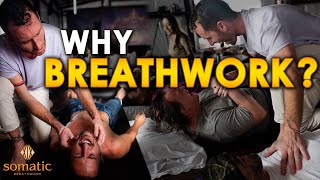
Two practitioners explain how breathwork regulates your nervous system, moving you from defensive to open states. They argue it bridges mind and body work, increases body awareness, and shifts healing responsibility onto you rather than the practitioner.
Chapters
So why breath work? I know for myself, I've studied so many different healing modalities and stumbling across breathwork. Specifically, I want to talk about why it's so powerful and why we've decided to kind of go all in on breath work. I would love to hear from you first, as a practitioner of many different modalities, and then I'll, I'll share my part if.
Yeah, I think the thing that has stood out for me is it's one, it's accessible, it's able, anyone can do it. And as, as I was moving into physiotherapy, I had to physically be with that person to move them, to manipulate them, to actually train them. And with breath, it can be done anywhere at any time. And the inclusion of it is just so much more aligned with where I'm at. As you always say when we're all breathworkers.
If you are a human that is working with another human in any sort of capacity, whether you're a coach, whether you're a therapist, whether you are a nutritionist, if you are working with another human, we are all breath workers. Because if somebody is holding their breath, their nervous system is in a defensive state, they're in a contracted state. And so anything that you're trying to do with them, it's probably not landing because their defenses are up. And breathing is the number one thing that controls the state of your nervous system. It controls whether you're in a state of fear, whether you're in a closed off state, or if you're in an open, receptive state. And we're not taught this in school, but our breath can actually change what state we are in. I know for myself, having a very physical background of working with people and different muscular imbalances and postural assessments, and working very physically with people to release knots and tension and all these different things, I was wearing myself out because I would continue to work on their physical body over and over and over again and they would come back with the same issues, realizing that what's controlling your musculoskeletal system to begin with, it is your nervous system what's controlling your mindset. On the other half of that, you know, so many people in the sort of mental health world, they work with the mindset. And if your body is in a contracted state, if you're not eating healthy, if, if, if you are in a constant state of tension, if you're in pain, try to think clearly. And so what's the bridge between this working with the mind, working with the body, it is the nervous system. And what controls the nervous system, it is your breath.
I like that because you're talking about pressurization, right? And as a therapist, we were always putting pressure onto that person an agenda, what we thought. And this is a pressurization of the inside. And I love that concept because I was always trying to find physical trigger points, knots if you will, in the body. And here this is an opportunity for the individual that's actually breathing the participant to pressurize their own self, their own emotional body to find things that come up for them. And so a lot of the work is actually done by the individual, by the participant, or without them even really knowing. And it became more of a guided, it became more of a sustainable model because as a therapist, as a coach, you will always have to be there. And it takes in a, a tremendous toll on the body and it's not sustainable long term. And this gives you an opportunity to actually let get out of the way. It's easier on the practitioner, which is huge. And you know, the participant gets so much more out of it because they're the ones doing the work. It's a big deal.
With breath work, we are using state change to initiate trait change, meaning that your breath is something you are doing all the time and you are not what you do sometimes, you're what you do all the time. And your breath, you can either think about it or you don't have to. You do it consciously and unconsciously. It's the only body rhythm that you have control over or you don't. And so I'll give you an example of sort of the bottom up way in which the physical therapy world and the yoga world and bodywork world works on people. If you've had bodywork before and someone's pressed on a sore spot on your hip and you're like, oh, I didn't really realize that that was tender. Well, you're actually not even aware of what's going on in your body. You're not occupying that part of your body. If you go to a, from the other side, if you go to a mental health specialist, they're trying to take you back to the memory of whatever happened because whatever it was, it was too much for you to handle and you checked out. Right? So they're trying to take you back to the place that you're not aware of. Well, you can work with it on a mind level, you can work with it on a body level, but you're going to have to address both and your nervous System is the connection between your mind and body, and the breath is the bridge between those two. And so the same thing happens with breath work. It allows you to become aware of the parts that you haven't been letting yourself feel. And awareness is the first step in healing anything. You have to be aware of that sore spot in your hip to be able to work on it. You have to be aware of the memories or the places and spaces in your mind that you've checked out. And so what happens with breathwork is it helps you become aware of the parts of yourself that you haven't been occupying and allows you to land back fully in this life. It allows you to become more alive. And I think that's what all of us are striving for.
Awareness actually comes up for the participant that's actually doing the breath work. As a practitioner, you do not have to actually go into the story. It's a big part you talk about. So that takes a lot of pressure off the practitioner because they don't have to have that agenda. They don't have to put something into the space. They can just allow for that participant to be fully with themselves. And that really, I think, is that just perfect place where actually really change happens. Where really transformation happens. Healing, whatever word you want to put in there. But that's when that significant change actually happens.
Yeah, it's a lot, it's a lot of pressure that health professionals have put on them because it's their responsibility to heal this other person. It's their responsibility to make this person better. When at the end of the day, no one heals another person, we all just put, we. We can put ourselves in position to heal ourselves. You go to a doctor, if you have a cut on your arm, he's not going to heal your arm. He's going to stitch you up and put you in position for you to heal yourself. Which takes pressure off the health professional and it also takes pressure off the client of this feeling of being broken. No one's broken. We all are just looking for a way to become unstuck, to have someone help us remember that we have access to all of the parts of ourselves and we can, we can do it ourselves.
Yeah. Why breath work? Because breath work reconnects us to ourselves and that is the only thing that we need. If you're interested in breathwork, if you're interested in reconnecting to yourself in here, I really encourage you to join our monthly members community. We'd love to have you there.










