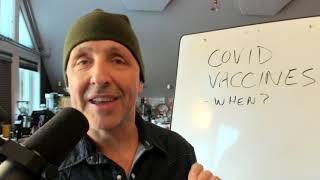
This is a YouTube video titled "Dave Asprey - COVID-19 Vaccines: When?" created on March 20, 2020, featuring Dave Asprey discussing the state of COVID-19 testing, vaccine development timelines, available treatments, and functional medicine approaches. The content provides an informative monologue on the pandemic situation, vaccine progress, and potential therapies, emphasizing innovation and public health preparedness.
Chapters
If you think that you're going to stay self isolated like I am, or that we're going to live under strict quarantines like they are in Italy until we come out with a vaccine, I've got some good news and some bad news for you, and this is real numbers. But it's pretty exciting, to be honest. As of March 3, just a little while ago, restrictions on COVID testing were lifted on labs in the U.S. it turns out there's a whole bunch of lab companies who are saying, we could test for this. It's not even that hard, but. But were not allowed to. And before the third, these lab owners and one who I spoke to yesterday in person, the CEO of one of the companies, they're hamstrung and they were not allowed to test even when they had the capabilities. In other words, they're raring to go. They want to help. And this is one of the reasons that medical freedom really matters. It's a fundamental freedom for you to be able to select any lab test from any company to test anything that comes out of your body without needing anyone's approval. And you can choose whether the validation is good enough for you, because it's your body, it's your information, and it's your tissues. And that means you get to decide. And if that freedom was just in the constitution, we'd all have $7 Covid tests now and they'd work just fine. The good news is they're coming because these companies are now unleashed. So you should see a wave of COVID tests that are coming. But knowing you've had it or you have it isn't that valuable. Except you would know if you were immune and you had natural immunity, because you're probably going to be one of the 80% of people who says, oh, I don't think I had it. I felt a little achy for a day. Was that it? And you can always say, oh, no, I don't know. But once you know you're immune and you can go out and help people who actually are at risk. But here's the exponential improvements we've seen in just hacking vaccines over the last little while. It took years for us to make a MERS vaccine for human testing, but it only took 20 months to make a SARS vaccine. And keep in mind, SARS is 86% the same as COVID 19. So if we could do it in 20 months for SARS years ago, we. What could we do today? Well, it took only six months to make a Zika vaccine for Testing. And it took a company named Moderna two months to make an MRNA 1273 vaccine for coronavirus. Two months. From years to two months, just in the last 20 years. Go Science now. Too bad it's going to take a year of testing, using current testing guidelines, to verify basic safety before this would be labeled safe for widespread use. And it's going to take many years of widespread use to see if there are unintended side effects in vulnerable populations. In the meantime, though, there are two drugs that stand out as working today. But only really sick people need them. They're called Remdesivir and Chloroquine. Don't hoard these drugs, but if you're vulnerable, in other words, you're immunocompromised, you're obese, you're elderly, having a dose available in case you go to the hospital is a good idea, but only you can do the moral math. To decide if you having it in case you need it is more important than a hospital giving it to someone else when they know they need it. I am leaving that stuff for the hospitals. I believe you should too. And There are actually 29 other companies working on vaccines, medications and other treatments. Two of them are launched, two of them are in phase three, which means they're about to be launched. If they're successful, two of them are in phase 2 trials on humans, seven are in pre clinical trials and 16 are in discovery phase. In other words, the market has spoken. Researchers are innovating, 29 companies racing to make it. So Covid is not a big deal, but it's probably a year away. So if you did get sick during that time, those two drugs are already shown by science to be effective. If you get pneumonia, if your body's already broken and weak and can't fight things off, you could die. However, you could also die from flu and from any of the other diseases that go around for people who are not well. And what we don't know yet is how many of the people who get COVID 19 and die from it were on the same path of doing this from influenza or colds or other pneumonia. We simply don't know. But we do know that being older, being weaker and having an immune system that doesn't work well are risk factors. But we do have those drugs that could help you. Now, of course, if you wanted to go the functional medicine route, there are a couple things that work very well, and one of them is intravenous vitamin C, which is an ancient standby for functional medicine before it was even called functional medicine. It works to treat most infections, to make your body able to fight them better. It's worked very well in China and now it's being used widely, according to some reports. And ozone therapy, which you just saw a video about on my Instagram, which can be done via IV or via rectal routes. You can see Instagram videos, look at a couple podcasts I did with the top leaders in ozone therapy. And that stuff has worked on Ebola, it's worked on other SARS family viruses. And it would be my first line therapy of choice if I had a problem with COVID 19, if I had it, if I even knew I had it and I had symptoms. That's what I do if I have a cold. Anyway, no patents required. So there is hope. There are natural things, there are drugs. And our pathway to innovation is exponentially better. Exponential. If you were to map out those times I just told you it looks just like this. That's good. That means. See that math? Like, that's awesome. What that means, though, is that, look, the next time one of these comes around, we probably don't have to quarantine like this, but we do want to create some space. We want to buy time. And while we're at it, could we make hospitals with enough capacity that we're not running right at the red line even when people are? Well, because really, as a society, as a species, we're wealthy enough to invest more in, in our long term public health. And this is a big sign of that. So let's do that.