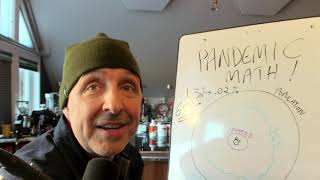
Dave Asprey breaks down pandemic mortality math: early death rate estimates are inflated because we don't know the true number of infections. The 2009 H1N1 flu looked 65 times deadlier initially (1.3%) than it actually was (0.02%) once full data arrived. South Korea's extensive testing suggests COVID-19's real death rate is around 0.9%, comparable to seasonal flu.
Chapters
All right, you guys ready to talk about pandemic math? Turns out that in every single pandemic that's ever been recorded, mortality estimates decline over time. And there's a serious math reason for that. And you have to understand this. There's four things that control pandemic math. Number one, how big is your population? And it turns out that we know that number. It's very easy to predict. And the next one though is the magic number. And this is one that is very, very hard to predict. So I'm going to draw it in light blue for you. And that is the magic number is how many people are infected. This includes people with no symptoms. You will never know the magic number at the beginning. And this is why the media goes nuts. This is why fear runs rampant because of the magic number. And here's what it is. So those are people who are sick but don't know it. They don't go to the doctor, they don't report it. They get better, they just never get counted. And then you have another number which is a big one that everyone pays a lot of attention to. And that is the total number of people who are infected, people who get sick and self report. And that's this number, little purple one in the middle. Those are number of people who have actually reported that they are sick and maybe have been tested. And then there's another number that no one likes, and that is the one in the middle. How many people actually die. The WHO usually looks at a total population. People who get sick and report it and people who die. In other words, they ignore this blue number because you can't know that up front and you probably never will know it, but you'll at least get closer to knowing it. Plus, if a disease targets people with pre existing conditions like Covid, even knowing the number of people who are going to die from normal flu instead of the new virus is impossible. But it's unlikely that the COVID virus is going to ignore people who are already weak and were targets for the flu virus. So we're going to have some overlap there that also cannot be measured or counted. Now, if you're questioning this, do you remember the H1N1 swine flu in 2009? We all lost our shit when the WHO said the mortality rate was 1 to 1.3%. Since they only knew how many people died and the number of people who got sick and self reported two numbers. They knew they knew the purple number and they knew the black number and we all went nuts. But four years later when they had all the data, the WHO revised the mortality rate from 1.3% to 0.02%. I'm going to write that down for you. 1.3 down to 0.02%. I'll do the division for you in your head. They reduced the mortality rate by 65 times. 65 times. Now, is that going to happen with COVID 19? Almost certainly. And why? Here's an example. A research out of Harvard estimated that 40 to 70% of the world is going to get infected with COVID 19. But he says very clearly this is total people infected, including those with no symptoms. In other words, he's guessing at the magic number. But if you did the media pandemic Math, you take 70% of people, that's 7 billion people, that means 4.3% are going to die. That's an inflated rate because they're only looking at these two. That's 200 million people dead. If you believe that, you're going to prepare for the apocalypse, buy a chainsaw in a bunker. But really, you'd just be bad at pandemic math. Fortunately, almost no one is saying that because no one knows the magic number of how many people are infected with no symptoms, this blue thing. But since up to 80% of people are gonna have no symptoms or mild symptoms, I think we can deal with this. In fact, an overseas employee of one of my companies just had COVID 19, as did his wife and kids. He described it as like a mild flu, but more chesty. They weathered it at home for a few days and they're all now well and they're all immune, so they're better equipped to serve their community because they're not going to get it again. But if we want more data, we could look at South Korea, who leads the world in testing, so they have the best data on how many people actually have Covid. Basically, the South Korean blue magic number is the closest we have to a real number to do real pandemic math. The South Korea reported Death rate is 0.9%. It's the one I'd bet on is the most accurate. Even though most people smoke like chimneys there, and smoking is a major risk factor, yours is not going to be average. If you don't smoke, for instance, you could then say, why is China's Hubei region reporting 4.6%? The reason for that is pretty straightforward. The collapse and overwhelm of the likely, not that amazing hospital system there, combined with a population that smokes like chimney, it's not a good Number but there are other doctors, like Dr. Richard Chavez, who's very credible because he was Ontario's chief medical officer. That's basically a state in Canada, so a big deal for 10 years. And he was chief of staff at a major hospital during SARS. He says that the COVID 19 pandemic is a global crisis for people who can't add. And looking at the data, he estimates that the magic number here, this blue number of people get sick and don't know it at this is 20 times the number of reported cases. He concludes his piece in the Globe and Mail saying that Covid looks like an overall burden comparable to influenza. So we should keep, and this is a direct quote, keep quarantine back where it belongs in the Middle Ages. So what does this all mean for you? Number one, chill. You have a greater than 50% chance of getting Covid. You have an 80% chance that if you do get it, you. You'll think you have a cold or you don't even know you have it. You can quarantine like I am for a few weeks to give hospitals time to catch up and to support our elders and people in the community who are vulnerable, people who are immunocompromised, people who are obese, people who don't take care of themselves, et cetera. But the world isn't going to end after you get COVID 19. You'll be immune, just like you're supposed to be, just like we have been throughout all of history. And then you can go back to hugging, handshaking, buying groceries for people not healthy enough to go out during any cold or flu season, including this one. Take a deep breath. Understand you can delay. When you get it, you're probably going to get it and you're probably going to be fine. Just give yourself time. And if you do get it, or there's a tiny chance you get it because you have one of the symptoms that I post on Instagram that you'll find all over the place. Take a couple weeks, don't go get coffee, don't go into the office. Isolate yourself. And that will do more for all of the people that you know and love who. Who might be at risk and all the people you don't know and maybe don't love, but maybe could who are also at risk. So be kind, be cautious, but don't be fearful.