EPISODE #905 Longevity Strategies To Use Right Now Tony Robbins & Peter Diamandis, M.D.
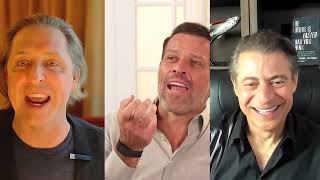
This is a YouTube video titled "EPISODE #905 Longevity Strategies To Use Right Now Tony Robbins & Peter Diamandis, M.D." featuring a detailed interview hosted by Dave Asprey with Tony Robbins and Peter Diamandis. Recorded in May 2022, the discussion covers advanced anti-aging and longevity strategies, including stem cell therapies, bioelectronics, epigenetics, and mindset practices. The conversation also explores the science behind aging, recent breakthroughs, and the societal implications of increased human lifespan. The content is an in-depth expert talk on health, wellness, and longevity technologies.
Chapters
You're listening to the Human Upgrade with Dave Asprey. You're listening to the Human Upgrade with Dave Asprey. And today, Peter Diamandis and Tony Robbins, co authors of Lifeforce, a brand new mega amazing anti aging and longevity book. You've seen both of them on the show before. And I am great friends with Peter. I've been in his abundance group forever. I'm a huge Tony Robbins fan. I've been in his VIP audience and been blessed being able to share my message with some of his team as well. So thank you both for being here and for writing such an awesome book.
Thanks, Dave. Great to see you.
Good to be here with you, buddy.
You guys put together 800 pages of precious knowledge about anti aging. And this may not be the question you think that I would ask, but how much did you rely on artificial intelligence to know what to put in this book? Because it is really good.
Well, if Peter is made of AI, then we've used a lot. I think the good news is we had an army of researchers help us because it was during COVID You can imagine trying to track down doctors and get a hold of them. It was a. We did an army of work on this together. But it's been a passion project for almost three years. And you know, Peter's been focused on this his whole life. I've been focusing this whole life. And we just came together to see if we couldn't bring the latest breakthrough. So it's really a tipping point right now in technology that's most people still don't have a clue. You do. People like you do. And maybe some of your audience, but I think even they'll be surprised by some of the things that we'll share today.
I'm so impressed by how much Tony has learned. Learned and mastered. I mean, you know, money, mastery of the game. This is for Tony. Health, mastery of the game. And buddy, just hats off to your font of knowledge. I told Tony I've got two universities between International Space University and Singularity University. And one of them, I'm going to give him an honorary PhD for his work.
Nice. Tony, tell me about your shoulder. Like this is personal for you. You and I both had joint issues and body pain. You're a bigger guy than me physically, and I'm not exactly a small guy. I think when we're big, we have more joint issues and stuff like that. What happened to your shoulder? How did you approach this from the Tony Robbins angle?
Well, it's actually. What was the impetus of this? It started When I was being an idiot going down the side of a mountain and chasing a 22 year old professional snowboarder. And regardless of age, I did not have the moves this young man had. And I had an accident where I thought I broke my neck. I was knocked out and when I came out, fortunately I didn't break my neck, but I ripped my rotator cuff severely. And you know the pain when you have nerve pain, it's 9, 9 on a 0 to 10 scale. I've dealt with pain before, so the first thing I did is go get a PEMF machine. I think you're familiar with impulse electronic magnetic frequency. There's about 3,000 studies that show how it can reduce pain. How specifically it can heal bones in half the time, even help with nerves. So it took me from 99 where I literally two nights. I had an hour's sleep one night, an hour and 15 the next. And I was breaking down to sleeping, but it wasn't enough to heal it. So I go to the docs, as you always do, and are smart enough hopefully to get a second opinion as I went to four and every one of them surgery, surgery, surgery, immediate surgery. And when I asked them prognosis, that was my problem. And I'm sure you've done this before too, Dave. It's like, well, you know, you, after we do the surgery, it could tear again. Sometimes it's likely to tear again. You may never lift your arm above your shoulder again. And oh, by the way, it's four to six months for rehab. So I can't imagine you've been to my events. You know, 15,000 people in the stadium for 12 hours, I can't be able to do a one arm move like this. So I said, well, what about stem cells? Because, you know, I've got some of the greatest of all time athletes in a variety of sports I've coached over the years. And you know, Cristiano Ronaldo, who endorsed the book, he, you know, he's supposed to have three months down he was up and two and a half weeks with stem cells. But every doctor said, no way, they won't work for something like this. So I thought, okay. By the way, the last guy looks at me and this is his delivery. You appreciate this, Dave. He said, oh my God, Tony Robbins. I'm sure people meet you all the time and they're so excited to meet you, right? Oh, you changed my life. You did this, you did that, you made me this money, turned my marriage around. And then all of a sudden, he stops he goes, now I'm really sorry, I need to be your doctor. And he puts up my spine on the screen and he goes, life as you know it is over. Who? I first paused and I said, well, you clearly didn't go to my communication seminar, right, because this is not funny. He said, you need to listen to me right now. No more snowboarding, no more jumping, no more running. One good hit and he said, you could never walk again. Wow. I'm a strong guy. You're a pretty strong guy. Somebody hits you in the stomach and you're ready for it. But I was not ready for it. It took me about two and a half hours to get my head together. And I was like, okay, I'm not going to accept this. There's always an alternative. What is it? So who do you call when you want an answer? I call my genius buddy over here. Right, Peter. Because he's the most network. He's a rocket scientist, Harvard. I mean, people have no idea how brilliant Peter is and how networked he is. And so I said, peter, who do I go to can give me the straight scoop on the best stem cells in the world? And Peter, why don't you share with them what happened?
So I turned Tony on to Bob Hurry, who's a partner in this book. He's a partner with 29, a number of events.
He's also been on the show. Longtime listeners heard the interview with him. He's a brillian, brilliant guy.
Amazing. So you know, Bob was a neurotrauma surgeon and fighter pilot and found himself in a position to start what effectively was a stem cell company. As part of Celgene $100 billion company, he ran the cellular medicine division. He discovered that the placenta is the richest source of, you know, really stage zero stem cells, the most pluripotent, most potent stem cells out there. And built a company around that. And you know, I said, tony, talk to Bob. Bob will know where to go. And Tony, what happened?
First of all, it's like saying, I want to learn about basketball. And your buddy says to you, well, let me introduce you my friend, Lebron James, right? That's the caliber with. He is right. You know all the people, he said to me, Tony, look, after 40, your stem cells drop off the cliff. So if you wanted to do autologous, meaning your own cells, maybe an elbow, maybe an ankle, but not all that you got going on. He said, you need stem cells with a force of life, life force. He said, you need something that's like four day old stem Cells. And I said, well, I don't want fetal cells. He goes, no, Tony, nobody does those anymore. He said, I'm talking about at birth. As we just described, the placenta is the 3D printer of the human baby. It's filled with all these factors, but especially the stem cells, exosomes. And he said, and then the cord. And he said, that's what you need and you're not going to get it here. Told me where to go. So I went to the three day treatment. All it was was 20 minutes a day of an IV in a single shot. And the first day they warned me I'd probably feel really tired. And I did. No big deal. The second day I had a cytokine response which is pretty intense. But I knew what it was. I wasn't scared. Shaking, freezing for about 25 minutes. It's pretty intense. But my body was really responding to this. I went to sleep, Dave. I woke up the next morning. Not only was my shoulder perfect, I mean, I got mri, this is four years ago. I've never had a problem with my shoulder stance. No surgery, no recovery time. But also I stood up for the first time in 14 years with no pain in my spine from my spinal stenosis. So I became obsessed. I want to know everything about stem cells. And then I began to realize it's not just stem cells. There's this regeneration revolution that's happening. Right? Right. And so right around that time, Peter was going to go with his group, you know, the Pope, actually every two years has this big conference with the greatest scientists around in regeneration and precision medicine. And Peter invited me to go. And I was back and forth about it. And then they invited me to speak, you know, as the cleanup speaker by the Pope for the last day. And I was like, okay, if I'm going there, I'm going to attend every class. And it was mind boggling. You met a dozen patients or more that were sent home to die for various things who are alive six, seven years later. Right. Sent to hospice. And they just didn't give up. They met, you know, Carl Jun, for example, did car T cells or so many different technologies. My mind was blown. And then I met.
Yeah, that meeting with the Pope. I was supposed to be there with you and Peter at Peter's invitation. But it was my son's 10 year old birthday and I wasn't gonna miss it, so I stood in for the birthday. I regret not being there so much because I can tell how much fun you had. No one listening to this understands what happens when you get that many smart people in a room. But that's what Peter does and it's right transformative. It's so cool. So I didn't mean to cut you.
Off there, but you made the right choice for the birthday kit. And you go back, it's every two years. You'll have the newest version of things now. But what's really cool is Jack Nicklaus is there, right? Greatest all time golfer. And so I got started talking with him and he says, you know, Tony, I couldn't stand for 10 minutes the pain was so severe. So they told me I needed to fuse my spine, which of course doesn't even work 50% of the time. And thank God he didn't do it. He went with stem cells. He's 82 now, plays tennis and golf again without pain. So I went to Simon Schuster and said, you know what I want to do? I want to do what I did with money. I went to the 50 brightest people on the face of the earth, the Ray Dalios, the Carl Icahns, the Warren Buffetts, and figured out what they did, synthesized it and brought it to the general public in a way that really people love. It was the number one New York Times bestseller. So I said, I want to do that in health, but I want to interview like 100 or 150. We end up interviewing 150 Nobel laureates, scientists, medical doctors. And I thought, well, am I going this journey? Who better to go on than with Peter and with Bob? I mean the ones started this journey with me and they're brilliant. So we worked on this together. It's a three year passion project and now we're donating, by the way, 100%. I've done this with all three of my last books. We had a giant advance. We donated all. We're going to feed 20 million people. I fed 850 million people over the last seven years on the way to a billion. And we're going to also provide this financing or the money and research here for Alzheimer's, cancer and heart disease. So it's a really beautiful project where people can find out the best about increase their energy, their strength and their vitality. They learn the basics of what they can do and they also learn what to do if they have a real challenge or if somebody in their family does.
All right, I want to cross some, cross some streams the way we would in Ghostbusters. So you are a personal development master. And I want to know when you did your stem cells, did you do a gratitude practice? Did you do visualization? Because I've done a lot of stem cells to 22 vials of exosomes. And I've done it with gratitude, with the practice, without. What did you do in your inner voice, with your energy, all of your personal development when you were doing this stuff with your shoulder?
Great question.
That's not in the book. What did you do?
I have a day. Well, at the end of the book I talk about the power of the mind in great depth because you can do everything else and not sacred your mind. You make yourself sick or make yourself well. So I have a process I do daily, and I did it that day twice I did before, in the morning, at the end of the night. And it's really simple. It's called priming, that's what I call it. But it's a 10 minute process is all it is. But I do it every day. It's like most people are wired for stress and they got a dirt road to happiness. So I decided I was starting to feel that way. I got 105 companies, I got five kids and five grandkids. It's like I felt myself about four or five years ago not fully appreciating everything. So it's like, okay, what do I need? I need gratitude to be a part of the practice. Not it's the way I live, but like a discipline practice where I think of specific things I'm grateful for every day. Not just once. When I'm all excited, I do that too, but systematically. So I do this 10 minute process and it's 10 minutes, so there's no excuse not to do it. You don't have 10 minutes for your life. You don't have a life. First I change my body radically with a breathing pattern. Then I do three minutes of gratitude where I think one minute each on some specific situation I'm grateful for. And I make one of them. Something simple like the smile on my daughter's face, the breath, you know, the ocean in my wind, in my hair type of thing. But I don't like, you know, if you think of a memory when you're on a roller coaster over there, you don't feel it, but if you remember the front seat. So I do that. Then I do three minutes of this type of blessing process to cleanse my body. And then I do three minutes where I focus on what I call three to thrive. What are three things I want to achieve or make happen? But as you know, the brain doesn't know the difference between something you vividly imagine and Something that you actually experience. So I see it as done, I feel it, I celebrate it. And on that four days and three and a half days, I made sure that what I was seeing was the healing of my body in every way, both in the middle section and the last section. So yes, I did do that, but that's all I really did along with this component. But I do it every day so my nervous system is prepared. Right.
It was built in. Peter, you've done stem cells as well. And you're more, I'm gonna say more robotic. Not that you're not a, you know, incredibly abundant minded guy. I mean abundant and bold. Right. But I mean, you have the rocket scientist mind as well. Do you do the same thing when you do stem cells? Do you have a visualization practice?
So I actually have done exosomes mostly exclusively. I have not done a stem cell. And I'll consider it. There's a number of reasons why we can go into some other time, but what I do have is a very much a longevity mindset focus. Right. I am absolutely fundamentally clear that we are going to all be given extraordinary opportunities over the decade and decades ahead to revitalize our lives, give us the energy, the vitality, reverse our aging. And so that clarity, that confidence of where the tech is going reinforces my desire to do everything I can today to intercept those technologies. So it's about diet, it's about exercise, it's about sleep, it's about fundamental belief and just the realization that my future is, you know, not infinitely bigger than my past, but substantially bigger than my past and just being excited to see it and to live it. So that energy I feel like I exuded and it revitalizes me.
That's such a powerful answer. I actually stopped identifying as being 49 years old. I am 28% old because I'm going to live through at least 180. And that's part of my whole mindset. And that came in large part from you, Peter, just that huge, abundant mindset. I can do 50% better than the world's current best, which is about 120. And so that's built in there. And so thank you guys for talking about that stuff because those are sometimes the things that are hardest to teach, hardest to share, and they're very hard to write about. And I think you do a great job with the mindset section at the end of the book. I mean, you are like the leader in the world in personal development. So there's that.
But.
It'S so hard to Hear it from you is really helpful for me, just personally and, and I want to go into a couple technical things from the book. One of the things you wrote about that is really profound. You talked about dealing with autoimmunity and some of the really cool tech. This is a book that has the most current tech that's out there. Talk to me about autoimmunity and aging, what our immune systems are doing to make us old. I don't know which of you is best positioned to answer that.
Why don't you start with that one, Peter, and then I'll pick up the one maybe on.
So first of all, the book attacks a wide range of things and you can read the book a section at a time. If you're concerned about autoimmune disease, you can read that section or obesity or diabetes, whatever the case might be. So while the book is, you know, almost 800 pages, it's, it's written in story, it's written around heroes, it's written in a way that's very consumable. So please don't be fearful of the length of the book. We didn't want to shortchange any of the incredible things that are out there. So, you know, autoimmune disease means when your immune system starts attacking self. And it is a, it's a tricky situation. It, a whole slew of syndromes are, you know, result from that. And you know, there's a number of things. Number one, stem cells are a treatment for autoimmune. It turns out when a woman gets pregnant, if she has lupus, for example, which is autoimmune or celiac, or a number of different autoimmune diseases, her autoimmune disease will significantly abate, will wane. And one of the reasons it's thought to occur is because the placenta is generating a large supply of stem cells that are going across the placental barrier into the mom and that calms her autoimmune disease down. There are a number of other different treatments and therapies that we talk about in the book. But you know, autoimmunity and inflammation are the two headed beasts that are in the book that we, that we talk about that we need to really be getting a handle of. Tony, what do you want to add there?
Well, just, you know, there are many different techniques, but one that stood out to me that we found is called bioelectronics.
Right.
It's really fascinating because one of the reasons that we end up having disinflammation, there's lots of Reasons, obviously, this autoimmune is that you get stuck in sympathetic versus, you know, parasympathetic. Parasympathetic for everybody to know is when your body's calm and relaxing and healing. Sympathetic is go, go, go. Kind of like a lot of how we live our lives, right?
Yeah. Right.
When that gets stuck. And so there is this way of treating the portion of the body that affects that most, where literally, in a matter of a few weeks, they've been able to reverse what's happening in the body. And so the body stops attacking itself because the automatic nervous system comes into balance. And some of the stories of some of the patients that have gone through this is really inspiring and exciting. And it's not invasive. It's not a scary thing. And so I think that's really critical. Then, of course, there's obviously a million different techniques, but the most important thing is to avoid that building up in the first place wherever possible, and inflammation. As you know, there's so many ways for us to avoid that. And one of the most important things is understanding what's making the body break down, period. Instead of think of the book this way. There's five sections of the book, so it's not overwhelming. The first section really gets you oriented. What this is teaches you about stem cells. We introduce you to Dr. David Sinclair and explain how aging really occurs. We'll come back to that in a second. The second section is these unbelievable technologies, some of which you would think happened 20 years from now. They're available right now that'll blow your mind. We'll talk about some of those here. The third section is all the basic things you need to do, but showing you some real great hacks that can get you to get the result quicker and faster and easier, whether it be sleep, whether it be diet, whether it be working out. And then the next section is the big section of all the big six diseases. So whether it's cancer, heart disease, what do you do to prevent it, what do you do to diagnose it quickly? What do you do to turn it around? What are the best tools and the last section of the mind? So let's come to why we age. Peter, why don't you start that piece off? Because you and I love to bounce back and forth on that. And then maybe I can tell them a little bit more about some of the tools that we, some of our buddies are coming out with here. Love it.
So one of the questions to ask. I know, Dave, that you know this stuff cold, and you've written about so many.
Sure. Audience.
But why, if you got the same genome at birth at 20, at 40, at 60, at 80, at 100, do you look different? Why don't you look like you're ripped at 20 years old? And the reason is it's not the genes you have, right? We get 3.2 billion letters from our mom and 3.2 billion players from our dad. It's our genome. It's broken up to 23 chromosomes, et cetera, et cetera. It's not the genes you have, it's which genes are turned on and which genes are turned off. So your genes are not your destiny. It's the epigenome, the word epi, from the Greek word for above, that controls your genome. And what, what David Sinclair, who published an incredible book that, you know, lifespan that we commend to everybody. It's extraordinary book. It's, it's really a beautiful match with, with Life Force. David talks. And we have a hero chapter on David, and we built many chapters around the heroes who have done extraordinary work here. And, and so David explains how the epigenome controls whether a particular cell is a skin cell or a heart cell or liver cell. Every cell in your body has the same DNA and has the same genetics, but yet why does one look like a liver and why does one look like a skin cell? Again, it's your epigenome. And the epigenome is basically, if you think about the genome as the keys on the piano, the epigenome is the piano player. And the piano player is deciding which keys to hit when, and they change over your aging life to determine which should be what cells in the body and whether you're 20 or whether you.
Look at your 80.
And what we talk about in the book is an important system that controls the epigenome, which is called your sirtuins. And so there are seven sirtuins, seven sirtuin genes, and seven sirtuin proteins and systems that control the epigenome. But these sirtuins have another function in life besides controlling making sure that the right genes are on, the right genes are off. Those same sirtuins control DNA repair. So we're constantly having DNA damage, right? I think the number I read is like, for every cell, between a thousand to a million damage points a day. That can be double strand breaks, single strand breaks can be a whole slew of different oxidation events that occur. And thank God our cells have incredible DNA repair mechanisms so that we're able to keep ourselves in line and not mutate away. But your sirtuins are part of that. And the challenge is, as we get older and older, we're accumulating more and more DNA damage and our sirtuins are getting preoccupied fixing our DNA instead of regulating our epigenome. And there's another problem, which is the, and you write about this beautifully in your, in your books, the whole idea that our sirtuins are powered by NAD energy currently inside the mitochondria. And as we grow older, our NAD falls through the floor, right, by as much as 50%. So at the same time that our sirtuins are trying to do more and more and more to fix the DNA and to keep epigenome in place, it's losing its food supply, its nad, and the whole thing goes to pot. And you start having, you know, dysregulation of the body.
So you're getting less energy. So less energy means less DNA repair, less DNA control.
Bob described it to us in a really great metaphor. One day he said, think of, you've got this beautiful mansion, you have a young staff. So anything breaks down, it gets fixed right away. Boom. 7 billion liver cells died just now. 7 billion get created in your body. But what happens is they get older and older, they get senile, they get tired, they get weak, they don't repair things as much. And then on top of it, you don't have the fuel, you don't have the resources. Now your mansion becomes a disaster. That's aging. And as you know, Ned is what fuels those seven master sirtuins, Those master genes, they don't just turn on and off. They also reduce inflammation, which we all know is the basis of most breakdown in the body. And they allow food to be converted in the mitochondria to have that energy. And as you know well, but maybe your whole audience does. I just want to mention, in order for NAD to work, you need the precursor, of course, of NMN, right?
Yeah.
And both of those are dropping almost 50% when you need it most. So here's the cool part that some of your audience probably doesn't know some of it. It might even be new to you for all I know. You know this. I'm sure you can take an old mouse, an old mouse, a 70 year old person version would be a 20 month old mouse. And you put them on a treadmill and they can barely do a quarter of a kilometer without being exhausted. You take a brand new young mouse, the equivalent of someone in their 20s, and they can run four times further without exhaustion, literally a full kilometer. You give NMN for 414 days to a mouse. And suddenly the old mouse I'm talking about is running 2 to 3 kilometers, 2 to 300% more than the youngest, strongest mouse. And they're only absorbing about 30% of that NMN. Now there's. So the good news is you can supplement it. The bad news is most of NMN is not in the product. David Sinclair is a good friend of both of ours. He's on our biology board. And so with his lab, we looked at six different companies. Not one had a single ounce of NMN in it. And some were selling it for 39 bucks, some for $120. So I asked the lab guy, I said, are these people just thieves? He said, well, a lot of it comes from China. That's possible. But he said, I think it's more likely NMN breaks down within 30 to 45 days. So by the time it gets from there to your table, it's actually worthless. So David has got nmn. That holds up. But here's the most exciting thing. You know, you say those mice studies are interesting, Tony, but mice studies, do they transfer to humans? Sometimes, sometimes not. So David is partners with a group called Metro Biotech. They're based out of Boston. And Ed Schulock's the founder of that company. Brilliant guy. He's correlated about 100 of some of the best high tech, brilliant longevity experts in the world. But unlike some of these companies like Google, that brought everybody together, gave them big salaries, nothing came out of it. He's incentivized them accordingly, and they have produced real results. And the first result, the most exciting one, is that they've created a crystallized version of NMN. It's not NMN. It's its own molecule. It's called MIB626. But listen to this. For two years, nobody knows this. It was under top secret because it was the military. The military's been testing this on their greatest athletes. You're talking about the people that are special Forces. These are men and women that don't have a lot of room to improve. Right. First they proved the safety in those two years. Then they went for efficacy and just finished the studies literally a few weeks ago. And the Daily Mail did a story about this about a week and a half ago, and it was also in a Boston paper about three weeks ago. So I can't tell you the final details, but I can tell you what the commander let loose. He was so excited, he broke protocol and he told a reporter about it. And here's what he Said the studies you saw in mice that we're seeing in the strongest men and women in the world are seeing the same kind of endurance explosions increases as we saw in the mice. Secondarily they're building muscle mass stronger and greater with the same stimulus, not more exercise less. And the most important one is cognitive has shot through the roof because when you're in Special Forces, you're exhausted. What's going to save your life or beat the enemy is right here. And energy, as we know that's in the mitochondria, that Covid steals that. That's why people fatigue. Right? So there's a study now with this right now. And by the way, this is not an over the counter, this will be an FDA approved item. They've already done the safety, they're doing efficacy, they're moving forward. They believe they'll have us in 24 months. So imagine this, Dave. You go to your doc and they give you a natural substance your body has, but it doesn't have enough of anymore. It's not gonna break down. It's absorbing 2 and 300% versus 30% and you dig it in your body and what happens now? Your sirtuins, the NAD and your sirtuins are rocking. They're gonna turn on the right ones, turn off the wrong ones. Talk about genes. They're gonna reduce your inflammation even more. They're gonna give you more energy in your cell than you've ever seen. And they got the energy now to clean up your DNA. And we're talking about an unbelievable shift in the quality of somebody's life. And it doesn't require surgery, it doesn't require any of these things. It's just taking the body and reversing it. And you should ask, I'm sure you know about the Yamanaka factors, but you have. Maybe Peter's the person to go to to tell you about what Dave did around getting mice who are blinded with glaucoma. You can't get those nerves back and turn around. Maybe, Peter, you want to share that?
I think it's let's do it. And for listeners before you get there, Peter, this stuff is real. This isn't science fiction. It's we are right on the edge where you can do stuff that is going to make you 10 and 20 years younger and more powerful than you've ever been. And then you can use the energy to do personal development stuff and to grow your career and all the other stuff. But if you're depleted, you can't do what you do on stage, Tony. Right. Or what you do on stage.
This is an example that David is 53. Chronologically, he's 33. Biochemically, we don't age at the same tempo because of the things he's doing. I've only been doing what he taught us less than nine months. I just had my age done. I'm 62, but I'm 51. I want to get that sucker to the 40s. But share with him, because if you talked about three years ago, even, we're going to reverse the aging process. Most people in the medical community would just laugh at you or think you're an idiot.
So there's been a sea change in the conversation. You know, we've talked about, finally, the idea that aging is a disease, right? It's a disease that correlates with every other disease. The number one parameter that correlates to dementia and cancer and heart disease is age. And the NIH and the CDC and the FDA have never thought about age as a disease. But the conversation over the last. And it's been five years, five years ago, this was laughable. Today, it's the hottest stuff about aging is a disease that can be slowed, stopped, and, we believe, reversed. Now, the idea that you can reverse your age is. Is something that I'm spending a lot of time on. You know, my venture fund, we're investing on an age reversal. I've got $101 million age reversal X prize that is 80% funded. I'm super excited to launch. Launch that.
Wow.
And.
And this is based on the work that David Sinclair and George Church and a number of other researchers have done, which is to realize there. So going back about 10 years ago, a researcher at Japan, Dr. Yamanaka, won the Nobel Prize for the discovery of. Of what are called the Yamanaka transcription factor. There's four genes that, when introduced, can take a differentiated cell, a skin cell, a liver cell, a heart cell, something that is differentiated, and bring it back to a state of pluripotency, a pluripotent stem cell, where, like, at the beginning of life, it can then become any cell you want. So this concept is extraordinary, and it's been used. And we'll talk about how it's being used in a lot of fascinating, fascinating techniques. But what David Sinclair did was he used three of these four Yamanaka transcription factors, and he did it in aged mice that had lost their vision and developed glaucoma. They had had their optic nerves basically die off. They had been. They were blind. And he gave them Through a gene therapy, these three Yamanaka factors. And he was able to revert the age of their visual systems to the point where they regained their, their sight. And it's the COVID of Science December 2020. It's a landmark paper. It's Nobel Prize worthy work. And that idea that you could reverse the age of the visual system, give them back, regrow their nerves, give them back their retina and have them see again. It was then repeated about six months later in, in mice hearts. And so this is a notion that's now going to be moving into dogs and then eventually humans. When you ask David and George, when do you think you're going to start to see this kind of age reversal gene therapy entering into human trials? It's this decade. It's extraordinary.
Wow.
And so there's so much tech and so many descriptors of these things in life. In the book, in Life Force. I want to know though, a question people have asked me, but I don't know how you guys would answer this. What's going to happen when we have a lot more older people who are full of energy in the world?
Great things, hopefully.
Great. A lot of people are worried about that. We're going to have too many people. Peter, you've done so much homework on that. You should take this one.
So one of the concerns, I write about this in Lifeforce, that people are saying, oh my God, we have enough of a problem population problem and we're going to have overpopulation. If you're extending people's lives 10, 20, 30 years and the data actually doesn't support that. So here's, here's the data. In the 1950s, if you looked at the reproduction rate globally, on the average, There was between 5.5 to 5.7 children per family. Today, globally, on the average, it's dropped from, you know, mid fives to 2.4. The replacement rate for human population is 2.1. The US is below the replacement rate. Europe, Japan, parts of China are all below the replacement rate.
Right.
Are likely to have a population crash. We're going to peak at nine, nine and a half billion. And then a rapid die off. And now the question not die off, but a rapid lack of replacement. And Covid made it exacerbated even worse. The US population growth rate rate declined even steeper during COVID And so the question becomes, you know, where we can get our workers from? We need humans still. We don't have AI and robotics at that point. Harvard, Oxford and London School of Business did an epic Study about eight, nine months ago. We talk about it in the book that evaluated if we could add just one year of life to every human on the planet, it would be worth $38 trillion to the global economy. $38 trillion. In 2022, we're going to hit 100 trillion global economy for the first time. We're talking about increasing the global economy by a third by adding one year of life at the end of a productive period of time. Because that's when you're earning the most. You've got the most knowledge, the most connections, you know, but you go into retirement or you give up on life and going into retirement and giving up on life, or synonymous to a large degree, especially for men, because you're in pain or you're tired, you don't have the energy. You just can't wake up in the morning again. And there are things you can do about that. And you've written extensively about that, Dave and Tony, you know, you're the master here.
There's another thing. If I was going to hire Anthony Robbins when he was 20 or when he was 62, but only biologically, 51, which is going to give me better advice, Tony, That's a question about that one, isn't it?
It's also something else interesting. You know, Peter and I, when we're at the Vatican, I remember Peter asked this group, these are all longevity doctors, and said, how many want to live to 120? And 2/3 of them did not raise their hand. And Peter was crestfallen because he's going to be 150. He's not selling for 120. I saw his face, I said, peter, this is predictable because most of these people still are programmed to think 120, drooling, not knowing who your kids are, not being able to communicate, not looking good, good. But that's not the world we're heading towards and just disease itself. There's all these studies that show people that live into their 90s, to their hundreds, the centenarians, which by the way, is one of the fastest growing groups in the world right now. That group of people have a very short period of sickness and then they die. The people that get sick in their 60s, 70s, and 80s have a long period, sometimes 14 years of that breakdown. So think about the difference in productivity if you're strong, until, let's say, 90 even. And then there's a short period of time where your body breaks down and you go away. It changes everything. It changes the impact on your family. It changes the impact on economics, it changes the hospital system. And those are facts. You can look up and see the.
Statistics for those planning for your life. If you're a financial advisor listening to this or you're talking to your financial advisor, it's a challenge because a lot of people are planning to say, you know, I need enough money to get me to 80 or 85, but what happens if you're healthy into 100, right? So it's important to start, you know, do you desire that? Do you believe that? Are you going to do what it takes to get there? If you've got energy and vitality, it changes the Runway that you see your, your world and tell about your dad, about your stepdad, your, your, your father in law, Tony.
I mean, because one of the big pieces is diagnostics, right? So the diagnostics have changed completely. I mean, going to the doctor still, unfortunately for some people, Somebody's smacking your knee, they're listening to your heart, they're picking things in your ears, they're making you cough, right? But today the tech has changed so radically. So think of it this way. Right now, what's the number one killer in the world? Heart disease, right? For men and for women. By the way, I want to mention one thing I don't want to forget for a second here. If you're a woman born today, like my daughter, the projection for them right now is to live to 100. That's without any of these changes. Just so you know, that's where it is currently. But let's look at the diseases that don't allow you to get there. So heart disease is the number one. So most people, they don't know what's going on with their heart in any real way unless they got some real issue. Then they get a CT scan. And I'm sure you've seen one before, they're very hard to read. And what are we looking for? Plaque. Well, soft plaque will kill you. Calcified plaque, it means it's healed, there's no problem. But trying to read these scans, up until now, it's a crapshoot, right? They can't tell much of the difference. It's difficult. A lot of surgeries happen. They don't need to happen. So our partner, Bill Capp at Fountain Life, we have these Fountain Life centers across the US and now we're open in Abu Dhabi in places. But he's like one of the, you know, he built 12 hospitals from scratch. He's an incredible human being. The most understated guy you can imagine. He sold all his hospitals, because he's so tired of disease care. So now he's into regeneration. Precision calls me up and says, tony, in his gentle way, I talk like this. He talks like this. He goes, tony, he said, I really want you to come down because I think we found one of the biggest breakthroughs in cardiology in 10 years. Everybody else says it, you go, but you know, he says, you lean in. So I said, what is it? He goes, well, you know, CT scans, you've had CT scans. He goes, well, there's this new technology, ccta. He said, it opens, it use AI to digitally open your arteries. Goes through and measures within your arteries. Is it calcified plaque or is it soft plaque? Calcified plaque means you're healed. The soft plaque can be the widowmaker breaks off and gives you a stroke or gives you a heart attack, right? And he goes, tony, they can predict the heart attack five years in advance and tell you what to do to prevent it. So the reason Peter brought this up, I think is because I said, okay, I'm in. I'm going to go check it out. I'm not worried, but I want to know, right? And so I said, I'll come in three days. Meanwhile, my father in law is visiting. He's 80 years old, really good man, good heart, good heart, you know, emotionally good heart. Built his own business from scratch, lumber business. Pretty strong guy physically. But you know, you enter your 80s and everybody around you is like, well, you know, the writing's on the wall, you got to get your will together. And I could just see him start to dip emotionally. It's more of the hat than his body. So I said, pops, I said, I'm going to go do this in a couple days. I said, we're both at a stage of life. We're going to have some soft plaques. But wouldn't it be nice to know where it is and know what to do? And I said, why don't you come with me? So he said, okay. He wasn't excited about it, but he says, okay. We go there, he gets the test. My father in law is clean as a damn whistle. There was nothing in their soft wax. He's like, got a whole new lease on life. I'm better than I was five years ago. I'm doing great. But he literally was just about perfect. So now his whole Persona changes. So I turned to him and I said, dad, I said, look, you know, we have these world class athletes, we bring in professional athletes and you know, you get injured and the connective Tissue hardens and then you don't get the same blood flow, water, you know, hydration. And a lot of nerves get trapped. And guys go through all this rehab and still have this problem. So I had one, for example, on my ankle 16 years ago. Even if a masseuse came by, like, don't touch it because it would create like an electrical shock up my body, the nerves. So I did this process. They scan you with ultrasound. It's called relief. They find the places where there's a challenge. They put this fluid in like amniofluid. It opens the space and if there's a nerve there, it'll snap back in place. I actually felt it snap back in place. You can smack me with a hammer. Well, hammer might not, but anything else, I don't feel it there. Ankle's perfect. So I said, dad, I said, what's making you feel old? Okay, now you feel young with your heart because it's like a 25 year old heart. But it's the pain, it's not being able to walk right, right. You got so much pain in his hip. So I said, why don't you go see our guys here, the fat and lifted guys that do that. So took him into another room, he meets this doc, super great guy. In 30 minutes, they scan and they figure out two locations where it's all happening. They put the fluid in, they open it up. Thirty minutes later, he's walking like he's 25. Everything's smooth as silk. We get on the plane, I'll never forget this moment. He crosses his arms, he's sitting across from me, and he goes, you know those people talk about living 110, 120. He goes, I don't know about that, but, Tony, my heart's perfect. I'm walking perfect. I could live another 20 years. I could live to 100. You've only got her 22 years. He has a totally different life. Same thing. True with cancer. I used to be so scared of cancer at a young age because I thought, oh, I've succeeded at this young age. I worked my ass off, but it must be I'm going to die young from cancer. And I got exposed to somebody who had cancer and I helped this person turn around. I went through my own tumor later on with this pituitary tumor, but that's what made me grow so much. But you know, now today you don't have to have any fear because all these heroes in the book have, they have something in common. Almost all of them lost a husband, a wife, a Daughter, a son, and it drove them to spend 20 years. Now it's here today, the result, but 20 years to go beyond the standard care and do this. And one of those people is Jeff Huber, who used to work for Google. Very successful guy. Lost his wife to cancer. Cancers today, most people don't understand. There's been 100,000 person study done by the National Cancer Society. The study shows that if you get stage three or four cancer of any type, you got an 80% chance of dying, 20% chance of living. I'm more interested in. But their point is important. It's much harder to turn around. Not impossible, but hard. If you catch it at stage one or two, it's 80 to 99.9% chance that you're going to survive. But the problem is the cancers that get us are the ones we have no tests for. So we only have a few tests. You know, mammograms for women. Right. Maybe colonoscopy. But this new blood test they've created and just came out in the last six months. Six months, it's called grail, can find up to 50 different cancers in your body at the earliest stage before there's any symptoms. So we had a guy that came to Fountain Life and his wife pushed him. He's like, I've already had a physical and you know, they did my blood and, you know, you did urinalysis. And we give him the Grail test. Sure enough, kidney cancer. But it's just the beginning of it. So it's a 20 minute outpatient process and there's no cancer. So that's the world we're in right now. And so that's why, you know, I used to be. Peter's much better at this than I was. It's like I want to get in the system, you know, they overreact. And some of the old technology was really inaccurate, but today it's so precise. Tell them what you do now, Peter.
Yeah, so for the last five years, I go and I get myself digitally uploaded. There's Human longevity and health Nucleus down in San Diego.
Yeah, I've been there with you.
Yeah, yeah. Fountain Life is in five cities, will be in a dozen, globally in the next 18 months. And I went on Wednesday to our facility down in Naples. It's five hours. I'm digitally uploaded, full body MRI looking for any kind of cancer, looking for aneurysms, brain, brain vasculature image, the clearly AI enabled coronary CT looking for soft plaque. Again, if you have a calcium score of a thousand that's not the issue. It's the soft plaque that can kill you. Genomics, grail test, DEXA scan, all the blood tests in microbiome. And as a result I feel like I know what's going on inside my body now. Right. I actually reduced my coronary soft plaque score from last year, which is great. I'm down by 50%. So it's even better than it was before. And ultimately, you know, most people have no idea what's going on inside their body. We're all optimists. You know, we all know people who have, who have died suddenly or people who went to the hospital and found out they had the stage this, that 2% of everybody who went through has a cancer they don't know about 2 1/2% have an aneurysm they don't know about 14.4% have some dangerous life threatening situation that needs attention immediately. And it used to be that people like, I don't want a doctor, I don't want to know. And that's bullshit. Of course you want to know. You want to know as soon as you can so you can attack it and solve it.
And Peter, tell me about the insurance that we've created over Fountain Life.
I'm so proud of this. So Fountain Life is what we talked about and you can read about it more in the book. And, and the challenge is that not everybody can afford, you know, that level of preventative, predictive health care. Right? It's an annual membership and the price will come down over time. But what we built was something called Fountain Health. And I wrote in my last book, the future is faster than you, than you think that Dave, we've talked about, I talked about the future of industries and I said the insurance industry is perverse, right? Fire insurance pays you after your house burns down. Life insurance pays your next after you're dead. Health insurance pays you after you've had sickness and it needs to flip. And so we've done that. I'm so proud of the team at Fountain Life and Fountain Health. And so for right now, it's for corporations with 50 employers or more. You pay your normal health insurance rates, it's competitive with other health insurance and you get all of the testing at no additional cost. And the business model is that we're going to take some upfront cost to prevent long term major payouts from the expensive surgeries and chemotherapies and car T cells. And it's extraordinary, right? So it's really to shift the entire field. I mean we've had just love letters coming in from people. It's like, thank you, thank you for making a dent in this ridiculous healthcare system.
And there's a couple of tests, a couple of the tests I'd love to mention if I could, real quick, real fast. One of them is a metals test. And I'm sure you know this, but I've had, I have the direct experience of this. I had a few years ago, 2019, I had mercury poisoning so severe that it burned a hole in my esophagus and I lost a third of my blood supply. Could have died. And it was pretty intense. And where did it come from? Well, most of us don't understand how many metals are in the environment. I was very disciplined. I was a vegan for 12 years. Then for 10 years I was just eating fish. But what I'd have is I was only eating for fuel, right? I'm really disciplined. Salad and fish. Salad and fish. But I sword fish and tuna and they're 75 year old fish and they eat the younger fish and absorb all of their Mercury. On a zero to five scale, I was 123. It's the most they ever measured in the state of New York. They actually gave the information to the Florida health Department. They came here and interviewed my staff because they thought maybe my wife was trying to kill me because they've never seen a number like that. I have a huge life insurance policy. Obviously it wasn't her, it was the fish. And I don't methylate well. So the combination was brutal. So I have about 1 out of 3 people I recommend doing. It's so inexpensive metals test. And when you're starting to feel brain fog or you're tired or you think you're getting old, usually it's metals that have accumulated. And if you catch it early, I've had to work for years to get it out. But if you catch it early, aluminum. Like one out of three people have aluminum. They'll have lead, they'll have cadmium, or they'll have mercury. You get it out of your system and you feel 10 years younger.
Guys, one of the biggest public services you may have done with this book is take heavy metal toxicity out of weird alternative health and make it mainstream real. I also had high mercury and lead. It was a major cause of my brain fog. It makes you get candida, it messes up your brain. Your joints are automated immunity and daily.
So your source of energy gets.
But now you guys have made it real. And there's been a few people out There talking about it. But it takes a certain number of very qualified academics to put it into the notion of western medicine accepting it. Between what you guys have done with your new book, with Dale Brosn's book about Alzheimer's, I feel like maybe all of medicine can finally just accept that mercury and lead might be bad for us and we should test for it always. Thank you.
Well, thank you. I want to give one more that's so simple that we all know, but very few people act on. So you want to change the quality of life right now? Forget about longevity long term. How about right now? Well, you know, we said metals is one of the things that gets in the way. The other one is hormones. And most women are familiar with hormone replacement therapy because of menopause. By the time you got to replace something, you got a real problem. So let's even take a man like, we had a gentleman come to fountain life, you know, and he's 36 pounds overweight and he's listless and he doesn't feel the drive. And so we say, well, let's see your blood. Let's see. And where's. Let's take a look at your hormones. Oh, I've done my hormones. My hormones are fine. What we do is blood tests. He's, you know, I think it was 225. And you probably know for a man to feel like a human, it's 7, 8, 900, right?
Yes.
The doctor's not going to tell you to do anything until it's dangerous. You're down to 125. And so today, instead of hormone replacement therapy, you can optimize, which is what your whole life's about.
Narcissists.
We give this guy a small amount of testosterone slowly to build him back up. And guess what? Loses 36 pounds in 90 days. Feels like 10 years younger. Sometimes the little things, little things, like you're worried about cancer. Okay, well, what can you do besides testing? Well, here's something simple. Broccoli sprouts. There's a thousand studies on broccoli sprouts showing how it reduces cancer, but also how it reduces breast cancer by 80%. Simple thing. You want to lose weight. Oh, my God, it's over. Oh, my. I can't lose weight. Well, go try. Plenty. It's a brand new FDA approved device. It's just cucumbers. You drink it with water in advance. Unlike the old products that made people sick or gave them a bad gut. It just fills you up. And guess what? The FDA shows the average person loses 22 pounds using it. So there's like these little hacks that are so easy that can change your life.
It's so powerful to hear you talk about that. And it has felt overwhelming. When I was 26, I had less testosterone than my mom and my thyroid was near zero. And I know because my anti aging doctor had my mom's numbers. And when I went on testosterone and of course I had high levels of mercury and mold and xenoestrogens, I was trash. But to get your life back and suddenly, oh look, the weight's falling off. The number of people listening to the show, number of people who read Lifeforce, all it's going to take is that. And it's not just men. You have a whole chapter in there for women and talking about a whole part of the chapter because it's different, but it's still testosterone, right? It's just different levels.
It's different ones for women. And I didn't write that chapter and I, Peter didn't. I hired three of the best, most brilliant doctors in the world. Feminine. Because I wanted to be written from their side of the table. Yes, yes. You can change so radically the quality of your life. So we have Fountain life for diagnostics. And by the way, people don't live there. In the book we have a way you can download an app and your doctor can get that CCTA test done for you by ordering it through that so you don't, you don't have to be there. And then we have my life, you know, mylifeforce.com, which is where we deal with peptides and we deal with hormones and we do the testing for you from wherever you are in the United States and get you what you need. So. And we're using telemedicine so you don't have to sit there and wait in the doctor's office. All that stuff that keeps people. There's too much friction. We take away the friction so they can really get the result.
It's that time where we can talk about peptides in a serious way. We can talk about hormones. And this was the land of freaks five years ago. And there's so much science now that didn't exist, where we can say it's real. But I gotta ask you guys the tough question. Sometimes I have to leave the United States in order to get access to certain treatments or to get a certain peptide and all that. Do you sense that we're going to have like a regulatory parody where, where there's some license for cutting edge biohacking that we can do. I'm kind of curious, how do we make innovation happen faster?
Yeah. So we're working on this, working on this. Inside of, of Fountain Life we have an edge program where we're working to get investigational new drug approved with indigenous applications where our members can participate in stem cells in rapamycin in question. Right. In, in all of these areas. And you can go to again@lifeforce.com and learn about it today. You're right. Most people go to go to Panama, Mexico, Costa Rica, the Bahamas to get treatments because we're not, it's not legal here in the United States.
Yeah.
And, and the FDA plays an important right. Role in regulating how risky things are. And, and we're going to see over the next three to five years the science data help us demonstrate improve. Right. And that's one of the things we want to do with Fountain Life and sister company Cellularity that Bob Hughes is the chairman CEO of that's in cellular medicine is if you can wrap the, the science around it so that everybody's being uploaded every year and then if you're getting your stem cells or exosomes and being uploaded next year, you can start to look at the actual data to see what does it mean. Because it has been the wild west, people go and anecdotally they feel better. But show me the double blind science study and it isn't there yet, but we'll get there. And at the same time there's enough bent twigs, enough signal that there is real value in these cutting edge therapies that people will skirt the system and go overseas to get access to it.
It's, it's that time where people with some meaningful amount of disposable income can do this with cell phones. Peter, you and I have talked about this. Your whole track on technology and abundance talks about how things are ridiculously expensive 30 years ago are commonplace like mobile phones.
Yeah. When it, when it's expensive and doesn't work well, the rich people use it. And by the time it works amazingly well and it's dirt cheap, the entire world uses it. And it'll be the same thing with a lot of the biotech.
Well, you actually, it's already happening. One of the reasons we came together with Fountain Life, Michael was how do we get the price of stem cells down like target, be like 90% less and you know, utilizing what some of the technology Bob's done and getting 100,000 out of one, you know, experience out of one placenta, for example, you know, is extraordinary. And so that's the direction it's going. But I got to tell you, when I went, did my treatment, I went recently just for a fun update. When I say fun, like I just wanted to continue to maximize like you. It wasn't required. I didn't have a problem. But I went to Antigua also because they have some stem cells there that come from Stanford and Harvard. I mean the same ones they use at Stanford and Harvard. And I knew a couple doctors down there. I was going to chance to meet the Prime Minister and really learn what's going on. And what's interesting is the price point was 50% less than it was. So today you could say, well this is expensive and you'd be right, but you got a laptop for this amount of money, or you could have your whole elbow and knee done for pretty much the price of a laptop today. Something more extensive might take more, but it's really mind boggling that it's coming within range and it's continuing to drop. So I had that original Motorola cell phone that was £2 and a foot long, I remember, and you charged it for six hours. So you get 30 minutes of talk time and it cost four grand, which is 10 grand today. And now you get your Apple phone and you know, cost you nothing with a contract and you got 100 times the power that they have, you know, for the Apollo mission.
Let me give you another, another example. Yeah, just another example. It's really important for real people to realize this is what exponential technologies do consistently at an accelerating rate. So today if you go get a, there are gene therapies out there where you use a, what's called an adeno associated virus that targets your liver cells or your kidney cells and can inject a specific gene into it that might be missing or might be a bad copy. And those gene therapies can cost between a half a million dollars and $2 million. They're expensive and so they're not available to everybody and insurance doesn't cover it. But we just saw a major experiment occur that shows that the price can get down to 20 bucks from a million or 2 million bucks. And that was called Covid. So if you think about the MRNA vaccines, putting aside whether you think it's the devil or, or a great thing or whatever, what MRNA vaccines are effectively is a gene therapy. You're taking ribonucleic acid in a lipid capsule and you're delivering it to cells in your body. And in volume of a billion people in manufacturing, the price got down to like 1015 bucks each. And so what we're going to see is the same kind of if you talk to David stuff Sinclair and George Church and ask what's the most likely age reversal technologies, it's going to be a gene therapy like that. So imagine if, you know, your gene therapy is, you know, okay, maybe not 20 bucks, maybe it's 100 bucks, maybe it's 1,000 bucks. But what is 20 years of additional health span worth to you?
It's that injection we told you about that you know, will regrow your tendons. Right now the target price is $3200. So it's cheaper than anything you would do for surgery. And you got all new tendons in your body. So that's what's happening. Think about the human genome. Took 13 years, $2.7 billion to one person's human genome. Now it could be done $600 overnight. That's the world that we're entering right now. It's pretty damn exciting for everyone. It's not just for someone who's doing well economically.
It's amazing. And I want to double down on something you said. There's Peter MRNA as a technology, is one of the most promising anti aging possibilities out there. Even before COVID I had an early episode about how this might be an amazing way to get in and have fine tuned control of our biology and what you do with it. It's like having a shovel. You can do all sorts of stuff, dig holes and make posts, whatever. So when people try to demonize it or say it, it's just a tool and you get to make what you want with it. So I'm all about changing my mitochondrial DNA to make them more effective. How long am I going to have to wait till I can literally recode my mitochondria, give me a prediction.
So CRISPR technologies. CRISPR is the technology, as you know, for being able to precisely edit from a single nucleotide to a bunch of nucleotides in your genome. Won the Nobel Prize in 2020. It's been doubling in revenue every year. Jennifer Doudna from the UC system won the Nobel prize with her partner on that. We're seeing CRISPR trials today to cure a multitude of diseases, right? Cure beta thalassemia, cure sickle cell anemia. There's a trial to cure aids, HIV infections. And so it's a matter of when the right team is going to go and create that study. These are still expensive studies to be done and they're going after the biggest diseases first. And these are the diseases that are shortening life, not necessarily increasing your energy levels. But if I were a billionaire wanting to go after mitochondria, that'd be an incredible place to build a company. And one of the things I write about in the book is the amount of capital flowing into these areas right now is staggering. Right? We saw Altos Labs with Jeff Bezos and Yuri Milner really investing and committing billions of dollars. Evolution foundation out of Saudi Arabia and the Emirates committing billions of dollars. We saw Brian Armstrong, the founder of Coinbase, start a new company called New Limits. And it's just, I mean, my, my count there are on the order of $10 billion a year being invested compared to the NIH, which invests like zero in extending healthy lifespan. You know, this is, I think people have realized you can't take it with you. And it's the world's biggest market. You know, a man or woman who has their health has a thousand dreams. And the man or woman who does not has but one. I love that. I heard that first from Joe Polish. And so, you know, it's an extraordinary time and it's accelerating. The price of all this stuff is getting cheaper. The amount of capital is going up, the number of people experimenting is increasing, and that's just driving this acceleration of the acceleration.
You got to remember though too, that what I love about, we've been able to do in this book is there's so many things that are happening right now you can do right now, and then the things that are coming in the next 12, 24, 36 months. So think about your mitochondria. Go back to MIB 626. I mean, do you really need to alter it or do you just need it to be more efficient and more powerful so that every, every cell in your body is stronger, every organ is stronger. I mean, that's really what we're talking about here. That's not something 10 years in the future, 20 years in the future, need billions of dollars for. That's coming now.
It's true. And there are probably some peptides that can do a lot of the same things as well. You get some AOD in there and you have in the book. We won't get into that because of the time constraints that all of us have. But you've got things about your sexual wellness, not just hormones, but there's peptides like PT141. And I want listeners who are really into this stuff because my audience is all about longevity. You guys all have to read the book. And there's a bunch of free resources, too. TonyRobbinSlifeForce.com's URL. You give away all kinds of good info on here, guys, and I appreciate that too. I want everyone listening to figure out that's the most important thing, whatever in the book. That's the one thing that I'm going to do now because you can't do everything in an 800 page book. You can pick the chapter that's most applicable to you. You can read it and say, this one jumps out at me. I'm doing that. And that's you get rid of overwhelm. Because you can get anti aging longevity overwhelm. It's not necessary. You just pick one thing and do it. And that gives you so much more energy. Now you can do another thing. And that's how I recovered my health.
Yeah, Dave, the way we try to encourage people is when they're done to say, okay, let's look at chunks. First, let's look at your mind because that affects everything. What are we going to shift there? Because without that, you make yourself sick. Second of all, let's look at the fundamentals that already exist. What can you do? What are the hacks for sleep? What are the hacks for exercise? What are you going to do in your diet? Not everything. Just a couple of things. You know, cut 300 calories. Lancet did a study. 300 calories, that's one bagel. That's one Starbucks. Right? Either one. Both. One or the other. In 24 months, those people lost 16 pounds and their blood sugar normalized. Right? So pick something you're going to do that's fundamental. And then thirdly, now look at this tech and let's make sure we first figure out where you really are. Let's go find out by doing these tests. Where are your hormones? Where are your metals? Where are you in these areas? It's not that expensive. It's worth it for your life. And then let's see what your goals are and let's see what we get there. And then if you know somebody or you got a concern about Alzheimer's or concern about heart disease, then you can read that section of the book on those areas that matter. But this is a guidebook that you'll use for the rest of the next, at least the next five or six years of your life for yourself and your family. I get calls, I'm sure you do. At least once every seven, ten days, sometimes two weeks, three or four times a month. And it's somebody who's got Cancer, heart disease, or somebody who's got Alzheimer's or an immune deficiency. And what are you going to do? And. Well, now, one of the reasons we wrote this book is to show people these are exactly the best doctors. And there are multiple choices. Pick what really supports you and go rock at it. So you have this incredible resource for your entire life. But also, you know, the subtitle of the book is not just about you. It's who are the people you love? How can you help them as well? Which is what this gives you the ability to do.
It does. And for a lot of people, if your parents are still around, you can do what you do with your stepfather. You take care of your parents. And I think the most promising thing of all is actually the next generation, because when you have kids and you start them on these practices early, they're the ones who can hit 2 and 300 years old, because they're not going to take all the hits that all of us on this interview have taken because we didn't know better 50 years ago, but we know better now. And I think the knowledge is here in the book. So, guys, I want to say thank you for your time on the interview. I know how busy both of you are, and to line all three of us up is kind of a miracle. It just in and of itself. And I am such a fan of both of you. On a personal level, I've gotten to know you and on a professional and just changing the world. Thank you for your work. Thank you for this book. Keep doing what you do for hundreds more years. I'll be right there with you.
Thank you, Dave.
You know you will. Dave, take good care of yourself. Thanks for having us on.
We love you, buddy.
Got it. You're listening to the Human Upgrade with Dave Asprey.










