How Far Will AI Go in the Future? with Kevin Warwick | Dave Asprey
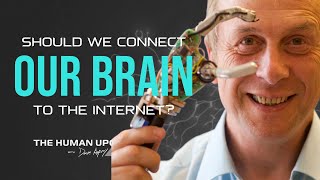
Dave Asprey talks with Kevin Warwick about AI's future and merging humans with technology. Warwick discusses cognitive firewalls to control AI, medical implants that enhance human abilities, and whether we can stay ahead of the systems we build.
Chapters
You have a great track record of being very early, being an innovator, as do I. Tell me your view 25 years from now of what it's going to look like with cyborgs and humans.
Well, I think the big one is the issues with AI. How is AI going to be used per se? So this is sort of not answering the question directly that you've said, but how far will AI go and how will it be relied on and used per se for itself and given control over this, that and the other? And particularly with networking, it is being networked more and more. With a network, very often we can't really tell if this happens, what are the consequences going to be. It's very difficult to work that out. And in a military scenario, if that is linked in with a financial setup, et cetera, et cetera, et cetera, the there could be big dangers, as I think some people in the AI field are recognizing. So we're getting away from the use of AI in a machine that you can switch off and switch on and you can decide when it's going to play and when it's not going to play. This is something that is in control of a scenario and it could be dangerous. I think then there is a need to move to the cyborg. The AI is not working alone, but it's working as part of you as a network. Then we're going into a science fiction scenario. Is it IROBOT even, or is it the global network involved? Whatever? I mean, is it the matrix that we're talking about in the future and would it occur in 25 years time? I think history is littered by scientists making miscalculations at how long something is going to take or whether it's going to be or whether it's not going to be. But I'm putting the problem rather than being a cyborg problem, I'm changing the question to being. It depends how quickly and how far AI is going to be integrated in everyday life. At the moment it's going very quickly. But.
The reason I started laughing like that is in another life, I was the first person to sell anything over the Internet. And it was a T shirt that said caffeine, my drug of choice. And it was over Usenet before the browser was created. And I was an entrepreneur magazine when I weighed 300 pounds and I'm wearing this double extra large T shirt. And I was just trying to pay my tuition like it was a small business. It wasn't like, you know, a big thing. E commerce wasn't a Word. But they interviewed me and I said, oh, in five years there'll be no more need for junk mail. We'll just be able to get all of our, all of our communications on email. That was like, I don't know, 1993, was that 30 years ago? And I still get crap in the mail. So clearly like I'm one of those people that history is littered with is.
Is.
That's why you made me laugh.
Well, I've got a, I've got a better story on. In 97, I went to the World Economic Forum in Switzerland and the very first day with my wife, very first day that we were there, we met up with some guy called Jeff Bezos who had got this back in the day website called Amazon, which I'd never really heard of much before. And we were formally. We had to go to, as we were sort of part of the system. Had to go to dinner with Jeff and his wife and we were sitting there talking before we mingled with the other people from different companies and that. And so he asked me what you're doing. Oh, I'm into robotics and implants and so on and so forth. Very. He seemed, I'm not saying excited about it, but interested. Anyway, I asked him what he's doing. We've got this website which at the time was selling books. That's really all it did. And he asked me, well, what do you think? Should we expand it? And, and so my advice was no, no, don't bother doing that. Exactly what you're saying. You know, I thought, no, it's not really going to. Just stick with the books and make things work for that. You know, you be safe on that.
Do you still go to the World Economic Forum? Was that like a one time thing or is that a regular?
For me it was a one off. Yeah, it was interesting, but not a regular thing that I entered.
There's some interesting schisms there because, you know, the, there were two founders of, of the World Economic Forum. There was Klaus Schwab and the other guy. And the other guy dropped out kind of out of disgust because it was being used in a way that he didn't like. And they're big proponents of transhumanism and I think given their public statements that they're the kind of people would happily put implants in you so that, you know, they could feed you bugs. I, I don't think they're working for the good guys right now, but. And maybe when they were founded they did, but you know, I also, you know, you never Know if someone goes or doesn't go, what their motivations are. Right. Because, you know, if you're working to fix a wrong, you might hang out with people doing bad stuff. So there are. People get really triggered by that idea. And I'm, you know, I'm, I'm curious about everything, including transhumanism. I, I do not believe that a dystopian future is what we want. And, and I also believe that if I'm in control of my own biology, it's my right to put any hardware I want in my body and that I should. I'd be really stupid if I put hardware in my body that someone else controlled, because that's a bad idea. Um, just imagine if the guys who do TikTok's algorithm were in charge of what's in your brain. Like, that's not good.
So I, I, I agree with you 90%. There's that bit of me that says, well, I'm thinking again of medical devices where if you did end up with Parkinson disease and you're faced with a company saying, well, we can put something in your brain that allows you to live relatively normal life, and it's going to apply signals. When it thinks that signals should be applied, then how much would you trust them? Would you say, no, I want to stay like I am, which could be very pretty awful, or do I want to go for this? Because you trust them that they know what they're doing and it's tried and tested and there's many people before you that seem to be all right with it and so on and so forth.
So I would totally trust them as long as I could either remove the stuff or I had source code access. If I couldn't remove it, that would be the thing.
And have it removed. Or somebody can.
Yeah, yeah. Know that it could be removed safely. Right. Versus those eyes that once they're in, they're in. And when I, I look at AI and, and cybernetics and cyborgs in the future, what I see happening is that there will be large numbers of AI systems vying for your attention, and they will be the best at manipulating you. Better than the best sociopath. Fact. It's called marketing. We're pretty good at it already. What we don't have yet is what I like to call cognitive firewalls. So when we do have augmented reality glasses that you'd want to wear or even just running on your machine, there's no reason that every web page you see shouldn't be rewritten according to my rules. For AI to only show me what I want. There's no reason that every YouTube video shouldn't be automatically translated into two paragraphs of text instead of watching 10 minutes to see some guy with a weird face that's probably auto generated anyway. So it's up to us to arm ourselves with AI that actually is used to filter reality so that we only get the information we want in a way that's not manipulative. And so if you could have that built in y you do. It's called subconscious processing and it's energ. It's very energy efficient because what we're both seeing and sensing right now is probably.01% of all the signals coming into our body gets filtered by your body. I need augmented filtering that's onboard or or off board to help me ignore stuff that doesn't matter and to allow me to choose where my attention goes. And that's the attention economy that, you know, Wired is written about and everything else. I just want to be the one who trumps what all these bad systems are doing so that I don't get distracted by nonsense and I can stay focused on stuff I care about. Does that sound like it might fit in your future?
I go for it. Yeah, I'll sign up for that. Where do I sign? Yep.
All right. Somebody come start a company with me on that. Not like I don't have enough companies, but yeah, that's a blending of computer security, security, cognitive science and AI. And it's the equivalent of my old company, Trend Micro antivirus software. I need antivirus software for my mind right now, not just for my computer.
So it's just as well we didn't meet up ourselves at the World Economic Forum. Otherwise if you asked me what I thought for the future of the company, it would have gone nowhere. I'd have got it completely.
I'm sure that's why Jeff asked lots and lots of different people. And Amazon was a big customer of Exodus Communications where I was a co founder of, of their consulting business. And it was an amazing time in the 90s for the expansion. We're doing that right now with AI and we're right at the beginning. It's 1993 right now for longevity.
Yes.
Right. And the Internet really hit in like 97 is when it just went crazy. And so right now, like the longevity business, the number of, of small companies I've talked with who are going to add 5, 10, 15 years to human life. Oh my God, like the next five years is going to be the biggest ever and it's going to make the Internet look small. And once we have 200 year lifespans, I'm going to need that cognitive firewall. Otherwise I'll spend the whole time watching TikTok.
Yeah. And this is where it becomes very difficult predicting what's going to be big, which direction is going to go in. And that's where Jeff Bezos got it right, I guess, as far as Amazon is. And I got it hopelessly wrong. That's why I'm not extremely loaded and been very successful in business, but no problem. Well, good luck, Good luck with it yourself. Hopefully you get the longevity. You do. The Bezos as far as longevity is concerned.
Well, I don't need to be that absurdly wealthy. And if I am, I will be using it for the greater good, that's for sure. Kevin, it's been an honor to talk with you. I've literally known about your work for 23 years and we finally got to connect. So thanks for being a pioneer. Thanks for being dangerous.
It's gone so quickly. I didn't believe.
Has and I truly see you as just a pioneer in being human because you're saying, well, it was worth it. I'm going to take the risk and I'm going to see what happens. And you were willing to accept the risk in order to receive the knowledge and you did and you shared it and it's academically amazing. And for listeners. Thank you. You know, there is a dark transhumanist future that's possible. There's also the possibility of enhancing your ability to show up in the world in a magical way. And I am well aware of the risks.
You should be too. I'm going to leave because there's. Linking your brain up to a computer I think opens up lots of positives and some of them the possibility of thinking in more dimensions. I know I talked about communication before, but the possibility of doing that, just that one thing you can think in maybe just 10 dimensions, whatever, which a computer of course can do. It can process data in all sorts of dimensions. I mean, maybe, maybe just this is again science fiction, I guess, but it can change how we look at the universe around us. Perhaps it will allow us to. To travel much better than we can think of traveling at the moment. Because we've gone almost nowhere in the universe, just to the moon, which is like an outside toilet for the Earth. There's hardly anything there. The possibility of doing the Star Trek and traveling out into distant galaxies and so on, it's got to be easier than actually having to sort of almost pedal into space. So I just hope that. That we can understand the universe around us in a much more complex way if we link our brains up with technology.
You're listening to the human upgrade with Dave Asprey.










