How Fasting Resets Your Biology and Helps You Live Longer | Valter Longo | 812 | Dave Asprey
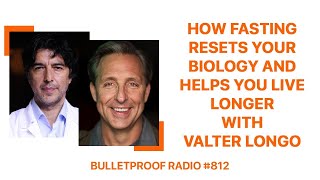
Valter Longo, a longevity researcher, talks with Dave Asprey about how fasting resets your biology. Longo's clinical trials show fasting can trigger cellular regeneration and slow aging. The conversation covers fasting protocols, what happens to your body during extended fasts, and whether living longer is actually worth it.
Chapters
Bulletproof Radio, a state of high performance. You're listening to Bulletproof Radio with Dave Asprey. Today we've got our live audience from the Upgrade Collective in the house. We got lots of people in because this is going to be a really powerful episode. If you'd like to be in the live audience, be able to ask questions, go to ourupgradecollective.com and join my private membership group where I'm teaching all of my books and all of my knowledge with a team of coaches, super structured. Answer all your questions and teach how to be bulletproof. Today is an episode that I've wanted to do for a long time. And it's hard to get this guy on as a guest. He's a director of the Longevity Institute at usc, the Leonard Davis School of Gerontology, director of the Longevity and Cancer Program at the ifom, the Italian foundation for Cancer Research. And he was named by Time in 2018 as one of the 50 most influential people in healthcare for his research on fasting mimicking diet as a way to improve health and prevent disease. He wrote a famous book called the Longevity Diet. I'm talking about none other than Professor Valter Longo Valter, welcome to the show.
Thanks, David. Good to be on it.
I've called you multiple times when I'm talking about fasting and answering questions about it, and all as sort of the godfather of fasting. And one of the things that. One of the reasons I say that is that you've spent so many years looking at fasting way ahead of the curve. Why did fasting come into your lens so early compared to almost everyone else alive? Where did the original inspiration come from?
Yeah, I think two things. Mostly ucla. So I went to UCLA because Roy Walford was there. Right. So in Roy Walford, back in the days, in the early 90s, he was in Biosphere 2, and he was basically doing the first human calorie restriction experiment. And he was a pathologist, a medical doctor at ucla. And at the time, he was the most famous person in the world for, let's say, nutrition and longevity. Right. And aging. And so certainly Roy was a big influence. And then the other part was the lab, the other lab that I worked on at ucla, which was first Steve Clark and then John Valentine. And with Steve Clark, I worked on starving bacteria, and with John Valentine, I worked on starving yeast, you know, And I don't know, I was interested in that maybe because of the woe for the influence. And so every time I got an opportunity, I was really infatuated by the starvation and the effects, of course, that I was observing early on. So the bacteria, you starve them, they become long lived or much longer lived and they become very resistant. And the yeast, you starve them, same thing. Long lived and very resistant to all kinds of toxins. And so when I saw bacteria and yeast responding the same way and then connecting with Roy Walford, he was not working on fasting, he was working on calorie restriction. But I think, you know, I made the connection and I knew this was a very powerful, very powerful 3 billion years old function that was poorly understood. And keep in mind, everybody was making fun of this at the time. Everybody thought it was a joke. Why would you possibly work on starving bacteria and yeast? It's just the most boring thing ever. So that was the attitude back in those days.
Do you like to be seen more as a longevity researcher or as a fasting researcher?
Yeah, I think longevity, and not just longevity, but what I call youthspan and juventology. Right. So how do you stay young and then once you cannot stay young anymore, once a youth span period is over, how do you stay healthy? And that's the healthspan program. Fasting is really, in my mind is the probably most powerful way to reset and help regenerate, but also help clear junk and damage that is accumulated.
How often do you fast?
I don't. I mean long fast. I mean, first of all, I always say, I always start by saying fasting doesn't mean anything, Right? Fasting is like saying eating after you eat. So I think the answer is every day, right? So every day I do 12 hours, about 12 hours of fasting and 12 hours of feeding. And then maybe once a year I would do a fasting mimicking diet, a five day fasting mixing diet. Sometimes I may do it twice a year, depending on the need. But mostly my diet, I follow my diet, what I discovered in the book the Longevity Diet. And so I think we're seeing a lot of evidence in the lab that for the very few that follow this very precise type of diet, the fasting mimicking diet doesn't have to be done as much. Right. So the average person may do it three or four times a year. But I think that for somebody that has an ideal diet, maybe once or twice a year is sufficient.
Okay. So if you eat the right stuff, then once or twice a year you do a longer fast. And it's permissible to have something during the fast as long as you're getting your macros, right?
Yeah.
Because you're still Maintaining autophagy.
Yeah, it's not just eating the right stuff, I think is the timing, is the frequency, you know, is whatever else you do, you know, the exercise, et cetera, et cetera. So I think it's lifestyle, mostly nutrition, but not only nutrition. And so yeah, if you do all the right things and then probably, probably that's sufficient.
A lot of the research I've seen says that 12 hours is the very minimum effective length of a fast for increasing ketosis over time. Dr. Murad from Australia has done some studies on alternate day 12 hour intermittent fasting and seen slight increases in ketones. But a lot of the, the research I've seen lately is looking more at 16 hours without food. That seems to be where a lot of people end up and occasionally going longer. Like for me it's been 24 hours since I ate anything and I just, I'm not hungry and I guess I'm gonna force myself to eat cause I don't wanna do a two. But why 12, not 14? Is there a specific reason for that?
Yes, there is. So if you look at, I always say I could never find a negative study under 12 and 12. Right. But I found many negative studies under 16 hour. And also one of them, multiple of them, are having to do with gallstone formation, people that fast for 16, 18 hours a day than to have twice as much gall bladder operations as people that fast for 10 or 12 hours. And, and also I'm concerned about the now four or five studies showing that people that skip breakfast live shorter. Right. And have more cardiovascular disease, and now a new study showing more cancer. So, and of course these are epidemiological studies that are associations. But at the same time, I always say, if, you know, most people that skip breakfast will say fast for 14, 16, 18 hours. If that was so beneficial, why is an encounter balancing whatever negative that these people may be doing? So maybe they're not living shorter because of the fasting, but why is the fasting, if it's positive, not making them live normal? Right. And that's a concern right there.
It's always a question, you know, are people who skip breakfast skipping breakfast because they're too tweaked or too busy or you know, going to work or they're having a cigarette? And I think they account for cigarette smoking usually in most of these. But is it an unhealthy lifestyle choice because there are people who aren't caring for themselves or is it conscious fasting?
Yeah. So my point is it's hard to tell. Why is the Fasting not helping them against whatever other bad lifestyle they might have. Right, that's my point. So that you figure that if it was so powerful to do 16 hours a day, then it should take care of and they'll live at least a normal life. They will have a shorter life. Right. The concern is when you see shorter. Yeah, that's when you say that's very surprising. Right. If it was so good for you, why don't we see them at least living normal?
Got it. And it could be that if they ate breakfast, they'd be even worse off. But we don't really know because of epidemiology. It's a tough one, right?
Exactly. We don't know. But the question is, it's a fair question, how much you want to risk considering these studies. Consider the gallbladder operation, Considering also that most centenarians don't do 16, 18 hours. So this is why in my book I always talk about a five pillar approach and try to get the common denominator. What is the common between all, what do they all support? Right. So if you look at centenarians, 12 hours is very common.
Is there a difference in the length of fast that's appropriate based on your age?
Well, again, it depends on what fasting you're talking about. I think that the, the five day fasting mimicking diet, as we're testing clinically, we think it's appropriate until age 65 to 70. Then it does not mean it's not appropriate anymore, let's say to do it three times a year. We now have an ongoing clinical trial and Alzheimer's patients. And, and so they're fine so far. They're doing okay. They're doing fine. So you know, they're much older than 65. Some of them are in their 80s, so it doesn't mean they cannot do it. But right now we just don't have enough data to do this long fast in the 70 and older. Let's say then if you're talking about intermittent fasting, again, you know, if you do 12 hours, it's perfectly fine. There is really no reason to stop at any age. In fact, they may be very healthy, even for 100 year old person. If you're looking at other forms of fasting, I think I would put it in the same category. Let's say that somebody does two days a week or one day a week. I would put in the same category as the fasting mimicking diet, meaning that to do one day a week of let's say a 24 hour fast. I would not recommend it to somebody who's 75 years old.
I agree with that assessment. I found one person who's 81 who's been doing about a 14 to 16 hour fast every day for 59 years. She does not look like she's 81. Her brain is totally sharp. Her name's Margaret Paul. She was just on the show, does a lot of work more around emotional and psychological trauma. But when you look at the few people we can find who've practiced it, it seems that there's something going on that's really beneficial.
Right, right. But we're starting to think of a standard or an FDA like standard. Right. And then you have an FDA like standard. If you think about that, it's like saying, you know, if you give a vaccine to a few people, they've done pretty well. Can we give it to the whole world? Right. No. Well, we need 70,000 people, right? We do. So yeah, that's the same. The same is true here. And unfortunately the epidemiological studies, when you do 70,000 people or 700,000 people, they show a shorter lifespan. Right? So for the biggest group that we can find doing 16 hours, that's why you have to, you have to say, wait a minute, you know, what am I? Even though it could be beneficial to a lot of people, what if it's detrimental to even more people than it is beneficial to. And this is very typical for most of the traditional things. If you look at something that's very old, they usually tend to do lots of good for, for in one sense and lots of bad. Right. And that's why they, they never quite stick around. And so yeah, then we had to find, how do you get. And this is calorie restriction, for example, say calorie restriction that my, the Roy Walford used to study has been around for 100 years. And if you look at it now, and they used to do say fantastic things about calorie restriction back in the 70s. How many people do calorie restriction right now? Almost nobody. Almost nobody. Right. So but why? Well, because even the monkey studies, after Richard Weinjerk, somebody else that was in Roy Walford's lab, He did the 25 year long study, he realized that, you know, there is lots of positive and lots of negative. So if you look at cholesterol, blood pressure, fasting glucose, amazing results. Right? And then the monkey may drop dead after anesthesia and you're thinking, wow, how is it possible, what happened that in calorie restriction that makes somebody so sensitive to Anesthesia, but yeah, so. So the age related disease causes that were much affected by the long lifelong calorie restriction, but then the overall survival was not that much improved. And when they did the same study at the nia, the National Institute on Aging, it was unimproved at all. Right. There was no difference in survival. Yeah. So that's the type of thinking that we try to put together to then come up with what's very safe for people and at the same time can make them live to 110 healthy.
Do you think we're going to get to the point where you look at your genes or you look at your gut bacteria or some mix of markers from the blood and go, oh for you, you should do X amount of fasting or this is your ideal eating window. Is that even conceivable?
Oh, it's very much conceivable. And I think no more than five year ahead of us. Five years ahead of us. So yeah, absolutely, that's going to be, that's already done for. Should you eat this or that? And so I will imagine soon enough we'll have enough data associating or correlating a certain profile of microbiota with the response or lack thereof to fasting. So we're already collecting this, for example, for multiple sclerosis trial, we're collecting microbiota. The cancer trial, we're collecting microbiota. The Alzheimer trial, we're collecting microbiota. So yeah, the IBD trial, I'm sure we're also doing that. So I think it's just a matter of time before we have enough data that we can say the non responders happen to have this profile. And at some point I think artificial intelligence is going to have to help us do it because it's just going to be lots of data that extremely difficult to analyze the classical way.
Are there private companies that you've seen that are working on that problem or is this all university and government funded?
I know I don't want to mention the name of the company because I don't know if they want me to mention it. But I know even years ago we were approached by a private company looking for the data. So I will assume there are many already that are looking at intermittent fasting, periodic fasting, et cetera, et cetera. And, and they're starting to collect data that eventually they will analyze to distinguish the responders from the non responders.
Well, I am looking forward to that day. I would love to be able to sit down and look at someone's stack of hormones and thyroid and everything else. Plug it into an AI engine and say eat for X amount this day and maybe even what to eat. And I know there's a bunch of people working on it, so I was hoping you'd tell us the coolest ones. But I understand there's NDAs in place and all.
Yeah, no, I know. I don't know if they have. I don't think they have it as a service yet. Right. So I don't think they're at the point that they can make. That they can give it to the public. So. Yeah, so that's the main reason why I don't want to mention it. If I knew it was publicly available, I would mention it, but I'm not sure. I don't think it is actually.
I get it. Yeah. Don't throw a company in hot water with thousands of people calling them all at once when you can't buy what they have. But when, you know, send me a note and I'll definitely talk with them.
Them.
What did you learn from yeast that translated best into human aging in your labs?
Everything we do is based on yeast research. Yeah. So I think we, we forget that this is as old as we are. Meaning like we, we all come from the same organisms and, and we've evolved in parallel with the yeast and so we obey the same rules they obey. We have the same, what's called force of natural selection. And so for example, all our work that we do on cancer started in yeast and the discovery that the genes that were, if you start by yeast, the same genes that are proto oncogenes. So the ones that are involved in cancer are the one that prevent the protection. Right. So the. Remember earlier I said the yeast, you starve, it becomes very protected, all kinds of toxins. Well, if you have an oncogene, which most cancers have in them, that oncogene prevents the protection. Right. So. So that's the first observation was, well, if now by having this type of gene like ras, if you have ras that is always on, and if that prevents the. The cancer cell from becoming resistant, then this is a way to distinguish all cancer cells from all normal cells. So all normal cells, including bacteria by the way, will respond to starvation in a coordinated manner and will go into the starvation response mode, the only disobedient cells are going to be the cancer cell. Right. So yeah. So then, then you know, then it will all the way to clinical trials and now even successful clinical trials. So I think everything. So we discovered the Torres is kinase pathway in yeast. And there was the first. You know, now everybody talks about rapamycin and TOR in aging. Well, you know, we discovered that thanks to yeast. And. And. And when we did screen, it was a screen meaning that we basically mutated all the genes in the DNA of the yeast. Right. It's all, you know, say, most of the 6,000. And then we asked the question, which mutations make the yeast live longer? And one thing kept coming up, and it was something called Sch9. And Sch9 is what Tor regulates. And, you know, that's what rapamycin, the drug rapamycin that is now so famous for aging research, is blocking. Right. So there was not something that we even thought about. It was the yeast that told us, focus on this, because this is the most important thing that you can. Plaque to extend life. And in fact, once we combine the mutation in that gene and in the. So I call it. I call that the protein pathway, the amino acid pathway, and there's a sugar pathway, which is pka. So once we have two mutations in these two genes in yeast, and then we also starve them, we extend the lifespan by tenfold. Right. So we make the organism ten times longer lived than the normal one. Right. So, yeah. So again, he's pointed to all the right directions.
And today, you know, like you said, mtor and rapamycin are all the rage. And certainly that original discovery that you had led. Longtime listeners have heard me talk about tripling down things that suppress mtor so it can come back up later, like, you know, very well, fasting and coffee and exercise suppress mtor. So just thanks for doing that work. I think it's led to all kinds of innovations and understanding and nutrition and anti aging and exercise, and it's really foundational work, which is really cool. Now I have some more questions. In my book on aging, I had seven pillars of aging, like, things that we know, pathways we want to maintain so we can be youthful. And in your book, you had this concept of pillars as well, but you had five pillars of longevity. Can you walk me through those five pillars so people hear the show can get a sense of how you're looking at aging because you've studied it for 30 years. I want to know.
Yeah, So, I mean, one is for sure, the genetics of aging and the basic research, like what I just mentioned. Right. So what controls the lifespan of all organisms? And is there a longevity program? And can you switch that program? Because now you take advantage of what I call 3 billion years of research and development, and you basically say the organism Already have something there, an alternative program that they can go to that can already extend the lifespan. So the question is, how do you get in there? Is there like an hibernation like state for humans that you can switch to and how do you get in there? Right. Or is there a regenerative mode in humans that you can get to and how you get there. So the basic organisms and the research on longevity in this, what we call model organisms is very essential. The other one is of course epidemiology. So studies a large population. What I was mentioning earlier, what happens to people that fast for a certain number of hours. Whereas a few years ago we published on protein, what happens to the Americans that eat low protein versus those that eat high protein? And is there an age specific effect? You know, and so we, we published that, yeah, the low protein was better up to a certain age, but not after 65. Then after 65 the moderate protein intake was better.
Thank you for that study by the way. That was part of the recommendations in my anti aging book was based on and I did reference your, your study in the book. So well done, good finding.
Thanks. And yeah, so that epidemiology, large population because then you bring in the math, right? The ability to do statistics and use math to make conclusion. Then clinical trials, randomized clinical trial, like I always cite the one by Astruc and colleagues in Spain. You know, you take 7,000 people, you put them in either a low fat diet and there's always been this fight, right? Low fat versus high fat. And so there's 7,000 people either on a low fat diet or on a high olive oil and nuts diet. And you wait five years and then you say, you know, in that case they showed that the olive oil and not consuming people had less heart attacks and, and live longer. And so yeah, so that's a very good study to published in the New England Journal of Medicine, by the way, that tells you maybe a very low fat diet, if it is olive oil is not such a good idea for people that have cardiovascular disease or are high risk for cardiovascular disease. And so in another pillar is the centenarians, right? So what about, what if you go to Okinawa or in certain regions of southern Italy, whether it's Facadena or Calabria or Loma Linda or or lots of other places, you know, what, what do they do, what do they eat that makes them get to 100 so frequently? So I think that's a very, probably one of the most important pillars just because it brings in, I think a major safety factor. Right? So if all this population have this in common, so if most of them or all of them have a vegan plus fish or a vegan plus a little bit of meat diet, it probably is not bad for you. At least we can say that now. Did they make him live to 100? Well, it's more complicated than that. Most of them seem to have, regardless of the stories we hear, most of them seem to have a genetic component. So they have the right diet, but they also genetically predispose to get to very long lifespan.
Yeah. A guy who's been on the show, James Clements, flew around and collected genetic data from 100something people who are all over 100 to get the genetics into a lab to be able to figure out what are some common genetic markers there. That's been influential. I forget who we worked with on that, but there's definitely a genetic component. Have you seen the studies that say the other component is poor record keeping and high taxes in some of those areas that there's some amount of fraud?
Yeah, yeah, most areas actually I have a large amount of fraud. I always remember the Vilcabamba. Everybody used to ask me what about Vilcabamba in Ecuador? And then finally I sent some journalists and this was world famous for the centenarians. But then I was talking to my colleagues because we do research in Ecuador and they say this is all made up so the people there will tell the journalists whatever they want to hear so that the journalists keep coming. So I send some people from the television, from an Italian television to check and there was not a single centenarian in, in Vilcabamba. Right. So this is very, very common that people exaggerate. They may take the identity of their father or uncle, you know, for whatever reasons. Right. And maybe to get their pension and inheritance taxes and whatever then. Or yeah, or inherit, whatever. And yeah. So I think it's very, very common.
And it still doesn't say we shouldn't study people who are actually older. And there's some pretty well validated ones where my perspective is that there's at least one person that we are pretty Darn sure is 120 years old. So that's our current basically top level. And like how do we beat that over the next hundred years so that, that becomes more of a mid level. If you put on your hat 100 years from now, how old do you think the oldest person on earth will be?
That's a tough question. I think that unfortunately, maybe fortunately or unfortunately, I think technology is going to take over in the next 50 years. And I think bionics is going to take over in the next 50 years, and I think it's going to be a very different world. I don't even think that. And I could be wrong. You know, usually it takes us longer to get there. So it may be 200 years and not 100. But I don't even think right now whatever we're doing is going to be that relevant for 200 years from now. I think it's going to be a very different. A very different approach. Right. It's going to be an approach that it has to do much more with memory, memory transfer and all kinds of crazy things. But yeah, I imagine that's a world of one to 200 years from now. It's not the world that it's not going to be modifying TOR or pka. It could be that one of us identifies a way to reprogram. I always say, can you reprogram a mouse to make it live as long as a naked mole rat?
I say, yeah, my favorite spirit animal.
Yeah. So you go from two to three years to 30 years. Yeah, that's possible. Right? That's possible that we can turn some of the programs on and those programs could revolutionize lifespan. But I think it'd be in parallel with some of the more crazy science fiction things that are unavoidably going to. Going to happen.
So you're, you're thinking the oldest living person 100 plus years from now will be a cyborg?
I think that I would be shocked if in 30 or 40 years where most people before we die are not going to be part. Part human and in part something else. Right. And we already have that. Right. So the pancreas and all kinds of, you know, artificial hearts. Right. So we already have a lot of that. And it's just hard for me to. And I'm not endorsing it, but I think it's hard to imagine that we're not going to use that more and more and more. It's much easier to build things right now, of course, when you get to a brain or a liver, it's much more complicated. But for sure, even in the next 50 years, I think that we're going to see a lot of bionics and a lot of parts being introduced and, you know, rightfully so. I mean, if somebody is waiting for a kidney transplant, why not use an artificial kidney? And I imagine that technology every year is going to get better and better. And so.
Yeah, you seem concerned, though, like, for better or worse. I hear a Lot of trepidation in your voice. What's scary about that to you?
Well, you know, I think it's the abandoning who we are. Right. So. And that's got to be a scary thing to anybody, Right? And then you want to, as we are investing in technology, we have to ask the question, is all this technology, I mean the atomic bomb, Right, but the atomic bomb in a small, like a very small example compared to what this could be. Right. This would be much, much worse. Right. So that's what I'm worried about. Right. Where our inability for the first time in history to control where it goes. Right. Not so much what we can do with it, but are we going to be in control of it? And that's the scary part. Right.
Personally, I hope Facebook's in control of it so that my ocular implants can get malware. Wouldn't that be great?
Yeah, yeah, maybe if it was Facebook, maybe. But you know, as systems are starting to learn, you know, to self learn, you can only control that up to a certain point. Right. And at some point that self learning process is going to take into something that can decide for itself. Right.
So you're worried about Skynet?
Yes, I'm worried about human beings losing control of the technology and the technology being in charge of the technology. That's my big concern.
Coming out of Silicon Valley as an actual computer hacker. One of the reasons that I named it biohacking is that generally hackers are the people who try to take back control from the big companies. We have Linux and open source operating systems which run most of the Internet now, not closed source big companies. And I'm hopeful the future of biohacking is relatively transparent because we have a community of people who are paying attention to these things. And I'm still hopeful about a positive future. But yeah, it could go dark. I'm 100% with you, Valter.
Yeah, yeah. And great. I mean that's exactly what we need. We need a lot more of that. Right. So who's regulating this and what is going to be our plan to. To fight this? Right. So to make sure it doesn't go that way or it goes in a positive way, not in a we lost control way.
Yeah. And we've got to define our humanity so that we can maintain it. And it's such a mushy concept right now that being able to decide what that means and what we want it to mean. These are huge philosophical questions that go beyond just life extension. So I love that you're thinking about this in the Context of longevity. In fact, it's really refreshing to hear where your mind is on it.
Well, I mean I, I come, I think, you know, as a, I come as a 18 year old that wanted to live forever. Right. I mean, that's how I got started. Right. And, and then, you know, I always say I heard the story, but I, I never heard it from Roy Walford but I heard he was going to freeze himself and then I heard he also took himself off the list to be frozen. Right. So at some point Walford, like in myself, you know, went from I want to live forever to I'm not sure anymore and maybe. Yeah, so I don't know why and if that's a correct story, but that's what I was told and so I wouldn't be surprised if it's true and that he went from, from that state of mind to a very different state of mind as he was getting in his 60s and 70s.
I have often said that I'm going to live to at least 180, but the reality is I'd like to die at a time and by a method of my choosing. If I'm done, I'm done. I have the freedom to do that, right?
Sure. I mean, and I'm the same way, of course, you know, so, so yeah, I would definitely like to have that option, but, but it's just, I think that it can get more complicated than we appreciate. But certainly, yeah, 180. I think it would be something that most people will say yes to. I, I always remember I asked my mother right. Maybe 20 years ago and I said, and I expect she's very religious. And I said, well, would you want to live to. I forgot what it was 200 or something like that. And I was sure she was going to say no way, you know, because the religion. And she said of course, you know, and then she said, you know, because I'll be able to see your kids grow up. And so then it was really interesting from such a religious person to hear that she will want to live to 200 because of, you know, feeling like she's leaving now when, when maybe she's got four or five generations that she can watch and then she's, she's ready to go.
I'm really hopeful, Valter, that the longevity movement and you've played a major role in it, but it's going to enable us to have an epidemic of wisdom where we have people who've been around long enough to have figured out a lot of the stuff in life like you're saying Roy did as he aged. Where we attain some wisdom, we learn some things, and we have enough energy to share it so that we can maybe steer the ship a little bit better than we have before. Because if people start losing their faculties in their late 60s, right, when you probably figured life out when you were 16, and then you don't have much time to pass that on. So we end up doing these waves of change that doesn't always go in the right direction. But if we have people who are, we've seen this three times before, it's all right, here's how we're going to navigate it. It feels like we could actually do a better job as a species. Do you look at longevity as maybe something that's going to support the planet versus put a further burden on it?
Yeah, I think that there is no doubt. I always talk about 110 healthy and Roy used to talk about 120 healthy. So I think it's a very good goal to get, you know, if we could get. And I always say, I don't think we're going to get the planet to be 110 healthy. I think we're going to get the people that follow all the, all the things they should follow to get to 110 on average healthy. Right, so. So that's a goal. Right. A lot of people are going to keep smoking and doing whatever they want and they're just going to probably keep about what they got already right now. But then I think that, yeah, for the group that, for the group that wants to get there, there's going to be ways to do it. And you know, and of course some people are going to die earlier, some people are going to die later. But that is reasonable to start thinking about 110 average lifespan with most of it lived healthy as a goal.
Do you ever get life insurance companies who call you and say, I want the data so that we can actually figure out who we should or shouldn't sell life insurance to too.
They don't call me, but they are certainly working with us. I think now at least some of the biggest ones are starting to work with us in starting to getting aligned with the patient's health. Right. More the health insurance company than the life insurance insurance companies. But so I think that, yeah, so that's. The life insurance companies are also aligned with the health insurance companies, I would say. But yeah, so we're starting to work with health insurance companies in looking at how to. Instead of reimbursing whatever problem disease cost somebody has, can we Avoid that. Can we think about, you know, getting to 100 healthy or 110 healthy? And, and in the past, surprisingly it wasn't like that. Right. So the health insurance companies were working on, were just reimbursing whatever it cost and charging people for it. Right. So, so now I think that's moving and soon enough will move more into, here's what we reimburse and if you can keep everybody healthy, then you can be wealthier as a clinic or as a doctor and keep more of the fun and better. And so, yeah, you seem concerned though.
For better or worse. I hear a lot of trepidation in your voice. What's scary about that to you?
Well, you know, I think it's is the abandoning who we are. Right. So. And that's got to be scary to anybody, Right? And then you want to, as we are investing in technology, we have to ask the question, is all this technology, I mean, the atomic bomb, Right, but the atomic bomb in a small, like a very small example compared to what this could be. Right. This would be much, much worse. Right. So that's what I'm worried about, right. Where our inability for the first time in history to control where it goes. Right. Not so much what we can do with it, but are we going to be in control of it? And that's the scary part, Right.
Personally, I hope Facebook's in control of it so that my ocular implants can get malware. Wouldn't that be great?
Yeah, yeah, maybe if it was Facebook, maybe. But you know, as systems are starting to learn, you know, to self learn, you can only control that up to a certain point. Right. And at some point that self learning process is going to take into something that can decide for itself. Right.
So you're worried about Skynet.
Yes, so I'm worried about human beings losing control of the technology and the technology being in charge of the technology. Right. So that's my big concern coming out.
Of Silicon Valley as an actual computer hacker. One of the reasons that I named it biohacking is that generally hackers are the people who try to take back control from the big companies. We have Linux and open source operating systems which run most of the Internet now, not closed source big companies. And I'm hopeful the future of biohacking is relatively transparent because we have a community of people who are paying attention to these things. And I'm still hopeful about a positive future. But yeah, it could go dark. I'm 100% with you, Walter.
Yeah, yeah. And great. I mean that's exactly what we need, we need a lot more of that. Right. So who's regulating this and what is going to be our plan to, to fight this? Right. So to make sure it doesn't go that way or it goes in a positive way, not in a we lost control way.
Yeah. And we've got to define our humanity so that we can maintain it. And it's such a mushy concept right now that being able to decide what that means and what we want it to mean. These are huge philosophical questions that go beyond just life extension. So I love that you're thinking about this in the context of longevity. In fact, it's really refreshing to hear where your mind is on it.
Well, I mean, I come, I think, you know, as a, I come as a 18 year old that wanted to live forever. Right. I mean that's how I got started. Right. And then, you know, I always say I heard the story, but I never heard it from Roy Walford, but I heard he was gonna freeze himself. And then I heard he also took himself off the list to be frozen. Right. So at some point Walford, like myself, you know, went from I want to live forever to I'm not sure anymore. And maybe. Yeah. So I don't know why and if that's a correct story, but that's what I was told and so I wouldn't be surprised if it's true and that he went from, from that state of mind to a very different state of mind as he was getting in his 60s and 70s.
I have often said that I'm going to live to at least 180, but the reality is I'd like to die at a time and buy a method of my choice. Choosing. If I'm done, I'm done. I have the freedom to do that.
Right? Sure. I mean, and I'm the same way, of course, you know, so, so yeah, I would definitely like to have that option, but, but it's just, I think that it can get more complicated than we appreciate. But certainly, yeah, 180. I think it'll be something that most people will say yes to. I, I always remember I asked my mother, right. Maybe 20 years ago and I said, and I expect she's very religious. And I said, well, would you want to live to. I forgot what it was, 200 or something like that. And I was sure she was going to say no way, you know, because the religion. And she said of course, you know, and then she said, you know, because I'll be able to see your kids grow up. And so it was really interesting from such a religious person to hear that she will want to live to 200 because of, you know, feeling like she's leaving now when. When maybe she's got four or five generations that she can watch. And then she's. She's ready to go.
I'm really hopeful, Walter, that the longevity movement and you've played a major role in it, but it's going to enable us to have an epidemic of wisdom where we have people who've been around long enough to have figured out a lot of the stuff in life, like you're saying Roy did as he aged. Where we attain some wisdom, we learn some things, and we have enough energy to share it so that we can maybe steer the ship a little bit better than we have before. Because if people start losing their faculties in their late 60s, right, when you probably figured life out when you were 16, and then you don't have much time to pass that on. So we end up doing these waves of change that doesn't always go in the right direction. But if we have people who are. We've seen this three times before, it's all right, here's how we're going to navigate it. It feels like we could actually do a better job as a species. Do you look at longevity as, you know, maybe something's going to support the planet versus put a further burden on it?
Yeah, I think that there is no doubt. I always talk about 110 healthy, and Roy was used to talk about 120 healthy. So I think it's a very good goal, you know, to get, you know, if we could get. And I always say, I don't think we're going to get the planet to be 110 healthy. I think we're going to get the people that follow all the. All the things they should follow to get to 110 on average, healthy. Right, so. So that's a goal. Right? A lot of people are going to keep smoking and doing whatever they want, and they're just going to probably keep about what they got already right now. But then I think that, yeah, for the group that. For the group that wants to get there, there's going to be ways to do it. And, you know, and of course, some people are going to die earlier, some people are going to die later. But that is reasonable to start thinking about 110 average lifespan, with most of it lived healthy as a goal.
Do you ever get life insurance companies who call you and say, I want the data so that we can actually figure out who we should or shouldn't sell life insurance companies too.
They don't call me, but they are certainly working with us. I think now at least some of the biggest ones are starting to work with us in starting to getting aligned with the patient's health. Right. More the health insurance company than the life insurance insurance companies. But so, so I think that, yeah, so that's, the life insurance companies are also aligned with the health insurance companies, I would say. But yeah, so we're starting to work with health insurance companies in looking at how to, instead of reimbursing whatever problem, disease cost somebody has, can we avoid that? Can we think about, you know, getting to 100 healthy or 110 healthy? And, and in the past, surprisingly it wasn't like that. Right. So the health insurance companies were working on, were just reimbursing whatever it cost and charging people for it. Right. So, so now I think that's moving and soon enough will move more into, here's what we reimburse and if you can keep everybody healthy, then you can be wealthier as a clinic or as a doctor and keep more of the funds.
I love that. I'm really hopeful that we start getting a more normal and science based situation there. I bought some life insurance a few years ago and they're like, we're not going to sell you life insurance. I'm like, why not? I said, well, you had this really advanced cardiac risk profile done. I said, yeah, but it showed that I was healthy. And they're like, yeah, but you must be worried about something because you got the lab data. I'm not worried about anything. I'm tracking my progress. So we were coming from very different worlds and they finally did give me a policy, but it took a lot of banging around and sort of aggressive maneuvering so they would do it. We were coming from very different worlds and they finally did give me a policy. But it took, you know, a lot of banging around and, and sort of aggressive maneuvering so they would do it. And I, I feel like in the future maybe they'll look at the actual data versus some sort of mythical table. And I, I feel like in the future maybe they'll look at the actual data versus some sort of mythical tables from the 50s, which is.
Yeah, I mean, of course a lot of people are resistant to that. Right. So a lot of people don't want them to look at the data. Right. So that especially in the United States, they're not going to have an easy time in doing that. But I think they certainly want to do that. Right. Both health insurance and life insurance companies.
I guess the trick is for some sort of health insurance or some life insurance company based in Mauritius or somewhere where there's no regulation to just sell out of country policies based on real data to people. I like that idea. Somebody start that company and sell me good life insurance. That's actually going to be there. There we go. We'll just get around the regulation now.
Certainly it could be going the other way around. It could be that the very healthy people now go decide to release the data. Right. Because that's the biggest problem once they're very healthy people. So let's say the ones that invest in all the longevity intervention they could say or can we find or form even an insurance company they just pulls.
From the 50s which is.
Yeah, I mean of course a lot of people are resistant to that. Right. So a lot of people don't want them treatment us because we're okay releasing the data. Right. So if the group was okay releasing the data then then I think most insurance companies will probably go for it because to them it's just numbers. If they know you have a much higher risk, a much lower risk, then they don't mind, they don't mind lowering the premium.
It's a good point. I'm hoping that the data from your.
Lab to look at the data. Right. So that especially in the United States they're not going to have an easy.
Time and eventually makes its way into our decision making in a broader way. Right now individually we can in doing.
That, but I think they certainly want to do that. Right. And both health insurance and use it.
But to use it for the systems of society is one of the things I hope is of benefit for the future. So something else you've said in your book that made me really happy was you said without understanding how nutrients such as proteins and sugars affect cellular life insurance companies. I guess the trick is for some sort of health insurance or sort of function, aging and aging, damage and regeneration, it's difficult to determine the type and quantity of nutrients for optimal longevity. What have you learned about the type and quantity of nutrients that are important in different types of fats, different types of proteins, different types of carbs? Like what, what has come out of your science that tells us different carbs do different things and things like that?
Yeah, so we learned a lot. Right. So we, we can now usually go down to let's say a specific amino acid or we can define, for example in our cancer studies we define what the level of sugar needs to Be lower to for the cancer to start suffering.
Some life insurance company based in Mauritius or somewhere where there's no regulation to just sell out of country policies based on real data to people. I like that idea. Somebody start that company and sell me good life insurance.
They're also starting to distinguish between different type of cells and what cell needs what. Right. So yes, the mechanisms. Before you can get something approved by the fda, you have to have mechanisms and here's no different. Right. So if you don't understand the mechanisms, you really walking in the dark. And so you know, because we know that say proteins control growth hormone releasing hormone, which controls growth hormone, controls IGF1.
That's actually going to be there. There we go. We'll just get around the regulation.
Now certainly it could be going the other way around. It could be that the very healthy people now go, but the, the protein also control the levels of insulin and they control insulin sensitivity. But then within the product it's not just about proteins about, about the amino acid profile.
Right.
Amino acid profile can have completely different effect. So you can have 100 grams of protein that are bio similar to 20 grams of protein depending on the under source. Right. And depending on what you're going after. Yeah. So the same is true for fats. You know what type of fats and not just in a simple decide to release the data. Right. Because that's the biggest problem once the very healthy way because again you have 100 different types of cells. Let's say they can respond 100 different ways. So a liver cell can respond to something the opposite way as a muscle cell response. Right. So now if you're, if you're using the liver cell, Maybe it's producing IGF1 and insulin and the, and the muscle cell is responsible. So let's say the ones that invest in all the longevity intervention they fund into IGF1 and insulin. So they of course they have to have a very different role. And yeah, so this systems biology approach is really fundamental. You know, if we don't use it then we're just going to be lost. Right. And I think soon enough. This is why I really am a promoter of the team of doctors together with molecular biologists. I mean the clinic, my foundation has a clinic here in Los Angeles, we have one in Italy. And I think our approach has been like that. You have a molecular biologist, you have a physician, you have a dietitian and the rest of the medical team. And, and they work together. Because now I think you could say or can we find or form even an insurance company that just treats us because we are okay releasing the data. Right. So if the group was okay releasing the data, the systems biology is so complex that the doctor couldn't possibly try to handle all of this including let's say microbiota metabolomics, but just the strategizing based on if you just look at the blood test from a regular doctor that already has an immense level of information about that patient that if you really bring it into systems biology then I think most insurance companies will probably go for it because to them it's just numbers. If they know you have a much higher risk, much lower risk, then they don't mind understanding you can come up with the opposite treatment for that person than a doctor will come up with. So for example, lots of doctors will say they don't mind lowering the premium.
That's a good point. I'm hoping that the data from your.
Lab you put somebody on metformin and then metformin sulfonylurea and then eventually insulin. So of course in our clinic the doctor tries to do the opposite, just get you off. If you are on metformin, is there a way working with the endocrinologist we can get you back to non needing metformin and you know, is there something that we can do to unlock that insulin resistance that was generated? And you know, is it because the fat delivering the fat in the liver, is it because of the fat eventually.
Makes its way into our decision making in a broader way right now individually.
We can in the visceral area and you know, how do we eliminate not necessarily make you lose a lot of weight, but make you lose whatever is responsible for the generation of insulin resistance. Right? Yeah. So I think that systems biology and mechanisms are, are have to be in the next five years, not talking about 50 years. In the next five years they have to be at the center of decision making in the doctor's office.
I love your view and I share it. We're right on the cusp is but to use it for the systems of society is one of the things I hope is of benefit for the when it comes to metformin. Many of my anti aging friends go back to when the first studies came out that said metformin causes some genetic or epigenetic changes similar to what a calorie restriction diet does. I think in 2003 a biotech so something else you've you've said in your book that made me really happy A marker pharmaceuticals was out talking about this and I met with those guys and I took metformin for three years because I thought it was going to make me live a long time. And then I saw some other studies and felt some effects around mitochondrial suppression. What's your take on metformin? Occasional use or regular use as an anti aging substance? Are you for it or against it or.
Yeah. First of all, I'm very scared of Near Barzillai because if I ever say anything negative about metformin I get a.
Call was you said without understanding how nutrients such as proteins and sugars affect cellular.
Is a friend of mine at Albert Einstein College of Medicine and he is the person leading the big trial on the TAME study on metformin. Yeah. So I think if you had to pick. If I had to pick two drugs, one would be robomized function, aging and.
Aging damage and regeneration. It's difficult to determine the type.
And in black and TOR and wannabe metformin blocking both TOR by the way and the PKA pathway, the sugar pathway and the, and the protein amino acid pathway. So I think I, I think there's a lot of potential. We just have to wait and see. And I think near is doing absolutely the right, is doing it the right way. Basically saying there's enough data quantity of.
Nutrients for optimal longevity.
What have you learned suggesting that this could be benefiting people? Let's do you know like the as study thousands of people, the danger is very low. And so we should be able to like for the vaccines and everything else we should be able to get a pretty good idea hopefully of not only does it benefit people overall, but is there a subgroup of people that shouldn't.
About the type and quantity of nutrients that are important in different types of fats, different types of proteins. Different.
Right. And because it may, may not benefit them at all, it might actually hurt them. And yeah, so like you say it's an inhibitor or mitochondrial respiration, it's an inhibitor of gluconeogenesis. When the liver makes, you know, glucose, its own glucose because the brain needs it. So you know what happens for example, if you're into any intermittent fasting or periodic fasting and you're taking metformin. Well, you could be in a lot.
Of types of carbs. Like what, what has come out of your science that tells us different carbs do different things and things like that?
Trouble. Right.
Yeah.
And we've seen some, we've seen lots of mice dying like that. Yeah. So we learned a lot. Right. So we. And the combination of fasting and metformin, this is why in the Clinical trials. You know, I'm always very, very scared of, of combining the two, whether it's cancer trial or diabetes trial that we're running. And we usually stop the metformin for the days that somebody's on a fasting. But yeah, as it goes out there, as it goes out there, you know what, how many combinations are there on metformin plus that are negative or very negative as the one I just described? Every. There is a 50 different things that we can now usually go down to, let's say a specific amino acid or we can define that you could do. And maybe they're not very common things to do, but like fasting is not necessarily very common, but it is becoming very common. Right. And so now what if, you know, if you do it, if you, for 50 or 100 times you combine metformin with fasting, you end up, you know, in the hospital, if not worse. Right. So yeah, that's the thing that we have to think about. But hey, yeah, I think it's a good idea to do the research and I think at some point I'd love to see maybe a form of rapamycin that does not cause hyperglycemia because rapamycin unfortunately caused the blood glucose level to go up. So hopefully some studies will be done trying to avoid this side effect of rapamycin.
It's interesting, I think, that for people who want to use metformin, the likely lowest risk path is use it once or twice a week on days where you're not doing heavy exercise because it inhibits your ability to benefit from exercise. And don't do it on a day during a fast. And if you want to do that and get some benefits, there might be some in there. And that seems safe. I think, taking it all the time.
For anti aging, for example, in our cancer studies, we define what the level of sugar is.
I did do it for a while, but I don't think it's necessarily something we know enough about yet. But I think I'm in the minority of anti aging extremists.
Yeah. Also you have to think of something else, whether it's rapamycin and targeting our own pathway or methods to be lower for the cancer to start suffering. And we're also starting to distinguish between different type of cells and what cell forming. I always was very scared about intervention at the core of life needs what. Right. So yes, the mechanisms before you can get something up. Right. So if you look at the TOR pathway and you look at the PKA pathway and the RAS pathway, I mean they're at the center of everything. Right. And so the question is, you know, I always think about, I have these car analogies. I love car analogies. So if you take a car and you say, why don't you just poke holes through it until, or block things, you know, I just randomly block things until I get something that gives me a benefit. But then the question would be, okay, you're probably going to find something like that. The question is, would you want to, let's say, block some electrical wire in the car for the life of the car and what is the consequence of that? Or, you know, pipe. Take a pipe in the car and you block it. Well, I say, you know, you want to make a car better, you have to be better than the engineers that made it in the first place. Right. So you, you want to take a car that is already sophisticated, you just don't block things. You go in and say, okay, I want to understand, I'm going to take 20 years to understand how this car was built and then I'm going to improve it. Right. But, and I may get this effect that you will get by blocking the pipe approved by the fda. You have to have mechanisms and here's no different. Right. So if you don't understand the mechanisms, you really walking in the dark. And so, you know, because we know that say proteins control growth hormone, releasing hormone, which controls growth hormone, controls like GF1. But also I will avoid the long term consequence that the car is going to overheat, you know, two years from now and then blow up. Right. Or you, you damage the engine. Yeah. So I'm very concerned about, I mean, pharmacology is extremely sophisticated and extremely unsophisticated. Right. It's extremely sophisticated because it's very hard to, you know, be able to find a drug that targets say TOR pathway or PKA or whatever. But it's very unsophisticated because it just goes in there and it just plucks it all. Every cell, every cell type. And yeah, so I think yours is a good suggestion if you're going to have to go that way. Try to, you know, don't block this pipe all the time. Try to let it work most of the time and then once in a while you can block it. But even that, like what you and I are saying, it's fairly unsophisticated. At some point we want to know why exactly is metformin, you know, doing what it is doing and how can you replace the metformin with something that does not have Those type of side effects and dangers and. Yeah, so that's, that's the question, you know, and I will argue that fasting, at least periodic fasting and some other forms of fasting are starting to get in that category. Right. They don't need to be done all the time. But the, the protein also control the levels of insulin and they control insulin sensitivity. But then within the product it's not just about proteins, about the amino acid profile, right. Amino acid profile can have completely different effects. So you can have 100 grams of protein. They can be done periodically and they can achieve all of it or a lot of it with so far without any side effects that we see. Eventually we could see them but I think by being very, very careful in the way we approach it. So for example, if you look at our fasting making diet, people say, you know what, there are bio similar to 20 grams. Don't you have less carbohydrates in there? Why don't you have less sugars? And I say I don't want to have less sugars in there. I mean it's very little sugar. But you know, should we go even lower? I don't want to do that because I want to make sure that we don't have this back and forth extremes, right. Which even though I don't have any evidence now for that they may hurt people in the long run, I'm afraid that one day we'll find that out. So I want to avoid the possibility. I don't want to put anybody out of a thousand, not even one in a thousand in the situation where I say, you know, I should have thought about this. I should have thought about the fact that one person in a thousand as you know, if it is a, let's say 10 million people, one in a thousand, it's a lot of people. So, so that, that's how we're thinking that protein depending on the, on the source, right. And depending on what you're going after. Yeah. So the same is true for fats. You know, what type of fats and not just in a simple that we should be sophisticated enough in the approach that nobody gets the side effects. And I think some of the side effects you see from these drugs are not going to be one in a thousand. I think they're going to be much, much higher.
The car analogy is really fitting if you look back at the history of hacking some of the first way because.
Again you have 100 different types of cells. Let's say they can.
Modern day hackers were people who Would build hot rods. And they did this to get around, to get away from the cops during prohibition in the US So they would take a car and that was relatively simple back then, and they would study it and they'd figure out, how do I make it go faster? And then you fast forward. I used to.
You're respond 100 different ways, right? So a liver cell can respond to.
Something that the years ago I had a BMW and I had it serviced at the Dinan garage. Dinan makes racing cars. So you take your car into a racing car mechanic and it is noticeably faster and better when they're done. These are the people who did the work. Right. But when you do that, you also have to be on an aggressive maintenance schedule for the car because otherwise the car falls apart because you're running it hotter. And it feels like when we're doing more longevity work, that it does take more maintenance. If you're going to be tweaking with pathways, but the returns are, you know, all the time. You have more energy in a car that stops better and accelerates faster and all that. But if you don't do the right maintenance stuff, we don't get there. And I feel like to your point, systems biology is what's going to give us the maintenance schedule for our race car, whether it's a Honda or not. Does that seem accurate?
Yeah, it seems very accurate. Way is a muscle cell response, right? So now if you're using the liver cell, it means producing IGF1 and insulin, and the muscle cell is respiratory. But the problem, I think is the sophistication. If you look at a car, it's extremely, extremely simple. Even the space shallow, you know, is extremely simple compared to a human body. So when you gotta go in and fund into IGF1 and insulin, so they, of course, they have to have a very different role, so. And fix millions of components. If you think about it, then you have to say right now I better use something that has been around. So I always use the example of if you cut yourself, can you imagine if we had to repair a cut with technology? You know, then you have to bring in stem cells and you have to bring in epithelial cells, etc. Etc. Instead of letting the body fix itself and two weeks later, you let the body do its job and the wound is fixed. Right. So this systems biology approach is really fundamental. So I think in the short term, and this is why I like so much fasting, we let those 3 billion years and we let the programs develop in, in history, do their job. We just have to learn how they work so that we can point them in the right direction. Right. So essentially says if we don't use it, then we're just gonna be lost. Right. And I think soon enough. This is why I really am a promoter of the team of doctors. Together with molecular biology, we could take a mouse and damage the pancreas and they become type one diabetic. And then we start the fasting, making diet, refeeding, and we see that there is an embryonic like program that starts and these cells in the pancreas are turned into, you know, the same type of cells that were there when the, when the mouse was first born. Just, I mean, the clinic, my foundation has a clinic here in Los Angeles. We have one and they start regenerating the pancreas. Right. And it's really an incredible a program. But imagine if we had to do that with technology, just by inserting all the cells. You're looking at a 50 year project just to get what we were able to do with the fasting, making diet and refeeding.
I love that analogy. Yeah. It would be so challenging to re engineer that. But we're going to get there. It's just a question of when. Let's go into a couple audience questions. The Upgrade Collective is a group of.
People in Italy and I think our approach has been like that. You have a molecular biologist really interested.
In biohacking and they've studied my books or they are studying my books. And it's a vibrant community. So I'm really stoked on these questions. What we'll do is you and I will be quiet while Diane asks her questions so we don't get any echoes. And then once she's done, we'll put her on mute and then we'll answer it. Diane, you ready to go? I'm ready.
Can you hear me?
Are you okay? Can you both hear me? Okay, great. So first of all, thanks for all your work.
Doctor, you have a physician, you have a dietitian.
Arlongo, you're amazing. Here's a question. Why can't humans use anti appetite prescriptions like phentermine to help with our fasts, especially if somebody's really obese and this is something that they're having a hard time handling. Does it maybe interfere with the pathways that lead to autophagy or mtor, or is there a molecular issue that makes it harder and it doesn't work?
Yeah, I can tell you we just finished two trials, one on hypertension subject. The rest of the medical team and they work together because now I think the systems biology is so complex that the doctor couldn't possibly trials and one on diabetic subjects. Most of the subjects were overweight or obese. We had very high compliance. And this was done both in Europe and the United States. In fact, one of the studies was done in Tennessee. So, yeah, I would say we're going back to what we handle all of this, including, let's say microbiota metabolomics, but just the strategizing based on if you just look at the blood test from a regular doctor. Just discussed with David about the poking a hole through a car, some of these drugs are probably to be avoided, but I understand in some cases there may be no options. And so if there are no options, then drugs are okay, the right type of drugs. So I don't know enough about this appetite suppressing drugs to, you know, tell you, you know, can they interfere with the fasting? I think they just are probably to be avoided at all cost unless you really need them. Right. So unless that's the only way that you're going to achieve the effects. And so, yeah, I would say that that's probably a safe way to go. That already has an immense level of information about that patient that if you really bring it into systems biology.
I really like that answer. Thank you. Cass, are you up for asking your question on the air? Okay. I wondered, Mr. Longo or Dr. Longo, with regard to the COVID 19 vaccine that so many people are getting shots for currently, do you agree that this is the proper way to go? Are you going to get the vaccine or do you already have it? If so, why?
Understanding you can come up with the opposite treatment for that person, then if not, why not?
Thank you.
Yes, yes. So I'm vaccinated. I got two of the Pfizer vaccines. And the answer is obviously yes. Why? Because COVID 19 is a very scary doctor we'll come up with. So, for example, you know, lots of doctors will say B virus. And that's the danger is really whatever minimal danger there is from the vaccine, there's a very big danger from the virus, even for younger people, but especially for those that are older. So there is really, if you look at the numbers, there is really no doubt about it. The sooner people get the vaccine, the quicker we be out of this very historical moment.
Do you have any concerns about the poking holes in a system sort of thing where we haven't done this kind of vaccine before? And by the way, I agree with your thing. There's Definitely risks from the virus that are known and relatively large. Not as large as Ebola by a long shot.
But there's put somebody on metformin and then metformin sulfonylurea and then eventually insulin. Right. So of course in our clinic there's.
Real risks and long term mast cell activation and things like that. There's less data about the vaccine, but the data we have says it's lower risk than. Than the virus itself. But are you worried about the. The long term aging effects of vaccines or anything like that? And this is not a pro or an anti vax show. It doesn't have to be.
Doctor tries to do the opposite just get you off. If you are a metformin, is there a way polarized.
It's a science show where we're curious.
I understand.
Okay.
Yeah, yeah. I'm very worried about any intervention, especially intervention that is working with the endocrinologist. We can get you back to non needing metformin and you know, going after the immune system now, especially in an era where autoimmunities are everywhere and they're going up very, very rapidly. Not just autoimmunities, but also inflammatory diseases. So. Yes. So that's very unfortunate that we don't have an extra body of control that says, you know, even if I give you a vaccine and this could be the, let's say the flu vaccine. Right. Let's forget about COVID But say who's watching to make sure that whatever we get injected all the time are truly, are truly optimizing our health span. Right. And that's what I think that, you know, the clinic in Los Angeles that we have, we call it Aspen Medicine. So our goal, whether a dietitian or a nutritionist or a physician, is to. I'm not treating you for what you have today. I'm treating you. Or is there something that we can do to unlock that insulin resistance that was generated and to make sure I optimize your chances to make it to 110 healthy. So, you know, is it because the fat, delivering the fat in the liver, is it because of the fat? I don't want to. And of course we call it. I have to also worry about you're going to make it to tomorrow. Right. So yes, I can take more risk because this is really putting you in, in such a dangerous position that, you know, having had, you know, three or four FDA approvals related to this really minimizes the acute risk. But we still have an uncertainty on long term risk and that's just very unfortunate in the visceral area. And you know, how do we eliminate. Not necessarily the CDC etc are now looking at, you know, where are the lifelong consequences of let's say the flu vaccine every year. And maybe they are, you know and if they are that's good. But we would like to hear more about it because they are. Nobody's ever heard that. I never heard a comment about this.
Very well put rational response. And I want everyone listening to the show.
It's okay make you lose a lot of weight but make you lose whatever is responsible for the generation of insulin.
A to choose to get vaccinated because you look at your risk profile it's okay to say I want to know like there is no good or bad. We're all doing our best to here and so don't be judgy of people who choose to do something different than you. Like, like we're all, we're all working through it and we're all making our best decisions. And this should not be a political thing. It is simply a question on the science thing. So like I don't do polarization about that kind of stuff.
Yeah. And again existence. Right. Yeah. So I think that systems biology and mechanisms are have to be in the next five years. Not talking about 50 years in the next five years particularly my purpose is to get people to 110 healthy so without worrying about the ideology behind it.
There you go. And we need a lot more thinking like yours in the world today. Another question's coming through but I can't tell who it's from in the upgrade collective because of our interface here. Have you looked at using alpha ketoglutarate AKG or with vitamin C with yeast longevity. Is that, is that a part of what you're doing? I've been seeing a lot of anti aging about that as well. I actually prefer OKG to akg. But have you looked at those pathways.
To be at the center of decision making in the doctor's office?
I love your view and I share it. We're right on the cusp is at all.
We are certainly looking at the pathways. We have never supplement alpha ketoglutarate or anything like that. You know again we try to, we try to be much more upstream when.
It comes to metformin. Many of my anti aging friends go back to when the first studies came.
Because if you interfere with the cells at the level of some of these molecules you may not get the full reprogramming effect. So this is why we really like the growth hormone receptor. Growth hormone Level signaling because that is what I call the master regular. Well of course we now have people that we follow down in Ecuador. They have mutation in the growth hormone receptor. So it means like they're, they're almost as if they had very little growth hormone activity as adults and, and they will show they have much less cancer, rarely develop diabetes came out that said.
Metformin causes some genetic or epigenetic changes.
Cognitively they're younger or much younger than you expect them to be. And now we're about to publish similar.
To what a calorie restriction diet does.
I think in 2003 a bio study on cardiovascular disease. And let's say that that's also non negative. So yeah, I really like looking at these master regulators rather than looking down almost at the end. Alpha ketoglutarate is really almost at the end of the, of that pathway. Right. So again, you know it could be very good for one cell type, it could be very bad for another one and sometimes it could be let's say feeding some cancer type cells and could be killing some other cancer site cancer cells.
So yeah, again Marker Pharmaceuticals was out talking about this. I met with those guys and I.
Took metformin for the focus on the, and the evolutionary and the pathways that have evolved for the purpose of changing longevity is probably the best one.
Really, really good answer. So it sounds like more research is needed on that one. And a new study just came out in the last two weeks that showed arginine supplementation was actually causing more harm than good. So I'm three years because I thought it was going to make me live a time long, long time. And then I saw some other studies and felt some effects around going through that and writing it up. I don't know if you came across that yet, but I'll share that with the upgrade collect and I'll put it on my blog. So it also has some good sides with nitric oxide and things like that. But again like you're saying with systems biology, you know, pros and cons and maybe you should do it once a week, not every day. And it seems like for a lot of these things it might be occasional interventions just like with fasting you don't have to do it every day and you're.
Yeah.
And that's where the mitochondrial suppression. What's your take on metformin? Occasional use or regular use as an anti aging substance. Are you for it or against it or.
Yeah, first of all, I'm very scared of, you know, I haven't looked at your Pillars yet. But you know, that's where the multipolar approach comes, comes in. Right. So you want to say is arginine supplementation both, for example, is it extending lifespan of a mouse, is it extending lifespan of a rat? Is that people, epidemiologically, people that have a lot of arginine in their diet, they live longer. You know, what about arginine rich foods? What about the centenarians? Do they consume a lot of argen rich food? That's what I think is the, is a good way to put it together and say do I of near Barzillai. Because if I ever say anything negative on metformin I get a call, do it or not. Right. Well if four out of the five pillars are negative, you definitely don't want to do it. If let's say one is negative and three or four are positive, yeah, that's probably a much safer direction to follow. So I will assume if you look at arginine there will be no data for most of these pillars. Right. So you wouldn't be able to say oh, arginine. So it being conclusive that you know the arginine consumption in the food is making people is associated say with a longer lifespan or less disease. I would be surprised if you see Ranier is a friend of mine at Albert Einstein College of Medicine. Pillar after pillar showing positive correlation with mortality or let's say negative correlation with mortality.
What are the top five supplements that you take or that you think are most helpful?
I don't use and is the person leading the big trial and the tame study. I'm at four usually. I mean I take two supplements and one is multivitamin containing all the things that. And I take it every maybe three. Yeah. So I think if you had to pick, if I had to pick two drugs, one would be rapamycin, three days or so. And the idea is to, is to plug holes. Right. So let's say that I'm becoming vitamin D deficient. And if you get this every three in blacking Tor and wannabe metformin blocking both Tor by the way, and the PKA path delays or calcium deficient is probably gonna plug that hole and make sure that I never get a develop a severe deficiency. And the other one I take, if I don't eat a lot of fish, fatty fish, then it's the omega 3 fish oil. Yeah, those are the two that I feel pretty confident about.
So you're taking vitamin D without vitamin K2. It's interesting. Any reason you don't add K2 to it.
Well K2 sugar pathway and the protein amino acid pathway. So I think the supplement I take is already. I don't take vitamin D alone. Right.
Oh it's in your multi.
I think that. Yeah, I think they're already in there. I assume they're already in there.
Yeah. Make sure because vitamin D without K2 tends to drive tissue calcification which is not the direction we want to go. But when you have it with K2 it tends to keep the calcium in the bones at least according to all the, all the research I've, I've done. So that's.
I think I, I think there's a lot of potential. We just have to wait and see.
And I think I bet it's in there if you're. I'm assuming you're taking a high end multivitamins so you should be fine. Yeah Beautiful. Valter, thanks so much for your work in the world in academia and working on cracking the code of, of aging here. I think you're one of the greats in the field. I'm grateful you were on Bulletproof Radio Griffith. You shared those answers with the Upgrade Collective and just keep doing what you're doing.
Yeah thanks for having me and great questions, great discussion.
If you guys like today's episode, you know what to do. Well try intermittent fasting at least some of the time.
Seems like there's years doing Absolutely, absolutely the right. Is doing it the right way basically saying there's enough data suggesting that this could be benefiting people. Let's do you know like the asterisk study thousands of people. The danger is very low and so we should be able to like for the vaccines and everything else we should be able to get a pretty good idea hopefully of not only does it benefit people overall but is there a subgroup of people that shouldn't some pretty.
Good evidence for that. Don't have to do it all the time and join the mission to live way longer than you're supposed to. I think we can all do that and it's a lot of fun working on it. Think, think about being a part of the Upgrade Collective because we're doing that together. OurUpgradeCollective.com and you can find everything about Valter Longo's work by going to valter longo.com V A L T R Longo L O N G O dot com See you all in the next episode.
Right. And because it may, may not benefit them at all, it might actually hurt them and yeah so like you say it's an inhibitor or mitochondrial respiration. It's an inhibitor of gluconeogenesis when the liver makes, you know, glucose, its own glucose because the brain needs it. So you know, what happens, for example, if you're in doing intermittent fasting or periodic fasting and you're taking metformin, well, you could be in a lot of trouble. Right?
Yeah.
And we've seen some, we've seen lots of mice dying like that and the combination of fasting and metformin. And this is why in the clinical trials, you know, I'm always very, very scared of, of combining the two, whether it's cancer trial or diabetes trial that we're running. And we usually stop the metformin for the days that somebody's on a fasting. But yeah, as it goes out there, as it goes out there, you know what, how many combinations are there on metformin plus that are negative or very negative as the one I just described? Maybe there is a 50 different things that you could do and maybe they're not very common things to do, but like fasting is not necessarily very common, but it is becoming very common. Right. And so now what if, you know, if you do it, if you, for 50 or 100 times you combine metformin with fasting, you end up, you know, in the hospital, if not worse. Right. So yeah, that's the thing that we have to think about. But hey, yeah, I think it's a good idea to do the research and I think at some point I'd love to see maybe a form of rapamycin that does not cause hyperglycemia because rapamycin unfortunately caused the blood glucose level to go up. So hopefully some studies will be done trying to avoid this, the side effect of rapamycin.
It's interesting, I think that for people want to use metformin, the likely lowest risk path is use it once or twice a week on days where you're not doing heavy exercise because it inhibits your ability to benefit from exercise and don't do it on a day during a fast. And if you want to do that and get some benefits, there might be some in there and that seems safe. I think taking it all the time for anti aging is. I did do it for a while, but I don't think it's necessarily something we know enough about yet. But I think I'm in the minority of anti aging extremists.
Yeah. Also you have to think of something else, you know, whether it's rapamycin and targeting our own pathway or metformin I always was very scared about intervention at the core of life, right. So if you look at the TOR pathway and you look at the PKA pathway and the RAS pathway, I mean, they're at the center of everything. Right. And so the question is, you know, I always think about, I have these car analogies. I love car analogies. So if you take a car and you say, why don't you just poke holes through it until, or block things, you know, I just randomly block things until I get something that gives me a benefit. And, and, but then the question will be, okay, you're probably gonna find something like that, right? The question is, would you wanna, let's say, block some electrical wire in the car for the life of the car and what is the consequence of that? Or, you know, pipe. Take a pipe in the car and you block it. Well, I say, you want to make a car better, you have to be better than the engineers that made it in the first place. So you want to take a car that is already sophisticated, you just don't block things. You go in and say, okay, I'm going to take 20 years to understand how this car was built and then I'm going to improve it. And I may get this effect that you will get by blocking the pipe, but also I will avoid the long term consequence that the car is going to overheat two years from now and then blow up. Right. Or you damage the engine. Yeah. So I'm very concerned about, I mean, pharmacology is extremely sophisticated and extremely unsophisticated. Right? It's extremely sophisticated because it's very hard to be able to find a drug that targets, say, TOR pathway or PKA or whatever. But it's very unsophisticated because it just goes in there and it just plucks it all. Every cell, Every cell type. And, and yeah, so I think yours is a good suggestion if you're gonna have to go that way. Try to, you know, don't block this pipe all the time. Try, try to let it, let it work most of the time and then once in a while you can block it. But even that, like what you and I are saying, it's fairly unsophisticated. At some point we want to know why exactly is metformin, you know, doing what it is doing and how can you replace the metformin with something that does not have those type of side effects and dangers? And yeah, so that's, that's the question, you know, and I will argue that fasting, at least periodic fasting and some other forms of fasting are starting to get in that category. Right. They don't need to be done all the time.










