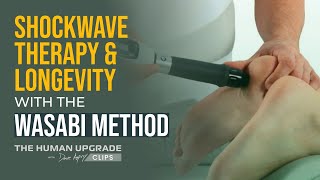
Adam Gavine and Dave Asprey discuss shock wave therapy and how it stimulates healing at the cellular level to speed muscle recovery. Gavine explains the physiological mechanisms behind the treatment and shares personal experiences with muscle injury and recovery outcomes.
Chapters
The physiology of how it works is basically we're stimulating the body to come and heal and repair the tissues that we treat. That's the simple version.
So when you come in with your thumbs and you do, like, deep tissue work, why doesn't that do the same thing?
Because that's simply like mechanical pressure. And what we're doing is that the sound waves themselves cause the tissues. It's working at a molecular, cellular, and tissue level. So it's stimulating those tissues to release certain chemicals and enzymes and different growth factors, and that's what stimulates the healing.
When we talk about those chemicals, a lot of people on the show know some of it. You also may not know about this stuff. One of the things that's really potent is a compound called vegf. And unless you read Superhuman, my longevity book, you probably don't know about this. Or maybe if you're into toxic mold recovery. This is a compound that controls small blood vessels, right?
Yeah.
What happens if you have a knotted muscle and you've had it for months? Months. What happens to blood flow in that blood vessel?
Well, again, you're stimulating it to change the blood flow.
I mean, what happens when it's knotted up? What happens before you treat it?
Oh, well, before. So you essentially have a trigger point. So the trigger point itself will cause the muscle. When you contract the muscle, it can't contract as forcefully, so it decreases force production. But it also, if you want to lengthen that muscle, like stretch it out, it can't lengthen as far either. So it's limited in both capacities. So you can't lengthen and you can't contract as forcefully.
Anyone who's had a muscle injury or just a knotted muscle, it's not even an injury. It's a protective response that doesn't get turned off. So over time, and I know this very well, because having had fibromyalgia and chronic fatigue syndrome, you get these really tight trigger points all over your body, and I've had to work through those and all that. But you get something called pseudo hypoxia.
Yes.
Right. Can you walk through what pseudo hypoxia is?
So, basically, hypoxia is you're not getting enough blood flow to the area. I always tell people think of blood flow almost like water to a plant. That plant's not getting enough water. So instead of thriving, it's kind of drying up and shriveling. And essentially our tissues can stay in that state for virtually forever.
Yeah, yeah.
And a lot of people do. Like you said, your assistant had that problem.
I had one, too. This is kind of embarrassing, but I'll tell you how I did it. So, as you know, I built a regenerative farm on Vancouver island, and one of our pigs escaped. Now, pigs are mean assholes, just to be really clear. They just do that. I mean, even if they're kind of nice, like they're animals.
Just levels of assholery.
Exactly. And the very best ones that become politicians. But anyway, I'm trying to get the pig back in, okay. And I'm like, pushing on his butt. We got our farm manager, the kids, and we're like, yeah, get it back in, get it back in. And the thing will not move. Right. This is a 250 pound pig. And I'm shoving and shoving and then all of a sudden decides to move. And I'm like, I'm gonna faceplant in the mud. Straight up faceplant. That's not okay. So I kick one of my legs back to counterbalance me. Yeah, Right. And I pulled something in my low back from just kicking that leg back at that angle. Like, it was a very awkward thing. It was like a graceful yoga move with a back injury. And I had it not there for like two years after that. And physio and massages didn't do anything for it. But then with the wasabi method, it's like you hit that knot, there's a little knot like this big, just one time, Right. And you just feel this like, oh, that's intense. And then, ah. And it just melts.
Yeah.
And what had happened there was my body said danger. So you get this danger response and it. It tightens that muscle to prevent me from being hurt. Correct. And it's going to make sure I never get hurt again, even if I'm disabled from it.
Right.
So by going in with the wasabi method and getting those pressure waves into that spot, it causes an increase in vegf. Yes, and vegf. And also nitric oxide, which you guys have heard a lot about. Both of those go up dramatically and that combination restores blood flow.
Yes.
And it relaxes the muscle itself. And I'm like, whoa. How is it that a five minute treatment using the wasabi method was able to do what hours of massage and other things and even chiropractic adjustment, it couldn't get it right. And I think those are the two biggest things was an increase in nitric oxide and vegf.