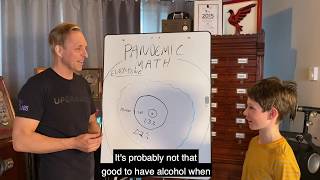
In this informal conversation, Ellen Asprey and her father Dave Asprey break down the basics of COVID‑19 statistics for a mixed audience of children and adults. They start by questioning reported death‑rate figures (e.g., 3.8‑4.3%) and explain why those numbers are misleading when based only on confirmed cases. Using simple board‑style visuals, they illustrate how the true infection count is likely far higher because roughly 80 % of cases are asymptomatic or mild and go untested. By scaling the denominator from tested individuals to the global population, they show how the apparent fatality rate drops from several percent to well under 1 %. They compare this to the 2009 H1N1 pandemic, noting that initial fatality estimates (1.3 %) were later revised to 0.02 % once better data were available. The duo emphasizes that, while the virus is not as deadly as early headlines suggest, it remains dangerous for vulnerable groups—especially the elderly and immunocompromised—hence the need for social isolation to protect them and to keep hospitals from being overwhelmed. They also stress that most people, including kids, will experience only mild illness and develop immunity, and that collective actions (flattening the curve) help safeguard the most at‑risk. The conversation blends casual humor with clear explanations, aiming to demystify “pandemic math” and encourage responsible behavior.
Chapters
I'm Ellen Asprey, and this is my father, Dave Asprey. And we're here to talk about the coronavirus. This video could be good for adults, kids. Just in general.
In general. All right, so you had some questions and I had some answers. Or maybe you had the answers. What do you want to talk about?
The death rate of coronavirus.
You want to know about pandemic math?
Yeah.
All right, let's do pandemic math.
So what was the death rate? It was pretty high. Or not that high. But what Was the percentage?
4.3%? Or was it 3.8%? We keep hearing different numbers. You want to know why?
Yeah.
It's because X plus Y minus Z divided by infinity plus two equals. No. Okay, okay, maybe that wasn't why.
I think you went onto the wrong thing.
Ah, too much coffee does that. All right, let's talk about what pandemic math is. So should we start in the middle and build up, or should we start at the world and build in?
Let's start in the middle and build.
Up the middle, and then you hit the room. Okay, Here we go. So this is the number of people who die, okay? Now, every day people die of air pollution, cancer, heart disease, car accidents, all kinds of reasons. And more people die from those things than coronavirus. So coronavirus spreads and it's dangerous, and it's creating a surge in hospitals that we're doing things to stop, but it's not as big as some of the other things. So it's dangerous, but it's not that dangerous. Right. So right now it's a short term danger for society. But what percentage of people don't have symptoms or don't have very strong symptoms? 80%. And you can still get someone else sick, which is why we're socially isolating. But that means most kids are pretty safe. Yep.
Yep.
Do you have friends who are worried about it?
I don't know, because we've been self isolating. I've only been talking to one on Skype, and I think he. He has coronavirus.
So he's coughing a lot, isn't he?
Yeah.
Well, he seems like he's doing okay, but he's. He's working on it.
Yeah.
All right. If this is the number of people who dies and this is the number of people who have coronavirus because they've been tested. Okay. Then this number way out here.
Okay, that's.
We should get a bigger board, shouldn't we?
That's really big.
That's the population. It's everybody. This Is everyone. Now, if you want to figure out what percentage of people die, it's the number of people who die divided by number of people in the world. That's going to be a very different number than this. So if we test 100 people, then.
If, let's say five of them die, the death rate will be 5% versus if you test everyone, and let's say 100 people die.
So that looks like about 5%, right about. Do you see a problem with this math already?
Yeah, that's what's tested.
Do you mean there might be a magic number that no one knows that's the real number?
Yeah, because like you said, 80% of people who get the coronavirus don't know they have it or have mild symptoms and don't get tested, so they can't know.
So we also have data from people saying eventually 50% of people at least are going to get coronavirus. Just like common colds.
Everyone's had a cold. Pretty much.
Pretty much. So let's assume that the real number of people who have the coronavirus is that. Now, from an area perspective, this is four times bigger than this, at least, and probably even five or ten times bigger, based on other pandemics we've had. So the real death rate, if this was 100 people and this was five people, we go, oh, no, 5% of us could die. But in reality, if you look at this, this might be 10,000 people.
So if it's five out of 100, that's 0.5 out of a thousand and 0.05 out of 10,000. So.
So this is 5%, and this is 0.5%.
0.05.
No.
Oh, wait, yeah, zero point.
Am I right? Oh, no, you're right. 0.05%. Thank you for the math correction, son.
Thank you. Because it's 10 times.
I had an extra zero there. I thought that was 1,000. It was 10,000. So if you look at this, the number drops dramatically. Named Dave, we think you're making up these numbers. Except let's talk about another thing. Ellen, have you ever heard of H1N1?
No.
H1N1 is another similar pandemic that happened 14 years ago, I think, and it came out and scientists said this could be the end. The death rate is 1.3%.
No, don't even say corona.
Well, still, if 1.3% of people who get it die, that's a lot. Because we got 7 billion people on the planet.
That's a lot.
That's because they only knew this Number of people tested, they didn't know the infected number.
So do you know what it actually came out to? After we knew everything?
Yeah. Four years later, after they really had a good way of determining the magic number, they said, oh, we were wrong. It wasn't 1.3%. It was 0.02%. So does this mean that the coronavirus is not dangerous? No, no. It is dangerous. Right?
Mm.
Why is it dangerous?
Because you could die. But it's very unlikely.
You could die. But if you're old or your immune system doesn't work, you have a pretty strong chance of that.
That probably goes up from zero. It's just a guess, 0.02 to what would you say? 0.5?
We could guess, but it would be meaningless because who knows the magic number?
Yeah, no one.
But what we do know is that the magic number is way bigger than the number we're using. So when people get on the news, then go, it's the end of the world, and they say 4.3% of people, and then they multiply that, it's just junk science. It's not real. But what is real is that our grandparents, our elders, our wise people, if we don't stay home for a little while so that they can be isolated and so that we can let the hospitals empty out a little bit when they do get it, they have a much greater chance of dying. So because we care about others, we are self isolating. And for us, we're not perfectly safe if we get it. I'm not going to go out there and lick Corona juice like some Corona beer.
You're guaranteed to get it.
I think I probably wouldn't lick the Corona beer either at this point.
It's probably not that good to have alcohol when.
Yeah, alcohol doesn't help your immune system. But this is what I wanted you to know and I wanted people listening to know, is that the large death rate isn't so likely. But that the people that we love and people we don't even know can and do die from coronavirus. They also die from the flu and heart disease and cancer and other things like that. And that's why all of us can work together to make sure that you are strong. So that if and when you do get the coronavirus, you're sick for a little while and then you move on. And if and when I get it, I'm sick for a while, I move on. And what happens after you get it?
You're immune.
Hallelujah. So let's do our part. Let's flatten the curve and then let's go. Wait a minute. What if I just never have to go to the hospital? I'm technically part of the curve of someone who got infected. But I didn't clog up a bed.
You didn't count.
That's right. So be one of the magic numbers who never has to get tested because you didn't know you were sick because you're that healthy. Will you join me in being healthy?
Yep. Also, talking about elders dying, I think you're a pretty good elder, so please don't die on me.
Did you just call me an elder?
Yeah. Well, I'm not even 50. You're knowledgeable. How's that?
Thank you. I am so. I am so happy about that. By the way, you know where I learned most of my stuff?
Where?
People over 70. Oh, I consider those my elders. But when I'm 70, I'm going to go after those 90 year olds. And I am your elder.
So you're going to go after 110 years old.
I'll share my knowledge with you and anyone else who wants to hear it. And thank you for asking. Thank you for doing this video for everyone.
This is a good instance of sharing knowledge because all you people watching, I know how many there are, but if you watch this, you'll probably learn something from it.