How to Talk to Kids About Coronavirus: Flattening the Curve with Dave Asprey
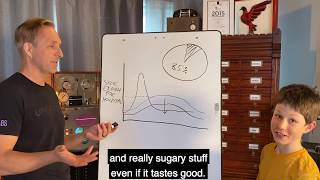
Dave Asprey explains flattening the curve to his 10-year-old son Alan, showing how a 5% reduction in severe cases cuts hospital demand by 25%. He argues the real goal is keeping people healthy enough to recover at home through sleep, vitamins, and avoiding sugar and fried foods.
Chapters
Hey, I'm Dave Asprey and my son Alan, who's 10, has been asking a bunch of questions about the coronavirus. And we thought about it and we said, hey, what would happen if he asked me those questions on camera? So that way we could record the answer. And then if you want to play this for your kids or you just want to hear what I have to think about it, this is something that is suitable for adults and suitable for a 10 year old. And I probably won't swear very much.
Just do your best.
All right, what did you want to know?
The whole thing that. Well, at least I've been hearing about the whole flatten the curve. Like what actually is that?
What is that? Okay, let's talk about it. So you know what a curve is, right?
Yeah, it's okay.
It's a way of graphing things. Here's what we're thinking about there. This is how many people get the virus. Now a lot of people get the virus. They're not even going to feel much. They might like to have a cold, but some people get really sick and this is over time and if we just run around and hug and we don't do social isolation and stay home, then this is what happens. A lot of people get sick all at once and then it goes down. Okay. Okay, this could be all right, except maybe this is the number of hospital beds we have right now. That means all during this time, doctors, they're going to be working 24 hours a day. There isn't enough beds or enough equipment. So some people who get coronavirus would die because they just don't have a doctor. Or some people who needed a doctor who just had a heart attack and didn't have coronavirus, they would die too. So this is the curve that's dangerous because this part up here. So here's what flattening the curve looks like. And by the way, flattening the curve is a terrible idea. And I'm going to explain why, even though social isolation is a good idea.
Interesting.
All right, so what we're saying is if we all stay home for a while, then the number of people who get sick, it might look like this and say, okay, this is great. All these times when we would have had hospitals that are overwhelmed. Now we don't.
It's still above a little bit though, so.
But by this time we should be able to build more hospital beds. So it's about the same. Yeah. So maybe there's a few people in hospitals that are very crowded, but we'd Be okay. We wouldn't run into this crisis that we're about to run into.
Okay, so, okay versus yeah.
But there's one little problem. This is why I think it's not a real good idea to just focus on flattening the curve, which is a good idea. You haven't done calculus yet, have you? No. Okay, let's see if we can explain this.
But why isn't calculus a way of finding the area of a curve instead of lines?
Imagine this. Most kids your age know how to tell the volume or the area of something like this, right? Yes.
Multiply by that.
So you multiply that times that. And you also know maybe how to figure out the area of that plus the area of this, right?
Yes.
This is another little triangle. And what you're going to find here is that if you flatten the curve, how many people get sick? The same number of people get sick here as this as get sick here, Right?
It's about the same.
So why are we flattening the curve.
Then for, I guess, on hospital beds? Because you're not.
To save beds so that people who need medical care here can get it. But what if instead of spending all of our available resources, this idea that we're going to flatten the curve, what if we instead focus not on the number of people who get the virus? Let's look at the curve of people who sick enough for hospital. Now check this out. We know that approximately 80% of people who get coronavirus are gonna have mild symptoms or no symptoms. And it's these ones who get really sick. And some of those have to go to the hospital.
So if you get the virus and you don't go to a hospital, doesn't that not count here?
Well, suddenly we've changed what we're measuring. Instead of measuring the number of people who get sick, all we worry about is, hey, how many people got sick enough to go to the hospital? Because that's all that matters. And then we shift our thinking and we say, what can we do? Well, we're all social isolating to prevent this problem, to make sure that fewer people go to the hospital. If we could move this number instead of 80% of mild symptoms, what if we just made it so 85% of people don't go to the hospital?
So then that would be a big reduction, because even if the cases would look like that, the hospital effect wouldn't be as much.
In fact, a 5% drop in the number or 5% increase in the number of people don't have to go to the hospital.
It's a quarter.
It's a. Hey, you nailed the math right on. It's a 25% change in this number up here. And what that means, that means this curve drops by 25%.
Lovely. So it would look more like that.
So what it would mean is that it would look like this because we're no longer focusing on. Oh, no, did you get the virus? Cause frankly, who cares if you never felt it? What you're worried about is how many people are going to go to the hospital. We would still socially isolate, but we would take the time to. What are the things you could do to maybe get yourself healthier so you would survive the virus?
Take your vitamins, as you're always telling me we do every morning.
Yeah, just take your vitamins. What else could you do?
Have more sleep and not eat fried and really sugary stuff, even if it tastes good.
It's almost like you read the Bulletproof Diet.
I haven't. Do you think you're like, I haven't, but I've listened to the author, so you're funny.
So anyway, that's our trick. We're going to talk about what if we can, instead of flattening the curve, which we're going to do anyway, let's talk about dropping the curve and let's talk about the number of people who have to go to the hospital. What I want to do is I want to build superhumans like you and like me who have. Have really strong immune systems. And, and this is for everyone out there, the tools to not have to go to the hospital.
So if you get coronavirus, just if you're healthier like that, you could just stay home, not have to go to the hospital, save a bed for someone who actually needs it and be immune after. And then you're done with it and you don't have to worry. And then you can also help people who have a high chance of getting it because. So they would have to go shopping and stuff.
You nailed it. Our biggest chance of helping the most people is to lower demand for hospitals by making all of us healthier. And we talked this morning about a side effect of people staying at home that had to do with air pollution. Do you remember that one?
Oh, yeah. There was, wasn't it in China?
It was in China.
In China. There was in Wuhan, since everyone wasn't going outside, not as many cars and buses and things that create pollutants that saved. I think it was 70,000.
Yeah. The scientists were estimating that in Wuhan, over The two months of social isolation, the drop in air pollutants, micro particles, saved 4,000 young children's lives and 73,000 older people's lives.
So how many of the coronavirus?
Less than that. Oh. So it turns out we can do a lot to keep people out of the hospital. And it's our job. Now that we've all seen that the coronavirus is a threat, how do all of us become stronger, more bulletproof people? And let's change our discussions. Change it at schools, change it at home. Is. Hey, even if we flatten the curve, at least half of us and maybe 70, 80% of us are going to get the coronavirus at some time.
Because.
Because it's a disease, like a cold. So let's just make it so if it happens, we've got this.
If you have it. If you have it, don't go to a hospital unless you really need it.
Yeah. Save the hospitals for people who really need it. Alan, thank you for asking me questions. And thank you for helping to explain.
You're welcome.
Nice job.
That was a good high five.
That was so good.










