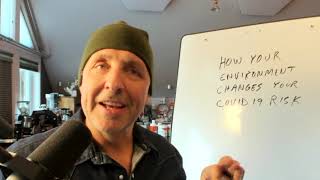
This is a YouTube video titled "How Your Environment Changes Your COVID-19 Risk - Dave Asprey" created on March 19, 2020. It features Dave Asprey discussing environmental factors that influence the risk of contracting COVID-19, including temperature, humidity, air filtration, and mold. He shares personal practices for reducing risk and thoughts on natural immunity and community protection during the pandemic.
Chapters
A lot of people are freaking out about their risk of getting Covid. And I've done a lot of research, got a lot of numbers for you, and I'm going to make a series of videos that are going to share some facts so you can see whether you're at average risk and even whether the average risk numbers hold water. They don't. In this video, though, I'm going to focus on what your environment does to whether you're likely to get it. Did you know, for instance, that 90% of infections are in places between 23 degrees Fahrenheit and 68 degrees Fahrenheit? Average temperatures and 20 to 65% humidity? What that means is that if it's really hot or really cold outside and either very wet or really very dry, you have an advantage, in fact, a pretty big advantage, in having a lower risk of this being in your community or you getting it. You might say, okay, what does this mean to me? Should I dehumidify indoors? I would say, given what we know, probably not, because if you make it too dry, you can actually get a cracked nasal lining. Unless you're used to it because you live in the desert. And the flip side, should you humidify? After all, high humidity might be good. I would say maybe. But the problem with high humidity in certain environments is that if you have a wet house, it increases your risk of mold growing in your house. And if you want to really mess up your inflammation, really change your IL6 cytokine, which is the one that Covid seems to raise, the one that causes a lot of the problems, well, then you don't want to have mold in your house. So if you know that you have a clean house without mold or you're willing to do something about mold, there's ozone treatments. One of my companies, Homebiotic, yes, it has a probiotic spray for that. I'm not suggesting you go out and do that. I'm just saying if you humidify, watch your mold levels. If it smells dank or it just doesn't smell good, then don't do it. Your humidifier should have either iodine or silver in the water or grapefruit seed extract as a way to reduce the odds of stuff growing. All of those actually do work. But. But if you have iodine or hydrogen peroxide at too high of a concentration, you can either bleach or stain everything around your humidifier. Not a good deal, which is why silver is probably a good choice. Should you filter your air well? Yes, you should. Anything that removes small particles is A good idea. Yes. It'll also remove small farticles, but that wasn't what I meant to say. And HEPA or there's a few high tech solutions from different companies that I've mentioned on Bulletproof Radio on my blog. Any of them are a great idea. I use a variety of these filters, but you can't buy an air filter at any price right now. So use them if you got them. That's a good idea. Another point, most infections are between 52.5 degrees latitude. This is basically Germany, Netherlands and 25% latitude which is UAE in Mexico. And that data comes from Johns Hopkins, who and a JP Morgan analysis of a lot of data that came out that they send to some of their clients. So I'm happy that I got that summary of things. And what do I do? Here's the deal. I live in a really wet environment. Vancouver island is technically a rainforest, just not a tropical one, which is good. But I'm at 48.3 degrees north, which is in the zone of risk, which is a bad thing. But I'm healthy and so is my family. We've already decided that we're self isolating for at least two weeks and we have everything we need to care for ourselves, including pigs and sheep in case we get really hungry. I also spray home biotic around the house because it's wet and mold would definitely increase our risk. And I know for me it's the number one thing that would take out my immune system, make me actually at real risk of COVID causing harm. We use air filters in the house, we have no visitors right now. We're getting sleep, we eat well, we're avoiding sugar and inflammatory foods. And I've got ozone therapy, which you've seen in another post. And I've got immune enhancing herbs to stop IL6 inflammation. There's about a dozen of them and there's a whole special on bulletproof radio just on the herbs that affect the inflammatory cytokines that Covid will bring on for you if you get it and if you know you got it. Keep in mind 80% of us won't have this problem now given all this. And this is going to be really inflammatory and I don't mean biologically, I mean just I got to say this. If there was a reliable way right now that I could intentionally expose myself and my family to COVID 19 right now, I would choose to do it. We would completely self isolate during the time I live on a remote farm where we can reliably do that and the odds that we would live are exceptionally high and live undamaged. But the reason I would do that is that then we would be immune and we'd be in a really good position to do risk free shopping and provide care for older people who actually need help and are at real risk. In other words, it's like what my parents and grandparents did. You invite your kids to a chickenpox party and then they get chickenpox and then they're immune. Yes, we have other ways like vaccines to prevent chickenpox now, but natural immunity is what we've relied on as a species and all life has relied on for all of history. Since it's going to be about a year until we have a vaccine. And by the way, that's a real number. You're going to see that in one of the videos that comes out right after this. Would I rather have natural immunity, get on with life and be in a position to serve my community and others and know that I'm not transmitting it, but I'm helping? I would. And I think that it's a very reasonable risk given, given my health status and how blessed I am to have that. In other words, good old natural immunity will work just fine for us. It's a great way to protect our older, our immune challenged community members. And I look at those people as the elders. They're the keeper of our hard earned wisdom and we could all use more of that wisdom. Now what does that mean? Turn on your air filter. There's probably nothing really to be done about humidity, but maybe you should add a little bit if it's too dry, but not dry enough to be protective. And know that if you're living where it's really cold or really hot and moist, your risk is lower. But you still should do your part to keep the hospitals from being overwhelmed. That means either self isolating like I'm doing, or at least social distancing. Stay tuned for the next video.