IG Live! Jamil Zaki, Ph.D., and Dave Asprey on Kindness & Empathy
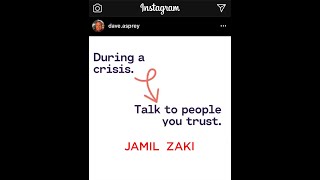
Dave Asprey talks with Stanford psychologist Jamil Zaki about what neuroscience shows on kindness and empathy. They cover how social connection affects mental and physical health, and why kindness works as a learnable skill, not just a feeling.
Chapters
There we go. Welcome, Jamil.
Hey there, Dave. Good to see you.
Good to see you. So, Jamil, I was just telling people we just recorded a podcast that's coming out about now on Bulletproof Radio, and you are the professor of psychology at Stanford, and you talk all about kindness here at Stanford's neuroscience lab. And I wanted people on Instagram to get a sense for who you were, because this is. It's an epic podcast. And when everyone's all full of fear, you're like, war. War for kindness. So thanks for coming on Instagram live with me.
Oh, of course. Yeah. So a little bit of background. I mean, I've spent the last 15 years thinking about, like, a few things. How people connect with each other, how those connections help us, why it can be hard to connect sometimes, and how we can get better at it. So I think you're right that moments like this that are so full of fear can tend to draw us inward, can make us focus on whatever we feel like we need and not focus as much on each other. But it turns out that's a huge mistake, because when we help other people, we actually benefit ourselves in all sorts of ways.
So helping others is a selfish act.
We talked about this on the episode. I think it depends how you define selfishness. Right? I mean, if you want to define it narrowly, then helping others. No. Is not selfish. But if you think about something that's selfish, being anything that's good for you, well, then all sorts of things that we value are selfish, and maybe that's okay. In fact, I think it's really beautiful to think that people have evolved so that helping others feels good to us. I mean, we found in our lab that when you donate money to others, for instance, you activate similar parts of your brain as when you eat chocolate. Right. So it's a. It's a broad kind of selfishness that actually is kind of poetic.
So if you were to, say, buy a cup of coffee for someone and they bought a cup of coffee for you, it actually feels better for both of you. Like the net ROI on the coffee was higher.
Absolutely. And there are all these experiments that demonstrate that people get this wrong. They don't realize that spending on others would make them happier. And. And so they make the mistake of being selfish. And not only do they get a poor ROI on that, they miss out on not just happiness, but on social connections which also keep us healthy and even improve our immune function. Right. Which is something that we could all probably stand to benefit from right now.
Now I'm thinking About Burning Man. This is one of those things where you feel fantastic when you go to Burning man because everyone just gives you stuff, and you just give everyone stuff. And I donate, like, thousands of cups of coffee. We set up, like, a free coffee shop. It's the only thing you're allowed to buy Brandon Man's coffee at the Central Camp, But I'm not. It's free going free, like, and it's unbranded. Like, there's no bulletproof stuff on there, but it feels really good. And then you're riding a bike around, people are just giving you a bacon sandwich or whatever. Some people have kale sandwiches, but no one eats them. But the feeling there was really good. I tried to explain to people, and I think our podcast episode help me to explain. Like, that's one of the reasons that it feels really good to go hang out like that for a week, because it's like. It's kind of like mainlining kindness and empathy. Talk about neuroscience and neurochemicals that change when you help another person.
Yeah. So like I said a minute ago, when you help others, parts of your brain that are associated with sort of reward and motivation tend to be active, but also parts of your brain that are associated with empathy. So you probably have heard of the mirror neuron system. We talked a little bit about this in step two. But, you know, there are all sorts of brain systems that allow us to basically experience what it's like to be another person in the moment, to sort of dive into their point of view and. Yeah. Walk around in their. Kind of. In their experience. And. And those parts of our brain are also active when we decide to engage in kind behaviors. And the better a job that we do taking someone else's perspective, the more fully we understand where they're coming from, the more that we feel like, hey, we're connected to them and we might as well help each other.
Okay, and this is all based on your laboratory. Laboratory research and, like, really deep neuroscience, not just sort of the, you know, the ancient wisdom that we've all talked about, like that. How does this apply to. We didn't talk about this on the show, but how does it apply to things like warriors like, oh, like, I'm gonna go, like, you know, punch this asshole on behalf of my community?
I mean, there's. There's a kind of interesting push and pull between aggression and protection. Right. So we have two. Well, we have many ancient instincts, but two of them are to be connected to the people who we depend on and who depend on us. And also to split the world into us and them. Right. And moments of struggle between groups often increase kindness within groups. So for instance, during wartime, after the 911 attacks, for instance, there's two things that happen. One, people feel more aggressive towards an out group, Right? They feel like more warlike in a way. But two, they act more pro, socially, more kindly towards people who. Who are in their own groups. Again, after 9 11, there was this huge sort of explosion of charitable giving and volunteering within the US Because I think that a lot of us felt like we were under a common threat, and so we had to band together. Right? And I think an interesting thing about this moment is that we're all potentially under a common threat, but the enemy is not another group of people. You know, it's a virus.
Right? So sort of the unnamed or unseeable, unknowable kind of enemy there, like that, which is what we're facing right now, that can actually drive empathy and kindness or it can drive fear. If I. If I'm paraphrasing what I say, how do you make it more empathy and more kindness? There's people listening to this right now, the middle of their workday, if they're lucky. Otherwise they're in their middle of their, you know, eating a lot of processed food day, because what else are they going to do? How do you, like, how do you flip the switch in your head? That's probably the biggest thing that we talked about. Yeah.
I think one of the things is to. Is to acknowledge that fear and pain and suffering are part of this moment and they're not something to avoid or to pretend is not there. Rather, I think an important thing is to acknowledge our own pain, our own fear, and then understand that those experiences, in fact, make us similar to each other, that they are shared experiences. Right. This is the sort of contemplative practice, for instance, of common humanity, where you don't use your suffering as a wall between you and other people, but rather as a bridge to help you understand that, hey, my fear is something that other people are experiencing too. And one of the best ways that we can both move beyond it is by working together, by understanding that this common experience creates a common purpose as well.
All right, that makes sense to me. People are asking in the thread here, our episode's coming out on Thursday. I thought we might have had it coming out today, so in two days on Bulletproof Radio. So you need to subscribe or at least put it on your calendar to do it. And, guys, I wanted to just get a Taste for who Jamil is, because there's not a lot of people studying this and, you know, at the highest level, university neuroscience, things to understand, untangle what's going on inside. And I feel like right now, so many people are tweaked and there's a lot of fear. Doesn't have to be there. And then we have the separateness and the idea that you can use intentionally triggered empathy and kindness as a skill, as something you can do, you can do it remotely, you can do it for your neighbor, that it's probably the best way that I can think of to stay sane and maybe help your immune system work better. Do you agree with that mindset, like, as the best thing you could do?
I mean, there are a lot of things that we should be doing, but I think that one of the things about kindness is that it's so it's pretty easy to do something kind. You don't need to donate all your savings to charity. Simply reaching out and connecting with someone who might be struggling, asking how they're doing, can help them and you at the same time and improve people's mental and physical health. Yours and the people you connect with. I mean, social connection is like a human superpower hiding in plain sight. And, you know, we need it all the time, but especially in times like this. So I really hope that the episode can encourage people to look inside themselves, because kindness and empathy aren't just powerful. They're things that we can practice and get better at. And I think a moment like this is a great opportunity to do that.
Right. I believe very strongly in learning from the masters, people who've spent their lives studying things so I can get the Cliffs Notes. I think you did a good job in the episode, delivering it. So people listening to our little Instagram thing here, this is one that's worth catching because you have to spend any money. You have to do anything. But there are specific tricks you can do to turn on things in your brain that are probably turned off by the media right now. And that's what this episode's for. So tune in on Thursday. And, Jamil, your War for Kindness book is out there. It's worth reading. And just thanks for taking a minute to be on Instagram. Thanks for the long episode. It was one of my favorites. So thank you.
It's my pleasure, Dave. And thank you for all the work you're doing, too.
All right, see you online, too. Bye.
Take care.
Bye.










