IG Live Q&A! Let There Be Good Light in Your Home: Robert Soler & Dave Asprey Show You How
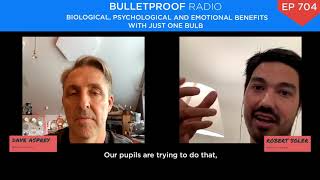
Dave Asprey and Robert Soler, the lighting designer for the International Space Station, discuss how light affects your circadian rhythm and health. They explain why blue light matters and how BIOS-powered LED bulbs can improve your home lighting.
Chapters
What's up, everyone? We're going to be talking today with my friend Robert Soler, and he is the guy who designed the lighting for the International Space Station. So I think you guys are going to be fascinated to hear from him and sort of what it's like. In fact, I have a piece of the International Space Station right behind me. I see that thing. There he is. I was just telling people how I've got a piece of the International Space Station sitting right behind me.
Oh, yeah? What is that?
Not a piece of International Space Station. Okay, here's a question from Matt Columbini. True dark glasses are the best ones. I actually wrote one of the patents for that. That's an easy one. So, Robert, I'm just showing through the questions. Can you see those as well?
Yeah. Good.
So Soulgirl Love one says that you're a hot dude. And I'm. I'm just saying that it says it right there.
Cool. Good times. See, this is what happens if you.
Tell engineers that we're hot. We're like, really?
Yeah. We don't know how to take that kind of information.
Yeah, we don't know what to do with that. So, Robert, let's talk about lighting. People are always interested in this stuff. And full disclosure, you guys, Robert is a part of a company called BIOS Lighting that has brought the kind of technology that's done for the space station where it's the worst circuit in the environment, I would say on Earth, except it's not on Earth. So there you go. And. And has created something new. And my company, TrueDark, or True Light as part of it's called, is working with bios. Just so you guys know. Like, we. We do have a relationship here, but it's because I'm just, like, super excited about making lights that work. Hey, Kim from Canada says hi.
Hello.
Also from Canada. That out there is Canada.
All right, awesome.
So tell me about toxic blue light versus good blue light. This is why, like, the blue blocking glasses piss me off, because it's not right to block out all blue. So what are the differences between toxic blue and the stuff that you've identified the sky blue?
Yeah, that's a great question. Before you get to that question, I actually want to talk about that partnership because I think it's really important. You know, BIOS had thought about this technology and creating these light bulbs that create healthier interior spaces for a long time, and we've been doing it commercially for a while, but we really didn't have the channel to educate people on how to do this. And that's where you are perfect because you've been educating people on biology and how the environment and how things that we put in our body impact our health and well being. So this is kind of a match made in heaven.
So it really is kind of the.
Best of both worlds is we're kind of the, you know, we're the developers of this technology. But you're the educator, you're the guy that has these people that are, that are doing this, you know, to speak to it. But I will talk. Yeah. About the technology.
So light's a nutrient, basically. And I think this is becoming a part of the way we see the world. And now everyone's stuck at home. You're like, oh, wait a minute, I'm getting junk light every day because I can't even go outside. Or if I do go outside, it's very limited. So Robert, Nika here is asking like, what light spectrum is filtered through home windows? So let's answer a few questions that people probably know the answers to and we'll get more into, you know, what, what it's going to be like in the future to have proper lighting in, you know, in a commercial building when you go to work and stuff like that. But so what do windows do to natural sunlight? Is it good, is it bad?
Yeah, so windows are okay. You know, it doesn't give you everything. It filters out some of the UV from what we're talking about, from a circadian standpoint, it's giving you a ton of sky blue. So I mean, that's the number one thing you should get is what's going on outside those windows is your number one source. But when you don't have that and when you don't have and when the sun goes down, what do you do? And I think that light has historically just been something that we see, you know, we used to see it by, but now we're starting to understand that it has all these other biological pathways. And so what we've done is created a light bulb. And actually I've got one right here that you could put in. I've got, let me see if I could get it hard, far enough away. There's a little dimmer switch and as you pull it down, you know, pulls out all that sky blue. And that's really important.
Happened like, so. So guys, I've been saying for years, LED lights suck. Unless you're using, you know, a red light or something for therapeutic purposes, they are bad for you because they harm your eyes. And I'D been saying, all right, how do I go about making a bulb that could, that could do this? But it takes real engineering beyond what I can focus on right now. So then I meet Robert at BIOS and like, oh yeah, we spent five years custom drivers, like we re engineered the LED light because part of blue is what our eyes want. You know, it's that sunlight and, and that's the sky blue. But then there's the lower blue, the toxic blue. And that actually stresses your eyes and your brain out. That's the stuff that messes you up, especially in the evening. But even in the middle of the day, it tweaks on you. So these bulbs. And by the way, I have one right here, the true light bulb and it is powered by BIOS technology. And now the thing is also my, I'm opening upgrade labs and yes, a bulletproof cafe in downtown Victoria, which makes me sort of, sort of crazy because it is a pandemic time. But I'm doing this. All the lighting and in the house that I'm remodeling are. It's all the BIOS commercial grade stuff. I think we're going to be in a, in a future where everyone, when you go to work, you're just going to have these. And when you do this during the day, you're getting enough of the blue that, oh, I'm awake. But it's not the blue that tweaks on you, it's the blue that feels good. So I can literally say now there's an LED light that you can look at during the day. You can work under that doesn't make you feel crappy. And that is like game changing. I thought I was going to have to go solve this problem and start a new company and I was like, thank you, bios. But then the tweaker is when you dim it. And by the way, no weird EMFs. You don't have to have a magic phone and plug in a Philips hue or any of that stuff. You literally have a dimmer switch on your lamp, a plug in, one or one on the wall. Like I recommend for years in my books, when you dim the lights. Show them again what happens when you dim that thing.
Yep, Dimming it down. Let's see if you can get in the camera shot. When I dim it down, you could see it pulling it out. So if you get up in there.
Yeah, there you go. It's linearly pulling it out. So in the evening, your eyes expect sunset and then candles and that's all. And even candles and Fire are relatively recent in human evolution, but there's no blue in those at all. Unless you put those little crystals in that make your fireplace turn blue for a second. We won't worry about that. So what's going on there is this is natural and, and to do it with just a dimmer switch and no weird tech, you don't have to have your WI fi turned on. There's no Bluetooth or anything like that. That is the new trulite circadia bulb that has the bios. You know, all the stuff in here is from bios and we just put this on the market very recently, as in like last week. We're already almost sold out of the first batch.
But we got new supply coming, new supplies coming.
Yeah, and anyway guys, I wanted you to talk to Robert. This guy makes astronauts not die of circadian dysfunction. And so he's a world expert. So more, more stuff. Tell us more about what you do there. By the way, there's a podcast on this as well, but a lot of people haven't heard the podcast.
Yeah, so I think that there's a couple things that I want to bring up. Cause I saw some questions go by about Philips hue and how it changes the color light. So we're changing the color of light here, but we're also doing some really interesting things with spectrum. So there are certain frequencies of blue light that are, you know, that cause the visual perception of blue light, it also causes some increases in glare and kind of that off put feeling you have. That's not what this is. We're using long wave sky blue frequencies that go into it. And what's super interesting is that we actually don't see them very well. So I could put a lot of sky blue in this. That gives you that daytime feel, even though it looks like something that you want to have in your, in your home. So it's not super blue, not anything like that. But we did some clinical studies with Thomas Jefferson University and we showed two light sources. One, that is our spectrum and one is that a standard LED spectrum that looked the same, but we had smaller people sizes with ours because that's our natural protection mechanism to make sure that we're filtering out all the good blue, that's all the bad blue, the junk blue light. Our pupils are trying to do that. And our light spectrum actually helps you facilitate your natural protection mechanism. And two, we saw a dramatic reduction in melatonin suppression with our spectrum compared to the regular LED spectrum. So what you see and what the color appearance is, is Something that gives you a hint of what's going on, but a targeted spectrum and a spectrally optimized solution like what we've done at BIOS, is really what you're looking for to provide the benefits of day and night and with the same simple dimming interface to do it.
So what I've done now is I put these in my kids bedrooms and I put these pretty much everywhere in the house where I can. And we've got more sizes coming out for you, so this is the first size. We're going to end up having some spots for you, so you can put in the floodlights and things like that. And it's pretty neat. Oh, here's a question from local global girl in the uk. Is this available outside North America? I think we can ship the consumer ones if they light bulbs are the same either way, but I have to check, are they?
Yeah. So the challenge is that the dimmers work a little bit differently. So 230 volt, 120 volt. This is a 120 volt system. And 120 volt dimmers are a little bit different than 230 volt. But we're absolutely working feverishly to come up with the 230 volt solution, because this is not a US problem.
The BIOS commercial lighting will work in the UK, right? Because that's just a head unit power supply change.
Yeah, yeah, yeah. The commercial solution. Absolutely. Yes, absolutely.
The commercial solution works. If you're in control of an office building or a restaurant or whatever, you put the lights in, people feel better. They actually are nicer to each other under good light. It's transformative. And I do this at the Bulletproof Cafe in Santa Monica. We haven't put this lighting in yet because it literally just got launched, but there's been like a mood box around the door and feel like, why do I feel good here? I'm like, see that metal on the floor over there? That's electrically grounded. See the lighting in here? So we're like tweaking on the lighting and I insisted on halogen, where I could get it and things like that. So it's like, how do you create an environment that naturally makes you feel relaxed and happy and good and lighting is such a big part of it. So basically, you want to get the BIOS stuff everywhere in a commercial setting, and then in your bedroom, get a true light bulb. It's the same tech, right? Or in your kitchen. And so our whole house is like, you dim the switch and like, oh, it didn't just dim the lights, it changed the color. So. So. And it's like this warm feeling and then it just tells your body. Oh, like, start getting ready to chill out. It's gonna be bedtime. And it changes things. People saying, what size are the bulbs? How long do they last?
Oh, yeah. So LED lighting is like everything else. We warranty them for five years, but they're designed to last, you know, tens of thousands of hours. I mean, the LEDs themselves are designed to last hundreds of thousands of hours. But, you know, power supplies could go, you know, if they get hot. There's things that could. That could go wrong. But these things are warrantied for five years. There's. I'm not going to give you the. I'm an engineer, so I can't.
Like 50,000 hours.
50,000 hours is standard. Yep.
But. So in that range is a reasonable assumption. But you guys can do that. So people are saying, well, how big are they? They're like the same size as a normal light bulb. They fit into anywhere with a normal, like, large. I think this is. There's a name for this, like T45 or so. I don't know. I'm a network engineer.
I'm going to shut this one off because I saw something about. So I also have them up here. There you go. And, yeah, don't mind my drop ceiling. And so I also could dim it down in here and change the environment in the entire space. And I think that this is really important. So somebody asked about Kelvin. At full output, it's 3500 kelvin. When it dims down, it's full amber. So it's a very warm light, but it's everything in the middle along the way. But I think now that we kind of live in a world where we're in the same space all the time, it's really important from a sleep standpoint, from a behavioral standpoint, to make that sleep space look as different from day to night as we possibly can. So I think that that's a really important component that we have to discuss, you know, think about is like, this is designed to really create that day, night delineation inside the built environment.
There's other questions here about flickering, and we talked about this on the podcast. I hate flickering LED lights. If you put your phone on slow mo and you saw those videos of, like, cars and their headlights are flickering, this is why people get headlight, like headlight fatigue and migraines driving at night because LEDs suck. So these don't flicker the way cheap LEDs do explain to people real quick how you've solved the flicker problem, basically we talked about on the podcast. But just kind of walk. People aren't engineers through how you did that, Robert.
Yeah, so I do want to say that the flickering is a function of the, of the dimmer and the system too. So it's a good quality dimmer is going to go a long way there. So what you'll find out if you, if you use like the old incandescent dimmers. There are new LED dimmers because when you dim this thing down, if you have something that's expecting to see a 100 watt light bulb, you know, or you know, a bunch of 60 watt light bulbs, it's designed to see that stuff. It's not, it doesn't think about a 10 watt or I think our 9, 9 watt light bulb. So you got to get the right dimmer to go with it in order for it to work. But the way that we do mine.
Work on the normal dimmers. I just have, I have dimmers like just in, in my walls that are, that work fine with halogens. They work great with these as well.
Yeah. So it depends if you have one. I just want to make sure that everyone understands what to expect. So if you have one on one dimmer, it might, it might at the low end have a little bit of a flicker.
Okay.
I haven't seen it, but if you have four or something, it's gonna, it's gonna rock star.
That's why. So my overhead lighting, I have multiple ones on the same dimmer.
That's right. And that's right.
But the flicker, for me, I want to. It actually gives me a migraine sometimes. I'm not really prone to migraines anymore. I used to be, but I feel like. I just feel like someone gave me Valium. Like, I'm like, oh, not the good value. I'm just, just sedated after a while from that. And I don't get it at all from these. And that was the first thing I'm like, yeah, LEDs, they're going to flicker even if they have the right spectrum. But these don't do that.
Right. It's all to do with what's going on underneath that, that bulb. The dark opaque white part, the power supply there has all the filtering components to get the flicker out. So anything that you might see is due to the dimmer, not the light bulb itself. Because it's important.
Check out Jen Sandhu here. He says, I work in commercial real estate and in Current environment, we're looking at ways to stand out from competitors and wellness is more and more important. Like, I'm going to be really straightforward, you guys. In commercial real estate, you are not going to be able to rent a place with shitty lighting when I am done, okay? Like, people will go and be like, I'll pay you $0.01 per square foot because I'm going to increase the number of employees I have to have to get work done because you're drugging them with your crappy lighting. It's that big of a deal, right? And as a tenant, in fact, I, you know, a new office building, we're building out from raw space here in Victoria so I could get it set up the way I wanted. I would have loved to just lease it, but everyone gives me crappy lighting and I'm not allowed to change it. So, like, your days are numbered. If you're going to have like industrial prison lighting in an office building, we're not going to do that anymore. So that Jen, the same guy says, could be a game changer. Love the pun there. What's the price differential than normal led? So on a commercial basis, you're gonna put in a bio system in a commercial building. Are these more expensive, less expensive?
What does that look like? You know, it's in the 20% more. So if you're buying, you got a lighting budget, it's about 20% more to have this lighting technology in it. If you think about it from, you know what Dave just said, the productivity gains that you have, the ROI is pretty much a no brainer, right?
It's a no brainer. I'm thinking that I should have done that Uncle Fester thing. Did you ever see that? The Adams family?
Yeah, if you could do that.
I've got to figure out how they do that because that would be the best ever. I'm not on TikTok, but if I was, I would have to inflate the bulb. But I just want you guys to know, if you're at home and you're not going to be in an office building where you get to control the lighting, go to shoptruelight.com this is where you get the BIOS powered stuff for your home. There's several more bulbs coming out for different form factors, different things to change the angle of lights. Because there's three things that control your junk light. And Robert and I talked about this on the podcast. One of them is the angle of the light coming into the eyes and that's the basis for the, the glasses they're called the sunset glasses, the basis for that patent. But there's a new bovia coming out that solves that problem for you. And then one is the color spectrum where toxic blue no good. But if you take out all the blue during the day, it will also trash you. That's why the blue blocking glasses are bad. That's why the true dark glasses that block some blue but not all blue, that's why they work the way they work. And then you also get the intensity of it. So if the light is too bright at night, even if it's got no blue in it, it's still going to mess you up. So you got to get all three variables right. Kind of like if you're eating what kind of carbs and how much, what kind of fat and how much and what kind of protein and how much. So lighting is same thing. Those combination of angle, color and intensity. And this bowl, it solved it. I didn't have to start a new company to do this. Robert did it. So thank you, Robert, and thank you for partnering with Trulite, because everyone can have these. These are price competitive, actually cheaper than the hue. There's not weird EMFs and stuff like that. They work with any switch and use a dimmer switch to activate the nighttime stuff. But if you just use the daytime feature of these things, what you end up with is I didn't get the toxic blue. I just got the sky blue. So I'm awake, and I don't want to just either fall asleep or punch people at the end of the day, because that's what drunk lighting makes you do. Robert, thanks, man.
Yep. Thank you.
All right, guys, have an awesome day. And yes, there is a dinosaur.
See you, guys. Bye, guys.










