IG LIVE with Amy Shah
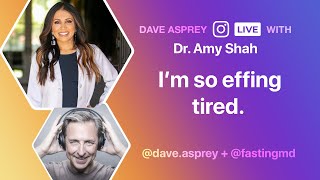
Dave Asprey and Dr. Amy Shah discuss intermittent fasting, circadian rhythms, and women's hormones. Shah promotes her book "I'm so Effing Tired" while Asprey discusses "Fast This Way," offering practical advice on fasting and diet for better energy and metabolism.
Chapters
Hey, Instagram, how about we do a live with someone who knows a lot of cool stuff? I'm talking about Dr. Amy Shaw, author of a brand new book that I just read that I think you guys will like. So let's talk about why you're so effing tired. Let me add her in real quick here. Standby. All right, I just invited her.
Hey, Joanie, how are you?
I am great. Thanks for taking time during your book launch to share with all the bulletproof peeps.
So excited. I wanted to tell you, though, the other day you posted about fruits or vegetables or something from your farm. I'm so jealous. All the stuff, I think. I think about that. If you can just grow your own food, you can just get everything you need from your own land. How lucky are you?
It is an incredibly large amount of work to do that. It's also one of the best things you could ever do for your performance. For years, I used to spend every Sunday, my kids were very young in California. I'd go to the Mountain View Farmers market, right? And we had this little red wagon and we pull them around. And my daughter, when she was like two, she had this little tiny beggar cup and she walked around going, blue bear, blue bear. Because you couldn't say blueberries like begged blueberries from the blueberry vendors. And so you can do it at a farmer's market, but you blow 300 bucks on a week's worth of veggies when you do that. But you're getting a quality that gives you a food vibe that's like so incredibly, incredibly powerful. But growing it yourself, it's like, kids, go pick it. Like you pick the salad, wash the slugs off.
Love that. I mean, we have a miniature version of that. And I think a lot of people can do that. And I love that they get their hands dirty because it's so good for your microbiome and getting in that dirt and really playing in it and maybe not washing it off completely before you eat it. You know, having a little bit of dirt is good for us. Even. I know, during the pandemic, it's so hard to say that, but a little bit of dirt, you know, organic, nice. You know, dirt from your backyard is not a bad thing.
It's totally not a bad thing. I'm looking at the comments here. A lot of people grew up that way. And we've got Dr. Emerson, who was bullied in seventh grade, says pseudoscientist. I don't know if he's talking about you or me, but I feel your pain, my brother, and I'm sending you a hug. It's okay. You are loved. All right, there we go. So we dealt with the troll. All right, so here's a question from someone who just came up and just scrolled off this thing they're talking about. Okay. Why French? Okay, let me ask you this, okay? You have to make a choice. A big plate of french fries cooked in two week old soy oil from the fast food place, or you have to smoke a cigarette. Which one do you do?
Who, me?
Yeah. You don't have a choice. You have to do one of the two.
How many pops of the cigarette? Maybe the cigarette. I can't.
I'm the same way. They both suck, right?
Yeah, worse and worse or whatever. So, yeah, maybe just one puff would be fine. I would say.
There you go. They're both bad for you, let's be perfectly clear. But the amount of inflammation in the body is less from the cigarette than the amount of time from all that bad oil washing through there. But like, why would you do either one? They're terrible.
They're terrible. I love, by the way, that your, your book and my book have so much in common. I think that they're very complementary. And I talk about little bit shorter fasting intervals and I talk about women a lot in circadian rhythms a lot. But I know that you talk a lot about circadian rhythms too. So it's like a lot of the same thing. Living and eating with your circadian rhythms is going to be good for your health. That's what people do.
It's so important. And your book, by the way, guys, it's called. You have to read it backwards. I'm so effing tired. And it's. You know what you should do? You should get one of these printed in mirror images. When you hold it up, they can read it.
I know, I just thought of it. You should do that for your next book.
I totally should.
Yeah. That's something that you could, I could totally see you doing because you have like books coming out all the time.
This is my first time and congratulations. I know what a labor of love it is to write a book like this. And your title made me really happy because when I started on my path, you know, £300, I was like accelerator to the floor all the time and no one explains it's a metabolic issue. And there's other toxins and stuff like that. But let's talk about women. So I did a chapter on women, right? I looked at some of the research that's out there, that is women specific. And you focus a lot, and I'm effing tired on women in fasting. So tell me, what's different between men and women for fasting based on your research?
Yeah. Women are not just smaller men, as they were kind of pinned in the medical literature. So before, they never did research on women, they just did it on men. And then they would like, just make the dose a little bit smaller.
Yeah.
And that's just not how it works. Right. We, there's different hormones there. Women bear children. So there's pregnancy, there's menopause, there's puberty. That's very different from a male's puberty. And life changes. So. So women are wired hormonally, obviously differently, but we also think that the cortisol, the HPA axis is different in women. It's a little more sensitive to stressors. Makes sense, right? If there was a famine or you were in danger, evolutionarily, you should not carry children, you should not be able to become pregnant during those times of famine or danger. And so our, for women, their whole hormonal system is very sensitive to check for famine, for stress, danger. And if any of those are happening, the GNRH in our brain, the start of the HPA axis pauses. And so that month you won't ovulate, that month you won't get your period. So women athletes go through this all the time.
Yes.
They are training so, so hard that that brain senses that danger and shuts it off the whole system. But fasting can do the same thing now over fasting says women cannot fast. Quotes the same stupid animal study. And it was an animal study where rats were fasting for 16 hours. But remember, rats metabolisms are three times our metabolism, so. So 16 hours for a rat is more than 24 hours. It's like 30. You know, it is, it is more than almost two days for a rat to be fasting. So when they did this experiment, they found that rats, female rats that were fasting for about 16 hours a day did lose their menstrual cycle after about 12 weeks now. Yeah. You know, 16 hours a day, if you were thinking about this in a human, a day and a half of fasting every other day for, you know, then it was 36 weeks. Yeah. Probably would do a number on your hormones.
It's called starvation.
Yeah.
And, you know, anytime something's hunting you, by the way, if you run for an hour and a half a day, you send that signal epigenetically. Anytime there's just not enough energy, you're going to have these problems. And energy is calories, that's how we measure it. And it's okay.
And so anybody knows that exercise is a great analogy. If you over exercise, it can be quite harmful to your hormones. You know that because people who exercise too much, they damage their hormones. They won't for women, they won't be able to get pregnant or won't have their period. But exercise is obviously a good thing. You would never say don't exercise because there's a risk of over exercising. So same thing with intermittent fasting. Just because there is a theoretical risk of over fasting, that doesn't mean that you never do it.
What is the ideal length of a fast for women?
So variable.
Thank you. There isn't one answer, people.
No. And postmenopausal women. The one good thing about being postmenopausal is that you will be able to do longer fasts. You will have a physiology that matches your male counterparts a little bit better in childbearing age, years. It's very variable. I have women telling me that they fast 18 hours a day, every single day and they are fine. And that's great. There are women who cannot even do a 16 hour fast on a daily basis. And I think that was someone like me. I had a lot of trouble. I jumped into it. I wanted to love 16, 8 fasting, which is 16 hours of fasting, 8 hours of eating. I did it for three days and on day three, I still remember I woke up, I was hadn't. I couldn't sleep because I was so hungry. I was irritable, I was cranky. I wanted to eat everything in my sight during my eating window. And I knew that this wasn't right for me, that it was way too aggressive for me. So I actually start women way back. I start them at 12 hours, 7pm to 7am or 8pm to 8am and it feels really good for most people because they're eating 16 hours a day. So even eating 12 hours a day feels really good to the GI tract. And people feel rested, their insulin sensitivity is improved and then you go up from there.
I've seen studies from Dr. Murad in Australia as well. She was on my show recently and she looked at what if you do a 16 hour fast every other day, right? Just Monday, Wednesday, Friday for women specifically. And it worked really well. But the idea that every day there's this narrow eating window, I don't think that works for anyone, including men. I've seen so many Especially, you know, I'm 23, you know, I'm in good shape and I'm just going to do one meal a day for the rest of my life. And you know, like, you are not going to like what happens when you do it. I call it the fasting trap. It's like I felt good when I did it, so I did it more and more and more. And it's like too much of a good thing.
Absolutely. I actually in the book, My plan has three days of a shorter fast, like 12 hours or 13 hours, and then three days of a push fast. Whatever push fast means for that woman or that man. It could be 14, 15 or 16 hours as a push fast for three days a week. And then I ask them to take one day completely off.
I'm on my fourth day of doing one meal a day because I've been playing around with what time the one meal is. And if I eat at 2 o', clock, I am just like not hungry at dinner. And then I sleep well and I wake up and I'm not hungry and all of a sudden the next lunch rolls around like I guess I could eat, but if I eat at say six o' clock at night, there's no way I'd want to do omad. So that timing seems to really matter. If you were to eat once a day, what would your ideal eating time be?
Yeah, midday would be my ideal time. So there's a really great study, the big breakfast study, and that basically showed that it was 700, 500 and 200 or something like that. And they mixed it up. Either you had the 700 in the morning, 700 in midday, 700 in the evening, and they found by and far not having the 700 in the evening was the best. Having the least number of calories at that late evening meal is the way you want to go. So you really want to stack your meals in the daylight hours and when your digestion is strongest, when your metabolism is ready to take in all that glucose. And so I agree with you, if you were kind of timing when to eat, it would be during the first half of the day.
I interviewed Margaret Paul on a recent episode of bulletproof radio. She's 81 and she's been intermittent fasting for 59 years before we called it intermittent fasting.
Wow.
And she says when she was younger, in her 20s, she would do three, four, five day water fasts and things like that, but that she found that what she's been doing now for decades is her last meal is by 5:45pm no matter what. And she'll do about a 16 hour a day fast. And you would not know if she's 81, you'd think she was 60. I mean, her brain's on fire and she's doing all kinds of trauma work. But it's fascinating what benefits happen over long periods of time.
Yeah. So, you know, the Ruth Patterson study, Dave was one of the ones that really turned my eyes to this. She took breast cancer survivors and she asked them to just do a modest fast, 13 and a half hours, or between 12 and a half and 13 and a half hours a night, because they said, these are cancer survivors. These are people who don't want to do lots of stressful things. They have a lot of things to think about, a lot of mental stress and watching them and follow up after a few years of doing this on a regular basis. There was a 34% difference in breast cancer recurrence rates. And so just like you're saying, it's not just about looking good and feeling good, which is amazing because we want to feel energetic. And that's what my book is all about. We want to look energetic. That's what everybody is buying all these products for. But it's also going to stop you from having diseases like cancer and diabetes and heart disease, the biggest killers on this planet.
And people are asking about the name of your book, guys. Amy Shaw's new book is called I'm so Effing Tired. E F F I N G. You can find it on Amazon. It's worth a read. And what's going on here is fasting is about having more energy the day you fast. And when you fast right, you actually have the energy. And if you fast wrong, you become hypoglybitschy. At least I do.
So, like, no, that's how I became too right. It literally can be medicine. Somebody wrote, it's medicine. It literally can be medicine. Now, you know, some. There are doctors in my field who are anti fasters and they say, you know, these people who come out and I don't know if they're talking about. They're pretty much talking about you and me and all the other people who talk about fasting and they're saying, oh, these people claim it to be the, you know, magic bullet, the elixir of life. And nobody is saying that. Like, you didn't say that. I didn't say that. It is something that is free, that is available, and that has many benefits, much less supplement or medication. And so that's why we're excited about it. Not because it's a panacea or that it cures every disease.
I thought that those doctors are like, those are the fat doctors, right?
Yeah. Serious, seriously. But it's very easy. Yeah, like it's really easy to be like oh, those people, they just talk about fasting as if it's like the only. No, you're talking about eating health. We just talked about gardening, we just talked about getting sunlight, you know, being in nature. Those are all important. And you can't out fast. Do you believe Dave, that you can out fast a bad diet? Because I'd love to know your opinion on that.
You know, if you're a vegan, say that includes, I think Cheetos are vegan. I'm pretty sure they are. Right. And Diet Pepsi is too. Right. If you did that and you fasted 16 or 18 hours a day and you ate before dark, you are still going to feel better and perform better. You'll be hungry all the time because that kind of food gives you cravings. But you will actually be much less likely to die of all causes. So you can use fasting like you would use exercise, but you can't exercise away a bag of chips because it's inflammatory omega 6 fat and it just is. But you can at least help to attenuate it. But saying, well I ate six bags of chips so I'm going to go run a marathon today. It's just going to end poorly. So what I would recommend for people there is you don't have to eat perfectly. And the doctors say, well it doesn't fix everything. You know what fixes almost everything? Not getting diabetes. Because diabetes is the precursor for Alzheimer's, cancer and heart disease. And 88% of people in the U.S. thanks to our seed oil diet full of toxins and fake stuff and glyphosate and all that, 88% of people are metabolically unfit. They're pre diabetic. 88%. So how do you know if you are not? You can use like the levels monitor that lets you look at your blood sugar and you know if you intermittent fast you will get better regulation of your insulin which is going to reduce your chances of diabetes or at least the strength of your diabetes which is going to reduce all cause mortality. There is no cheaper intervention anywhere because it's cheaper than buying breakfast. How do you lose?
No. And the thing is that you can't fast. You won't be even able to do a 12 hour fast if you stay on the typical western sad Diet, because you will have hunger and cravings and you won't even be able to get through 12 hours of fasting. So what I ask people to do off the bat is, hey, if you want to try intermittent fasting, you're going to be a lot more successful if you up your vegetable intake and lower your processed food and sugar intake, because otherwise it's going to be. You're going to be white knuckling it, because you're going to need that sugar high every few hours, and you're not going to be able to make it, you know, from dinner to bedtime, all the way through the night until breakfast without changing your actual diet. So that's. But a lot of the people that are listening to you and to me say, okay, I've done some of those diet changes. So this would be the, the thing that I would add. And for me, I really do believe in syncing it with circadian rhythms as much as you can, meaning getting darkness and good sleep while you're fasting and then getting some sunlight and maybe a fasted workout before you break your fast. Oh, there you go.
I've seen you wear Those before, the TrueDark glasses.
Yeah, I do that. I have. I have that dimming in my room in my bedroom and yellow incandescent light bulbs that's changed my life. If anybody wants to try something easy, do that.
Check this out. Oh, and actually, you can't see the red one behind me, but this one turns on all my red lights at night and this one turns off my studio lighting. Um, so at night it's all red. And there's a chapter in fastest way that's in alignment. What you're saying, because food is the second signal for circadian timing and light is the first. So if you were to say, I'm going to fast and I'm going to turn on all of the lights in my house and stay up till midnight, you will have food cravings and blood sugar dysregulation even if you sleep right. And if you're using just plain blue blockers, during the day, they block the daylight signal, and at night they only block one of the four kinds of light that mess with your circadian timing. That's why I started TrueDark, the company. Cause I'm like, guys, these glasses don't work. Blue blockers are like 1990s tech. So, like, don't block all the blue during the day, but don't get too much and then at night. So if you have junk light, avoid that and avoid Junk food. And you do both of those, man, your metabolism just works.
It just works. And, you know, one thing I learned about the pandemic during this year is that, you know, so many people spent so much more time in nature, and they saw how good it is for your mood and for your stress levels. And so if you're someone who is really struggling with fatigue from being stressed all the time, just taking a couple minutes to go outside and spending a few minutes in natural light and then turning down those blue lights at night, like you said, makes such a huge difference.
People are asking for the name of the guest on Bulletproof Radio who is fasting for 59 years. Her name is Margaret Paul. So Google Bulletproof Radio Margaret Paul, and you'll. You'll figure it out. And something else that happens with fasting, that's a little bit more esoteric, but we're wired. When there is no food in your stomach, then all of the energy that would have gone into breaking down the food goes into fixing the body or into thinking and awareness. And when your stomach's empty for a little while, something else happens. And we have a quadrillion ancient mitochondria in the body. They're environmental sensors. They're not just power plants. They sense and respond, and they make hormones and neurotransmitters and a bunch of other proteins, and they make ATP and energy. So when suddenly there's no food in your stomach, they start opening up. And if you are fasted and you go for a walk in the forest and you pay attention, you see the trees differently, you see the sunlight differently, and you actually are more open to the world around you. You're more connected to it as a result of not spending a portion of your energy on breaking down whatever you put in your stomach. And it's ridiculous, but if you just go for a fasted walk and look at a tree and go, oh, interesting. And so this is the softer side of the science of fasting, but it's noticeable.
That's really cool. Yeah. And the other thing that happens, acid workout, is you get into that metabolic switching zone. So most of us are using glucose for fuel all the time, unless you're in a ketogenic state. And when you're sleeping overnight, you're still using glucose. Your brain uses a ton of glucose, and, and you may even tap into your liver stores of glycogen. But if you wake up and you go for a fasted workout in nature, say you're going to use up all of that glycogen and you're going to have no more glucose left. And when that happens, your body has to switch fuel sources. And when your body switches fuel sources, that seems to be the magic switch that creates a lot of downstream changes and benefits similar to when you're exercising doesn't just improve your muscle. There's all these brain and metabolic and hormonal benefits that happen downstream. And that's the same thing that happens when you metabolic switch. So I ask people to at least as they start to learn a little bit more about fasting, try doing a fasted workout or maybe deplete your glucose stores. You know, maybe don't eat. So such a big carb load laden meal. You know, the meals before you fasted keep it kind of low and then you fast, then you go for a fasted workout and you can really, really can get into that zone pretty easily.
Fasted workouts are so much more productive. And there's a couple of questions here. One is from M. Oroz Con Pollo and the other one is from Lucas McCarthy. They're kind of similar, difficult or easier to build muscle or put on weight while intermittent fasting. What's your take on that? I kind of want to see if it's different from mine. I agree. Or we'll have more.
Yeah, yeah. Okay. So I think that you can definitely build muscle while intermittent fasting, but you have to time your protein intake to be right after say a fasted workout. So you want to have it within that one hour window so that your IGF1 signal, when you eat the protein, you get the signal to build muscle and you're able to build muscle while still, still fasting. And that's even possible also if you're trying to gain weight, you know, basically increase muscle mass in a either, you know, either increase weight or keep your weight the same, but increase the muscle tone. I would recommend timing your protein after a workout.
I've seen some studies that say even within a half hour after workout blunts of 48 hour spike in cortisol. So if you're trying to put muscle on really soon after you work out, and some people might even say right before you work out because by the time it hits the bloodstream you'll be done with your workout. If it's a relatively short, intermittent fast kind of thing.
Yeah.
And so what you want to, what you want to do there, in addition to IGF1, you talked about insulin itself, when it goes up, is also a growth factor that drives nutrients into cells. And when you fast, when you drink coffee and when you exercise, all three of those suppress a compound called MTOR that I know you're familiar with, but all of our listeners might not be. And then the way MTOR works is like a spring. The more it's compressed, then when you eat protein first and to a certain extent carbs, then MTOR spikes. And if MTOR spiked all the time, you get cancer. But if MTOR spiked right after a workout, when you've suppressed your cortisol because you ate some protein, all of a sudden the body's like, I've primed everything possible to put muscle on. I don't know, I'm not like a walking balloon animal, but I'm reasonably muscular. Right. I don't have to do very much for this. It's like you do some squats and push ups and pull ups before you eat and it's just not that hard.
No, you have an amazing transformation story yourself to go from what was a £300 to keeping it off for so many years through your work. So it's really cool. I think the work that you're doing teaching people how to fast and not do it so painfully, I think is the same concept that I'm saying is like you don't have to be doing crazy damage to your psyche and to your body in order to feel good on a daily basis. You can make it shorter, you can make it easier. I allow about 40 calories during a fast as well, like water, coffee, tea, with a splash of whatever you want. I do think that for women, if you keep it short and you keep it pretty low calorie, then you do a fasted workout, get some nature time, get a good night's sleep, you'll have amazing results. And I think this goes for both genders. But I think especially women tend not to hear the advice of going slow and low. And I think that you have to understand that you will get amazing benefits even with going 12, 13, 14, 15 hours of fasting.
What I found is that it's less about the number of calories during a fast, but more than 15 grams of protein throughout a day and probably less than that in a single serving is enough to break the MTOR and insulin effects of fasting. So I want your protein to be at zero during the fast, and carbs other than prebiotic fiber are going to raise your insulin levels, which breaks the fast. So if you just have 40 calories of orange juice, you probably broke your fast. And that's why MCT oil and butter kind of are safe. I don't Think it's a good idea to put 500 calories of that in there? Unless, you know, you're some kind of huge power lifter, but, you know, 50 or 100 calories of that. The way I talk about in the book, it does suppress hunger. And especially for beginning fasters, the body's like, oh, I've got some ketones present. I guess I should use those. And you become metabolically flexible faster. But people who do that for a couple of months end up at the point where, oh, I could do 16 hours just because they built the. They built the systems. So I find it. It works how?
I love how you said no protein, because I think people get it so wrong when they're fasting. They are, like, sipping on their collagen drink or they're taking. And, you know, I just. I keep telling people, like, no protein turns off the benefits of the fasting.
Yep.
You really want to stay low protein. I think 4 grams is, like, enough to put you breaking all those benefits. So you really want to keep that mtor quiet during that time. So people that are taking protein supplements or having protein water, protein, collagen drinks.
And all that stuff doesn't work during a fast.
Yeah.
And I'm the guy who put collagen on the map. Like, I'm collagen's biggest fan. Like, the reason you're all eating collagen is 10 years ago. I'm like, guys, this really matters.
Yeah, you're the collagen person. Yeah.
But I'm like, not when you're fasting. Don't do it. Then do it some other time.
I like how you say, you know, I say the same thing. If you want to blunt your hunger a little bit, if you're having trouble, this is the best. Having a little bit of fat is the best way to kind of get you through those cravings. And a lot of people will say they just need something to get them through the first few days, and then they get the hang of it, and they're able to do it, you know, much easier after that.
It looks like Aaliyah is asking. No collagen protein powder in your morning. Bulletproof coffee. You can do it. But there's a name for that. It's called breakfast. Because you're having protein and fat, and that's not a bad thing. Like, sometimes you wanted to have breakfast. But if you're saying, okay, I'm gonna. I'm gonna fast, you can have a second bulletproof that breaks your fast if you want to. With collagen in it. And that's what I'll often do. Like right before lunch I'll do 20, 30 grams. My goal is 30 grams of collagen protein a day. And if you're looking at not having too much protein, you can push the limit with collagen because collagen has amino acids that cancel out some of the other inflammatory proteins. Say if you eat a lot of whey or even eggs or meat or whatever. So collagen is kind of filling in some missing things and balancing out the inflammatory aminos that are present in some protein. But definitely not during a fast.
Yeah, way to like these. When we were talking about, you know, building muscle, I think one of the best ways to time your day is so sleep really well, get some sunlight. Maybe you do a nature based workout or some kind of workout and then immediately eat your high fiber, high protein, healthy meal and then you'll be set yourself up for a great day.
That is so cool, guys. Amy's book is called I'm so Effing Tired and my book is Fast this Way. And a lot of you've already bought my book and thank you. If you go to Amazon, you haven't buy both. They're very complimentary. You'll learn different things in each of the books and if you do that then on Amazon then everyone knows these books go together. Like this book is purchased with this book, which is really cool.
Are you still doing your fasting challenge, by the way?
I think yeah, absolutely.
Doesn't know you who's on here or hasn't tried it should do it because I think that's really cool that you're offering that.
So guys, go to fast this way.com and I'll teach my book to you for free. And it's a two week challenge. There's 40 something thousand people in it. There's a private Facebook group and these are people who are learning how to fast or long term fasters. Looking for what supplements can I use during a fast? In fact, let's end with that question. Fasting mimetics, either drugs or supplements that mimic the effect of a fast. Are there any that you like?
You know, I'm not a, I'm not a fan. Well, depends which ones are you talking about? I'm curious.
Well, we know that Metformin, the diabetes drug is a fasting mimetic. I'm actually not a fan of metformin. I've played with it since 2003 and the first studies came out. I think it harms mitochondria Long term, but doing it once or twice a week is probably good. Yeah, there's spermidine is another one. Spermidine life. What do you think about that?
I don't know Spermidine. I know berberine, that's a kind of metformin like compound that I like, but not necessarily, it's not necessarily a fasting mimetic, but it does bring insulin levels down.
Berberine is interesting. It's a lot of people, including me, used it instead of metformin. However, berberine is associated with a slowing heart rate and sometimes really low blood pressure. So I actually had, I was having some symptoms from that that were very weird. Yep. And so did James Clement, who's been on my show, is one of the most brilliant anti aging guys I know. Same thing. We both use berberine kind of religiously as a fasting assist and found out it was messing with cardiac rhythms. So I'm, I'm a little skeptical of it. But it works for some people.
I will, I tell people. Well, I don't tell anybody, but when I experimented it with, with myself and I still am experimenting it, so I'll let you know what I think. But I have been taking it pretty much every other day, mostly because I don't really take a lot every single day. But I haven't had any issues at all taking in small doses every other day. And maybe it's not doing significant things to my insulin because I'm not taking such a big dose, but I'm also not getting any of the side effects.
I think most people don't get the side effects from berberine. And then there's a bunch of other supplements that I have written about this in the blog. I know you talk about them as well, things that you can do during a fast, like do you want electrolytes and magnesium? And it's probably more than we can cover in this live. But you talk about that in the book. I talk about that in the book and I think we have slightly differing but similar opinions. Okay, I said there was our last question, but I got one more. Should women fast during their period?
Yes, I have talked about this very extensively. Women have two parts of their cycle. There is a luteal phase, which is the second half after ovulation. And that luteal phase the week before your period, day 21 through 28 is called the late luteal phase. Guys, any woman knows that the week before your period is when you feel like crap. You are insulin resistant. You will crave sugary foods, but not be able to metabolize them. Well, that's the week you really turn on the self care. You turn down the intermittent fasting, you turn down the intensity of your exercise. You get a lot more sunlight, a lot more self care massages, that kind of thing. But then when you get your period, about day two or three, you feel like a million bucks again. You may not be ready. You know, you may still be menstruating, but you feel really great and you're ready to fast, you're ready to do your workouts. It's not about not fasting during your period, it's about lowering the intensity the week before.
There are, and I've talked to like hundreds of women about this and it feels like there are some who benefit from a shorter fast, even like a 12 hour fast during menstruation. And that sort of the longer 16, 18 hours oftentimes seem like too much. So modifying the fast or just having breakfast, if you wake up and you're feeling wrecked, that idea, there's no one right answer. But knowing you might want to go light then, but you don't have to, but it's a time. It seems like that was a pattern that's come up. I know with my wife, Dr. Lana, we talked about that and fertility cycles and all that. So I like your perspective. Like absolutely you can fast during your period and in fact it's the week.
Before that you really want to turn down the fasting.
So it's the week before. Okay, cool. I like that. So, all right, ladies listening who are still menstruating. There you go. So a little bit more, a little bit less fasting before your period and fast as much as feels good, but not more during your period.
Perfect. So great to talk to you. Fastest Way is amazing book by the way. I think it's a perfect pairing and thank you so much for having me.
You've got it, guys. Make sure you follow Amy. She's got lots of good stuff. Pick up her new book, it's called I'm so Effing Tired. And pick it up with Fastest Way. If you want to know about fasting, read those two books. You will be armed with knowledge that will make you live longer. See you later, Amy. Thank you.
Thank you. Have a great night.










