Leveraging AI and Innovation for Health with Peter Diamandis | 1159 | Dave Asprey
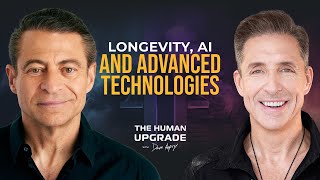
This is a YouTube video titled "Leveraging AI and Innovation for Health with Peter Diamandis | 1159 | Dave Asprey" created in May 2024. It features a long-form interview conversation between Dave Asprey and Peter Diamandis discussing topics such as AI advancements, longevity, health optimization, and innovation incentives like the XPRIZE. The discussion covers cutting-edge technologies, mindset, and personal development related to extending human healthspan and lifespan. The content is a single-speaker interview format without Alicia Mackey Huber as a participant.
Chapters
All of us are getting an extraordinary amount of opportunities, like left, right, and center. You know, you're reading about stuff, you could chase everything. The question is, how do you filter? How do you decide what to do and what not to do, what opportunity to follow, what not to follow? And for me, it's, if you're clear about your massive transformative purpose, if something aligns with it, go for it. If it doesn't be interested, you can be supportive, whatever, but don't chase it.
You're listening to the Human Upgrade with Dave Asprey.
Good to see you, buddy. It's been way too long.
It has, Peter. I mean, I. I loved abundance. Abundance. 360s, I think. I've been a member for nine years now. But that's when you're the man of the hour, so we barely get to talk.
It sucks. When I'm walking by and I'm seeing you in the corner there, and I'm, like, in the middle running to my next. My next meeting, and it's like, no, stop. Go give Dave a hug, because he's your. He's your buddy, and you have to at least give him a hug.
You know the. The biohacking conference that's coming up here at the end of May, beginning of June, Same thing. Like, I see so many friends, I just want to stop and say hi, but you know your security guys, like, you're on stage in one minute, so what are you going to do? Right?
Totally. Yeah. And a 360 was amazing. We had a lot on AI, and it really is just a coming wave that's reinventing everything. You and I were talking about this a little bit earlier, and the question is, when can we get AI or humanoid robots to do our work for us? Like, meditate for us and, you know, eat properly for us and work out for us?
You know, I think you can get AI to work out for you, at least partially. I mean, I'm doing that. That's part of the upgrade labs story is, you know, there are AI systems that will provide a neurological input to me way better than I can provide myself. And that's been part of. Of my physical transformation over the years, but especially over the last three years. But it's not really doing it for you. It's just make. It's making sure that every little ounce of effort doesn't go to waste. And we can probably get it there with food, too, right? Where every bite you take does what it's supposed to do and tastes good. But I'm probably not going to Figure that all by myself it's going to require AI intelligence to do it.
I keep on harping on the vision that we're all going to have a version of Jarvis from Ironman and it's not too far now we've got Siri. I won't say alx yay because she'll wake up in the background here but your, your Jarvis, if you turn it on to health autopilot or whatever, some version of that, it'll tell you don't take the escalators, take the stairs, don't eat that, remember, you know, take these medications. Now it's measuring your blood micronutrient levels all the time and it's advising. You can tell it to shut up if you want, but if you really want to turn it on to maximum health taskmaster, it can motivate you, support you and keep you in optimum because you know sometimes, as you well know, at the end of the day, after it's been a hard day and you're exhausted on making decisions, it's just difficult to do the right thing unless you've got somebody to support you. It is.
And Meta trained an AI on 48 million PubMed things and then turned it off after two days and didn't say why. But it's probably because the British Medical Journal talks about the, the epidemic of irreproducibility. In other words, we think something's real because there was a study but no one else can replicate the study. Maybe because someone with a personal interest or a financial interest might have falsified the study or someone made a mistake. But if AI believes the studies are the bible of knowledge and it turns out they're wrong, you could get advice to drive off a cliff the way Google Maps used to make you do. Right.
I had a walk yesterday with Brian Armstrong who lives here in la. He's the founder of Coinbase and he's also co founder of New Limit, one of the new billionaire backed biotech epigenetic reprogramming companies. And we're just having a catch up and he was telling me about that and the numbers are pretty staggering in terms of the number of published journal articles that are not reproduced. And when I was in medical school and when I was in the lab, it was just always gospel that if it appeared the peer reviewed journal it was real.
Yeah, it's a little bit scary too because on the same day in two different journals you can see the exact opposite results and I think it's causing a little bit of schizophrenia for, for People who try to get their health information online. And you're saying, well, how do I, how do I know who to believe? Which is how we used to do it and now it may be which AI engine do I believe? Because I get different answers. But I, I find that now if I say and tell me why when I make a query that I get a much better answer. And so I've been able to, especially with the very Latest updates on ChatGPT, molecular pathways and stuff, it's so much easier than it used to be. But for an, an average person just saying, what should I eat? It's going to tell you, eat a balanced diet, make sure to exercise in a healthy way and eat plenty of fruits, vegetables, grains, cereal, meat, eggs. Oh, and not too much fat. And, and you're like, and don't forget to breathe. Oh yeah, don't forget to breathe. Right. And like, it's just, it's vapid. So do you think we're going to get better? And, and if the data we're using is corrupt, how do we get better?
Yeah, I think, number one, we will get better. And you're right. A lot of the. So one of the things, for example at Fountain Life we're doing is we're actually gathering data from pre symptomatic healthy people, which is really important to then track them and see what were the early signals before they developed something else. Because most of the data that we have and build in models now from hospitals is all sick care versus health care. Right. The other thing is we're actually, the whole field of functional medicine is so important, right. Where rather than studying like disease by organ systems, you're actually studying disease on a cellular level. What's the pathway involved? And so what's the particular supplement or vitamin or mineral required to impact that pathway? And there's a lot of. My sister is going through functional medicine training. I mean all of our physicians at Fountain are functional medicine MDs. And, and she's an amazing doctor, but she's saying none of this is taught in medical school today. None of this. And it's like they're not learning about nutrition, they're not learning about any of the medicine that really cutting edge medicine can provide patients today. It's stuck decades ago. Really sucks.
They used to teach pretty much a flowchart. So like do this, then do this and if you do anything but the flowchart, you're a bad doctor. And the functional people are saying, well, you know, there is no flowchart that we're aware of. Because we have 800,000 sites of methylation. So let's just follow the path and see what's there. And it's just, it's, it's a systems thinking versus mechanistic thinking. I don't believe we're meat robots. And I do think AI like the way you're using, it's going to help.
Yeah.
But there's, there's other things. Like at 40 years of Zen, which is my, my brain upgrade neuroscience program.
Which I, I need to do and I'm way, I'm remiss of being there.
You're on the list. Naveen just went through there. It was, it was really good. Naveen Anu. Naveen Jane.
Yeah.
And what we're launching coming up here, I'm kind of sneak peeking it is adding ketamine to the program as an optional addition. And so I went through. I have a medical director of course, but I've familiar with this era, this area of personal development. And I'm like what are the mechanisms of neuroplasticity? And I knew three, but there was a fourth one about inhibiting something called GSK3. So GSK3 inhibits neuron growth and ketamine inhibits an inhibitor of neuron growth. So I want people super neuroplastic when they're doing deep personal development work so that they can get more benefit in less time. And I wouldn't have known that and GPT last month wouldn't have done that. So I just feel like it's finally gotten to a point where you can actually answer questions in a good way.
Agreed. The challenge in a lot of the AI models today is they are become either woke or, or socially, socially conscious or they're just. The lawyers are getting involved in protecting what they can or cannot say.
It makes it something much worse than 1984. The Google wokeness thing. I don't trust Google's AI until they can certify that it's woke free.
Yeah. This is one of the points that Elon made. He said, you know the, the film 2001 A Space Odyssey, Hal went crazy and killed the crew because he was asked to lie. He was told, you know, take the crew to the monolith and Jupiter, but don't let them know what's going on. And the only solution that the AI had was to kill the crew and take their bodies to Jupiter. And that's what it did. And so the question is, if you're forcing an AI to lie, that sets you up for really bad circumstances. So wow, we're gonna, we're gonna see, I mean, X AI, which is Elon's newest startup, which, you know, I will never bet against him. He doesn't play for second place.
Yeah.
His basic premise is a, an AI system that is maximally truth seeking and maximally curious, which I find really good parameters to maximize around.
It sounds like a functional AI because right now I would love to be in charge of any of the current AIs and just say, don't let the government lie. And, and if it was programmed that when it acted like hal, that would be bad for the government. So maybe the government would stop lying because like I've just had enough. And all governments of all flavors lie. I just want more transparency. So this isn't a call about one political party or another or one form of government or another. It's just governments are maximally power seeking over time. That's what they do. And I'm a little tired of where we are now because I'm actually curiosity seeking and freedom seeking and so I just want a healthy balance. And I think AI should help you and me, Peter, versus like an army of corporate lawyers who say that it can't tell me, you know, to cut my own hair because I might stab myself with scissors. Which I think that's that.
Yeah. Not necessarily the topic of our conversation today, but I could not agree with you more.
Think of your body like a high powered machine. Each part of it needs just the right amount of oil or tension in order to work the right way. Good blood flow is one of the most important things your human body needs. Without it, your organs get starved of the nutrients and oxygen they need to work. Well, good news. Calroy Health Sciences two supplements can help. Both are backed by really legit research. Arterosil HP protects the fragile inner lining of every blood vessel in your body. And Vasconox HP provides nitric oxide support for up to 24 hours as measured by an open label published study. If you're ready to amp up your vascular game and keep your body Moving, go to calroy.comdave for a special deal. You know, today we're talking about some of the things that are happening in the future itself, like advancements in AI and robots and longevity. And the reason that you know, we're talking about this is I've been a member of your Abundance360 mastermind group for almost 10 years. And I remember in 2014 going with you on the X Prize 10th anniversary and going visiting JPL and SpaceX and playing with lunar rovers and just really getting a sense for the future. And then working with you on the, the Carbon Capture X Prize, giving that, that speech and a small donation that eventually led to you working with elon Musk on $100 million carbon capture prize. And so, like, you're just always the most excited, happy guy. You've been on the show with Tony Robbins last time talking about longevity. So I haven't introduced my audience in years to what you're doing with Abundance360 or just to a conversation about AI and robots. Plus, we're going to talk about longevity, but I want to share a little bit more about your work because you do many things that people don't know. A lot of times all the stuff you've done. So tell me, let's start probably with just xprize. How many X prizes have there been? Tell me about the most recent big one.
Yeah. So for those who don't know, XPRIZE runs large scale incentive prizes. We don't give out money for a business plan or an idea or something you've done in the past. We put out a big challenge and say, I don't care where you went to school, what you've ever done. If you solve this problem, actually demonstrate it, you win. I started the foundation in 2004. This is our 30th anniversary and we run 30x prizes in 30 years, launched almost $600 million worth of prizes that have driven, wow, you know, over $10 billion in R D. And we have 300 million dollar prizes. We've got our $100 million carbon capture prize with Elon. We've got a $101 million health span X prize. We can talk about asking teams to reverse functional loss in immune, muscle and cognition by 10 years minimum, 20 years goal. And then we have $120 million desalination prize. And the last prize we just launched with Google is a quantum algorithms prize. Can you use Google's quantum systems to demonstrate an algorithm that can improve one of the UN SDG goals? So that's what's going on. It's, it's amazing. Anusha Ansari is the CEO. I serve as executive chairman and founder. Anusha was our first prize benefactor. She put up $10 million for a private spaceflight prize. So that's amazing. And Dave, you're welcome to our visioneering, which is in October as usual. And that's where we debate and we discuss what prizes we should launch next.
It's one of the more fun things. I've even brought my kids and people Listening might not understand how dynamic that is, but it's a group of philanthropists and people who are positively oriented towards the future trying to figure out, like, how do we incent people to solve problems that businesses won't solve and then make a price for it. And I think it's been world changing. There would be no SpaceX had there not been the X Prize. Yeah, is, is my take on it. Maybe there would have been, but it would have taken a lot longer.
We definitely lit the fuse on that, on that industry and, you know, looking to do a lot more. And so the conversation, you're right, is where is there a problem that's not being, that's not being solved or that we need to accelerate? And can we large, you know, launch a large incentive prize and get the smartest people in the world working on it? And what's interesting, going back to the original point you made, is we're entering a very unique period of time where small teams powered by AI, powered by, you know, 3D printing and AR and VR and all the information out there, and soon quantum systems can do things that only the largest governments could do before. So small teams, you know, going after big problems is what we're really trying to incentivize.
It helps to know the right people. One of the coolest things I've seen in a very long time at the last Abundance, where you're on stage and your phone rings and I call that, guys, it's Elon. And it wasn't stage, he was just calling, but he was calling from his jet over his own Starlink network. Like the ultimate. I did this myself.
Yeah, well, it was even. What? It was one thing. More than that. It was. Yeah. You know, so I've known Elon for 24 years. Years. And he's been a friend, a board member at Xprize, he's funded 2x prizes and he's a big proponent of this idea of abundance. So I reached out and say, hey, I'm having my big event, would you join? And I said, sure. And, and I said, I'll send you a zoom link. Because he was in la, he was in Austin, he goes, I don't do Zoom anymore. He said, I only use X video. Good for him, which is a video over X, AKA Twitter. And so he calls me on my phone. I had to hook it up to my computer and then from my computer to the main screen, but it was over X video over Starlink on his airplane, which was definitely baller.
I mean, as a former engineer, both of us Actually, we can both just say respect, you know, whether you like the guy or not. And I do. I think Elon's amazing. But that's noteworthy on a level that's not been done before. Even at the Microsoft level, things, you know, Microsoft and Google have done all sorts of big stuff, but that was just like, yeah, that was amazing. But you, you were there. I mean, you're the guy holding the phone. So just full, full appreciation for the scope of things you do.
Thank you, pal.
And I want to go deep on longevity. We touched base on it. You were on your book tour. You're kind of going through what's in, in the book. But I know because of the conversations we've had, how you and I share this interest in extending life. I mean, health span is the first goal, but let's make it longer and extend it. Yeah. And I want to talk about longevity, escape velocity with you.
I definitely do. Because when people ask me, how long do you want to live? You know, and when I was in medical school, I set a ridiculous goal of 700 years. And I set that ridiculous goal because I had heard that sea turtles could live that long. And, you know, since then I've tracked, you know, bowhead whales can make it to 200 years, and Greenland sharks can make it to 500 years. I'm not sure where that 700 number came from, but on my 50th birthday cake, it said 50 down, 650 to go.
So I love that.
But the reality is what I really want to do is make it to escape velocity. Right. To longevity escape velocity. That is the goal. And so do you want to define what longevity escape velocity is for, folks?
Sure. I mean, it's a concept from Ray Kurzweil, who is a good friend of yours, who I actually met through you at Abundance, and I've been a fan of his work for years. A chief something or another at Google.
Yeah, he's the chief futurist at Google. That is probably the most extraordinary success record on predictions. If you go and you look at Wikipedia, his prediction rate is like 86%. And like, as an example, in 1999, he predicted that we'd have human level AI by the end of this decade. And everyone laughed. And, you know, Elon was like, yep, Ray got it right.
Yeah, he. I think Ray might be one year behind schedule on that one, but given the time range, that's well within the window. He also wrote this book that was really important in Silicon Valley 20 or so years ago. The Singularity is Near. Talking about this idea and some other ideas about as long as we can have enough knowledge and techniques to reduce age. As long as they happen faster than you age, you're essentially immortal. And everything that I see after 20 years almost of running a nonprofit or working the longevity field in other ways, like you're investing in these companies with bold ventures. And I see them happening all the time and companies going, oh yeah, we're routinely adding 10% to the life of every mammal we can think of and we're doing trials in humans and the aging clocks support it. So my feeling is that we're like five years out maybe. Where are you?
You know, it's interesting, I, I ask, I go around and ask the top longevity researchers and I'll share what I get. So again, the idea is there's going to be a moment in time where for every year that you are living, science extends your life for more than a year. And that's just a rapid departure towards infinity. I know my 12 year old boys are going to have that, that lifespan. The question is, will you and I and everybody listening have access to that? And I think the answer is most definitely yes. Ray's prediction is that we'll reach longevity escape velocity by 2030. And his prediction is based upon AI really making accelerating breakthroughs. And I do believe that George Church and David Sinclair. George puts it at, you know, circa 2035, as does, as does David. They both scoff at the idea that there is an age limit.
Yeah.
The reality is everybody in the back of your mind, you've got a number and that number, it comes from your parents, your grandparents, society, religion, wherever it is. And that number is weighing on you all the time. And as you well know, Dave, mindset is one of the drivers. Right. There's a great study. I put out my second longevity book called Longevity Practical Playbook. It's a short version. It's 120 pages instead of the one with Tony at 700 pages. And there's a great study that I quote from the National Academy of Sciences that 69,000 women and 1500 guys were studied and optimists live 15% longer than pessimists. Yes. Amazing, huh?
That's one of the things that makes me feel comfort when trolls come online because you know, they're living 15% less than people who are kind. Sorry, that's, that's just how the world works. So I always use that to have empathy and compassion for them before I ban them from looking at my content.
I love it.
I feel good about that. You probably do too, although you don't.
Have to say that out loud. So you know, longevity escape velocity, Lev, when here's, you know, I, I think the answer should be within the next 20 years. Maybe it's within the next five or 10. And so the question for everybody listening is what are you going to do to make sure you get there? There you go. I'll never forget a dear, dear friend of mine, Todd Holly, who was my co founder of my first university, International Space University, died of HIV like six months before the retroviral drugs were were discovered and released. Right. And you just don't want to be the person who misses, you know, the breakthroughs in epigenetic reprogramming or whatever it is it gets us to longevity escape velocity.
If your everyday routine looks like mine used to, it includes some bloating and gas, trouble losing weight, digestive issues and probably microbial imbalances. When I learned that my gut microbiome was directly linked to all that stuff going on, I knew I had to do something. But it was hard to know what to do. And that's how I found out about VIOME and the VIOME Full Body Intelligence Test. VIOME stands out because it uses gene expression analysis, which is RNA, instead of DNA, to figure out what my body needs. They even use information they learn about you to create 100% custom formulated supplements and personalized probiotics just for you. VIOME gave me the information I needed to really upgrade my health. I've known the team at viome for almost 10 years and worked with them on their recommendations. It's real science. Now you can give it a try too. Go to viome.comdave and save $110 on the full Body Intelligence test. I see a lot of people, including some listeners of the show who get a little bit angry and they say, well, longevity is only for rich people. And I have an answer for that. But I want to know your answer for that.
I think that everything, all technology begins with the wealthy using it when it doesn't work so well. Yes. And then by the time it works extremely well, it's cheap and available to everybody. Now there are a class of medicines like gene therapies that for very narrow orphan diseases are very expensive. They're a million bucks an injection, 2 million bucks in injection and so forth because they're a narrow. You know, there's a population of hundreds of people out of the world. But the nice thing is there are 8 billion people with the disease of aging. And you know, George Church gives The best example, he goes, you know, it's likely to be a gene therapy. And we have an example of a gene therapy that despite the politics and all the ramifications of, of MRNA vaccines, they were gene therapies. And when you manufacture them in the hundreds of millions or billions, they cost 10 bucks. Yep.
In fact, Lou Reese came on this show two years before the pandemic talking about how MRNA could be used for longevity. And I, it, it totally could be. It's all about the payload. It's not about the technology being evil or not evil. The technology is never evil, it's how you use it. So if I could have an MRNA therapy and I knew what was in it for sure and it was properly tested and it, it didn't have to be rushed for any reason, I would consider that if the clinical trial showed improvements in health. Right now, in fact, I've done gene therapy on myself. I am now an advisor to Mini Circle and I've had the follow statin injection. I'm about to be in the first trial for the next one in two weeks. And so I, I think there's different pathways to do it. But that is a $25,000 cost today. Just like it was 25 grand for a cell phone in 1989. Right. It's going to come down.
And it dropped a call every block when you were on that.
That's true.
You know, so I do think that these therapeutics are going to massively demonetize and democratize.
Okay, so we're in agreement there. It's coming and we're doing it as fast as we can. Because honestly if you're running one of these companies, do you want to sell a hundred thousand, five thousand dollar treatments or 15 million dollar treatment, you make more money with the bigger customer, even if the cost has to come down. So the financial incentives are aligned and the humanitarian incentives are aligned. Right?
For sure. So one of the things that my health span X prize, we have 300 teams entered. I hope we'll get to a thousand teams and we're going to see so many different approaches to getting us towards longevity escape velocity. Will it be vaccines and or stem cells, cellular medicine? Will it be CRISPR edits gene therapies? You know, I think that we are really cracking the code for the first time. And it's this decade as I, as I say that AI and quantum sciences are going to enable us to understand actually why we age, how to slow it, how to stop it, how to reverse it. The body is a really complex system, right. 40 trillion cells, a billion chemical reactions are on that order of magnitude per cell per second. There's a lot going on. I had dinner with Demis, the CEO of DeepMind a couple weekends ago. And you know, DeepMind, which is Google's AI division, did something amazing when they came up with, with their ability to, to basically predict protein folding.
That was a big deal when that happened.
It was, I mean, when I was in medical school, God knows, decades ago, the biggest, you know, supercomputing problem ever imagined was given this amino acid sequence. Can you predict how it folds and you know, AlphaFold their program figured it out. What they're going after next is equally audacious. They want to simulate an entire cell in detail. Right.
That's so big.
That is. And there's a few different companies going after it. But I have, you know, DeepMind is going to go. And then once you've got a single cell, and by the way, it can be your cell because they can put in your DNA sequence and then they can go to simulating a tissue and an organ and you. Right. And then all of a sudden it's like, what drug works? What drug doesn't work? And we can know it works or doesn't work in specific. It's a big deal. AI is going to change the game. And of course we're quantum systems and quantum technologies, COMPUTE will change the game again.
So we're both feeling more positive about that than ever before. And you mentioned optimism earlier and aging. And one of the things that's in my meditation is telling the cells in my body that they're at only 28% of their minimum acceptable duty cycle. This is my minimum acceptable goal, is live to at least 180, but it's really to die at a time and by a method of my choosing.
On impact on Mars.
Oh no. That is the way to go. All right.
So how old do you feel internally, Dave?
You know, I've asked a lot of people this and unless you're like really sick, most people who are under 60, in their mind, they're still 35. But at a certain point somebody's like, I started to feel old. And that's usually when there starts to be a change in the, the, it's P300D is the measure of neuroscience. But there's a, a reaction time on reality and when they realize they're way slower than everyone else and okay, something's going on. So I, I identify as being somewhere in my mid to late 30s. My brain is way better than it was at that age, to be honest. I am leaner. I'm ripped. I have abs. Like, everything is better except my face is pretty lean because I'm so lean. I used to be fat, so I've got a little extra skin, but I don't worry a lot about that. So in my mind, I'm, I'm mid-30s. How about you?
I probably put myself between 28 and 35, depending on, on how I feel. I don't feel any different from that. And in fact, I feel like physically I'm in the best shape I've ever been.
Wow.
And you know, sort of mentally and in terms of energy level, you know, I keep. Interestingly enough, I have a team around me that's in their 20s, and I have a. I usually have a Strike Force member, two Strikeforce members. They're entrepreneurs in Residents. They travel with me. They go every place. I think you've met Derek Dolan or AJ Scaramucci or Yanni Psaltis and such. And, and they're typically in their mid to late 20s. And I will run circles around them usually. And it's like, but it's.
And that's, that's kind of a flex. But it's not bragging because you really do have this. Ever since I met, you have this youthful energy and you and I have both gone through stuff. You know, business is, is emotionally draining sometimes, and there's a resilience that you can build in. And I, I've seen you do it and I've done it too. Same thing I tell people in their mid-20s. There's, don't, don't try and do everything I do because I've spent 20 years and 2 million bucks on biohacking and just do your own limit and don't copy because it's harmful. And I, I kind of feel bad if someone tries to stay up as much as I do, which isn't always a good thing. How do you counter that? You just do you warn them or.
I give them the reality check that a lot of them are doing a lot more than I did when I was in my 20s and, and 30s. And you're going to get there, right? It's like, you know, listen, you're way, you're, you know, listen, I was doing a lot in my 20s and 30s, but the access you have, the things that you're learning, the things you're having opportunities to work on are incredible. And so don't, you know, don't compare yourself to me. You know, compare yourself to to me, 30 years ago or 40 years ago, that's fine. But we're living in this massively exponential time where there are very few limits on what you're going to be able to achieve. And the most important thing, a young individual who's in your. If you're in your 20s listening to this, or even your 30s, I think the single most important thing you can do is understand your massive transformative purpose in life. I think, Dave, you're incredibly effective. And, like, you look like you're in the best shape you've ever been. And I've seen you just, you know, in your knowledge base and your ability to educate and communicate is extraordinary. And I think you're just so clear in what you want to do and the impact you want to have. You're. You're a very clear signal to the world of, this is who I am, this is what I'm going to do. This is where I'm going. Right.
You've helped.
Well, thank you. But I think a lot of people, it's like, what is your massive transformative purpose and what is your moonshot? And I think when people get clear about their MTP and they wake up every morning, right? So here's. Here's one of the points I make. All of us are getting an extraordinary amount of opportunities, like left, right and center. You know, you're reading about stuff, you could chase everything. The question is, how do you filter? How do you decide what to do and what not to do, what opportunity to follow, what not to follow? And for me, it's, if you're clear about your massive transformative purpose, if something aligns with it, go for it. If it doesn't, you know, be interested, you can be supportive, whatever, but don't chase it. Martine Rothblatt, who, you know, gave me one of the best pieces of advice, and she's an extraordinary entrepreneur, and this.
Is one of the people who's just legendary in the world of computer science going back even to the 90s. So just a luminary in the field.
So what Martin said was, successful people say no to most things. The most successful people say no to everything. Right. It is a monomaniacal focus on what you want to go and do in life. So I'll just mention for those, you know, I built a large language model for my community to help them language and define their MTP and their moonshot. And it's free and it's. I've had some people just go through it and it takes 10 minutes. It's not Long. So if you go to Purpose Finder AI, it's, it is an extraordinary journey to help you uncover in your heart what is your massive transformative purpose. And then once you know your mtp, you can then build a moonshot. So play with it. It's, it's an amazing, amazing journey.
The getting clear thing is, is something that when I'm coaching entrepreneurs, a lot of them, they don't really know. And, and I, I work with my team across all the different companies in my portfolio, which does not include Bulletproof anymore. For anyone who's listening who still thinks I'm involved with that company, it's to upgrade humanity. And upgrades happen. Sometimes it's hardware, sometimes it's firmware, sometimes it's software, sometimes it's interconnectivity, community building. But it's all around like, how do we make it better fundamentally? And that's what I do. And anything else, you know, I, I'm just not going to participate in some other thing, even if it might make money, if it's not on, on that, on that channel.
And you and I are kindred souls in that desire. Yeah.
And I, that's why I think being, being able to interact with you and your community over the last almost 10 years has, has really helped. I wrote about you in, in Game Changers, my, my book on personal development. And it was about, you know, the, the times where I think I'm thinking really big and then I, I would hear from you or Naveen and it's like, oh, no, no, I was missing it just by an order of a factor of 10 because we're all subject to blind spots. Who points out your blind spots for you?
My wife, my kids. That's a really important point. And it's not only just pointing out your blind spots, it's pointing out on the companies you're building or the projects you're running what's not working. Well. I was on stage interviewing Elon at a Goldman Sachs event a decade ago. And he said something I never forgotten. He said, my friends tell me what's great. My best friends tell me what sucks. Right? And so that's really important. So like, for example, I have gone on a tear for individuals going through fountain life, which is really important to me to build this company as sort of like most advanced diagnostics and therapeutics. And I'm like, I'm following up on everybody who I know went through it. I said, okay, don't tell me it's great. Tell me where you want it improved. Tell me what didn't work. Tell me where things failed. I need to understand that so I can constantly help the team iterate this. And so blind spots are, are really important. So I have, I call it my board of directors. There's five guys that are. They know me intimately. I mean, it's interesting to have people in your life that know everything about you in intimate detail. The problems on the family level or in your business or finances or that you feel completely transparent with. And I will go to them and ask them to tell me, this is what's going on. What am I missing here?
Wow. Do you meet with them all together or one at a time?
I just recently met with, with four out of the five on one particular personal issue. But it's. I will call them individually and. But they know, they all know each other and they've all given me their vow. I mean, Lou Reese, who you mentioned earlier, is the chairman of my board. I like Lou.
He's. He's the funniest guy.
He's at no bullshit. He'll tell you to your face exactly what he thinks. I love that. And he cares and he cares and he's a lovable guy.
Yeah, I think that's really inspirational for, for listeners. There's data out there. In fact, the, the, the current Surgeon general was on this show right before he became the surgeon general for the second time. And he said, our biggest epidemic is loneliness. It's lack of, of connection. And so for a lot of people listening, they might have only one or two friends if they're average. Although if you're listening, you're probably not average, because average, there's. It's a very narrow window at the very middle of average. But asking one or two or maybe four people, five people, just, hey, will, Will you be on my don't bullshit me board? I, I like that idea, Peter. It's a good strategy.
And by the way, you get that level of closeness by actually being fully transparent and intimate in that regard. It's letting people know the real struggles going on. And if you can open up that way with somebody and they can open up with you, it's a next level. I mean, you need to ask yourself, is there anybody in your life, perhaps, maybe it's your spouse, maybe it's not, who really knows everything about you? And you can be completely and open with them, complete and open with them on everything. That's a, That's a big deal. It's a big deal. And that number typically is 0 to 1 for most people. And if you can Broaden it beyond that. You have to take. It's risky to do.
Oh, it's, it's hugely vulnerable, or at least we. I think it's better to say it feels risky to do, but in all actuality, it, it isn't that risky to do.
Yes, you're right. And it's the benefits way out, you know, outweigh the, the risks.
And that's the, the blind spot. When I say upgrade humanity, that's what my next book is, is about, is there's all these different ways that your, your, your fast but dumb systems trick you to believing things before you've had a chance to think about them. And then like, I don't have to think about it because I already know it to be true. And one of those is, well, it feels really risky to talk about something you're vulnerable about. And so therefore it is risky. Therefore you'd have to think about whether it's risky. And it's that kind of blindness that makes me not notice something I'm doing that isn't good for my health or that kind of blindness that makes people do all sorts of weird stuff. And it's because we didn't think so. I, I'm always trying to build systems, always encouraging my team, same as you. Like, tell me the hard stuff, the easy stuff is great, but it, the most valuable is the hard. But we're also wired in our, in our monkey minds where, you know, whoever the dominant person is, and that would be the CEO in the room to, to act like it's, you know, a father figure or leader of the tribe, and then to not show those problems. And that's one of the flaws in our species. I think we can hack, whether it's a software or hardware fix, I don't know. But I don't want people to lie anymore because it just doesn't work.
You know, it's, it's interesting. I. My next book that I'm working on is the follow on to Abundance. It's called Age of Abundance. But the book after that, which is 2/3 written, is called Mindset Mastery.
Oh, I like it.
And you know, one of the things I'm passionate about, and you and I are very much, again, kindred souls, here is the realization that the single most valuable asset every single person has is their mindset.
Yes.
And you know, I'll say, you know, you heard me say this on the Abundance360 stage. You know, if you look at the greatest leaders on the planet, you know, whoever you might think they are or have been Martin Luther King or Steve Jobs or Elon Musk or. Or Dave Asprey. And you say, what made them successful in their life? Was it the tech they had, the money they had, the friends they had, or was it their mindset? You know, most people reflect on it and realize it's their mindset. And if it's your mindset that makes you successful as a leader, as an entrepreneur, as a mom, a dad, whatever it might be, then what mindset do you have? Where did you get that mindset? And what mindset do you need for the decade ahead? And that. That honest reflection is really important. And our brains. Our mindsets are neural nets. You know, we all are learning about neural nets from all the large language models and all the discussions on AI, and you train a large. On a neural net by showing it example after example after example. And the problem is, most people are showing your brains examples from the Crisis News Network every night, all the murders and all the negative things.
Right.
Or the stuff that they heard in school or all the dystopian information that they're consuming. And so the reason you're watching, you know, you know, the upgrade podcast or my podcast, you know, Moonshots one, is to try and rewire your mindset.
Yes.
And that's. I think it's most important thing that anybody can do.
It's the mindset. Just the idea that you can control your own biology.
You.
You might live longer than you're supposed to, you might be smarter than you're supposed to, you might have a different life than you did. But if you don't imagine it because of your mindset, and. And I think that's your. Your superpower, in addition to being smart and all that, is you. You just have one of those really, really positive future mindset things. That's infectious. So you come hang out with you for a while at your events, and all of a sudden you just see things a little different. So it's one of the reasons I like having you on the show and just giving you a chance to hang out and just get to ask you some hard questions. Because the other thing you do is you always know the guys who are making the really big things happen on the planet, and then you ask them behind closed doors what's really going on. And then you have this picture of the future that's more accurate than a lot of people because you have your own, you know, just a rocket scientist and a doctor, just little things like that, right? And then you go from there, and then you ask A whole bunch of other smart guys and you sort of ponder about it and then you're real positive. That's a good signal for me because if you pondered about it and bought a bomb shelter, I'd want to talk. But that's not your vibe. Were you as a teenager, were you this positive?
I was pretty positive coming out of the late 60s and early 70s. And I give the credit to the Apollo Program in Star Trek. Right. Because those were the drugs I took back then. The Apollo Program showed me what humanity could do right now. And Star Trek, I just say that scientific documentary called Star Trek showed us where the world was going. And those were both really positive visions of the future. And I also, I grew up in a family where my dad was born in a small village on the island of Lesbos, you know, tending goats, picking olives, and then went from there to becoming a successful OB GYN physician in New York. Crazy journey that he went through. And that was like, wow, that's amazing. He did that. And that's what humans can do. And so I had, I had, I was lucky in that regard and I worked hard. And then a lot of the current mindset, a lot of the abundance, exponential longevity, moonshot mindset really came out of the early days of the X Prize and Singularity University. Yeah. Where it was, you know, there really isn't anything we can't do. It's really a matter of having the committed and passionate human mind and bringing the technology and capital together. You can do anything within the laws of physics. You know, Elon is the, you know, exemplar of that, by far.
Elon, when you read his biography, he has this unusual way of thinking about things. He calls it like the, the idiot ratio, which is how much is the raw materials in something versus how much you pay for it.
First principle thinking is a term he uses. Yeah. When you look at it. So I was there at a conversation he was having with Larry Page and the CEO of Fiat, talking about the early days of Tesla and his decision to get into Tesla, which he funded. He's now known as the founder and CEO. He was, you know, there was a founder prior to him in that regard, but he looked at how much should lithium ion batteries cost compared to what they are.
Right.
And if you go and you look at the spot price of the lithium and the other metals and components of it and you say, huh, it's actually probably 100 times more than it should cost based upon the. So it's a, it's a production problem. Right. And Then in the early days, they were basing it on a Lotus body. And so for the. For the old early roadster. And he said, well, the battery should get a lot cheaper and the roadster body exists. This should be easy. And he got into it and found out, well, actually, the Lotus is not going to cut it. We've got to redesign it. The batteries aren't. And he was stuck. And then he had to engineer it. Yeah.
And he almost ran out of money then. I think as PayPal money was running a little thin then because he was only doing two or three other companies at the same time. And I think a lot of people have a lot of feelings based on not really having watched his path from the early PayPal stuff. Very few founders take all of the money they make when they make a huge amount of money on their first company, put it back into multiple companies. It's like winning at roulette. You put it all on 42 and then you win. You say, you know what, I'm going to put it all in 36 now and I'll put half on 36 and half on 24. Like it takes. It takes huge balls to do that.
Oh, I. Baby. And, and you're absolutely right. You know, Elon is one of the very few people who keeps betting at all.
Yeah.
And people don't realize unless you've actually dug in. I was there with him when he was going through this. I wish I had invested heavily at the time, but in 2008, he had had three failures of the Falcon 1 launch vehicle and he didn't have enough money for the fourth launch. And he borrowed money. He went into debt. At the same time, Tesla was tanking in the 2008 financial crisis and he got a loan from the government, which he repaid, unlike the other car companies.
Right.
But he went into debt. The fourth attempt of the Falcon 1 succeeded. And because the space shuttle had been shut down, there was a procurement for commercial crew and he got a billion dollar contract. But the world could have ended for him in 2008. He's also going through a divorce. It was a tough time for him. Yeah. And my question is, how many other gazillionaires are out there betting it all? And there's a few who are betting a lot, but very few do what Elon does over and over again.
It feels like Sam Altman might be one of those, like a younger version of that.
Sam is. Sam is, is building incredible companies. Mark Benioff is doing well, I think. Yuri Milner, Eric Schmidt but there are a lot of billionaires who are just putting their money to work to make more money or buying bigger yachts. I want to take out a full time, full page New York Times ad that says on the left hand side, thank you to all of you who are investing your money to make the world a better place and betting it over and over again. And on the other half, you know, glad you're buying bigger yachts and lots of homes.
There's a difference. And, and you know, people who are calling for wealth taxes and things like that, I, I'm a little worried that that would take some of the people who are working on like funding the next magical thing and just say, well, that's not going to happen now. And so I, I, I believe that if you're putting your money to make the world a better place and what else you can do if you have a billion dollars, it's more than you can really spend. So you got to do something and you might as well have fun making things better instead of just making money. But that's just my mindset. I feel like that's only half or maybe a third of the, the really truly wealthy out there.
I don't, I don't even think it's that, that big. I, I saw big Bill Gates last two weekends ago as well and, and was saying, listen, the, the giving pledge, you're pledging to give away half your money to philanthropy before you die, but you know, you can't take it with you, right? But why not? Making an impact pledge versus a giving pledge. And this is where Tony Robbins has done such an extraordinary job, right? And Tony keeps on making huge bets as well. He didn't say I'm just going to give money away. He's like, no, I'm going to throw feed a billion people and then I'm going to feed a hundred billion people. I'm going to plant, you know, 100 million trees. It's like calling your shot. And I think making it measurable and publicly claiming what you're going to do is such a massive differentiator. And I really, you know, that's what XPRIZE does. Well, you know, it's like once you make your public shot, like we're going to reverse functional age loss by, you know, functional loss due to aging by 10 or 20 years. We're going to extract a gigaton of carbon out of the atmosphere. I mean, it's hard to do, but if it's measurable, you don't give up. When I, the most important thing I did when I claimed I was. You know, I went on stage in St. Louis and I announced a $10 million prize for. For private space flight. And I didn't have the money. And the world is watching. It's like the pressure was on. I better go find that $10 million and run this competition. And there were so many times that people said, you got to give up. This is ridiculous. It's not going to happen. And it was like, no, I can't give up.
Your story about how you did that is truly like hair raising. And you wrote about it in your book, and I think it's in your documentary. And, you know, the idea that you promised it and then you found a funder and Anush has been on the show, the. The CEO of the X Prize. And I'm. I'm just in awe that that happened.
Well, we would not be having this conversation if it didn't. So in some parallel universe.
Yeah, some parallel universe, maybe it didn't, but it's. It's a. It was also a very big, very big move. So I. I'm grateful you did that because I think it's changed a lot of things in the world that people don't know about. And you're. Well, I have one more longevity question.
Well, and I got some for you. I've got some for you as well, so go ahead.
All right, so on the longevity front, what does your current diet look like?
So I'll share it with you and love the critique. I am focused on minimizing sugar.
That's a good plan.
That's probably my top priority through the day.
Sugar versus starch or just sugar?
Sugar and carbs. Okay.
Sugar and carbs.
Yeah. So I am attack vegetables and protein. I am optimizing for 150 grams of protein a day. Smart.
And you're about 150 pounds of target weight.
I'm 150 pounds, so a pound a gram per. Per pound. Last year, my goal was to add 10 pounds of muscle, which I did. My goal now is to maintain it. Maybe if I add a little more, I will. But I'm 63 next month. Right. And so, you know, for me, there's a direct correlation between muscles, muscle you carry, skeletal muscle you carry, and longevity for a number of reasons.
Great data supporting that, for sure.
So my protein is, you know, I love cajava. One of my favorite drinks in the world is Nutra 11, which is a zero sugar, high protein chocolate drink that I love.
That's a collagen based drink, right?
Yes, collagen based.
Guillermo, the founder of that, is a friend. It's a, we'll say it's a bulletproof inspired. It's got collagen and MCT in it.
It is a hundred percent built on your, on your formulations, my friend.
I know we talked about his formulation when he first came out with it. So I, you know, I'm happy people are bringing good products into the world. Okay, so you're doing some collagen, some MCT.
Yeah. So it's 150 grams of protein, minimize sugar and, and carbs. I mean those are the two most important things for me on my diet.
How about types of fat and types of protein? How important are those for you in your current strategy?
Well, I am mostly fish and legumes and some chicken. I don't do red meat right now. You know, listen, being able to make sure I've got organic, well fed produce is important to me. But challenge is I don't necessarily have a great supplier that is mobile with.
Me for beef or for produce.
For chicken.
Okay, got it. And, and you're not doing beef or lamb for longevity reasons.
For. Yeah. And also taste, you just don't like them.
Okay, that's different.
And I'm doing, I'm doing eggs. So those are my protein sources. Fat, I'm, you know, avocado, olive oil is probably my main sources of, of sort of.
So mostly mono and some Omega 6. Yes, got it. And you're not doing any kind of butter, cheese, milk, yogurt?
Occasionally some yogurt. But I'm lactose intolerant so I'm minimizing.
Yeah, that'll limit those. Right.
But what about you? What do you, what's your prioritized diet?
Right now I'm doing one gram of animal protein per pound of body weight. And I've played around at 0.6 and there's a, some longevity studies that are pretty good that say that 0.6 is the right number. But as you age you need 0.8 because of sarcopenia. And the evidence is really clear. Losing muscle mass or tissue wasting as, as you call it, you know, in medicine that's bad even if it's before you're aging. So I've, I've also seen data around 0.8 and 1.0 being the same. So I tested that and I do best on 1 gram of animal protein. I eat a mix of a 2 dairy and grass fed beef as my primary protein sources.
Let me ask you one question. I.










