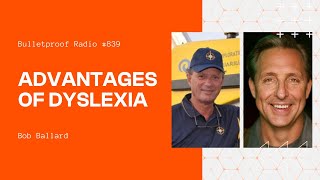
In this conversational segment, Bob Ballard and a co‑speaker explore dyslexia not as a deficit but as a cognitive advantage. They recount personal epiphanies—discovering the book The Dyslexic Advantage at age 62 and recognizing visual strengths that aid Ballard’s work as a field geologist and deep‑sea explorer. The dialogue references research and experts (Dr. Brock & Fernetti, Helen Erlen, Irene/Erlen syndrome) that describe atypical neural wiring, visual processing, and potential optical interventions. They argue that early detection and tailored learning pathways can channel dyslexic strengths into entrepreneurship and innovation, citing statistics such as a high proportion of self‑made millionaires and MIT’s “dyslexia disease” label. The conversation also highlights serious downsides: elevated suicide rates, disproportionate incarceration (60% of prison populations), and systemic educational biases that disadvantage dyslexic individuals. The speakers call for educational reform to provide equitable opportunities and prevent costly societal outcomes.
Chapters
Bulletproof radio, a state of high performance.
Okay, let's walk people through that. Because a lot of people think, oh, you have a disability or something's wrong with your brain. But you kind of kick some ass throughout your life, my friend.
Absolutely. I do not look at it as a, as a disadvantage. I look at it as an advantage. There are certain our brains. I mean, the key is that the research now has cracked the nut we now know. I remember I was driving a car and listening to a show and they were talking about two authors named Dr. Brock and Fernetti Ide, who wrote a book called the Dyslexic Advantage. And I never heard those two words in the same phrase. And I got the book, read it. Being dyslexic took me a little longer into the night, never put it down. And as I read that book, tears were pouring down my face because here I was, 62 years old, finally learning about me. This book explained me to me for the first time. And it was earth shaking because I realized I wasn't weird, I wasn't stupid, and I wasn't alone. There's 20% of our population that has dyslexia. And in this book they so beautifully explain the pathways to success. If you look, most self made millionaires are dyslexic. MIT calls dyslexia the MIT disease. If you go into engineering, I'm a field geologist where everything's visual, we're visual creatures. And when I'm in this command center and strutting my stuff, I take in all of these sensors and I create an image in my mind which we uniquely can do. That puts me down in the bottom of the ocean in total darkness. I'm never lost. It's cool.
I had a similar experience in the 90s. Wired magazine ran a piece on Asperger's syndrome. And I was like, oh my God. They just described my whole family, at least one side of my family, and certainly my brain and how I see the world. And my brain scanned and I did all this stuff and certainly was there. And I've hacked my brain since then. I don't represent that way anymore. But along the way I did visual training.
Yeah.
And with Helen Erlin, who's an expert in dyslexia and teaching how the brain do, you know, Helens work. And she looked at me and they looked at my eyes and they said, wow, you really do see. And I didn't know. I see all the floaty crap around all the words. I don't have dyslexia because I learned to track. Right.
Is that the. There's an IRENE syndrome where the letters are moving and they, they have. There's Erlen syndrome. And it appears that it's the frequency of the wavelength coming into your brain. And if you put on glasses, I think it's mostly in the blue spectrum.
It depends on the different brain.
Yeah. And the words stop moving. No. It's just cool to see that we have neurons that are much widely spaced. So we, we have firing mechanisms that are very different. And in some areas we don't hit the target like speed reading, but in areas we hit it in the bullseye. And the key is to get early detection and learn the pathways to success. Like I said, most entrepreneurs, because I couldn't live in the box, the rules inside the box were written by non dyslexics and they were simply not fair. I live outside the box, but I. If you come into this room and you're non dyslexic, you're going to have a little trouble understanding it. But if you're dyslexic, it's like eating candy. So it's really getting kids to realize. But you also have to understand there's a lot of downside. There's a high suicide rate. And in prison, particularly people of color who didn't have the opportunities I had to get around my issues and conquer them are in prison. 60% of the population of the prisons are dyslexic. It costs more to send people to Harvard than it costs to send them to prison. I think we need to re evaluate how we're educating people to make sure they go down a road to success.