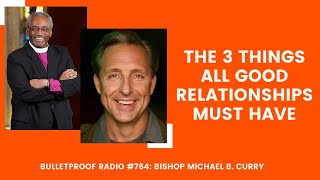
In this interview Bishop Michael B. Curry discusses the nature of agape love—self‑giving, outward‑focused love—and how it differs from romantic (eros) love. He references 1 Corinthians 13, explaining that Paul wrote the passage to address a divided, self‑interested church, emphasizing that unselfish love is the foundation of human community. Curry describes how, when two people move beyond self‑centered attraction and practice agape, a new relational reality emerges that heightens rather than erases the self. He shares pastoral observations of long‑married couples, noting that when one partner dies the surviving spouse experiences a loss akin to losing a part of their body, illustrating the deep interdependence created by agape. The bishop warns of the thin line between healthy self‑giving love and codependency, proposing a three‑point checklist—loving, liberating, life‑giving—to evaluate any relationship, including one’s relationship with God. He also critiques the English translation of “fear of God,” arguing that the original nuance includes respect and honor, and that a relationship based on fear can be unliberating. Throughout, Curry’s tone is conversational and pastoral, aiming to make theological concepts practical for everyday relationships.
Chapters
Bulletproof radio, a state of high performance.
You focus mostly in your book on, as you'd expect because, you know, you're a religious leader, but you're focusing on this idea of love that looks outward, agape. What is the sensation of that love? Like, okay, when you love someone romantically, like, there's a feeling in your heart and all that stuff. But when you're at your highest state of agape, what does it feel like?
You know, I mean, it's ironic, one of the passages in the New Testament that the love passage from Paul, though I speak with the tongues of men and of angels and have not love, I'm a noisy gong, a clanging cymbal. And I remember being in high school, that was like in our book of great poetry. And, you know, I mean, it was there along with Shakespearean sonnets and stuff, and there was First Corinthians 13. Well, the interesting thing about that, and I talk about it in the book, is that, you know, Paul actually wrote it. He wasn't thinking about a wedding, although it applies to relationships. He was thinking about. He was dealing with a church that was dividing itself into factions. And some of those were sociological. The rich were putting down the poor. I mean, it was a church that was in a mess, and it was operating out of self interest and the principle of love. He says at one point, now I will show you a still more excellent way. And then he goes into the. What is the poetry of love? That he sees love as the unselfish way that makes human community possible. Because apart from the unselfish way, human community is not possible. Selfishness does not build community. I don't care how you cut it. It doesn't do it. It destroys community. And it applies to a marriage and a relationship. Because if you're in a relationship and it. If you and I are in a relationship and it's all about either one of us, then it's not going to be about the two of us. You see what I'm getting at? So that on some level I've got to be concerned with not just myself, but with you. And if you do that, are concerned not just with yourself, but with me, if we do that, then something new begins to emerge. That relationship between the two of us in giving ourselves to each other creates a new, actual reality. That's what we're getting at in marriages. It ain't about a license. I mean, it's not about. You know what I mean? It is about a new relationship that's actually creating. I mean, we use Words like family or we don't have a lot of good words. But something new is created where there is space for two to dwell in one relationship. That's. That's powerful stuff. Now if you apply, then that's in romantic love. What has happened there is what begins as Eros. Over time, if it's real, grows into agape.
Interesting inner relationship in a relationship.
And I mean, I've seen it, you know, I mean, I was a pastor, a parish pastor for years before I became a bishop. And which is a slightly different job in terms of what you do day to day. But I walk with a lot of folk through a lot of sickness and a lot of hardship and a lot of death. And I gotta tell you, man, when I've seen couples, people who have been married for, you know, 50 years, these folk, and one of them goes on to glory, it is like the other one has lost part of their body. And that's because they moved beyond just mere romantic attraction which has its place. I mean, that's how the human species, I mean, perpetuates. If there was no such thing as romantic attraction, I don't think we would be perpetuating ourselves just out of good will. So, I mean, the Lord knew what he was doing with the biology. So that part's there. But there's a point at which you grow on top of that, you build on that and a relationship emerges. And it's a pretty awesome thing to behold when you see it. And that's where you have self giving a self giving love. That that's not about the obliteration of the self. It's actually a heightening of the self. You know, the truth is, when I'm concerned about we, that includes me. But if all I'm concerned about me, that does not include you necessarily. That we embraces me and you me, it's just all about me. And that doesn't create a relationship.
One of the benefits of having had your own parish for so long is you see codependent relationships. You see every kind of bad relationship when you're working with people, right? How do people know when they've taken the sacrificial aspect of agape love and gone too far and become codependent. It seems like that's a real common problem these days.
It is. And that's a human. Because it's just so easy to kind of slop into it. The question is, and I believe this is true with our relate any relationship, including a relationship with God. Is it loving? Is it liberating? Is it life giving? If it's missing one of those things, then something could be out of kilter. Is it loving? Does it, does it set you free to be, so to speak? Is it liberating? Is it, is, is it life giving? Does it make you better or at least somehow? You see what I'm saying?
Is it, That's a great checklist. I mean, if your relationship is working, you get those. If it's not, you need to work on the relationship some more.
Need to work on those. Right.
And that's some wisdom right there.
Yeah, I guess. Yeah, yeah. And that's true of a relationship with God. If a faith relationship isn't loving, liberating and life giving, then you got to work on that because there's something's missing, you know, I mean that's how religion can go off and go wrong.
You get that God fearing idea because if you're fearful of God and God is love, that might not be liberating in a certain way. Right?
Yeah, yeah. And the irony, unfortunately this is another, this is another classic example where our language, English, all we have is the word fear. Even in the Hebrew, there's nuance on that word. It actually means respect. I mean, there's a new article you add on it and it means fear because I'm scared you're going to kill me. But there's another way. It's fear that is, I honor you, I respect you. You see what I mean?
What a difference, God respecting, no one rejects that. But God fearing a lot of people, like, I don't really want that. So there's a mistranslation, basically.
Yeah, yeah. English is wonderful in Shakespeare's hands, but in common everyday language it's pretty basic. Sam.