Psychobiotics: Altering Gut Bacteria to Hack Your Brain – BiOptimizers with Dave Asprey – #749
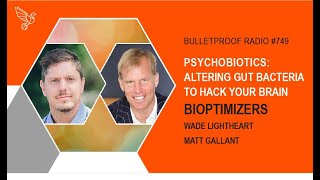
Dave Asprey talks with BiOptimizers founders Wade and Matt about how gut bacteria influence brain function. They cover psychobiotics, how bacteria produce neurotransmitters, and Chinese herbal blends that affect mood and cognition.
Chapters
Bulletproof Radio, a state of high performance. You're listening to Bulletproof Radio with Dave Asprey. Today's guests are founders of Bioptimizers and their regular guests on Bulletproof Radio and friends and I keep inviting them back on the show because they're biohackers. They're willing to go out there and say, what's the latest research with X? And then make something out of it. And I've talked to them a lot about digestion and probiotics and things like that on other episodes. But you all know because, well, after 700 episodes, I'm pretty sure you've heard at least some of them where we talk about the gut brain axis. Well, if the gut affects the brain, what if you did things specifically to the gut for the brain? There is some new research on that, and we're going to go deep on today's sponsored episode to talk about exactly what's going on in your gut that affects your brain and how you can take specific steps to change that. Wade and Matt, my friends, welcome back to the show.
Incredible to be here, you're talking to you is one of our favorite things.
Yeah.
Great to be here, Dave. And I want to thank you because I just stepped out of the pod at 40 years of Zen, so I've kind of broke protocol confession. But I just didn't want to miss this podcast because it's always so fun when we get to hang out. And as you can see, I've got my truedarks on right now, as we all do, is a kind of a little fun thing. It's a we come out of the pod, we got to have them on. It's really a lot of fun.
If you're watching this on video, we're all wearing different styles of the TrueDark glasses. And TrueDark's a company that I founded actually, several years ago around circadian biology. And the glasses have definitely changed my sleep quality. But at 40 years of Zen, my neuroscience company, you actually have to wear a specific one of the lenses we have that change your brain, because when you come out of a session, you're in an altered state, and it's a designed altered state, and we don't want to drop you out of it with the wrong light. So there's all kinds of cool environmental stuff you do for the brain, and it's very appropriate. We didn't plan it that way, but you're at 40 years in hacking your brain, and we're talking about hacking your brain via bacteria, which is just super Cool. Now, people haven't heard you on the show before. I think it's useful just to mention, Wade, you're president of Bioptimizers and you were a three time Canadian all natural bodybuilding champion and I've only bench pressed you one time. Some of those statements are true, some of them aren't. Former Mr. Universe competitor and you've been a coach for thousands of clients on natural training and all. So you know what you're doing, Matt, Strength and conditioning coach, degree in kinesiology, self defense instructor. And you've only been playing around with keto for something like 20, 25, 27 years.
Yeah, 26.
26. All right. And you've been supplementing formula and you've been formulating supplements rather than supplementing formulas for, for quite a while. And it's that level of experience and knowledge from different industries coming together with dedicated biohackers who've been into biohacking covers for years and all that makes you such interesting guests. So I just. There's our introduction for new listeners. Let's get straight to it. You've done some stuff to hack ketosis with one of your products that really looked at fat metabolism inside the cells, inside the gut. And we've talked about that on one of the shows with just an intelligent composition. What's new in the realm of cognitive function that you've come across? Tell me about the research that led you to make the new stuff you're making.
Well, with probably the most exciting development in bioptimizers is we have brought on two absolutely genius PhDs, one in bacteriology and another one in genetics. We've set up a lab like we're buying equipment to do research on probiotics. And we've got some mind blowing stuff that we haven't put out publicly. We could talk about some of it today, but it's a whole new realm. I don't think a lot of people are doing it and we're just doing constant tests. We're investing in equipment to measure biofilm and things like that. So that's a big part of where we're going. And today we're talking specifically about psychobiotics. And these are not evil, crazy American psychotype of bacteria. They're actually psychological bacteria. They're impacting neurotransmitters, which at the end of the day, how we feel, how we perform in so many ways comes down to having the right balance of neurotransmitters. And that's what a lot of what we eat does and the Biohacking does, and the supplements do, but most of it's created by the bacteria in your gut, like 95% of the serotonin, 50% of the dopamine, many other. There's about 30 different neurotransmitters that your gut produces. So we wanted to optimize the right strains, make sure that we're enhancing the effect, which we do. And we'll talk about all that, but. But that's the gist of it. And I'll pause here and let Wade throw his two cents in.
Yeah, I think it's a fascinating field. I mean, years ago, of course, people knew my story where I blew out my own digestive system and, you know, caused a dysbiosis. That's when I first started discovering this in 2003, after the Mr. Universe contest. And one of the things that I became fascinated with when I dug into some research from Charles Poliquin, for those who don't know who Charles was, unfortunately, he died recently on an untimely death.
But I dedicated my book before this last one. So the audio version of Headstrong was dedicated to him.
Yeah. And Charles was a really unique guy. I mean, he learned other languages to learn research from other people. And because there's kind of dominant fields in different cultures, would be leaned. Leaning one way or other in research. And one of the things that was fascinating him about an athletic perspective is that he would have his athletes determine what neurotransmitter dominance that they had and would adjust their training and nutrition based on their neurotransmitter dominance. And some people, if they had certain neurotransmitters, you're just not going to be a gold medicine. Now, of course, he coached gold medalists in 27 different sports, not to mention a who's who list of professional athletes. So an incredible track record and a real pioneer in the kind of this area and taking on that. And I had this epiphany when I was in the pod the other day. Before we dive into the research, I think is really important, is that I think it's our. I think it's actually our moral and ethical duty to be biohackers. Because we're all here, brother. We are here because of the people before us that did all sorts of experiments that led us to be able to be on this video call right now. And for the people to listen to us and share that. And embracing that spirit of adventure and discovery and exploration, with all of its challenges and failures and successes and learning points, I think is A is a, is an ethical duty of all of us because that's part of what puts. Pushes humanity forward just a little bit. Little bit. Little bit. So that's kind of what our goal is today. It's to kind of dive into some of the exciting stuff. And Matt, who is our resident scientist, I'm going to turn the floor over to him because he's about as jacked into this as anybody there is.
Yeah. So I feel extremely bulletproof and bio optimized right now. Just talk about the staff. We got capex, we got the product we're going to talk about today. I got polyphenomenal, which I think is one of my favorite bulletproof products. Of course, with bulletproof coffee, which we're adding another one of our new products in there too, which just tastes amazing. So I feel pretty focused and excited. So Stanford and Harvard were doing a lot of research and they discovered that the gut was a second brain. They discovered there's 100 trillion microbes in the gastrointestinal tract. Like we can't even pretend, we can't even begin to imagine what that number is. Right. Like even a trillion is very difficult to imagine. But essentially what happens is they create immune, they create energy, they break food down. But again, what we're talking about today is the neurotransmitters. And they're always sending signals to our brain. And just recently, by the way, we discovered it's a two way street. Our brain actually sends signals to our guts as well.
Yeah, but only 20%.
Fascinating.
It's like 80% from the gut into the brain, 20% from the brain back to the gut.
There's that old 8020 rule again.
Stupid 8020.
Love proto principle. But what we want to do is obviously build, put the right strains in, feed them, which some of your products like Interfuel, do a great job of, and then have them produce more of the neurotransmitters we're looking for.
All right, I gotta ask you a question there.
Sure.
You mentioned Charles's work, which is awesome. I was very sad to see Charles pass. But okay, 30 neurotransmitters in the gut and some people have the right one, some people don't. You're putting together gut bacteria in specific doses. How do you know which ones I need boosted versus my wife?
It's a good question. I mean the strains that we're talking about today have all clinical data to back that they're bumping up specific neurotransmitters. So that's why we chose those strains. Now there are bad strains that we could talk about it later, know gram negative bacteria, gram positive bacteria. That's a really fascinating conversation. That's some of the tests that we're doing. So of course, we also want to eliminate the wrong bacteria and we'll talk about that. And we got a new product that's just producing mind blowing results in the lab different than P3OM. P3OM is shining with certain. With actually eliminating certain bacteria. Because what we're doing, we're doing tests where we put strains in these agar jars, essentially.
This is the growth medium, right?
Exactly. And then we test different bad bacteria and good bacteria. And what we find is that our products are leaving the good bacteria alone and that they kill and attack most of the bad bacteria. I say most because it's around 80, 90%. It's not all of them. But with P3OM, we can get rid of E. Coli, which we knew because food poisoning is usually E. Coli. And just from personal experience, as well as dozens and dozens of our clients having brutal food poisoning and fixing it in 30 minutes or less every time. I don't think there's ever been a time that I know of, which is crazy compared to 36 hours of hell.
So, guys, I want you to think about the story of the founding, or the discovery of the founding, the discovery of penicillin. There's a doctor whose name I'm forgetting, and he said, well, I want collections of mold. And he'd done exactly what you were doing. And he at first noticed, oh, this kind of mold seems to push away bacteria on agar medium. So he asked everyone in his town to bring me moldy stuff. And a lady brought him moldy cantaloupe, which turned out to have penicillium on it. And that was the one that performed best, and that was the birth of penicillin. So here you are something like almost 90 years later, if I'm remembering my dates right, maybe 80 years later, and you're saying, well, wait, what would happen if some species of bacteria now that we can actually like genetically sequence them and we can see what they are, which he couldn't do back then. He just knew I had a fuzzy tuft and I had a bacterial smeary tuft, but he didn't know what they. So you're saying, what if maybe we could be more nuanced and we could use this bacteria kind of as a scalpel to push out this bacteria. And now we're playing with a system of just bacteria, which is Kind of important because we aren't made out of mold, we're made out of bacteria. And mold is the ancient enemy of bacteria. So maybe introducing those super weapons from mold into our system called antibiotics is less preferable than having basically more of the good guys. And even if they're not the good guys who are regularly present, you sort of bring in the special forces when you need them. And that's why I think P3O M is a really cool product. And it's very different than any other probiotic I've seen on the market. So if like really bad stuff's happening in my gut, I'm like, all right, I'm totally going there. But I've been taking the new stuff designed for cognitive function just every day on an ongoing basis, the cognitive biotics things. And what I do know is that you've got studies behind it because I look at stuff before I take it. So raising vitamin K and B12, that's good. You might as well have onboard production of that stuff. Reducing levels of cortisol seems like a really important thing to do. But even there, some people, if your cortisol is high at night, that's a bad thing. But if you reduce morning cortisol, you might just be tired. Is there a time I'm supposed to take cognitive. I've been taking one in the morning, one at night because as to a day. But I didn't really ask you guys. I figured you'd tell me on the show.
It's a good question. I'll usually take them all in the morning and I find that it gives me a lift from, you know, if I take them at 8:30, starting around 10:00 to. I just feel a kind of a really big lift because we have 18 herbs. We'll talk about the herbs, but the herbs, these are, these are Chinese herbal blend. I mean we've gone deep, deep to get these herbs. We've climbed up the food chain to get this blend and there's been using it for 2,200 years to treat depressive. And again, we're not saying it treats depression, but I'll talk about the data. There's a meta analysis on this herbal blend. So that's the other way we're hitting it. And we talked about this a little bit before. We're really into looking at an entire biopathway of a specific result or effect that we're aiming for and then optimizing all aspects of that. And that's what we did with Capex. That's what we've done with cognibiotics and that's also what we've done with Leaky Gut Guardian, which is more of an immune.
I'm kind of laughing at the verbal dance that you're doing for me right now when you're like, oh, it's depressionish symptoms and all. And the reason you're doing that is, and I'm just going to call it out, is that there can be things, especially Chinese herbs that have amazing results and amazing evidence behind them, but there isn't a study out of the US double blind placebo, et cetera, et cetera. So you actually know that it works. You can see that it works, you can measure that it works. But you're not allowed, if you put it in a product, you're not allowed to actually link to the research because that would be making a claim. And you're like, well it is a claim because it's says right there and there's data. But the way the system is currently set up, drug companies can do that crap. But people making supplements cannot actually sometimes say what's happening. Other people can talk about it. So I've had the same situation. Some of the anti inflammatory stuff I put together, the real superpower is a Chinese herb that I don't, I, I'm allowed to say it's on the, the label. You have to say it's in there, but I can't say what it does, I can only say what the other ingredients do. And I know you're doing some of that in this because I know how to read labels. So I appreciate that you put in things that support all of the claims you make, but that there may be other things in there that have other powers that aren't even on the label because you're not allowed to say that. And just for someone listening you're like, Dave, did you really just say that?
Yeah.
It is not a freedom of speech thing. When you make a product. Once you do that, you are in something called commercial speech and you literally have to dance around with attorneys to tell people what your product does. So I, I do think from my read some of the studies that you can talk about things like having bifido or bifido. I, how do you say it? Bifido. Bifido. I've, I've read this, I've written about it in my books. I still know how to say the damn thing.
I think it's a tomato, tomato kind of thing.
You know, I hear it from Experts like, like PhD people doing research both ways. I never know the official way. So. Yeah, what do you guys like?
Yeah, I'll go with Bifidobacterium longum. So by the way, we're all huge fans of, of bdnf, one of your products that I have right here.
Isn't that like when people tie you up and stuff? Oh, sorry, that's bdsm.
Yeah, you gotta go to the Neuromaster. Right?
Oh my God, that was like level. Okay, you just got out of neurofeedback. That explains it. That was incredible. But all right, so bdnf, brain derived nootropic factor, you guys.
Yes. So basically, if you boost that, I mean, some people call it fertilizer for your brain. It just helps your brain, you know, grow. And of course, one of the things that we're all hyper aware of because we've done it, that is a relatively new realization, is that we can grow and change our brains, you know, even in our 40s. We're all in our 40s, all three of us. And my brain is operating at the best it's ever been, you know, and if I look back, even five years ago, my memory was starting to fade. This is before I did neurofeedback and started really optimizing things. I hated the feeling. I hated the feeling of my short term memory was really starting to go. Yeah, it's scary. And my grandmother had dementia at the end. So I've seen firsthand what that's like. And now I've reversed whatever issue there was. And like I said, it's just improved and ways at Zen doing the same thing. And of course, Dave, you've done that. But what's exciting, going back to the topic is we can do that with probiotics, which is a whole new approach. So now on the mood side, and mood affects performance so much, right? People hear the mood mood and they say, okay, well, maybe I'm happy, I'm a little bit down. But it's hard to be in a peak performance state if you're feeling blue. You know what I mean? Are you really going to have the best workout of your life or best meeting or just show up and do a great job? Almost impossible. I mean, I work with a lot of addicts personally, something I do, and I just see what depression does, right? I mean, a lot of them have genetic challenges that make them depressed. And the point is their performance in life is so compromised. So anything that we can do to boost our mood is going to translate in so many ways, plus just better human beings, right? We're going to be a better husband, a better friend, a better boss, a better worker, a better coworker. So mood is such a big thing. And going back to Bifidol Longum, it found that when 22 men took it, their stress levels and memories were tested along with brain activity using EEG machines. And they found that people that took the probiotics perceived less stress and experienced higher memory recall. So there's actually a positive effect on memory as well, which is awesome. And there's another research has been shown to improve stress scores. So it's a really powerful strain. We're big fans of it. Now there's another strain called Lactobacillus brevis, which has also been shown to boost bdnf. So again, stacking things, I don't think you can have enough bdnf. The more BDNF, the better, in my opinion.
Yeah. Let's talk about BDNF for a bit. This has been a target for me because when you get toxic mold, which is in 100 million structures in the US it drops BDNF. And when your BDNF is low, your sleep quality is crap, you don't dream or you have nightmares, your brain shrinks and just all kinds of bad things happen. So if you look at my book Headstrong, I wrote all sorts of things about how to raise BDNF. And even today, you know, at 40 years of Zen, one of the things we're doing in addition to a stack of things, and I'm going to talk with Drew about actually adding cognitives into the stack because when people come to do the neurofeedback, we do a lot of herbal and nutritional things to put your brain in a state that it can do that kind of learning. But we run a small current over your brain to prime BDNF to raise levels. Right. And we're using Chinese herbs and all kinds of other stuff, just because if you're going to do anything to become better at something, you want a brain that's young and plastic. And of course, I formulated supplements. You mentioned Neuromaster, the notion of having BDNF enhancement on board production. Instead of just taking something externally or in conjunction with taking something externally, it's going to raise your levels. And my strategy has gone for something like, say, spermidine, which is in my anti aging book. Okay. Spermidine is an amino acid. Yes. It smells and tastes like exactly what its name is. It was discovered there first, but it's a very powerful thing like glutathione. So you could take capsules of it, or you could take a bacteria that causes it to grow in your gut, and it's associated with increasing lifespan. So I'm thinking, all right, it's good for your. It's good for your skin, and you're not going to get your gut bacteria on your skin. And there are now, like, creams coming out with that stuff in it. But the bottom line is, why not use the power of mother nature to build the stuff you need in the chemistry production facility that lines your gut? You have another chemical factor in your mitochondria, and we aren't yet to the point where we can tell your mitochondria to produce more BDNF via genetic engineering. But we'll get there. That's like at least 10 years away. So until then, like, why not just have some bacteria in there? Here's the question is where I'm going with this kind of little monologue. Do you guys have any evidence that the bacteria are sticking around long enough to actually make some BDNF or to increase BDNF levels via. I don't know if they're making it or they're actually just promoting it? Have you done a study or have you seen evidence of that?
So we just invested in a very expensive machine that measures biofilm. So biofilm is really the name of the game. And our bacteriologist, her thesis, she's an expert in biofilm. So this new machine allows us to actually measure the. Because what the bacteria do is they send signals that grow the biofilm, and some bacteria or colonies or blends of bacteria will produce more signals or less. And then the food matters quite a bit, which, you know, that you built a product that helps with that called Interfuel. So the food is a big part of it. And there's other things we can add that also help feed them. The other thing, too, that we're working on is to make them constantly more resilient. So back to P3OM. We just did a really cool experiment. You'll like this. So we're trying to kill them. Okay, we're trying to kill them in a variety of ways. Now, first we attack them with bad bacteria. That was a really fascinating. But recently we tested salt. Upping the concentration of salt. And what was amazing with P3OM was that it started to drop, and then it went to another level. It dropped. The resilience level was incredible. And we know that because of how we make it, we stress test it. Only 5% survive. And then these are the strongest, these are the fittest, which is why we call the Navy SEALs of probiotics. And then we culture that 5%. So now here's another mind blower experiment again. Trying to kill them. We tried attacking them with antibacterial, with basically antibacterial drugs, and they all made it. So we know that. I mean, these strains can withstand salt to a certain level. Although nobody's going to take the amount of salt. You couldn't stomach the amount of salt it would take to kill it. But acid, antibiotics, bad bacteria. So we have the data, we're going to publish it. We got the images. It's pretty cool. It's fun data. If I could run experiments every day nonstop, I would. So that's what we're getting into.
It's really cool. In fact, in parts of the world where there is medical freedom and you're allowed to culture your own stem cells for some reason in the US when the stem cells leave your body, they magically become drugs and you're not allowed to do what you want. I don't understand that perspective. But in the rest of the world, for the most part, you can take your cells, do what you want and put them back in. So when you do that, you take the cells and you do exactly what you said, you basically treat them poorly. Too much oxygen, not enough oxygen. You manipulate temperatures and all that. And the ones that are tough enough to just like the burly ones, you amplify and you grow those and you put those ones back in. So do you want your 5% strongest stem cells coursing through your veins or just the random selection of everything you got, including the weak ones? Well, I think there's something to be said for strength training. The probiotics that you're going to grow and put into a capsule, probiotics versus just, you know, whatever was there. So this, I'm going to call it gain of function in probiotics is something we might want to do for the good guys because we certainly know that they've been funding gain of function for the very worst viruses out there for some reason or another, even when the government said to stop it. So thank you for doing gain of function for the stuff that helps people. That seems more important to me and it's a powerful perspective on things. The other one that I thought was useful in a study that I hadn't seen, I probably haven't read quite as much as you guys have on the gut bacteria space, but I've gone pretty deep for a long time, mostly because I had to fix my own gut, which works amazingly the vast majority of the time now, which is a new state for me. It's been a while since I made rooms uninhabitable regularly. And what you have in there is Lactobacillus brevis, which resulted in global scores of feelings of anxiousness and low days going down in healthy women. So women who already were doing well without health problems, like, oh, wait, I actually have less anxiety and I have less days where I feel bad over 30 days, which is kind of cool. And it was more effective than one of the SSRIs, at least in rats, for feelings of anxiousness, sadness, and cognitive dysfunction. I don't know how you find a sad rat versus an anxious rat, but I know they have, like, a little.
They actually. They actually watch how they swim, too. They analyze their swimming behavior and their movement. There's a few. Few ways they kind of can see how animated they are or just kind of.
It's how frisk. How frisky they are any given day if he's feeling. Feeling up or feeling down.
It's interesting, though, because when you have a gut bacteria that actually works better for just reducing anxiety, that's kind of a good deal. And again, it's making onboard compounds instead of taking external compounds. And gut bacteria can be regulated by other gut bacteria and by your own immune function. The. The gul. The lining of the gut can talk to these guys and turn them up and down. They can turn it up and down. So you're basically changing the recipe of the system of the gut and the body versus adding another ingredient, because the body's not. It's not static. It's constantly changing. So I. I'm intrigued at studies like that. How did you know which ones to put in there and which ones not to put in there?
We focused on the clinical research. We just focused on all the strains there was some good data on and started from there. Then we have some other ways of testing from there. And then we picked a set that we felt good about. And again, one of the things that Bob measures. We never stop evolving our products. With several of our products, I think we're at version four, version three. It's just constant evolution. I mean, one of our core values is test, learn, grow, evolve. And we're like that as human beings, which as biohackers, bulletproof fans, and bio optimizers is what we do. But we take that same approach with everything. Like I said, my dream is just to have a whole bunch of laps, you know, doing awesome tests and research and then bringing cool stuff to the world. Like, that's. I've done 18,000 marketing experiments just to give you an idea of how much I love split tests, you know, how much I love testing things. So it's a lot of fun. As Wade, any comments?
Well, one of the other strengths. So we picked a variety of streams based on the research, as you said. So, for example, and we tried to address the different neurotransmitter dominance, again, because different people are running on different neurotransmitter dominance. So, for example, Lactobacillus helveticus, which sounds like one of the Spartans that went to war. I love that name for some reason. It just sounds like this sounds like, you know, this is for people who are more serotonin dominant. And of course, the research Matt might want pointed to where it's been shown to lower levels of cortisol, as well as help with depression and anxiety. And of course, that's. You have to say that with the caveat. And that's going to be oftentimes when you're doing experiments. And this is the one thing I have an issue with when you're talking about experimentation, is that you don't. They don't test for the neurotransmitter dominance of that group. And so it's an N of whatever, but you really don't have the specifics. And I think that's where. What separates you, for example, from say, maybe a research lab in the university of whatever is that you're saying, okay, well, I've read this research and I know where I'm at. Well, seems like maybe this would be a good experiment to run and put that together. That's literally how we come up with the process. It's just, hey, let's just come up with. Let's look at the research. Let's see the dominance. Let's throw these together and see. Well, we feel good. Okay, let's do this experiment and let's get some people to prove it. I mean, that's really the process.
It is, in fact, four of the most evil words in academia. They'll spend five years, come with this amazing new addition to human knowledge. And at the end of the study, it says more research is needed. And they say, please don't use any of this information because we might be wrong. And the answer there is everyone might be wrong all of the time. Every scientific theory we believe is probably wrong and will be proven wrong. Once we understand that it's a Quantum universe version seven or whatever, they're going to figure out in 100 years, and I'm going to be there and watch them do it. But whatever, whatever's going on there, it's okay to say, before it was a coin flip. Now, with this new knowledge, the coin is weighted, so it's going to come up more likely on this side. So let's go down that path instead of this path. And that fearful mind thinking in academia, it's not caution, it's career protection. And I respect that. Someone with tenure at a university has a motivation to protect their job so they can continue doing research that's good. But guys like you and guys like me, it's okay to say, let's try this, because there isn't a big downside. For instance, these strains of gut bacteria that we know are present in humans and don't appear to be causing harm in any studies. What would happen if you had more of that? Right. That's something that is an uncontrolled experiment right now happening throughout the world just naturally because we eat and because we breathe and we walk through forests and all that. So there isn't any control there. And so saying, adding more of what's already there, it's unlikely to be the end of the world. The safety risk profile is so good. And if there are other benefits that appear to be likely from 10 different studies, how can someone ethically say more research is needed before we actually just see if it works? And so that's the mindset, too. With food, with exercise, with everything, we are meant to play and discover and improve and to try and block that out of some sort of weird fear. It just doesn't make sense.
I'll add to that just a caveat, and just observe observation of people. So recently I moved to Venice, and virtually every day I stop in at Bulletproof Coffee. And there is, it's, it's an interesting area, let's just put it that way. There's a lot of. There's a lot of interesting going around and sitting outside the bulletproof coffee shop and Bulletproof labs. The conversation between the individuals is flowing well. People look healthy and radiant. There is empathy and enthusiasm. There is an exchange of ideas. And when I go to other places, I don't see that. So is it because there's a certain type of person that might be listening to this podcast, or is it those people who are natural experimenters who are willing to say, hey, you know what? Dave came out with this new book or he's got this new product or he's got this thing. I'll give it a shot. And when you see that happening, all of a sudden, it's so prevalently obvious that the people going to the shop are doing something different than the people going to the coffee shop across the street. It's just obvious.
Well, there might be a selection bias in what you're saying too. So it could just be that the people who are attracted to this kind of biohacking thing are. People are saying, all right, how do I tinker? How do I improve? The other possibility are it's the power of a community there. Right? And communities are interesting because having a community at a emotional and a psychological level is very well shown to do good things. But it also, if you're in a community, it changes your gut bacteria too. So it does. But there is definitely a mindset online. People listen to this and the number of times reporters have even said at the biohacking conference, and we're working on doing our 2021 conference now, assuming conferences can come back. Actually, they can come back. Just assuming that they will be allowed to come back. Anyhow, we're working on this idea. Okay? There's a community. People come in to these things. But the reporters say, you know what? I've never seen a group of people like this. Because of what you're saying, there's an attitude difference. And they generally look pretty healthy, or if they don't look healthy, they're on a path of improvement. And that. That's an important thing. What no one has done good enough data on, but maybe viome will, is is there a commonality of gut bacteria of people across a community, even if they're in different states? So we all know if we. If we work together, we live together, we will swap gut bacteria. Even if we wear masks and bathe ourselves in sanitizer, you can't stop it. That's just how the world works. So a little bit of it just moves around us. That's natural. And what would happen, and maybe you guys can do this. Who knows? But what would happen if you took 25 people interested in cognitive enhancement who live in totally different parts of the world, and you look at their gut bacteria. Are the gut bacteria the actual puppet masters, even head of the mitochondria? Do you. You think, are they the ones doing it?
I think they're the puppet masters in a lot of ways. One of the ways that I think is the most palpable, that I think a lot of people Listening. Have experienced multiple times is when you change diets. So we know that most of the food cravings are coming from the gut, and it's specific strains that are craving specific foods. And they seem to be sending specific signals to get you to crave those foods.
They totally do that, those little bastards. 100%, yes.
And you go from donuts to. So you're eating donuts and Doritos, which we don't recommend, but say that's your diet, and then you shift to bulletproof diet. Well, the first three, four days, you're still craving Doritos and donuts. But after maybe five, six, seven days, usually is where I notice it. The old strains have died. We're feeding new strains, especially with things like cognibiotics and interfuel and other great products like Leaky Gut Guardian. We're feeding the good strains, and then we crave new things. We're craving steaks. We're craving bulletproof coffee. We're craving salads like Wade. So whatever we eat. And again, we've all done so many diet swaps or changes or experiments, and we've all gone through that many times, right?
It's a cool perspective that says, all right, what are these guys in the gut doing? And you mentioned something pretty important that I was going to ask you about anyway. You talked about interfuel. And so for listeners, inner fuel is the blend of prebiotic fiber that I put together for bulletproof, and it's something that I put in my bulletproof coffee quite a lot because it actually quadrupled the number of different species of gut bacteria that I have. But there are other, other ways of getting digestive fiber. Not the. This is the kind of stuff that actually can be digested by bacteria, but not by you. It's different than eating sawdust or psyllium husk, which is indigestible fiber, or rocks, which is also indigestible, but just not fiber. So what. What I want to know, though, is for cognitive biotics, do I need to be taking prebiotics with it? And if so, do I take the cognitive biotics before the prebiotics or after? Or does it not matter?
You want to take it with now it has. So the herbs do help it and has a little bit of prebiotic. But here's the truth. The truth is, unless we created monster horse pills, which people hate to take. You know that Dave, right?
Oh, yeah.
I mean, you know, people are. You know, most people get scared if you told them take five, seven huge pills.
So I'm just Like they fit all in one hand and do it. But I understand people haven't learned how to.
We're freaks, right? We love that, you know, 50 pills at a time. Let's go. But anytime you're taking probiotics, if you add any prebiotic to it, it will be more effective. That is a good rule of thumb.
At the same time, or is it like, should the prebiotic already be resident in the gut or does the order matter? Or should you sort of wash it down with some.
Wash it down, all right, so exactly the same time, so that when it hits the gut, you know the prebiotic is there to feed them. And one of the things we're tracking in the lab is growth, and we're testing growth mediums, so that's the other thing. And not ready to reveal too many things yet, but we're testing all the prebiotics to see which ones they love the most. And that's very valuable data.
I bet I can predict some of them because I did a lot of research when I put together the three that I ended up using. But there are other small numbers, even like coffee fiber, which is present in your coffee, especially if you don't use a paper filter, it has a noticeable effect. And polyphenols are growth. So I'm hoping you're testing some of the polyphenols as prebiotics, not just as polyphenols. If so, I think you're going to find some radical results there. Probably I'd be looking at pomegranate polyphenols without the sugar, stuff like that. You're like talking about a research. I haven't seen your research, but I'm.
Just guessing, no stone will be left unturned. Now, one thing that's cool. And going back to 40 years of Zen for a second, there's a man there named Dr. Drew that we all love a great deal. A true genius in his field.
Yeah, he's our chief neuroscientist there. Yeah, I've been working with him for years, obviously.
Yeah. And I really became a believer in the power of Chinese herbs when I went to 40 years of Zen, I gotta say. Cool.
He's the guy who taught you well.
He made concoctions that you would drink and just like, whoa, come to life. And I'm like, holy shit, what is that? And all I can say is, it works. So there is a blend that's an 18 herb Chinese blend inside of cognibiotics that has been used for 2,200 years. Like I said earlier, it's called Shaihu Shugan Son. Probably butchered that. But if you Google css, you'll find it. Now, here's what the meta analysis said. Again, it's not a claim on cardiobiotics. This is just a synopsis of the meta analysis. It found that it was significantly better than antidepressants in improving depressive symptoms and increasing effective rate. And it was comparable in terms of increasing the recovery rate from depression. And it also helps with bdnf. And there's two ways you can increase things in the body, right? One is we can put more of it or two, we can limit the breakdown. So the way this boosts the BDNF is actually by attenuating the downregulation of BDNF in the hippocampus. So we're hitting it from the other perspective instead of just trying to add more, which of course we do with the probiotics.
I want to add one little, I just want to, want to add a little piece on that too. I think that it's one of the refinement aspects of if I'm feeling down or feeling up. It's like those are indicators. And I think Dr. Jordan Peterson talks about it is like, okay, well there's sometimes there's a good reason for you to be a little bit depressed. Maybe it's a wake up call, is that, oh, maybe I shouldn't have eaten that carton of donuts last night.
Maybe it's because you're an asshole and you just noticed it. Yeah, yeah.
So there's one thing about regulating how one feels and saying, oh, you know what, I've got a little warning sign that that's not a course of action that I need to do. I need a little course correct. As opposed to someone who might be dealing with chronic depression because of, you know, significant neurochemical problems. And I think there's a refinement in the details of understanding our neurofeedback. And one of the things that I learned way back in my bodybuilding career was to literally journal and each day I would check in of how I felt in the morning, how my, what was my energy like at my, my, my workouts, what was my energy like throughout the day, what was hunger levels and these little normal, everyday, normal sounding conversational components. But they can reveal a considerable amount, especially if you do this over a period of time and say, oh, wow, look at this, I don't feel that good when I eat, you know, too much of this or not enough of that. Or I've noticed some trends and you start to pick up trends and then if you can, correlate the trend with research. So, for example, if you're doing testing on yourself, you're doing a viome test after you've performed a diet for maybe 6 weeks or 8 weeks or 12 weeks or whatever it happens to be, whatever that designated time, how do, how do I feel? And what is the correlated data? And same thing. When we come into, when we're doing the 40 years of Zen, we're doing that, we look at our brains, we, we go through a thing, we come out, we debrief and then we're writing down and then we're getting feedback and then we go back in and do another experiment. And I think for biohackers and for regular listeners, I think they should never discount how, how smart their internal body is if they start paying attention to it. But the key is to pay attention to these things. It's like, you know, I've been depressed for seven days in a row. Oh, but I've been staying up at 3am watching Netflix, you know, you know, order, you know, ordering a barrage of things from 711 as opposed to, you know, eating a regular diet. Oftentimes the simplest solution is, is the best indicator of, of data and then, or of the result. So I think it's just a little clarity that we're not saying, hey, we're going to treat chronic depression, but if you're feeling down consistently, let's dive deep into what's going on in your life and what your diet is and how we can boost that up.
Wow, I'm so happy you brought that up. The power of journaling. It reminds me of a couple things. When I was really fat and really just not doing well in my early 20s, I just took my first job in Silicon Valley at a company called 3Com. They were acquired by, I think Dell eventually, but for a while it was Cisco Systems versus 3Com. And I'm there, I'm all excited and like, I'm actually like here on Mission College Boulevard. I'm really finally, you know, getting my feet wet in, you know, the place that was kind of Mecca for tech. And I was feeling like garbage. So I started just saying, anytime I feel off, I'm going to write it in the side of my engineering notebook. So at the time, anyway, I think when it was digital now, but we had these notebooks and the reason that they were spiral bound was you couldn't tear out pages, right? Because then if you needed to prove when you did something, it was in your notes. So this was part of protecting intellectual property. But in the borders of it, I would be, like, feeling like shit after lunch, really tired right now, or I feel really good today for the first time in a week. And I was cultivating awareness. And that's what journaling really does, cultivate awareness. And that really helped me see the patterns that if I ate my cheat meal, which I used to believe in, usually on a Friday or Saturday night, I'm like, yeah, I'll have some cheesecake, and, you know, whatever that great dessert is, and I'll have the bread. But then it was not Sunday. I'd be fine on Sunday, but Monday. It was just the end of the world, right? So all of a sudden, the start of the week was my most depressed day because there's a lag. But it took a while that it was because of that noticing. So thank you for bringing that up. And I would just encourage anyone listening. If you find you feel like crap, write it down somewhere. If you feel really good, write it down somewhere and just stop for a second. What I do. And if what you did was you took some probiotics, that's great, because any supplement you take, for most of them, you'll feel it. Some of them, like vitamin D, take a while to build up and all, and there you have to look at, okay, if I wanted to fix the cracks in my heels, that's usually a vitamin A issue. And that's gonna take a little while to build up. And things like growth of fingernails take a couple weeks to notice. But most things, you'll kind of feel it. And then your other thing that you talk about. When I decided to disprove the Tantric equations around how often guys should ejaculate, I'm gonna do exactly what you did. But every day for a year, I said, I'm gonna record my daily happiness number, which includes a scale of 1 to 10. What's my energy like? What's my happiness with life? Do I like my career? Do I like my family life? Is it a good day or a bad day? And just objectively write the number down before I go to bed. And you do that, and then you track it over time and you overlay it with other things, like, what did you eat? Or were you ejaculating or not, or whatever else it is. And the data that I found going through that was pretty darn convincing that the Tantric people were right, even though I didn't want him to be. And I would say the Fact you brought that up is a really positive thing. Because if you're applying that towards the process of creating strains of probiotics and creating products, that's the kind of awareness that is the opposite of double blind clinical trials where they're trying to remove the perception of the people doing the stuff. Well, I think that how you feel actually matters. And you're saying, all right, here's what I noticed, here's what I think should happen, here's the studies that say that what I noticed actually did happen. So maybe this is a real product, let's test it out some more. And that's when it gets really interesting. And that's the stage where you guys are with cognitive biotics. We've tested it enough in order to say, all right, everything lines up. And it's just such. It's a whole different mindset than the typical, say, drug development pipeline where it's almost like, let's remove humans, let's remove the power of healing and all these things and just kind of treat people like meat robots. And I don't believe that either of you can look at us as meat robots if you've done 40 years as then, because you have, you know that we're wired a little differently than a meat robot. So part of that is thanks for bringing up journaling and also just thanks for a very different perspective on making stuff. We don't have a lot of companies doing that, but I think we are about to have a lot of them. Are you worried about the people who say, just eat some sauerkraut, you'll get all you need. Mother Nature should do all this for you. What do you say about that? Do they affect your happiness number?
Well, you get certain strains, but are you getting the right strains? Just like kombucha, Just so many strains of bacteria. We have no idea how many there actually are. We're still figuring that out. We're discovering new stuff all the time. I'm sure VIOME has an insane amount of data on that.
They added 10,000 new species that we just. Oops. Didn't know about.
That's what I mean, how many more we don't know about? Right. So, yeah, it's endless. So the point is that these are very specific strains that you're just not going to randomly find in sauerkraut. Now, one thing that's kind of interesting, and I want to address the elephant in the room. And it starts with C and it ends with D. And we're talking about COVID And specifically, I don't want to get to politics or anything else, or talk about masks, but talk about the effects on mood. And I've seen it with people that I'm close to. I mean, in Panama, we're an extreme situation. We've been under four hours a week of freedom for five months. That is correct. I can leave my house legally four hours a week. And I'll answer the question everybody asks. How do they manage that? Men can go out Tuesdays, Thursdays, women, Monday, Wednesday, Friday, men. And you can go out at the hour based on the last number of your id. And do they have roadblocks? Yes. Or will they arrest you? Yes. Anyway, so we're all the questions that come up from that. But the point is that people, because of the lack of contact, the financial strain, just the lack of socialization, all the things that are important to be a happy human. Even myself. Like, I rarely, rarely feel like blue days. But in the last five months, I've had probably four or five days where I'm like, okay, let's take some cognitives to feel better. And I do, but I think a lot of people are struggling right now. I mean, I just know just from my own circle that that's the case. So.
So with Sallow, how do they do booty calls? Because it seems like the. The fertility rate is going to decline if men and women can never be out together.
I have friends. Well, then what's crazier too, is the buildings have rules. So in my building, I can't bring any guests, even in any time. So what my friends are doing. I'm married, so I'm not in that club. But what my friends are doing is they're sneaking women in through the parking lot. And anyways, so things are happening in the parking lot of the buildings.
Wow. Okay. That is not good for society. Wow.
No, it's not good for mood, for sure.
Yeah, it's saying that. I mean, in the first month of the mitigations alone, Zoloft prescriptions went up 21%. And it's at the risk drugs because it's dependent on foreign supply chains. So you can extrapolate that over the variety of things. And so I think the mental health consequences. Humans are social creatures and it's part of the physiology. And of course, there's the, the holobiome, which is the actual interaction. You're talking about the fields. There is bacteria in the fields of people that are inter. Interrelating. I had a lady on her podcast not that long ago talking about this, and they've Discovered this with plants and the plants actually read data with this holobiome kind of thing. So I think bacteria and you know, both good and bad are far more pervasive in our society. And I think the reduction of that. We don't necessarily know what the reduction of that exchange is. I don't think it's good. That's my conclusion. That's my layman's turn. I think that we are designed to interact and exchange bacteria and fluids and everything else. Sometimes that's good, sometimes it's bad. But I do believe that's part the of, part of the human thing. I do not think we can remove ourselves from normal communication and have a positive result. And I, and what my concern is is when all this stuff ends, that there's going to be a rash of infections and scaling disease and who knows what else, because we're, it's kind of like if I don't go to the gym for six months and I decide that I'm going to go and start squatting the exact same weight that I left the gym at six months and I pull that weight off the rack and drop down, I'm going to break something, you know, and I, I'm concerned about that.
It's funny, one of the most liked posts I've done in a year was about exactly that on Instagram. And there I just said, hey guys, here's what's happening with acquired immunity. Why is it that the people in prison, 96% of them have no symptoms and in meatpacking plants, 88% of people have no symptoms? These are people who don't eat a good diet and magically they're not getting symptoms. But people who eat a better diet and aren't as exposed to constant bacteria and viral loads because they're close to other people, they aren't well off. Well, the answer is why do emergency room doctors who are new to being ER doctors, why are they sick all the time for six months and then they don't get sick anymore? Why do frequent travelers like me, why do we not get sick when we travel almost ever? Because we travel frequently and we're exposed and our immune systems have, they've lifted weights, just like you're saying. And so now when you take people, you submerge yourself in wood alcohol based toxic hand cleansers with weird endocrine disrupting fragrances in them. And then you block allegedly some things with a mask. Many things do make it through masks. We know that. And you do that and all of a sudden it's like you're laying on the couch all the time from an immune system. So what's going to happen when they open things up again is everyone is going to get sick from everything for six months. Every cold, every weird little sniffle, you're going to pick it up until you acquire normal levels of health again. And so in that post I said, hey guys, here's what you should do. You should definitely go walking in the forest if you can play with a dog, play with a dog. Just get exposed to other stuff on a regular basis. And I think there's an argument that probiotics are probably a part of that, just making sure other bacteria are introduced. But that doesn't handle getting your T cells programmed to go after viruses. And that's probably what happened with these populations where they should have got sick if they didn't. They already had had a similar coronavirus. And without even having antibodies which they're all testing their T cells which are non antibody, they're like, yeah, I got this. Like they're, they're strong. Even if you're a little chubby because you're eating prison chow, your immune system is going to be better off because it regularly meets stuff it has to meet. Is there a probiotic play on this situation? Are they going to help us?
Yes. I've got a revelation. So let's talk about gram positive bacteria versus gram negative. So gram positive have no lipid membranes. In other words, they're not a fat wall on the outside of them. And the gram negative have a thin, slimy, lipid layer on the outside which makes it hard for the body to detect. So basically it's camouflaged. Now, the gram negative bacteria are the ones that can cause infections such as pneumonia, bloodstream infections, wound or surgical side infections, meningitis. Those are the ones that are tough to beat. Now in our test in the lab, again, no claim this is in the lab, we have found that our new product called Leaky Gut Guardian is extremely effective against gram negative bacteria and also gram positive. But the other P301 was extremely effective with gram positive bacteria. It did not work on gram negative bacteria. Leaky Gut Guardian was. So that's really exciting because we can deal with, at least in the lab we can deal with pathogenic bacteria, let's just put it that way. And again, Dave knows what I'm doing. I'm skating around saying certain things. But the bottom line is that's what we saw in the lab, which is pretty cool.
So how would someone know if, if they're dealing with a gram negative or a gram positive problem in their gut. One of them makes you get diarrhea, one that makes you fart. Give me some symptoms. How would I know P3OM?
There's so many of them on both sides. You'd have to figure out. Again, we know the food poisoning side P3OM. We know P3M does eliminate certain bad bacterias, including salmonella. Okay. Which leaky gut doesn't. So they seem to be very complementary, which, by the way, we have created the bulletproof gut stack, which is Leaky Gut, P3M and Cogni. So we're hitting all fronts. We're hitting the whole gamut. And just to talk a little bit about leaky gut garden, first of all, it tastes like frosting. The vanilla one does. It tastes like vanilla. Frosting works great in your bulletproof shakes. You can add inner fuel, which will make it even more powerful. We do have a fair amount. This is a powder. It's not a capsule. So we do have some prebiotics in there, but you can always add more.
Can I put it. Can I put that one in coffee or does that kill it? I know some bacteria are heat sensitive. Depends.
Depends. No, depends. I mean, no, you could. I'd blend it in my coffee if you. What you can do is do your bulletproof coffee and throw in at the end. Because when you blend, the heat drops, right? Because it cools it off and throw it in at the end. But most strains will grow faster with higher temperatures. Right. So again, there is the temperature where you'll kill it. But your coffee is usually not that hot.
Do you take P3OM every day? You do okay with every meal. Interesting. I take it if I'm getting something isn't right in my gut. But I've found that if I took it on a healthy gut, that either I wasn't getting any. It didn't. Like it was doing anything for me, and sometimes I'd feel a little different afterwards. So I take cognitive biotics every day, but I haven't. The ptom is like, okay, something's not right. And, like, at the slightest hint of my gut not working, I'll take that. So, all right. I could try it every day and see what happens.
I take P3OM at night, Cogni in the morning, and then I stroll down the bulletproof and have a coffee with.
The leaky cut of a bulletproof coffee.
So that's why the bulletproof stack, that's how it happened.
So just so people want to know.
Right?
That's cool. I think it works. And there is something to be said for taking a variety of probiotics on a daily basis. There are many people say, well, you know, most probiotics are a waste of money. And I don't think that's the case if you're taking prebiotics, if you are taking probiotics. I think I've spent a hundred thousand dollars over the last 20 years on probiotics. I mean some very expensive ones like that. And most of the time my gut was not where I wanted it to be. And then when I finally figured out don't eat the stuff that's irritating to the gut, that's a big important thing. And then make sure you have enough of the fiber. And then probiotics seem to have a very noticeable effect and noticeable. Anyone who's taken probiotics that work, you're like, oh, I could sense the next day that you're. My skin looks different, my brain feels different, or, you know, my, my visits to the bathroom are different.
Yeah, your, your prebiotic inner fuels is awesome. I love it. So it's, it's a great product that go along with it. And I think it's something that people just need to add into their diet every day. Because although I eat a very high fibrous diet, most people don't. And almost all of the research literature shows that pretty much any diet that people are following today in the modern world, they don't get enough of this. And I think that is really, really, really critical to make sure that you're feeding the good guys and starving out.
The bad guys back to the immune system. And we're thinking of actually rebranding this product to an immune based name because it's so powerful. Going back to the gut, 70%, that's what the estimates are of your immunity is created in your gut. And one of the things that will actually damage your immune system or weaken it more accurately is leaky gut, which is small cracks in the junctions where you basically have poop or food getting into your bloodstream. So we've created a product that and, and the results on this, on the biofilm are off the charts. I just got images yesterday from our bacteriologist and she's like, this thing is off the chains at growing biofilm, which is the key, you know, the key to sealing the gut is growing the biofilm. And the biofilm, depending which strains are signaling and integrating itself with it is essentially what becomes your biome.
But biofilm can be bad for you or good for You. So you're saying it's which bacteria make the biofilm is whether you have a healthy gut or not?
Yes. Now, here's what this product does. One, it eliminates the bad guys, different bad guys than P301, which is cool. Again, we can eliminate the gram negative guys. Two, it seals the gut. Three, this has different probiotics that are immune specific. And four, we feed the good guys, we feed the things. Now, there's some really interesting research on belly fat and leaky gut. And what they found was zonulin, which is something that you can find in the bloodstream when you do have leaky gut contributes to belly fat. So if you seal the gut, you might see a reduction in belly fat, which is pretty cool. But now there's one ingredient here that's the magic. It's not a, it's not a probiotic. It's an egg based immunoglobulin called igy. So the combination of the prebiotic, the IGY and the strains are what really make the magic on the biofilm growth. So it's not just the probiotics. We're feeding them and we're signaling them. There's magic. You know, it's just like bacteria have a physiology and they respond to food, they respond to stress, they respond to their environment just like we do. Right. We talked about the gym. We know that food affects us. We know that hermetic stress or positive stressors affect us. And that's how we're approaching the whole bacteria game. We're looking at all these different ways to make them stronger, to make them effective, to improve the doubling rate, et cetera, et cetera, et cetera. And that's what we've done on this product. It's truly amazing. Again, more on the immune side. So again, the bulletproof gut stack is let's clean out the bad guys with P3M leaky gut. Let's seal the gut with leaky gut. Then let's put in the psychobiotics in there so we feel better. And let's put the immune system boosters and it's a great stack. I mean, I'm certainly feeling it right now.
Beautiful. And I want to be super clear. That's kind of a nickname for it. But it's not a bulletproof product or.
A bulletproof product, correct? Yeah, correct.
Yeah. It's just in alignment with the bulletproof diet and the lifestyle, which. Thumbs up for listeners there. So they don't like go try and order it or anything like that. It's just, it's the. There's this mindset of biohacking and improvement, and you guys have stacked these together into something that really aligns with the core values on the bulletproof diet. And you say, dave, what do you mean core values on a diet? Like, here's the deal. It matters. Stop doing the things that make you weak, then do more of the things that make you strong. Who would have thought, right? But that's kind of the the problem with most diets, like do more of what makes you strong, but they don't have you stop the bad stuff first. So I think that carefully manipulating your gut bacteria is a very smart move. And I haven't had enough of a chance to play around with leaky Gut Guardian. I mean, I've tried it, but I haven't enough to provide a good sense for listeners for what I've felt from it. But I guess it tastes good. So I will play around with it some more and see what results I.
Have at interfuel and that. And boom.
Igy. Is it going to trigger egg allergies?
It might. I mean, my advice would be avoid it.
Okay, good deal. Awesome, guys. You're offering people who listen to this 10% discount. Use code DAVE10@Cognibiotics.com c o G N I biotics.com and I want to shut down the show by asking you Slash Dave. Oh, you have to go to slash Dave. Cognibiotics.com Dave use code DAVE10 and you'll save 10%.
I'm actually going to be even bigger saving that too. We got some awesome again, going back to the stack. We've got an insane deal for everyone listening that you will not find anywhere else.
All right, There you go. Cognitivebiotics.com Dave they're going to save you a bunch of money. And that's something I ask when people sponsor a show. I'm like, hey, make it worth people's while. The knowledge that you guys have shared today is clearly worth stuff all on its own. But when people go there, they'll save a bunch of money, which is good. And to close out the show, if you could just say three things that you think are most important for people to know about their gut and their brain and the connections between them. What are those three things?
Well, I would say the father of medicine, Hippocrates said that all disease begins in the gut. The second thing I would say is you're not what you eat. You're what you digest, absorb, and utilize. And the third thing is thinking that you can get a Healthy diet that's going to correct maybe a neurotransmitter balance in today's world is very low resolution thinking. There is an incredible array of unintended consequences from technological innovation. Some of those are extraordinarily good. However, in the early years, particularly after World War II, with the advent of chemicalization, fertilizers, pesticides, herbicides, genetic modifications of food, we have radically altered the bacteria and biome so much that researchers are scrambling to find societies that have not interacted with technology to learn what was really going on before. Because that started early enough before we got into this conversation. So really, we're swimming in the dark in a lot of the ways. And the reality is, I think if you look at the founding fathers of this country, these were polymaths, they were military leaders, they were writers, they were business people, they were farmers. So I think that the capacity of the human is far greater than we have been led to believe in recent times. And I believe that you're leading the way. You know, as many people know you as the father of biohacking. And I think what we're returning to is leveraging technology in a way to return our bodies back and then, you know, optimize to ramp them up to. To take it to the next level so that we can get a symbiotic relationship between technological innovation and Mother Nature. And that's what humans have been doing for thousands and thousands of years that have broke new ground and led to greater and greater civilizations. And I believe that that is the three things on my side. And I'll let Matt do his piece.
One, and I remember in my mid-20s, when I stopped being a student, started making money, the first thing I did is I started buying great food. And I remember the feeling, the effect in my brain, in my body. So if you have the means, you know, buying better quality food, whether it's organic, heirloom, or like Dave does, grow it your own. That's the ultimate. I'm jealous, Dave. I grew up like that. My dad has. My dad does have an epic garden, um, which is great. But the point is that investing in great food will have an immediate impact in your energy and your brain. Two is assessing, you know, whether it's getting help to assess your situation, but be able to assess how you know what your problems are. And viome's a great tool again. Assess your mood, get some help, assess your immune system. You know, there's so much expertise out there and investing in experts. We're big fans of building what we call Jedi councils of experts that we can talk to and get guidance. And I think no matter what level you are, there's great benefits in that. And third is to try things, you know, experiment back to our core value of test, learn, grow, evolve. Test is the key word there. You got to try things and the only N1 that matters is you. You tried a product, see if you like it, see if it impacts you, and if it does, keep, keep using it. And that's why we have a 365 day money back guarantee so that people that try things and don't feel the result for whatever reason, we just give them their money back or we recommend another product that better suits your situation. So conniebiotics.com Dave thanks guys.
It's always a pleasure to have you. Come on. We always talk about different stuff. There's always learning, there's always philosophy. And I love it that we're doing it right in the middle of 40 years of Zen session because that's when the creative juices flow best, at least for me.










