The Unusual Brain of Dr Eric Kandel #538
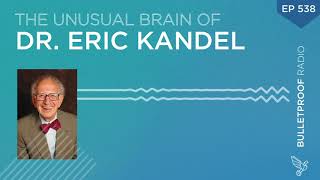
This content was created by Dave Asprey. This content was uploaded by Dave Asprey. This is a YouTube episode of Bulletproof Radio titled "The Unusual Brain of Dr Eric Kandel #538" (recorded/posted Dec 14, 2019). It is an interview-style audio conversation hosted by Dave Asprey with Nobel Prize–winning neuroscientist Dr. Eric Kandel. The discussion covers neuroplasticity and its limits, Kandel's foundational synaptic/Aplysia research, mechanisms of short- vs. long-term memory, learning and practice, neuromodulators (BDNF, nicotine), transcranial stimulation, PTSD, mitochondria and brain health, personalized responses to cognitive enhancers, exercise, scientific method/reductionism, and personal anecdotes about scientific discovery.
Chapters
Bulletproof Radio, A state of high performance. You're listening to Bulletproof Radio with Dave Asprey. Today's guest is Dr. Eric Kandel. He is a Nobel Prize winning, renowned neuroscientist with a psychiatric background. And truly one of the pioneers of modern brain science. He's been described by a colleague as one of the truly great intellects. One of the greatest scientists and greatest neuroscientists of the last hundred years. And something I would agree with. Dr. Kandel. My wife studied at the Karolinska Institute. Where you gave an acceptance speech. And she was actually in the audience when you accepted it. And she asked me to tell you at the beginning of the interview. That your medical textbook. Was her favorite book in all of medical school. And so she was really excited when she found out that we were going to get a chance to speak live. So, truly an honor to have you on the show.
Well, I'm delighted to be here.
You recently wrote a book called the Disordered. What Unusual Brains Tell Us About Ourselves? After decades and decades of research and looking at the mind. What do unusual brains. What do they tell us about ourselves? Like, what can we all learn from this? I've never had a chance to talk to someone who has this much knowledge in one brain and ask that one what do we learn? The one point.
Well, we see what different regions of the brain do, what their function is. Because we see that if some particular behavioral function is abnormal. We can trace it down to particular brain architecture. And that allows us to relate structure to function. There are a number of ways of doing it. But this is a very powerful way of doing that. What did the different brain regions and sub regions mediate in terms of behavioral function?
Does this mean that if someone has a structural problem in their brain. That they're stuck? If you got hit in the head when you were a child. That part of your brain doesn't do what it was supposed to do. Is there hope?
If it's a child? Yes. If, for example, you have damage to your left hemisphere which is involved in speech. If that occurs to you as an adult. You have something which is very unlikely to return to you in its normal level of functioning. If this happens to you when you're less than, let's say, 12 years old. There's a very good chance that the right hemisphere will take over and compensate for it. So there's plasticity in the young brain that is lacking in your brain and mine.
Do you believe that we'll ever be able to turn on childlike neuroplasticity in adults?
Probably not.
Probably not. Okay. What drives that assessment?
Well, there are anatomical changes that occur in the brain as you mature that are almost impossible to reverse. So it's hard to consider that now perhaps one can have a brain explant that is to take some immature brains, perhaps from somebody else and implanted in your brain and that might get incorporated and function as a immature brain in your skull, underneath your skull. It's unlikely, but that's an outside possibility.
When we talk about unusual brains, it brings to mind a couple stories. I interviewed a woman who has a phenomenal brain for research and asked her, why can you do what you do? And she said, when I was 21, I had a virus in a part of my brain and it created a lesion that grew another part of my brain inside of it. And she says ever since that happened, she could look at a stack of research papers and synthesize it in a way she never could before. So I always, like you look at these outliers or my wife, she hit her head when she was 8 before that 12 year old thing took out the language processing center of her brain. She fell off of a two story building and was unconscious for three days. She can do simultaneous translation and speak five languages and run an emergency room. But they now hypothesize, having looked at the structures in her brain, that it's because the right hemisphere took over. But she was a child example. The other one was an adult example. If you put on your 50 year in the future hat do you see any hope for people being able to programmatically make those kinds of changes to our brains? Or do you think that's just too mess and it's unlikely we'll ever be able to do it?
It's hard to predict what's going to happen 50 years from now. It's hard enough to predict what's going to happen 10 years from now. I think it's unlikely also to explant. To take a piece of brain from one person and put it into another person's head is not an easy game.
No.
And it's not the kind of thing you want to do routinely. You want to do it as an emergency measure. You don't want to do it as a way of enhancing your brain. Probably the more effective way of enhancing the brain is through practice studying foreign language, the piano, the cello, etc. Etc. That will cause enlargement of certain areas of the brain, give you new capabilities that you didn't have before. Particularly if you start at A young age, but the brain is most plastic. You'll have the greatest chance of developing new capabilities that you didn't have before.
There are a variety of compounds that we've discovered that increase things like nerve growth factor or a brain derived nootropic factor, bdnf. And it seems like we can raise levels of those by at least 50% in adults, even with things like exercise. In your experience in neuroscience, are those techniques likely to be valuable for helping adults learn better or do you think those factors are. That's not enough?
I think it's unlikely that those factors will help, but also certainly possible that we'll get some compounds, hormones and substances that will enhance cognitive capabilities. The substances that you mentioned are those that are normally present in brain and they're particularly helpful if some part of the brain is lesioned that produces that. So by giving it exogenously, you can compensate for the natural production of that by the brain.
Okay, that makes a lot of sense. I want to go back to two years before I was born, back to 1970 when you looked at how chemical signals change the structure of the connections between synapses. How did you arrive at the breakthrough to understand that? What was the learning process that led up to the aha moment for you? We're talking about the aplasia.
Between 1957 and 1960, I worked at the National Institute of Health and I had earlier in medical school had a six month elective period in which I could do whatever I wanted to. And I wanted to be a psychoanalyst. And I thought that even a psychoanalyst should know something about the brain active on the brain. And I just loved it. Based upon that one experience, I was nominated for the National Institute of Health. Why nominated? When I graduated from medical school, physicians were being drafted into the surface for two years stint. But those that were eligible were selected for a research program at the nih. And I was selected for research program at the nih. And I enjoyed it so much. I stayed not two years but three years and had a wonderful experience there. What I did there was to record from single cells in the hippocampus, the area of the brain that was known to be very importantly involved in memory storage. I found how these cells worked, but I didn't learn that much about memory storage. I realized that to study memory, particularly at the beginning, you needed to look at a behavior and see how it was modified by learning. Looking at the hippocampus was a little bit too complicated. As the first step, I decided to look for a Simple system that had a simple reflex behavior that could be modified by learning. I focused in on the marine snail Aplysia because it has the largest nerve cells in the animal kingdom and relatively few of them. You could work out a neural circuit, a withdrawal reflex, in terms of the individual cells that mediated. Work out the whole pattern of connections and then modify that behavior with a simple learning process and see what happens in the neural circuit when the animal learns something. So, for example, if I bang my hand on this table and I continue to do that, you will get bored. And after a while you will ignore that. That's called habituation. When you look at a neural circuit that mediates a simple behavior and you stimulate that reflex repeatedly, the reflex gets weaker and weaker. And when you look at the neural circuit, you find that the connections between the sensory nerves and the motor neurons are getting progressively weaker. So that was the first demonstration. The learning effects the strength of synaptic connections. If you scare the hell out of the animal to startle, that same stimulus that produced a very weak reflex will produce a much larger reflex, much stronger reflex. That's called sensitization. When we look at what happens at the neural circuit, you see that the connection that was there to begin with and had a certain strength that weakened with habituation, moved in the opposite direction with sensitization, became much, much stronger. So that was the first demonstration that learning involves the change in synaptic strength, how neurons communicate with each other. That has turned out to be a general principle.
How could we take that new understanding of the brain and apply it to the things that we do as human beings?
You play tennis, I play ping pong.
It's pretty close.
Okay. When you practice ping pong, what do you think you're doing?
Pretty much changing synaptics, synaptic strength.
You got it. When you continue to hit, you're getting the reflex gets more and more effective, more efficient. A number of things go on. Your attentional system also improves, but you strengthen connections in order to do that.
Recently, the military's been using transcranial electrical stimulation to increase learning speed. In fact, I run an electrical current over my brain when I play ping pong, sometimes using a. A device called a halo. Before that, I used an electrophoresis machine to do it. And it in studies in the military, it seems to let people learn specialized skills about twice as fast. Do you think that's a dangerous thing or maybe a good thing?
I think you would have to not just stimulate the brain in a very general way. You'd have to Stimulate specific areas. Yeah, I think, you know, as long as it's done in a controlled fashion, limited degree, it. It's an experiment. It is what circumstances it works. Under what circumstances it doesn't work. What is the age range of people who benefit from this? So it's, you know, it's a new finding. It needs now to be explored in terms of safety and significance.
At this point, it definitely passed the fda, and it's just running on the motor cortex regions. So for physical skills, and I'm. I think I see differences, but it's hard to also blind myself because you can feel it. And it's also hard to know. Maybe I would have learned that fast anyway, without the electrical current.
This is most likely to be most effective in people who have damage to the motor cortex for one reason or another, to allow them to recoup their original function, to bring in other areas that compensate for the fact that. That the primary areas have been weakened by disease.
Okay. I'm also very interested in your work on nicotine. I interviewed a professor from Vanderbilt University who wrote the first paper in 1988 on using oral nicotine, not smoking, for treating Alzheimer's disease and has been studying it for a long time. But I also know that you've looked at memory disorders, mental illness, and nicotine addiction, along with your wife, Denise. What's your take on nicotine after this research?
Well, I mean, nicotine acts on the brain and enhances the actions of certain drugs that you take after nicotine. So it has a powerful effect on the brain. Whether it's all beneficial is not at all clear. I don't think smoking is a particularly good idea. But smoking is more than nicotine.
Yeah.
And it's also inhaling all the stuff that comes with the cigarette.
I would unequivocally say having nowhere near your level of scientific credibility, but written some science books and looked at deep. Smoking is just bad from an aging perspective.
Well, smoking is more than nicotine.
Much more. Yeah.
It's inhaling all the stuff that comes with the lit cigarettes. Yes.
And for nicotine itself, it seems like for some brains there are very strong benefits, but for other brains, it just doesn't work much. Like a lot of things.
Yes.
How would someone listening to the show go about knowing whether coffee, nicotine, egg yolks, or any other compound, fish oil, anything that may affect their brain. How would they go about knowing whether it works or not, given there's so much individual variability?
Well, the first thing is I would very carefully read the literature.
Yes.
Let's see whether you take a population of people, let's say 100 people, a thousand people, and you expose, you divide them into two groups, a control group and experimental group. You give a control group, you know, seltzer, and you give the other group whatever the experimental drug is and you see where there's a difference between the two groups. And then you can statistically decide whether or not the drug that you're testing is beneficial and how it, what it does that is beneficial for you. It may also be detrimental, or it may be beneficial, but it may carry some downsides with it. So it's very important to understand how a drug works in all of its ramifications before, you know, one approves it. That's why the FDA is there to evaluate the safety of these drugs.
It works really well for populations to do that. And when you have an individual looking at a drug like say Modafinil, which is a well known cognitive enhancer in some people, it doesn't do anything. In other people, it turns the lights on in a new way and changes their ability to think, even their typing speed. And I'm looking down the road and saying, if we know that there's this statistical curve of how it works across a population, do you think we're getting close to being able to tell, genetically or environmentally or via some other mechanism whether a drug is going to work for one individual versus a broad population? Or do you think that's still far out in what we're talking about?
Well, it depends on the drug. In certain drugs you see that certain genetic predispositions allow the drug to work or prevent the drug from working. So there are some situations in which the biological information that we already have on that person or can easily obtain on that person will tell us whether this drug will be effective or ineffective in that particular individual.
I'm hopeful that companies like 23andMe and Ancestry.com that are now getting genetic information on hundreds of millions of people and starting to be able to do kind of the broadest epidemiological stuff possible to see. Not only does this drug work if you share that information with them, but it only works for people who have this whole genetic profile. And I've started to see some new information coming out of that. Do you think that that approach is going to be adequate to at least peel back the onion on many drugs, or is it going to take more than that?
I think you really hit the nail right on the head. People differ from one another biologically, that is, you know, to large degree genetically. And if you look at any single drug in a population, there'll be variability in how effective the drug is and knowing the genetic makeup of a person. And if you've tested that drug in a variety of different people with different genetic makeups, you can predict whether this is a good candidate for the drug or this person is a bad candidate. And that's important to know, because if a person has an illness, it can be helped by the drug. He may be one of a number of people with that illness that would be helped, but there are other people who have other biological predispositions who may not be helped. So the more we know about the biological underpinnings of a person, the more likely we are to make intelligent decisions about which kind of drugs will be helpful, which kind of disorders.
I'm exceptionally hopeful that this new data set is going to change our understanding of individual biological variants so that those unusual brains and unusual neurological structures and unusual genetic structures can be teased out. And we'll be able to go into a doctor and say, oh, why don't you try this set of compounds instead of this set?
Well, this is happening. We are beginning to get it just at an early stage. But physicians can tell from your biological history whether one kind of antihypertensive medication is more likely to be better for you or another. So in a number of disease states, there are several different drugs that will work, and which one may be determined by your biological makeup.
It seems like one of the most exciting times ever to be alive. Given the amount of information that we have available as laypeople and as researchers and physicians, how do you deal with, or maybe better questions? How have you dealt with this amazing onslaught of information? If you go back to when you were working at the NIH in the 60s, you had a. A number of research papers and you had connections with other researchers, and you'd have hallway conversations and you'd go to symposiums. And now it seems like every day there's a hundred papers that could be interesting to the things you care about. How do you decide what to look at?
You know, these hundred papers relates to a universe of science. Let's say I'm a cardiologist. I'm interested in the biology that relates to the heart and to the circulation, etc. That's a more discrete number. And a number of those articles, I come up with findings that are modest. Others come up with findings that are wrong. And then finally there are those that come up with findings that are correct and significant enough to make you rethink the kinds of therapeutic approaches you want to take to a patient with a certain kind of cardiac condition.
Okay, so you sort of sort the papers exactly based on what you're attempting to learn about or modify. That ties into something that you said about reductionism. You once said, it's better to make small progress on something really, really important than to push a trivial issue ahead. How do you think about reductionism, and how have you thought about it in your work?
I'm a reductionist. I try, whenever possible, to use a simple example of a larger problem and try to drive it into the ground. And then I come back and look at a more complex variant of that. But I like beginning on solid data.
How do you make that decision about what's really important versus trivial?
If you see a big change in a behavior, it's important. If you see a small change in behavior, it could be trivial.
You're very results oriented. So the person who was psychotic isn't psychotic. Maybe we should pay attention there. That's a very pragmatic answer. How did it feel when you went through and you proved that Dr. Kuhal, a 1906 Nobel Prize winner, you proved that he was right in that he said. He hypothesized that nerve cells talk to one another at the synapse. And when you had that proof point in your lab, what happened in your mind? Did you run around the street saying eureka, or did you celebrate with champagne? What was it like?
What you're talking about is Ramon y Cajal. That's pronounced Cajal Cajal.
I said it quite a bit wrong. I said kuha Cajal. Thank you.
And he was the first one to really pinpoint the fact that that neurons communicate to each other at specialized junctions called synapses. He also suggested that learning may involve alterations in the strength of these synaptic connections. I was one of the people who came along later on, substantially later on, and showed that his suggestion of how learning occurs is correct. I found that learning involves changes in the strength of synaptic connections. So Cajal was fantastically important, perhaps the most important father of neuroanatomy.
I want to know how you celebrated when you came to that full conclusion, when you saw the data on your lab bench and you said, wow, I've got really solid proof of this. Now we know. Did you go home with Denise and have a dinner? What do you do when you just realized you've proven a major point? That's world changing.
The first thing you ask yourself, what are the controls? I have to run in order to convince myself that this is so. Some skeptic like you won't say, this is complete baloney. So you want to think of the controls that you need to run. But of course, one goes home and one enjoys oneself. It is a wonderful thing. And also to have it being recognized, generally, the paper being recognized is an important paper is very satisfying that your colleagues think it's important.
So you do celebrate?
Oh, of course.
So how does a Nobel prize winner celebrate? I want to know.
Champagne.
Champagne. All right. The real French stuff, right? All right.
Get me out of these wet clothes into a dry martini is what the golfers used to say.
I love it. All right, let's talk about memory. Your memory is exceptionally sharp. You're going to be celebrating your 89th birthday about when the podcast hits the air. My birthday is a few days after yours, so happy birthday in advance.
Thank you.
What have you done to keep your memory, both short term and long term, working as well as it does?
I don't do anything specific about it, but, you know, I read, I write, I talk to people. I don't go home and memorize poetry, but I stay intellectually involved. Many people my age have retired, no longer involved. I'm talking to you from my lab. This is my office. Research is going on just on the other side of the wall here. And I'm involved in. I don't work every day. I only work about five and a half days a week. But when I'm here, I'm intellectually involved in what goes on in science and that stimulates the brain also. I mean, when I'm out of the lab, I also stimulate the brain. I go to the opera. I mean, I do things that almost everything you and I do during the course of the day involves intellectual activity of one kind or another.
So continuing to exercise your brain by using it keeps it younger or at least running. Okay, can you talk about self perpetuating memories and what you've discovered about those?
By self perpetuating you mean what?
A self perpetuating protein at the synapse in that if memories are sustained for a long period of time, what changes versus things? You memorize a phone number, you dial it and you forget it.
There are mechanisms at the synapse that once you produce a change in synaptic strength, you produce an alterations in the local machinery for protein synthesis that keeps the process going. So there's an alteration in gene expression that gets transported down to the synapse and that allows the synapse to produce more Proteins or more substances that are necessary to strengthen that synapse.
What happens if you're remembering something traumatic versus pleasurable?
Well, they both produce alterations in synaptic strength, but they produce it in different systems. There are some systems that mediate pleasure, some systems that mediate pain. So you recruit different anatomical pathways to mediate one versus the other.
Do you support the concept of ptsd, the post traumatic stress disorder?
Absolutely.
I was hoping you would say that. Certainly something that I've experienced.
I scare you. I can tap lightly the next time and you'll startle. So there's no question this is true for all of us. We have different thresholds. Some people are much more sensitive to it. Also, once you've been really frightened, you're much more susceptible to less threatening stimuli.
Do you think that's something that we can change?
No. I mean, I think that's built into us and it's probably beneficial. We want to be able to startle. We want to be able to move away from stimuli that are dangerous. But we should be able to get progressively better ways of helping people overcome the excessive fear that they show on a variety of circumstances. So, for example, if somebody is at a war front and sees a bomb explode nearby and hears this terrible noise that's associated with it, they may be frightened every time they hear even a slight noise. That sort of post traumatic stress disorder, One should be able to get them over it if only by habituating to them. Play that sound in a way that is clearly innocuous and convince the person's nervous system that no damage is going to occur.
Is there a way to look at the way we lay down pleasurable memories and use that system in order to get it active when people are re experiencing those sounds? In other words, is there a way to turn the brain onto pleasure mode versus feeling fear mode?
Not so very easily.
Why do we remember things from childhood, like a song that sticks in your head from childhood and other things like high school algebra, just go away. What's going on with the way we store and sort information like that?
Well, I mean, some things are more satisfying and more meaningful to us than others. And probably some things, you're mother's love or the first girl that you met and you really liked, that's more important to you than high school algebra.
So it's a measure of importance.
And satisfaction.
And satisfaction. Do we have any other control over how our memories are stored?
Yes. Repetition, repetition.
Okay.
If you want to learn French, you can't have one conversation in French and expect to Master the language, you have to go and learn it. And one way you learn it is, you know, learning the grammar, repeating things, practicing speaking it, et cetera, et cetera, et cetera. Practice makes perfect is one component of learning.
I have found that for me, to really learn something at the deepest level, I either have to teach it, and I was a teacher at the University of California for about five years, or I have to write a book about it. What is it about teaching or the act of synthesizing to write that makes things stay in your brain?
Well, you've described it perfectly. If you really take it apart so you understand the component parts and how they fit together so that you can explain it to your grandchild, it's going to stick in your head as well as making it easy for the grandchild to understand it. So taking a complex piece of information and simplifying it, thinking it through, is a very, very good way of learning it so you can hold onto it for a long period of time.
Is there a better way to do that?
Well, repetition is very good.
So it's either repetition or if you.
Don'T understand it, it's very hard to remember it.
Got it. So it's either repetition or disassembly and reassemble in a new way. Are the two big techniques related?
Yes.
In your newest book, you talk about something you could call a unified theory of the mind. How would you explain the one theory of the mind around how our sense of self emerges from physical matter?
Well, people used to think that brain and mind are separate, that the brain mediates walking, running, motor activities. But mind, you know, understanding something, communicating something else is not mediated by the brain. Now, we know that every mental process is a biological process that comes from the brain. Simple or complex, trivial and sublime. They're all brain processes. Every mental process is a brain process. That's been a major advance over the last 50 years.
Have you dug in on the role of mitochondria in the mind or in the brain?
I mean, I obviously know that mitochondria, source of energy in cells, are important, particularly at synapses, but I haven't worked in mitochondria in any particular way.
Okay, you haven't worked them in a particular way because I know that in your book on disordered things, you talk about autism and depression and schizophrenia and Parkinson's and addiction, and there are clear mitochondrial links to those things, and neurons have more mitochondria. And I've spent a lot of time on my last book looking at how do mitochondria behave, that affects how neurons behave. And it seems like if there's not enough electricity being made by mitochondria, you wouldn't get enough synaptic firing. And that that may be an important part, at least in some conditions. Knowing that you're not a mitochondrial expert. Does that theory hold water? Given that you know way more about the brain than I probably ever will, is that an area worthy of exploration?
That's true. I know more about mitochondria than you ever will. I have to read up on that. At the moment, I'm not convinced.
Okay, but is it at least worthy of asking, in other words?
Absolutely.
Okay, good deal.
But we don't know all the roles they have in learning and memory.
We absolutely don't. In fact, I think we don't know very much about them at all. Right now. I want to go back to short term memories. What's the difference between that example of remembering a phone number, what happens in your synapses? Something that you know you're only going to need for a little while versus something that gets embedded in your brain. I know we talked about repetition, but what's happening at a synaptic level when you just want to remember it for a little while?
There's a short term change in synaptic strength. When you learn something for short term memory, memory that persists for minutes, the synapse changes, but it's a functional change and it only lasts for minutes. But if you learn something through repetition or because it's very powerful for you, you actually see an anatomical change occur at the synapse. The synapse becomes anatomically more powerful and that's reflected in its physiology. Also, the presynaptic terminal is larger, the postsynaptic contact point is larger. So the synapse is much more effective because it's anatomically more effective. Fundamental differences between short term memory and long term memory. Short term memory involves a functional change at the synapse. Long term memory involves an anatomical change. Moreover, that anatomical change is produced by alterations in gene expression. So signal gets sent from the synapse to the nucleus, New gene products are produced, transported out to the synapse, and that allows the growth of new synaptic connections.
Is there something we can do to increase meaning consciously? To make it easier to remember those short term things and make them longer term?
Repetition, my boy. Repetition practice makes perfect.
I'm feeling good that you've told me that five times. So by repeating it for me, then I'll be able to remember it.
For the Therapy session.
Let's talk about exercise.
Excellent.
We know that exercise is good for the brain at this point. And when the New York Times was interviewing you, I think last year, you said, you've exercised your whole life. Now, there weren't a lot of people who practiced exercise in the 50s and 60s, but you did. What made you decide to do that?
I'm embarrassed to tell you this. First of all, I was in Vienna, 1938, when Hitler marched in. And one sport that Jewish boys in Vienna learned after Hitler marched in was to run away. I was surprisingly fast when I came to the United States. I tried out for my high school track team at Erasmus Hall High School, and I was co captain of my track team in my senior year. In fact, it was the coach of the track team who asked me, eric, where are you applying to college? And I said, I'm applying to Brooklyn College. My brother's going there to a very good school. And he said, have you ever thought of Harvard? I said, no. He said, why don't you apply to Harvard? So I applied to Harvard, and I got in. That was due to my track coach pushing me. Not that I was a great track start, but I was not. I was not good enough to really compete strongly at that level, but I was quite good in high school. I placed in a city championship and I ran on a relay team with three other people. So relay team is four people. And we won at all sorts of major events, the Penn Relays, the Seatonal relays, et cetera.
So you learned in high school that it was. It felt good, and you just kept doing it ever since, right?
Well, I became very athletically involved in high school. I was almost crazy in the amount of time I spent practicing for running. The co captain of the team with me was a guy called Ronald Berman, who also was my roommate at Harvard. We went to Harvard together. He was better than I was. But together in high school, we took track very seriously. And even on the weekend when there was no school, we would go running. We'd find a track and we'd go running there. We'd work out.
Did you ever start smoking?
I smoked for a while between 25 and 27. I.










