a new paradigm for reduction of fear and discomfort from disturbing and traumatic memories 1080p
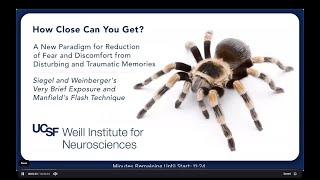
The 90‑minute webinar, hosted by clinical psychologist David Bullard, assembled researchers and clinicians to challenge the prevailing dogma that conscious re‑experience of traumatic memories is required for therapeutic change. The program opened with a contextual framing of trauma as a perceptual error that keeps the nervous system in a present‑danger state. Dr. Paul Siegel presented a series of behavioral and functional MRI studies on Very Brief Exposure (VBE), showing that sub‑conscious, masked presentations of phobic images reduce avoidance behavior without increasing subjective fear, activate frontostriatal circuits linked to extinction, and produce durable gains lasting up to a year. Dr. Phil Manfield described the Flash Technique – an EMDR‑adjacent protocol that uses a positive engaging focus, bilateral thigh tapping, and rapid eye‑blinks while the client is not consciously attending to the disturbing memory. He reported group‑delivery data (n≈175) with 55‑69 % immediate reduction in self‑reported disturbance and stable follow‑up effects. Dr. Shira Magin (UCSF/VA) presented VA electronic‑health‑record analyses showing that only ~9 % of post‑9/11 veterans receive a minimally adequate dose of evidence‑based PTSD psychotherapies (PE, CPT), with modest symptom improvements and notable racial and service‑connection disparities. Commentators (Sarah Metz, Prateek Mukherjee, George Silberschatz, others) discussed the limits of rapid, one‑size‑fits‑all approaches, the importance of safety and therapeutic relationship, neuroimaging‑guided biofeedback possibilities, and the relevance of moral injury and race‑based trauma. The session concluded with consensus that VBE/Flash are not cures but may lower initial fear arousal, making subsequent exposure or other therapies more tolerable, and that a pluralistic, patient‑centered toolbox is needed for trauma care.
Chapters
Welcome to our program, A New Paradigm for Reduction of Fear and Discomfort from Disturbing and Traumatic Memories. We're thrilled to bring together today for the very first time researchers and clinicians and some who do both to open up new possibilities for easing human suffering. The speakers will discuss research and clinical data from the past several years that challenge the prevailing dogma that treatment of fear and traumatic memories must involve a level of conscious re-experience of the disturbing memory. It's a difficult time today for humanity, February 28th, 2022, with suffering and trauma happening in many places. But in those same places, there are moments of bravery and generosity, kindness, resilience, and love. We need more of all of those. I'm David Bullard, a clinical psychologist, and have been on the clinical faculty of the University of California, San Francisco, in medicine and psychiatry and behavioral sciences for 46 years. Time flies. We're so excited to have this program. Your audience includes people from 13 different countries, neuroscientists, psychotherapists, trauma-informed therapists, other healers and healthcare providers, and other people who are just interested in consciousness, memory, and healing. We all should be. I'm going to add just a few minutes of background for what we are discussing today since we have a varied audience. It comforts me, first First of all, to remember the story of a great spiritual teacher who, when interviewed by a journalist, was telling her of the grief and great sorrow he had for the destruction of his country that his people endured in a war many years before. She saw immense sadness in his eyes. Then he looked out the window at a tree, and when he looked back at her, he seemed filled with bliss and delight and said, "Life is so very colorful, isn't it?" It was a demonstration of the importance of being able to be mindful in the present moment. Not always an easy task for us, and certainly not for many others in the world today. As we will see in these presentations, some traumatic and disturbing memories live on, somehow felt in our nervous systems as if they were happening now, and that we're still in danger now, and feeling the aftereffects now of something that actually happened in the past. We might even consider this as a perceptual error that a variety of healing modalities attempt to correct so the person can enjoy the safety and even joy of being in the present. As of today, all trauma-focused therapies recommended by the American Psychological Association are exposure-based: CBT, CPT, CT, PE, EMDR, brief eclectic psychotherapy, narrative exposure therapy. That's actually all of them. We will be talking about suffering from the aftereffects of pain, fear, terror, anguish, and other disturbing life experiences. But let's start with appreciation and gratitude. I'm so thankful for Joan and Sandy Weill's establishment in 2016 of the UCSF Weill Institute for Neurosciences, and especially for its director, Dr. Stephen Hauser. I'm also grateful for our 11 co-sponsoring organizations, the 6 speakers you'll hear today, all of you in the audience, future people watching the recording, as well as everyone we've all learned from: teachers, colleagues, friends, and patients or clients, and even family. It's important to note speakers' ideas and comments are their own and not the official position of UCSF or any of the organizations our speakers are affiliated with. Also, those of you who registered will get speakers' contact information, a list of their research references, and a statement of disclosure of conflict of interest from their— our speakers. You'll get that via email after today's program. Our three speakers will present for about 15 minutes each, then three very experienced clinician researchers will contribute their thoughts. All 6 will have a bit of a roundtable discussion, then we will end at the 90-minute mark. Then for anyone interested, and I highly recommend it, Dr. Manfield has kindly offered to give an opportunity for people to have their own private 15-minute group flash experience. So stay on the Zoom link after 3:30 Pacific Standard Time. You won't want to miss this chance to watch your own consciousness Perhaps it will change a memory's disturbance level. If you are watching this as a recording, of course, you will miss this opportunity, but can hopefully find other ones, other possibilities for you. I would also like to mention a quote from Dr. Bessel van der Kolk, whom I interviewed when his seminal book, "The Body Keeps the Score," came out in 2015. It continues as a New York Times bestseller, now having sold 2 million copies and having been translated into 32 languages. He said he values techniques and approaches such as EMDR, but that he would not call himself an EMDR therapist, that to do so would be like a carpenter calling himself a hammer carpenter. We need all the tools we can get. But of course, many of you do identify as an EMDR or other modality therapist, and that can be very helpful for those looking for a particular kind of therapy. Well, our first speaker is one I've been waiting to get on a program since July 18th, 2018, when Dr. George Silberschatz, having attended a flash therapy demonstration by Phil Manfield and Louis Engel at my home, sent me an email suggesting that Dr. Siegel's research might shed some light on why empirically the flash technique seemed to work. So now I'm very honored and pleased to have Dr. Paul Siegel from State University of New York, Purchase, and University of Southern California researcher, discuss his functional MRI scan work for very brief exposure. He will be followed by Dr. Phil Manfield, who's trained worldwide over 9,000 trauma therapists in this flash technique that you'll see. It was developed in 2017 but is relatively unknown still outside the EMDR community. Our third presenter is Shira Magin, Dr. Shira Magin from UCSF and the VA Medical Center, one of the foremost PTSD researchers and clinicians, and a colleague I've known since 2010. Paul, you're going to begin right now, and thank you for your enthusiasm, your research, and your willingness to participate with us today. Take it away, Paul.
Thanks so much, David. I really appreciate this opportunity, the invitation to come and talk about my, my research about very brief exposure. As you probably all know, it's been a longstanding, almost dogmatic belief in clinical psychology and psychiatry that a person has to directly confront their feared object or situation in order to reduce fear of it. Um, it really does approach the status of dogma in the history of psychology, and it's the basis of all prevailing treatments for anxiety disorders, right? Cognitive behavioral therapies, exposure therapies. Um, and I've, I've, and colleagues of mine have thought for a while that this approach is based on an untested assumption. Right, that, that consciousness is required to reduce fear. So challenging this, we've conducted a series of studies showing that when you present, um, phobic images unconsciously, it ex— you, you present them, as I'll show you, very rapidly, um, it still reduces fear. It allows them to get closer to their feared object, specifically their, uh, a live tarantula, um, and they report less fear of it, uh, when they do that. Um, I want to emphasize from the beginning, this is not a cure. Um, we don't get the kind of effect sizes that you get in exposure therapy. Um, but considering that people will sometimes miss their exposure therapy appointments as much as they will their dental appointments because it's so unpleasant and distressing, VBE, you know, by contrast, is painless. I'm going to give you an actual demonstration that participants do. First, we get a baseline measure of their fear. And as you'll see, there's a bunch of their images that are— the X is a fixation point, and then something flashes, and then the ABCD, ABCD, that's what we call a masking stimulus. In between the X and the ABCD is a creepy image of a spider that you probably cannot make out, but it forms on the retina and it gets sent to the brain. It's quickly replaced by the masking stimulus. If the masking stimulus were not there, you could definitely make out the image of the spider. You would see it, and you would see just how creepy these spiders are. So we just, you know, we do that over and over again for several minutes. Let me just escape from this. As I said, we've done a bunch of studies showing that this reduces avoidance of a live tarantula. In a seminal study that was published in Emotion a number of years ago, we had participants do a baseline behavioral avoidance test where they approach the tarantula. There you see a research assistant administering the BAT with the tarantula to a participant. And it's a series of 11 approach tasks. So they get a score from 0 to 10. That's a picture of the actual tarantula, who we've nicknamed Fuzzy to cope with our own spider fear. So this, this graph is showing the immediate effect of these exposures, right? Of these microexposures. The blue line is VBE. And as you can see, their BAT score is going up, which means they're getting, you know, much closer to the tarantula than both the control group who get, they get visually masked flowers. And then CVE, right? That's how we manipulate awareness of the phobic stimuli. The CVE group, they are exposed to the same spider images, but they can clearly see them. Right, so this is sort of the, the laboratory analog of exposure therapy. From a, from an exposure therapy point of view, the only people who should be improving are the people who are aware, who can make out, clearly make out the spiders. And we find that exactly the opposite is the case, right? The VBE group is getting significantly closer relative to both the control group and even more so relative to the, the phobic participants who are aware of the spiders. This graph is showing, by contrast, the effects of these exposures on immediately experienced fear, right? SUDS measure. And you see you get exactly the opposite effects. When they can see the spiders, the CVE group, their fear goes way up. Uh, the VBE group doesn't go up at all, no more so than the control group, which makes sense, of course, because they, they can't, they can't make out the spiders.
Right?
And so overall, we see that when we manipulate awareness of exposure, right, there's a double dissociation between the very brief masked, I mean, micro exposures and the clearly visible exposures. VBE is affecting their avoidance of the tarantula, and it's not affecting their conscious subjectively experienced fear, whereas CVE is having exactly the opposite effects.
Right?
It's inducing fear, but it's not affecting their avoidance. And what this double dissociation strongly suggests is that however VBE is reducing this avoidance, this fear, this phobic fear, it is doing so non-consciously. We also had these— by the way, this, the— this represents 98 spider-phobic participants in, in the 3 groups. We had them come back a year later, and as you can see, the VBE group, even a year later, they're maintaining their gains. They're still getting as close to the spider. The correlation between their, their post-exposure BAT score and then how close they got a year later was incredibly high. The correlation was 0.89. Just about every participant maintained their gains. So now I partnered with Bradley Peterson, who I've learned so much from out at USC, using brain imaging, 'cause we wanna understand mechanistically what's happening in the brain that these microexposures are reducing fear. And in our first fMRI study, we had a bunch of highly phobic control participants. You know, they got a psychiatric interview, they approached the tarantula on the BAT, and each participant got each of the 3 types of exposure I talked about before, right? They, uh, they— so they got all 3 types of exposure so we could compare them within the brains of the same participants. That's why we did this experiment. By having the participants be exposed to all 3 types, right? And then they also rated their level of fear periodically during these exposures. So first, I'm just gonna show you the overall, the brain maps, right? These are axial, 2-dimensional slices of the brain progressing all the way from the bottom of the brain, the cerebellum, all the way to the, you know, the top of the brain, 2-millimeter slices. And this is the clearly visible condition. These are the patterns of activation you get when they can see the spiders. And as showed by the color-coded bars over here, right, white is the highest level of activation, and this green means deactivation, means decrease of bold response or blood flow to brain regions. So this is when they can see the spiders. This is when they're unaware. I'm just gonna toggle back and forth. Wait, they can see them? They can't see them. They can see them? They can't see them. And clearly less is more here. There's a lot going on in various brain regions. I don't have time to talk about all of them, right? But in particular, what we're finding is that these microexposures are strongly activating frontostriatal circuits. These are the prototypically self-regulatory circuits involved in fear extinction, involved in motor and impulse control. That's what really stood out to these study is that in the unaware or VBE condition, you get a lot more activation of these frontostriatal circuits. This, the contrast column, would be like, you know, if you take aware, that's the CVE, the, the contrast is the aware column minus the unaware column, right? And that's why you see all this green deactivation. Basically, the contrast column is showing what we saw before, which is that the microexposures are activating these frontostriatal regions much more strongly than the CVE, the vis— when they can see it. So, you know, The problem with that study, of course, is it was just sort of a pure brain imaging study. We wanted to directly relate these patterns of activity to actual changes in behavior. And so what we did is an, uh, an RCT, a randomized controlled treatment during brain imaging. And this, we believe, is the first of its kind, the first time a behavioral treatment, as opposed to a medication, as opposed to a psychoactive drug, right, is being delivered during brain imaging. Again, we had a bunch of phobic and non-phobic participants given an interview. They're, you know, clearly severely phobic based on diagnosis and confirming having them approach the tarantula. And then, as in an RCT, where they were randomized either to VBE or control exposure— and I'm going to show you those control exposures in a moment— one month before At baseline, we had them do the BAT, approach the tarantula, and then they approached the tarantula again, you know, after the fMRI scan, when they got the exposures in the scanner. So overall, you know, methodologically, this is pretty radical, where we experimentally manipulated a treatment in randomized placebo-controlled fashion during brain imaging. So that we could directly relate the changes in brain activity to corresponding changes in symptoms and phobic behavior observed outside the scanner. The equivalent would be if you were able to measure the instant effects of Prozac on brain activity, you know, and, uh, which is, which is currently not possible. It's been done with very fast-acting psychoactive drugs, uh, psychostimulants, but they have not measured effects on functional brain activity. In that case, they've measured effects on levels of neurotransmitters. These are examples of the active intervention, the spider images. Just to show you that this was a bona fide placebo in the form of images, these were the corresponding flower images. We rigorously controlled for all the visual features, color, hue, texture, background, all these visual features in order to isolate the effects of the emotional properties of our active intervention, right, of the masked spiders. These are, this is simply, these are the patterns of brain activity during VBE. If I showed you corresponding slices from the prior fMRI study, you would see they are highly similar. So this was nice, we got an internal replication now in a between-subjects RCT context, whereas the prior study was within subjects. More importantly, right, we then, we correlated, first we correlated these patterns of brain activity with observed changes in phobic behavior approach towards the tarantula outside the scanner. The middle column is showing that, you know, we've got correlations in all kinds of brain regions. More importantly, we did more rigorous mediation analyses to identify the specific, you know, the specific brain regions that are mediating or responsible for the corresponding changes in approach towards the tarantula, which we observed outside of the scanner. And again, there's a lot going on here, but I'll sum it up on my next slide. The ventromedial PFC, which we know that's the primary brain region that's involved in fear extinction, in emotion regulation, and that, that mediated the reduction of avoidance of the tarantula. So did, as we saw, and, you know, as we suspected from our first study, the frontostriatal regions. A bunch of them were also involved in mediating the reduction of avoidance of the tarantula. And then the other thing we saw were a bunch of different regions that are involved in attention, vision, language processing, various regions that were probably involved in the participants' trying to identify, trying to figure out exactly what these masked, invisible exposures were. So the fact that the images are masked, that they're difficult to detect, actually results in more exposure-related processing. It makes them more salient to the participants. So this is what, at this point, our theory overall is that these microexposures are working by automatically automatically activating these regulatory regions, bypassing phobic avoidance behavior and defense mechanisms, and allowing them to then get closer to their actual feared situation. We're now moving on to apply VBE to post-traumatic stress disorder in traumatized war veterans. PTSD and specific phobia, they share a common pathophysiology in terms of fear activation and lack of fear inhibition. As you may know, PTSD represents a public health imperative in this population. It's highly associated with other psychological disorders, especially depression and addiction, suicidal behavior. And traumatized combat veterans are extremely resistant to exposure therapy. Exposure therapy with them is— it's associated with very high avoidance and dropout rates and very— and low efficacy. The most recent RCT found that 60% of the participants in exposure therapy still had PTSD at the end of treatment. And believe it or not, 100% of them were still depressed. This is going to be a really large-scale RCT, again, that we're going to conduct within the scanner. They're going to get one of the three types of exposure, and then, then they're going to get a corresponding form of the, of the BAT, where they're going to get a type of virtual reality exposure that's being pretty widely used now to some effect with traumatized combat veterans. So this would be an example of one of the micro exposures we would use during VBE. And this is the corresponding control image. And I have to say, my, my, my research assistants just did an absolutely lovely, masterful job finding these images. And then in some cases, we had to create them. You might recognize that not-so-famous psychologist in that really odd posture to the right, holding the umbrella. That was taken a few years ago when I was much younger. But you see, we're, again, we're trying to control for all the visual features. So VBE has, it has a number of different limitations, but I've spoken for a long time, and maybe we can get into those limitations during the discussion.
Thank you so much. That was wonderful, Paul. Your presentation makes me very happy that we don't have a test afterwards. And I'm looking forward to Dr. Prateek Mukherjee's commentary because he runs MRI scanning centers both at the VA Medical Center and at UCSF. I'm sure he'll have some interesting comments. He's doing a current research, I believe, on mindfulness and seeing what happens under those conditions of functional MRI scanning. Thank you, Paul, because it was a very brief exposure to a lot of years of hard work. And perhaps in the discussion period, you'll be able to share a little bit about how you discovered the whole phenomenon when you went to Adelphi University And we'll look forward to hearing that story.
Now we're on to Dr.
Phil Manfield, wonderful colleague of many years in the San Francisco Bay Area. And I don't exaggerate at all when I say he's just one of the world's top trauma therapists in the EMDR world and outside of that. He's written countless books, maybe 9. He provides EMDR videos for free on the internet. He's done an awful lot for the EMDR trauma community to provide free trainings and consultations. He teaches Advanced and Beginning and Flash, and he's one of the most prolific trainers and teachers that I've ever met. I'm glad to introduce you now, Phil, and I'm certain we're going to hear some interesting things because I always learn more things when I hear you speak. Take it away, Phil.
So thank you, Paul, for your presentation, and thank you, David, for creating this venue. It seems to me that this is very unique in that we're hearing from an academic researcher who is establishing that processing is more efficient if a person's not consciously aware of feeling disturbed, and our clinical work, which is based on the principle that people process more effectively if they're not aware of being disturbed. So this is a very, uh, special occasion to have both of these presentations in the same webinar. So I have been very fortunate that since, uh, introducing the Flash Technique, I've had some wonderful clinicians who have recognized the importance of the Flash Technique and gotten in on the ground floor and helped me to present the Flash Technique to the world, in particular psychologists Louis Engel, Nina Zadurian, David Bullard, Ricky Greenwald, and behavioral pediatrician Joan Lovett. Joan, Louis, and my brother David were co-authors in the original paper about the Flash Technique that was published in 2017. Since then, Louis has been a part of all my Flash activities— trainings, publications, research. He's been right there from the beginning in helping people to recognize the importance of the Flash Technique. And I think the wonderful thing about this is that Flash Technique can be done in groups. And so when we present to a group, we always do at least one 15-minute intervention where people get to experience the Flash Technique themselves. And that, I think, has gone a long way towards having people recognize that this is something that works. We're also going to give you the experience of having, uh, participating in a 10 to 15 minute Flash Technique, uh, exercise that we're going to do at the end of the recording of this webinar. So if you're watching this live, you can stay on and we'll do this intervention immediately afterwards. So the Flash Technique is unique, pretty unique, in that people process either very disturbing or moderately disturbing memories, and they do it without feeling the disturbance consciously. The mechanism for this is that we have people think of what we call a positive engaging focus, something that is engaging, that the client can focus on, and while they're focusing on it, they're not thinking of their disturbing memory. While they're doing this, we have them tapping their thighs, form of bilateral stimulation, which is common in EMDR, and we say the word flash. And when we do, they blink their eyes 3, 4, 5 times like a flutter. And after we've done that 5, 6 times, we check in with them to see if they notice any change in their disturbing memory. And we encourage them to do that without thinking of any of the details and without focusing intensely on the memory. Then we go back and start again with the tapping, the PEF, and the blinking. And we notice that with each check-in where we ask if anything has changed, people do report change. And gradually— well, the first thing they seem to report is that the memory seems further away. And as I'll say in a few minutes, that's consistent with our understanding about what happens when people experience Flash Technique. Then they start reporting, uh, that the image is vague or the memory is vague. Sometimes they report it's hard to bring it up, but gradually the trend is that they feel less and less disturbance when they think of the memory. And typically at about 6 or 7 of these check-ins they're at a point where they're not feeling any disturbance at all when they think of the memory. The key to Flash Technique, what really makes it work, is the positive engaging focus. And we think of it as our version of what Paul refers to as a VBE. Um, in other words, it's a focus that prevents clients from thinking of their disturbance. And since we started doing it, we found better and better ways to do it. One of the— we have a listserv with 3,300 clinicians, and one of the clinicians, Gina Ornelas, wrote in one day, oh, I have my clients talking to me about their positive engaging focus, and that seems to help them to stay focused, and it seems to make it more effective as a distraction. So we tried it, and absolutely, it, it's, uh, it's another step forward in being more effective with the Flash technique. So we've been doing that ever since. Of course, we don't do that when we do a group intervention, but Flash works whether or not a person is relating to someone else about their positive engaging focus. What we think is going on with the flash technique, and we don't have any fMRI yet to substantiate that, but we do have one fMRI that has been approved and is in the process being set up. What we think is going on is that, um, there's a healing of the time distortion that seems to be inherent in trauma memories. And so when a person thinks of a trauma memory, people who have PTSD have the experience of having that trauma as if it's happening all over again. They feel like they're there. And, um, so we think the healing of those traumas is for a person to develop an adult perspective and to recognize that they're here now and they're no longer experiencing what they experienced before. So that was then and this is now. Now we work with a wider range of memories than what the DSM would characterize as a trauma memory that could be related to PTSD. Memories that we work with don't have to involve violence. They can involve extreme shame or humiliation. They can involve terrible sadness. The key element that we look for is that when the client thinks of the memory, they feel like they're back there and it's happening in the present. So that's what makes these memories so disturbing, that people relive them and they feel the disturbance as they recall them. So that's what I mean by when a client says, I feel like it's— it seems further away That's a sign to us that the healing is happening. And that sense that goes with the disturbing memory initially of persons right there, as they report that it seems further away, they also report that they have more of an adult observer function available to them, and gradually they see the memory as something that happened in the past and is not ongoing now. So we've been very fortunate that as people recognize that FLASH is effective, quite a few people have taken it on as a research subject and begun studies. Initially, that was difficult because most institutional review boards, before they would approve a study, they wanted to know that flash was safe. And we didn't have any research that demonstrated it was safe because we couldn't get an IRB to approve it. And Really, what started the initial research was various researchers who either experienced the Flash Technique themselves or they experimented with it clinically, and they found that there were very rapid and startling, um, processing effects. So I think it was basically on the personal assurances that some of these researchers gave to their IRBs that enabled the IRBs to accept the safety of flash technique and approve the initial research. Presently, we have 9 papers that have been published about flash technique. One of those is in press currently. We've had 2 published RCTs and we have 4 RCTs currently in process. We have done a number of studies ourselves. Since then, we were approached by a union in Pennsylvania with 40,000 healthcare worker members who were suffering because a lot of their clients had COVID-19, and it was very upsetting, especially early on, trying to treat all the people who needed treatment. So the union asked us if we could develop a cost-effective, scalable technique that could give relief to the union members and So we started a study in which we provided FLASH as a group intervention to 175 participants, volunteers, and we divided them into work— people who were providing mental health and people who were providing other healthcare. We got excellent results on average. We gave people a webinar that was an hour long, and we provided two flash interventions, each 10 to 15 minutes in each webinar. The subjects took one webinar. If they took more than one webinar, we only counted the first one. And the results of this group intervention in which they were basically following our directions and they weren't— they didn't have the ability to ask questions or relate to us in any way. So we could have been a video recording of us doing this. And in the initial intervention, the average reduction in disturbance measured from 0 to 10, with 0 not disturbing at all and 10 the worst they could imagine. Initial reduction was 55% from this— it was probably 12-minute intervention. And then in the second intervention, some of them chose to use the same target they'd used in the first one, and those people got an average of 69% reduction in their disturbance. So, uh, that paper was published in June. As you can see from this graph, typically people started with a disturbance level of 7 or 8, most common SUDS level, disturbance level. When they ended the 10 or 12-minute intervention was about 2. And then we did a 1-week follow-up and, uh, the reduction was stable and actually improved somewhat in the follow-up. In the earlier study that didn't get published, we also did a 1.5-year follow-up of the people who started out most disturbed, and those results also held, and there was improvement during the year and a half. So, um, and now I'm going to turn the stage, as it were, over to Dr. McGann.
Hello, and thanks very much for inviting me today. I wanted to start by sharing that I'm a clinical psychologist by training, and I've been working at the VA since September of 2001 and at UCSF since 2006. I'm a PTSD researcher and clinician, and my main area of focus is PTSD care as well as moral injury in veterans. Today I'm going to focus on a research project that was funded by the Department of Defense where we examined evidence-based PTSD psychotherapies in the VA system for veterans who had served in the Middle East after 9/11. So first, to start out with some background, the Veterans Health Administration implemented a national rollout for evidence-based PTSD psychotherapies, or EBPs, to treat PTSD starting in 2005. This initiative involved training thousands of clinicians nationwide in two evidence-based psychotherapy protocols. Prolonged exposure, or PE, and cognitive processing therapy, or CPT. While participants in randomized controlled trials, or RCTs, for CPT and PE experienced clinically significant improvement, we wanted to understand if this generalized to veterans who are coming into the VA to get care on an outpatient basis. So in the electronic health records for the VA, there's over a decade of data to evaluate whether veterans with PTSD utilize evidence-based psychotherapies and whether they actually improve. So our goal was twofold: first, to identify whether veterans were using CBT and PE, and second, to identify whether they were improving. So we used a project in three parts to answer this question. So in the first part that I'll talk about, um, we're going to look at whether veterans are using the EBPs, and the second part We're going to look at whether they're improving. And then the third part, we're going to look at what predicts improving from PTSD EBPs. So for the first part, our guiding question was, were veterans engaging in CPT and PE? And if so, were they getting minimally adequate dose of care? Meaning, were they getting at least 8 sessions in 24 weeks? So we used the electronic health records to identify Iraq and Afghanistan veterans who received care between 2001 and 2015 and were diagnosed with PTSD. And our final sample included 265,566 veterans. What we found is that only 9.1% of veterans got 8 or more sessions of EBP, and about 13 to 14% got 1 to 7 sessions of EBP, with 77% receiving no EBPs. I'll specifically also share with you, if we look at numbers specific to CPT and PE, that only about 7.4% of veterans got at least 8 sessions of CPT, and only 1.9% of veterans got at least 8 sessions of prolonged exposure therapy. So with less than 10% of post-9/11 veterans receiving minimally adequate EBPs, these results represent modest success in the implementation efforts. There are several possible reasons for the limited uptake of CPT and PE which may include that veterans are using pharmacotherapy. They may have an alternative treatment for a comorbid psychiatric condition first. There may be administrative barriers that are preventing them from engaging in this care. There also might be cognitive and emotional load associated with EBPs that are— act as a barrier. So veterans may just not want to talk about their trauma. They may feel like they've tried to bury it for so long and they don't want to bring it up. And then there's also challenges with balancing other demands such as work or school. These sessions require 60 to 90 minutes. And then there also may be challenges with the therapy, right? People may feel it's too stressful, that the treatment may not be working for them. And then there may be VA system-level barriers like difficulty with scheduling. I'm also going to talk about the second study where we used emulated trials in the electronic health records, and that means that we created mock trials to simulate randomized control trials. Our goals were specifically to compare those who received CPT individual therapy to those who received other individual therapy. That was a our comparison group, and also to compare those who receive PE to other individual psychotherapies as well. Of note, we use the PTSD Checklist or the PCL to measure improvement with a 10-point difference being statistically significant and a 20-point difference being what we define as clinically significant. What we found, um, and I'll report results separately for CPT, um, and PE, of those who completed 8 or more sessions of CPT, they had a 6.4 PCL improvement than those completing a different individual therapy. What we found with PE is that those that completed 8 or more sessions had a 10.1 point PCL improvement. And so again, with both CPT and PE, we are just reaching a clinically significant difference and not so much— we're reaching, sorry, a statistically significant difference and not so much a clinically significant difference. We found that while patients engaged in EBPs experienced some improvement, improvement did not reach levels observed in EBPs that were RCTs of EBPs. Patients in routine clinical practice may be more variable in their engagement, their ambivalence, their motivation, and their skepticism of these treatments. Um, so they may be different from our patients at RCTs. They may also have higher suicidal ideation and substance use issues. So there can be many reasons for these differences. And given that most patients do not currently receive either PE or CBT, there is a substantial opportunity to improve PTSD outcomes in the VA with our veterans. So for our third and last study, our guiding question was, what are the demographic, military, and clinical factors associated with a clinically significant improvement in EBP for PTSD? What we found is that among 32,780 Iraq and Afghanistan war veterans who had at least one EBP session and an adequate PTSD symptom measurement, meaning they had a PCL at the beginning and at the end of treatment, we found that about a third showed clinically significant improvement, and we found that about two-thirds did not show clinically significant improvement. We also looked at what predicted improvement, and what we found is that female gender was associated with greater improvement. Getting engaged in EBPs earlier, within a year of getting involved in mental health treatment, was better in terms of improvement. Those who had a dose of at least 8 sessions also had a greater likelihood of improvement. And those who engaged in CPT individual as opposed to group, and those who engaged in PE only as a combination of PE and other things also improved more. Unfortunately, we also found that there were a number of variables that were associated with a decreased likelihood of PTSD symptom improvement. That included Black race. So Black individuals were less likely to improve from these ABP EBPs. Those who are engaged in CPT group as opposed to individual were also less likely to improve, and those who are service-connected or disabled in some way, um, were also less likely to improve. To sum up, only 32.5% of veterans improved with EBPs, and there were racial disparities in improvement, um, as well as individuals who were service-connected or disabled improved less. So to sum all three finding— all three studies up, um, despite national rollouts, EBPs for PTSD are used relatively infrequently in the VA. Using real-world clinical data, we determined that although EBPs were statistically better than treatment as usual, rates of improvements were lower than expected. So while factors like dose or modality or timing of treatments are associated with improvement, there may be racial disparities that are important to better understand when providing PTSD EBPs. So overall, we have a long way to go in making sure more veterans are getting clinically significant improvements and care in the VA system. And I'm going to pass it on to the next speaker now. Thank you so much for your time and attention.
Now we're going to hear from some commentators. The first one is— thank you, thank you, Shira. Thank you for that. That was really, uh, both impressive and heartwarming, not because of how difficult things are currently as they stand, but just that people like you are looking into ways of making things better for all the veterans and other people that you come in contact with. Our commentator is Sarah Metz, Dr. Sarah Metz, who's the UCSF Associate Professor in Psychiatry and Behavioral Sciences. She's also Director of the Division of Trauma Recovery Services and a Chief Psychologist at Zuckerberg San Francisco General Hospital. So there you are, Sarah. I really appreciate your background because for quite a long time, you've been treating people with trauma-informed therapy, including— you'll be talking about it. Take it away, Sarah.
Oh, yeah. Well, thank you. And thank you so much for inviting me to be part of this panel. It's always wonderful just to hear about current research that's happening. And the VA is near and dear to my heart. Worked for the VA for many years as well, so always love to hear updates about what's happening with our veterans and the care there. Yeah, so I have a pretty varied background, you know, and including in the VA, I've been trained in prolonged exposure therapy, cognitive processing therapy, in group-based STAIR skills training and affective and interpersonal regulation, as well as just kind of CBT practices in general. And it's, it's been curious to see how trauma treatment looks in different settings as well, even in comparison, for example, from the VA to some of the clinics in my division. The structure of the clinics are just very different. And so, you know, I think bottom line, you know, what I, what a big takeaway is for me from panels like this and even just hearing different clients experiences with different treatments is just there's no one size fits all. I think there's a treatment that works for anyone, right? Meaning that if the client believes in something and the provider believes in something, I think there's something really powerful about that. I think there's something really powerful about the relationship when you're doing trauma treatment, given that one of the biggest things that's impacted by trauma is trust. So even just having that reparative relationship in and of itself, I think, can yield quite a bit. But I've also, I've had really incredible clinical experiences doing things like prolonged exposure and CPT. And also, sometimes it's not the right treatment, you know, for folks, and, and that's okay too. It's finding, you know, I think you mentioned this earlier, David, you know, having a lot of tools, not kind of just offering a one-size-fits-all type of treatment when you're talking about something as complex as trauma, because no two presentations, you know, really are the same, you know, when you're talking about somebody's experience with trauma over the course of their life. So yeah, I'm happy if you also have any more targeted questions or things that you were hoping I would touch on to reflect on that as well. You're muted though.
There we go. Often other people would like to mute me, but I'm unmuted now. Thank you for that perspective. We're going to have a couple more commentators and then we'll have a chance to interact and maybe you'll get some of those requests. I'd like to now just give Dr. Pratik Mukherjee, MD, PhD, a chance to talk. He's UCSF professor— I had to write this down— yours too, Sarah— radiology and biomedical imaging, bioengineering, He's director of the UCSF Neuroconnectivity Lab, and he's an attending neuroradiologist. And finally, he's— not finally, but— director of the Center for Imaging of Neurodegenerative Disease. Very important subjects. And we hoped, Pratik, that you could just give us any thoughts you've got of any kind about what we were talking about, plus a little bit about the work that you are doing now. Especially, I'm intrigued by your study with mindfulness.
Sure, absolutely. Yeah, no, I was— I'm obviously interested mainly in the imaging aspects of what was presented. So Dr. Siegel's talk, I agree with him, this was a very innovative and fascinating use of of fMRI to monitor and identify potential neural mechanisms of the treatment as it's administered in the fMRI scanner itself. That made me think of potential, potential additional uses for the imaging technology, and certainly it could be a mechanism of biofeedback or neurofeedback that could help personalize the treatment for individual patients. Because if you can image the engagement of these frontal attentional circuits and these frontostriatal circuits that are— seem to be mediating the fear extinction, then you can calibrate the length of the treatment, you can calibrate the types of images that are being shown to the patient for maximal treatment efficacy. So many of these types of feedback are possible. It is, however, you know, very logistically difficult and expensive to carry these sorts of treatments out in an fMRI scanner. There have been attempts made in the past to do treatments and biofeedback in fMRI scanners, but inevitably they, you know, are research demonstrations and have not become clinically viable. However, it may be possible to do many of these same studies using cheaper and more mobile methods like high-density EEG, for example. Certainly, you know, you can measure many different visual potentials with EEG systems, including the P300 wave. Uh, which correlates with the novelty or salience of visual stimuli. You can also monitor the balance of frontal theta versus beta activity, which correlates with attentional engagement in the frontal lobe. Of course, you're not going to get the rich granularity of fMRI information. Getting signals from the striatum probably will be impossible but, uh, it may be worth an attempt to see if this type of study is possible, uh, and these sorts of neurofeedback are possible using EEG systems. And I think the last point I'll make about Dr. Siegel's work is that there's a growing literature now on affective conditioning in cortically blind patients. So these are patients with so-called blindsight. So they do not have function of their primary visual cortex. Often they don't even have function of higher-order, uh, visual object and face recognition systems. Yet it is still possible for them to, through this blindsight mechanism, uh, identify, for example, the emotions of faces that they're presented with. Fearful face versus neutral versus joyful. And the latest papers seem to indicate that this works. You know, first of all, the low-level visual system, uh, the transmission is from the retina to the superior colliculus and then to the pulvinar nucleus of the thalamus instead of the lateral geniculate nucleus, which is for standard vision, conscious vision. And then the latest studies seem to indicate that the projections that are responsible for the emotional processing are to the superior temporal gyrus, which Dr. Siegel has also identified in his slide as helping to mediate the effect he's seeing. So it could be that conscious vision is not required at all for this kind of fear extinction, and it's perfectly possible to do this same mechanism on cortically blind patients, and it does not involve the usual mechanisms for cognitive, um, vision, visual processing, and object recognition. So that's kind of an interesting potential follow-up study to do. Um, in terms of my own work using fMRI, I'm unfortunately not able to use it as directly as Dr. Siegel uses it, but I use fMRI, also diffusion MRI markers of white matter microstructure and volumetrics and segmentation at a microscopic level in the brain to serve as biomarkers for cognitive processing in patients with chronic cognitive impairment after mild TBI. And I have a randomized controlled trial at the VA here for those patients who suffered from mild TBI, chronic repetitive mild TBI, and are persistently symptomatic. And we've employed a strategy called GOALS which engages or is thought to engage attentional— again, these frontal attentional mechanisms, although probably not as frontostriatal— to, to improve their activities of daily living and attention-based function. And we're looking at these imaging markers both before and after therapy and long-term follow-up. So it's more on the cognitive side than the subject of this particular session, but similar in spirit.
I wonder if I can ask you more of a softball question. Most of us are not quite the neuroscientists that you are, but I've been listening to Mark Soames recent book, Hidden Spring, that I'm finding fascinating. And he gave our annual Wallerstein lecture at the Department of Psychiatry and Behavioral Sciences just before COVID I think 2019. Um, so my question is coming from that, but earlier I mentioned, uh, Bessel van der Kolk, who's well known in trauma field, and that his book, The Body Keeps the Score, is so— such a bestseller for the New York Times. My question to you is, does that sound accurate? Lately, after listening to Mark Soames and people like you, I've been wondering and thinking it isn't really the body, it's really everything happening in the brain. Can you comment on that, even title? Of course, the body shows up, but there are practitioners out there who believe that trauma is in the body versus trauma is an experience of different brain networks. Any thoughts on that?
Yeah, I'm not familiar with the works that you cited there, so I just have to comment more generally. But yeah, the relationship between the, you know, the body and the brain is, you know, certainly under active investigation. There's this whole literature on embodied cognition now and how the brain can make the body and even aspects of the world outside the body part of your persona. You know, sometimes like, you know, we— our smartphones are kind of becoming part of our persona. So if our smartphone gets damaged, you know, we feel physical pain as a result, you know. So It all depends on what the brain prioritizes. You know, of course the brain prioritizes, you know, the health of the body, you know, and there's many inborn genetic mechanisms for that. But increasingly, um, we're able to also incorporate parts of the environment as well. So, you know, it's something under, you know, active investigations. I mentioned I'm sure there'll be many interesting findings, but it may be too early to make definitive statements about it.
Well, thank you. I appreciate that. I've been intrigued as someone, uh, coming more from a therapy end of it, with the idea of the hard problem of consciousness that Mark Solms talks about, which other people have talked about, which is we can measure, like you're doing, all of these metabolic and other activities in the brain You can see things happening, but we still don't seem to know how that makes a leap into something we call consciousness. And, uh, it's a fascinating field to be in, and we're so happy to have you here, both at the VA and at UCSF. So, um, George Silberschatz is our next commentator, but I don't see him. There he is. Hey, George. George is my dear friend, and let me just give your credentials here for a minute. Besides UCSF clinical professor in the Department of Psychiatry and Behavioral Sciences, he's president— has been for a long time— of the San Francisco Psychotherapy Research Group, which started probably 40 years ago with mentors of both George's and mine that we really appreciated. And he's done outstanding research and publishing all over and speaking all over before COVID He's also the past president both of the Northern California and of the International Society for Psychotherapy Research. And I, I was hoping, George, that you would give your, uh, perspective with all the research that you know And I know a big part of it for somebody like you is the relationship. We're talking about a technique. We're not— the Flash is not a therapy, it's a technique. But I'd like to hear anything you'd like to comment about, anything at all.
Well, thank you. Thank you very much, David. Thank you for inviting me. I really appreciate it, and I very much appreciate the The efforts to reduce suffering in all of the presentations that we've heard, and you know, along with reducing suffering comes, typically comes an effort to try to do that more efficiently and more quickly. And probably Phil's flash technique is the quickest I've ever heard of. 50 minutes is about as quick as it gets. And I have to say, I, I have very, um, I have very mixed, uh, views and, and feelings about the, the effort to speed things up and to do things as quickly as we can, because that has a long history in the field of psychotherapy. You know, people starting with the, the emphasis in reducing the time that psychodynamic therapies and psychoanalysis took, and we could— we should be able to do it better, faster, quicker, you know, and that sort of thing. And, um, and I've been involved in research on that, so I know a fair amount about it, but I also know the limitations of it. And when it comes to trauma, I'm very aware, as Shira and others have pointed out, that with things like enhanced exposure therapy and stuff, which get big, you know, they're published in major journals Journal, the American Medical Association, and so on. Big statistical effects, but it doesn't work. It doesn't work for most people. It works for some, but the percentage for whom it works is way, way smaller than the percentage for whom it doesn't work. And some of that may be the effort to do it quickly. Some of it may be the, the emphasis emphasis on making people confront their fears, which, you know, the work of Phil and Paul Siegel's work, you know, shows that you don't have to do that and that there may be considerable benefits to not doing that. With Paul Siegel, there's a wonderful paper that they published, the title of which I love, is What You Don't See Can Help You. And that's sort of the essence of what the very brief exposure and some of what Phil is talking about, uh, does. But I think that for very focal kinds of traumas, uh, there are some people— I don't know what percentage it is, but it's a relatively small percentage— there are, for very, very focal, specific traumatic events, my guess is that there are various techniques that can address that and help reduce people's suffering. But the kind of thing that I see in psychotherapy, much more of, are not that. They are recurring traumatic experiences, what I call stress traumas, that a person grew up with in a very dysfunctional alcoholic family, one experience after another for year after year after year. And in my experience, those kinds of things— and I'm not saying that Phil or, or enhanced exposure people feel like that's the technique for them, but there's a danger of going to a place of thinking that all these things can be handled in a, in a quick, efficient way. And I just resonate with what Sarah said. There is no one size one-size-fits-all in psychotherapy. There just isn't. Much as we would like it, much as Basil likes to think that his approach is, is good for all trauma, it doesn't turn out that way. And I think that's one thing we need to be— much as I, I appreciate and truly respect the effort to try to do these things as efficiently and quickly as possible, a part of me also like almost rails against it, you know, because like with the healthcare workers study, I mean, I, I know a lot of people in healthcare that have been very traumatized by COVID, and there's a part of me that feels like, well, those people ought to be able to have access to whatever therapy they need to deal with that trauma. And the idea that we should just get them in for a 15-minute or a 1-hour session It just— the part of me has a lot of respect for people that do it, and a part of me feels like they deserve more, and there ought to be more that's available to them if that's what they want. So I will leave it on that for, uh, all of us to discuss.
David, I am chomping at the bit to respond to that. Do you mind? Please do, George. I could not agree with you more. I make this point in all of my papers at the end. Um, I cannot imagine DBE being a cure for anything. Um, what it might be able to do clinically, what it's been shown to do, is reducing the initial level of fear symptoms, all the physiological arousal, the kind of first-level defensive fear responses, reducing them enough right, so that people are then more willing to engage in exposure or some such, right? So for me, this is not about speeding things up. This is about making the beginning of treatment a little bit easier, overcoming people's resistance, so that then they're more willing to do, you know, the difficult emotional work. Of psychotherapy. And I, I also want to mention, in relation to what you're saying, I think, um, you know, we can say one size fits all, but that's not the reality, the clinical reality in this country, um, in terms of the most powerful institutions that are funding research and the most powerful institutions in clinical psych— where is this assumption that the gold standard treatment, whatever that means, is exposure therapy, despite all this evidence that it doesn't work for so many people. What Shira mentioned in her, her findings— her findings replicate what the most recent meta-analysis show for exposure therapy for combat-related PTSD specifically. Two-thirds of combat veterans get no benefit, right? Two-thirds of them end up dropping out. The most recent RCT with hundreds of veterans, 65% had PTSD at the end of treatment, 100% clinically depressed. It is unfortunate that psychodynamic people— in my opinion, as a clinical psychologist who's been trained in both CBT and believes in it, PE, and also in psychodynamic psychotherapy— psychodynamic psychotherapy provides two crucial things for anyone who brings trauma into treatment. One, a strategy for dealing with people's defenses and resistances. CBT has no strategy for that, as far as I know, in a skillful way. So that when you tactfully, skillfully work with a person's defenses, eventually they actually want to talk about their trauma. Not in session 8 because they're supposed to, right, but they want to. Um, and the second thing that psychodynamic psychotherapy I think provides that is crucial is the patient goes at their own pace. Not at some pre-programmed established goal of at session, at step, at session 8, this is what they're supposed to be doing, which I think is unethical, personally. And now I'll be quiet.
I knew that I was, we were gathering together, we'd have some, uh, good stuff going on, and I'd like to hear from Phil Manfield right at the moment.
Well, I already said a whole big piece with my microphone muted, so— Well, George, I agree with you, except that I think you're missing the point on this research. First of all, this research is not coming from an institution that got a half-million-dollar grant. This research is coming out of the researchers' pockets. To finance it, and what we're showing is that 15 minutes of group flash reduces disturbance significantly. Our effect sizes were over 3. That's, I mean, really, really strong impacts. And the next thing to do is to do research where we have repeated webinars. Right now we're starting a study with COVID victims. We're not attempting to cure them, but if they can get a reduction in their suffering from 15 minutes, that's great. And then they're going to be more easily treated with other forms of psychotherapy or with someone who's doing flash therapy with them individually. So, um, I agree. Uh, It's, it's not a one-size-fits-all, but flash seems to make psychotherapy easier for clients because that extreme activation goes down and they're just less resistant to looking at their trauma experiences.
I'll jump in with one very quick clinical kind of example of someone who I saw, and I was talking with him about the flash technique at some point, and he— I said, in fact, the client doesn't even have to say what the negative memory is. And he said, what? And I said, yeah, technically speaking, the therapist wouldn't even have to know what the guy is talking about, what the guy's the bad memory that he has. And he said, wow, he said, well, I've got something I've never told anyone and I never will tell anyone. I had 15 years of therapy with 3 different psychiatrists and I didn't tell them and I'm not going to tell you. It's just something I did once I'm ashamed of. If my wife ever knew, it was, uh, I was drunk. I'm never going to talk about it to anybody. And I said, that's, that's fine. So we did the Flash Technique with my knowing that much about what had gone on with him. 2 weeks later, he wanted to tell me what it was. And for him, as it lowered those defensive, you know, I can't talk about it, he was able to have compassion for himself. The shame and guilt that was all tied up in a place, in a compartment in his brain that he couldn't ever talk about, he was able to talk about. So that's just one example. I don't think we're really disagreeing, but it sounds like we are, which is wonderful. So who would like to jump in now?
I can jump in real quick. So I loved part of what several people actually brought up, which is the relationship in all of this, right? The relationship with the therapist, just even the story that you told, David, right? There's someone came back and they connected with you and they wanted to share something with you. And I think in my clinical observations, you know, the benefit of wearing kind of both a clinical hat and a research hat is I get to, to sort of use both of those pieces. And what I have found is— so I agree with Sarah completely when she said, when she has commented that one size doesn't fit all, but I think what happens and when people do improve with exposure therapy, so CPT and PE, is when the relationship feels safe, right, when they can actually go at their pace, which someone else says, but they can leverage the relationship in, in feeling ready and disclosing. And so in my observation, that's when these therapies work best. So whether that be, you know, any, any of these therapies, right, with exposure, and I've seen people improve tremendously with PE and CPT when that's in place, when it feels secure, and when it feels like— and I imagine the same thing happens with flash too, right? If you feel like you're secure and you're coming to someone who you trust, that goes a really long way. There are a couple of other pieces that I just wanted to bring up because I think they're important. So there is, you know, I get— didn't get to speak a lot about moral injury, but it's coming up a lot in the context of healthcare workers and COVID. And I think because we're talking about that, I just want to add that and fold that into the conversation because I think that when we talk about healthcare workers, it's really important for us to think about moral injury and how that fits into the whole paradigm. And I also think it's true of veterans, right? So a lot of the veterans who we work with did things that they don't feel comfortable talking about because they went against their own morals and values. And I think with a lot of healthcare workers, they had to make quick decisions, do things that they didn't feel originally trained for in the pandemic. And so I think that that complicates the picture when we're talking about trauma-focused focused care, or, you know, other things that come up in the context of pandemics as well. And so I just want to throw that into the conversation as well. And I think that is why many people don't improve, because there are these very complex processes that are happening that touch on to moral injury and kind of their deepest wounds. So, and then the last piece I want to just bring up is just around race-based trauma, which I think is also very important. So a lot of the veterans that I work with not only have experienced very severe trauma and ongoing trauma, you know, in war and potentially also in their early lives as well, that is, you know, not a one-time thing, but, you know, you know, multiple traumas that are quite complex. And, and I think that But if we don't look at that also in the context of other factors that are at work, so if you come from, you know, a racial or ethnic background where you're also being discriminated against, and that may be the source of your trauma, I think that that's also something that's, that's really critical to kind of add into the conversation as well. So I know that that's a lot to kind of chew on, but I think that these are all kind of important pieces to that. That I think it's important to think about when we think about veterans, when we think about trauma care, and how to move forward even with healing our healers, you know, who have experienced trauma during the pandemic.
So I agree with, uh, with what Shira's just saying. I just want to underscore two points that Shira brought up that I was going to mention earlier. One is the importance of safety, and I think that safety is something that sort of runs through a lot of these different treatments in different ways, and it— I think it's a very important piece in what Phil is doing, um, as well as in the principle behind exposure therapy. It is about enhancing a person's feeling of safety. The difficulty becomes the— the— this comes from Thomas Aquinas, that what's received is received in the manner of the receiver. And so different people are going to experience safety in different ways. And that's sort of the basis why the one-size-doesn't-fit-all kind of model— some people are going to do extremely well with not confronting their trauma, not, not facing that memory, and that, that will make them safe. But there are other people for whom it won't work that way. It just won't. And I think that's one point. The other point that, you know, Shir mentioned complex trauma, and that's what I was trying to get at before. In my clinical experience, most trauma is complex trauma. It's very, very rare in my experience to see simple traumas, and I think that that's, that's one thing that we need to keep taking into account in terms of our treatments.
Well, I think Phil has something probably to respond to with that. I just want to say that this whole arena, the way we've been talking today. First of all, I want to thank you all. You're— it's like an all-star game having all of you on here. There are two tracks though that I've been thinking of. One is what you're all talking about in terms of psychotherapy. The other is the neuroscience point of view. And there are people, for example, who experience their memories very vividly in a visual way. I'm not. I have aphantasia. 15% of us do not picture well, which may actually accrue to my benefit. But Phil, any, any further thoughts before you're going to introduce our opportunity for people who stay on the official— we're going to be doing the flash technique.
Well, the only thing I would add is, I mean, I agree with everything that's been said and, and I, when I train psychotherapists in the EMDR technique and working with complex PTSD and, and early trauma, there's a place for finding a way to, to, to bring those traumas into focus and then reducing their impact, and it does have an impact on their present-day experience of life. But obviously, in a one-to-one situation, therapist is going to be more effective. But we have an overwhelming amount of trauma in this country right now, and I think we have to look for ways, not necessarily to cure people, but to make the suffering less.
So if we can, maybe we'll do this again and call it the Son of Trauma and VBE and Flash Technique. But I want to thank you all, not only for this presentation and for giving your time time and effort, because everybody's busy. But thank you all for the work that you've done and continue to do and will do in the future, because this really is about trying to relieve human suffering. It's a pretty good— so thank you all.
More from David




Learning from the Tibetan Buddhist Experience, Thupten Jinpa, PhD, February 02, 2025; Sacred Stream

Prof Mark Solms and Dr. David Bullard discuss Memory Reconsolidation and Manfield's Flash Technique

Neuroscientist Mark Solms Discussing Memory Reconsolidation and Manfield's Flash Technique.

Brief experience with FLASH TECHNIQUE Lessened Disturbing Memory of Cancer Diagnosis' Impact

Flash Technique Experience for Hospice and Palliative Care Staff and Patients 6 10 24

Professor Mark Solms on completion of the 30-year project: The Revised Standard Edition of Freud

