Flash Technique Experience for Hospice and Palliative Care Staff and Patients 6 10 24

Sheena and David teach the Flash Technique, a rapid trauma-informed method adapted from EMDR to help hospice and palliative-care staff recover from secondary trauma and burnout. The technique combines grounding, eye movements, a positive memory, and a counting task to shift how the brain processes traumatic memories. Over 25,000 therapists have been trained in the past seven years.
Chapters
So our aims, uh, our intentions today are to give you all an opportunity to experience the Flash Technique, um, to learn an adaptation of the Flash Technique as a self-care strategy, because the work that we do, you know, we are at risk at vicarious secondary trauma. And when that overlaps with burnout, we're at risk of compassion fatigue. So there's also, in our work, there is an opportunity for compassion satisfaction that we know that we're doing a good job, that we know we have the support of our colleagues. And in a way, that's the antidote to compassion fatigue. Uh, and we're hopeful that Flash Technique has an important contribution to make in terms of our self-care. Uh, we might want to consider whether we want to add elements of FLASH to the restorative function of clinical supervision. I know a number of us are involved in clinical supervision in our work, uh, and to recognize what aspects of FLASH would support our patients, um, and also to consider whether we'd like to take it further with more formal training in FLASH technique or other trauma-informed therapies. Um, yeah, so just touching again on the importance of the relationship, um, David and I both like this quote: So know all the theories, master all the techniques, but as you touch a human soul, be just another human soul. So I'm gonna sort of run through a few considerations for you so that you can make an informed decision about whether to engage in the kind of experience that David's offering us. So the Flash Technique has a very strong record of not increasing the disturbance of someone experiencing, either in a webinar or in person. So that's over 25,000 therapists over the past 7 years. We do suggest that you don't participate if your sense is that it might be harmful to you in any way. Also, if you're uncertain, that you can think of a disturbing memory and then set it aside whilst you watch and listen to the webinar. If your sense of yourself is that you don't have good soothing skills, or if you're not sure that you can manage your activation effectively, then, you know, we're asking you not to participate in the Flash Experience. Um, but of course, those themes, they're important. And, you know, even me asking those questions might be an opportunity for self-reflection and kind of considering where you might go to, to to get the resources and support that you do need. So yeah, so I guess then it's, it's over to David, and I will stop sharing. There we go.
Okay, thank you, Sheena. Wonderful beginning, and welcome to everyone. Just a couple words to begin with, before we do the exercise, for context. In the late '90s, since I'm in San Francisco, I was trained in EMDR, which is, uh, very powerful and wonderful, useful trauma technique that Francine Shapiro, who was friends of us here in San Francisco, had developed into a whole community. One of the teachers that she had was Phil Manfield, and for 25 years he has taught internationally both advanced EMDR and beginning EMDR. About 7 years ago, he was talking, which he always did weekly, with a friend of mine who's my colleague, Louis Engel, whose office was next to mine for nearly 50 years. We moved, we got rid of our offices during COVID and Louis and I would have lunch every Thursday for 30 years or 40 years. And he, he said, you know, Phil's been doing something interesting. He's been doing his EMDR, but he said he gets better results when he doesn't even have the person focus on the trauma memory. Now, up to now, every trauma-recognized and approved trauma-informed therapy is exposure exposure-based, whether it's cognitive processing therapy or prolonged exposure that Edna Foa developed. And I just spoke last week with this psychologist at Yale who just got back from Ukraine, where he's— his fourth trip where he's setting up a PTSD clinic in the Ukraine. And he'd been in Israel training people, and he didn't know about this new paradigm that Phil discovered 7 years ago. So I've been along for the ride. We've had many seminars at my home with 20 or 30 UCSF and VA Medical Center researchers and clinicians, and it's been amazing to see how immediate this works. And I'm really pretty sure it's a neurobiological event, a switch in the brain that allows the person to understand that what they're seeing in their mind's eye is in the past rather than feeling it as if it's happening now. I wish that I had a one-to-one opportunity with each of you right now, but we're going to do it as a group to give you a sample of what this is like. But those of you who haven't experienced it, it's actually kind of fun. So take a moment, if you would. And think of a memory that in some way is disturbing to you. And by that I mean anything that makes you cringe. It can even be a sense of, oh, my sister's mad at me, I'm sure, because I didn't get the birthday card in the mail in time. A feeling of discomfort A feeling of dread because I had this auto accident and that was 3 years ago, but I can still see it in my mind. If I feel it in my body or emotionally, if it's a disturbance, we measure it on something called the Subjective Units of Discomfort Scale, or SUDS. And think for a moment if you can come up with a memory like that If you're lucky and don't have any of those kind of memories, that's okay. Maybe you'd think of something you saw on the television, or the telly— is that it?— or at the movies that was disturbing to you. Uh, Game of Thrones, perhaps. Many people are very visual in their memory, and I'm not. I'm kind of neurodivergent myself. I just recognized a year ago or so as people that have— maybe 5% of us listening today have aphantasia and a difficulty to picture in our minds. I— my son and my daughter both live in San Francisco Bay Area. I can't immediately see their faces even though I saw my son 2 days ago. It's, uh, very interesting on how we all experience the world through our conscious ness differently from one another. My son, for example, is almost photographic in, in recall, in his memory. So back to your disturbing memory, if you can pick one, and, uh, 0 to 10 scale. 10 is the worst you can imagine, I don't even want to imagine, and 0 would be, no, I had that auto accident, but everything's fine, nobody was hurt, and my body's not reacting, and I actually got a car I like even better after that one was totaled. That would be a zero, of course. So think of, if you can, something that's maybe a 4, 5, 6, but it could be 7, 8, or 9, or 10 even. And now that you've figured out a number— doesn't matter if it's hard to figure that out, but Forget about it. And I'm going to ask you to have a willing suspension of disbelief, which simply— that's what you do when you go to the theater or you watch a good movie. You let yourself take it in as if it's real. So I'm going to have you do this, which is the butterfly hug. Some people say accurately it's this, but I kind of like it this way. This is the, perhaps the equivalent of the eye movement in EMDR. And some of you non-trauma-informed therapists may have seen the wonderful interview with Prince Harry— I almost called him King Harry, that'd be a mistake— um, on Oprah when he talked about his own trauma and his use, uh, dealing with an EMDR therapist and how helpful that was to him. So you're doing this. I'm going to ask you to come up in your mind's eye, which is actually your consciousness, is your working memory. I'm— my working memory is telling me I'm talking to all of you and I'm sitting on a chair, I'm in my dining room, I'm looking at a computer, and my hands are going like this. Our working memory is limited. But I'd like you now to come up with something you would like to picture or imagine or remember in your mind's eye. Of course, it'll be different for everyone unless you're telepathic. And, um, some of the examples— we call it a positive engaging focus. So visualize it if you can visualize. It could be a place a beach, particular camping trip, or a mountain. But it also could be a person. One 50-year-old fellow said, "I'm gonna picture my grandmother when I was 5 years old. She loved me more unconditionally than anybody has ever since." I don't know if that's humorous or sad or somewhere in between, but he wasn't sad when he said it. It could be— you could imagine yourself right now having an activity. A wonderful 75-year-old psychiatrist with a 50-year Zen practice, when he did this exercise in a webinar like this, he later told us, you know, I remembered a marathon I ran 30 years ago, and at mile 18, when you hit the wall— or most people hit the wall and have a terrible struggle, the opposite happened for him, he said, and he just was in a state of grace and was able to finish the race with no body discomfort. And I asked him, how often do you think of that? And he said, I never think of that. I said, well, um, what's it like to think of it? He said, it's really wonderful. We all have these moments in life that we've had It's the opposite of trauma memory. So try and come up with something. People I know who have dogs, about most of them say, 'I'll imagine petting my dog.' Could be, could be any moment in your life that you'd like to just take a few minutes to savor, savoring the experience that you have. And Every once in a while I'm going to interrupt, but keep having your own particular memory. And I'm going to just say flash, and when I say that, blink, blink, blink, blink 3 times, 3 or 4 times. Just go blink, blink, blink. If you prefer to have your eyes closed, that's totally okay. Just squint them 3 or 4 times. Now, why are we doing this tapping? Why are we doing this blinking or the squinting? There is some possible neurobiological reason for it. I also think we're just filling up your working memory right now, and it's so even okay to have it overloaded. If you do this and you're feeling sad and it's hard for you to come up with something that's positive— there's a lot going on in the world, and I'll say something about that in a moment— but You could even just fill up your working memory by, for example, say out loud for yourself— it won't bother any of us— 347, and then subtract by 17s sequentially. What? Yeah, 347, that's easy, then it's 330, but after that it gets hard for me. That's okay, and you don't have to have an accurate number either. That's another way to do this. Other people use music and have people sing along or dance or watch videos. When they work with children, they might have them watch their favorite video game. It's all we're doing is filling up working memory. And flash, blink, blink, blink. Flash, blink, blink, blink. Pause. Take a moment. This is your working memory, and hopefully you've been engaged in whatever you were thinking of. But now, just lightly, bring back what I'm going to call your target memory, which was a negative one. Bring it back to your consciousness and now forget about it and come back to— we like to call the positive engaging focus because it's more fun, but more accurately, it just needs to be an engaging focus. One friend of mine, likes to use swimming in the San Francisco Bay, which she does most mornings. Brrr, that, that wouldn't be a positive focus for me. I'm interrupting you a bit by talking while you're trying to multitask and have your own personal positive focus, because we learned that it increases things to have a conversational element to it with the therapist occasionally talking, but I'm going to give you a chance to have some quiet time right now. So flash, blink, blink, blink. Flash, blink, blink, blink. Flash, blink, blink, blink. Pause. Bring back the target memory for a moment. And now forget about it and come back to— it's okay to change if you want to change your positive engaging focus. And when you're doing this work, it's a little bit like reminiscing with someone about their life, some of the positive moments. And some of them, when they start telling you about it, are really right there without being told the flash technique or anything. They're really engaged in seeing what they're telling you about. Pause. Bring back the trauma memory, or the upsetting memory, or the disturbing memory, the target memory, and ask yourself and see whether anything is different at all. We just did about a third of this. We're going to do some more, but just watch and see if Is anything for you different visually, if you're a visual person? Is there anything different in emotional or physical or both elements that may have come up that made it disturbing in the first place? This has been taught by Phil and Lewis to Ukrainian-speaking and Russian-speaking therapists and Israeli therapists. It's been quite, uh, reaching a lot of people. 25,000 therapists have been trained in it so far. So let's come back to this. Stick with the same if you'd like to savor that positive engaging focus, or come up with a new one. Flash, blink, blink, blink. Flash, blink, blink, blink. Flash, blink, blink, blink. While you're doing this, I'll tell you another story. The very first meeting I had at my house back in 2017 in November, Phil and Louis were talking and did a group exercise like this for 25 people who were from the UCSF Medical School and the VA Medical Center. And, uh, at the very end of it, people— number of people talked about the change that they felt. And Phil said, anyone— did this not work for anyone? And a friend of mine who's a Buddhist chaplain spoke up And she's a very kind, very kind person. She spoke up and said, didn't work for me. And Phil said, you want to try a little bit more in front of the group here, just you and me? She said, sure. And she did it, and it worked. Flash, blink, blink, blink. Okay, bring back your target memory. And if you would just note, where would that number be? If originally it was a 7 or an 8, is it still a 7 or an 8? If so, what makes it a 7 or an 8? Sometimes people say, oh, it's just the same, hmm, except my body's not reacting. Or some people say it seems farther away— visual people, not me. Or some people say, it's— I can see it, but it's pixelated or cloudy. I did this once with a friend who had a— many years before, had a terrible memory that she'd been driving. So let's, let's get back and do a little bit more while I'm talking. And you can do whatever you want right now, listen to this, but I think it'd probably be more fun to have your own positive, engaging focus. That beautiful time at the beach, or a person you loved who loved you, or just a dear friend that you knew accepted you no matter what. Pause again. Take a look at the memory and see if anything's changed. Let's just do one more set. Grab your own personal Whatever you'd like to have in your mind right now while I tell you something else that's been helpful to me. This is a painful, terrible time in the world. We all know most of you working in hospice and palliative care have very frontline views of human suffering. For 15 years, I've been blessed to attend an hour meeting with an outpatient, very innovative outpatient palliative care group at UCSF led by our physician Mike Rabo, and they're about 25 people, and it's a wonderful group. But I get to hear about the deaths that they experience. It might be a 38-year-old nurse whose 38-year-old patient with 3 children died. There's a lot of suffering in the world. And then we read about— we know what's going on in places in the world. So I take heart though by— here's a short story— the Dalai Lama 1984, he was interviewed. It's okay to feel interrupted, but keep your own thing going. He was telling the journalist with immense grief and sadness in his eyes what had happened to his country when he— they were invaded, and the destruction of temples, thousands, and the murders and the torture and the imprisonment of people who were simply following him in his footsteps, following his religion and his Buddhist ideas. Immense grief in his eyes. He looked out at a tree, she said, and when he looked back at me, he was filled with something else, and he said, 'Life is so very colorful, isn't it?' To me, that that gives me hope that we can be in the moment despite human suffering. Another Tibetan teacher that I met, Geshe Pema Dorje, put it this way: if you're thinking about things that are problems in your head and you can do something about it, do something about it. If you're thinking about problems in your head and you can't do anything about it immediately, why are you thinking about it? It doesn't do anything. When we think about things privately, we think we're doing something, but unless you're going to take action, it's, it's your choice. Last along these lines, I want to say Mr. Rogers, who was a TV character, had has said that his mother told him when he was growing up, when you read about bad things and learn about bad things that are happening that humans do to other humans, look for the helpers. And to me, you are all helpers. You wouldn't be here if you weren't involved in helping in a very deep way, at a very powerful, special time in people's lives. So I want to thank you all. We'll pause. Sometimes the, um, discomfort doesn't come down, and we know about that. Sometimes someone has what my colleagues, uh, Phil and Louis, call blocking beliefs. An example of that would be, let's say my trauma memory is my dad used to hit me with a belt when I was 5 years old. Personally, for real, my father was wonderful, but let's pretend I had that terrible experience. And I might be asked by the therapist, is there anything that would feel bad about not reacting when you have that memory? And I might say, well, yes, it's, it's like letting my dad off the hook. It's like saying whatever he did was okay. And the therapist might gently inquire, well, what do you think about that today? Does it really, uh, your father died 30 years ago, is it really letting him off the hook? Uh, isn't it really troubling you at the moment? Has nothing to do with him. I like to think and say that events really happen in life, terrible events. If If every terrible event that ever happened to us, we remembered it with this kind of immediacy and feeling it in our bodies and emotionally, we'd all be in a fetal position and we'd be, um, in a room and the world would be too uncomfortable to go out, too scary to go out into. I think evolution has given us our nervous system a way to process bad things, but sometimes they stick, and we'll call that a trauma memory. In the very beginning, when Phil and Lewis and I were talking, I said, well, Phil, doesn't this technique— maybe I, in my own mind, I think I had a hydraulic model of trauma, which was it's this stuff, and maybe you do something like flash and it pushes it down, but then If I wake up tomorrow morning, it'll be back, or next week it'll be back. Phil said it doesn't seem to ever come back. And over the years of doing this, that seems to certainly be the case. And I think we figured out why. So imagine that you are typing on your computer or typewriter, I guess, if you're old-fashioned. And you misspell a word, there's an error, a spelling error, and then autocorrect corrects it. When you get finished typing what you did, do you ever tell yourself, I better go back and look because maybe after autocorrect corrected it, maybe it reverted back to the error? No, I don't think we do. And I would like to ask an existential question: when you have that autocorrect, the misspelled word becomes spelled correctly. Where is the error now? From memory reconsolidation research, we know and understand, uh, they talk about perceptual error. I use it a little bit differently than they do. The perceptual error that we, most of us doing trauma work, understand is one that somehow the memory is caught up at the time it was experienced. But now, today, when you remember it, it's experienced as if it's happening now. Researchers at Yale even are telling us that maybe we need a different word for trauma memory. It should be— our brain should recognize that threat or that upset is in the past. World War II is in the past. Attila the Hun is in the past. My father, if he beat me at age 5, when I was 5— I'm now 70, almost 79, uh, it's not salient. I don't have to worry about that. My mind wants to actually be aware what's in— what's the danger now. That's the negativity bias that we all have, which It's good, but it's also good to have a positivity bias, and that's a little bit like taking some time with PEF.
More from David




Learning from the Tibetan Buddhist Experience, Thupten Jinpa, PhD, February 02, 2025; Sacred Stream

Prof Mark Solms and Dr. David Bullard discuss Memory Reconsolidation and Manfield's Flash Technique

Neuroscientist Mark Solms Discussing Memory Reconsolidation and Manfield's Flash Technique.

Brief experience with FLASH TECHNIQUE Lessened Disturbing Memory of Cancer Diagnosis' Impact

Professor Mark Solms on completion of the 30-year project: The Revised Standard Edition of Freud


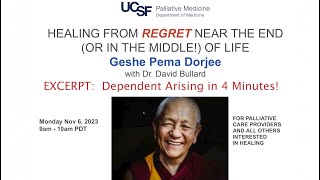
Geshe Pema Dorjee at UCSF, 11/6/23; Excerpt: "Dependent Arising" from Palliative Medicine webinar