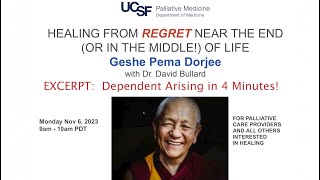
In this brief interview excerpt, the host (Speaker A) mentions an upcoming teaching opportunity for Geshe Pema Dorjee in New York with Robert Thurman at Tibet House US, and asks whether Geshe can simplify the two central Buddhist teachings of non-self and dependent arising. Geshe Pema Dorjee responds that he is exhausted and cannot provide a condensed explanation at that moment, highlighting his fatigue despite his scholarly background.
Chapters
You did a wonderful job of condensing that, and you have another opportunity in New York with Robert Thurman at Tibet House US soon to do 5 days of teaching about people who are interested in learning some more. I'm tempted. I know I'll hear a big laugh from you when I ask, is there a way for you to simplify the two main teachings of sanghapa or non-self and dependent arising? Maybe that's a bit beyond condensing because you're a scholar and you've studied these texts and there's quite a bit of depth of 2,500 years of thinking about this. But I thought I'd ask you anyway.
I think, no, I'm exhausted. You're what? I'm exhausted.
Exhausted?
Yes, yes.
Tell me about that.
I can say, okay, I can say, okay. I will try to explain a little bit, okay. So in Buddhism, interconnected Interconnectedness and the interrelated or dependent arise is a very, very important view. Okay, view. So normal, in a very simple way, I think that I'm existing independently. Actually not. I'm depending upon others, including my clothes. I need to go to someone else. If I need some food, I have to go to others. If I need a medicine, I have to go to others. Okay, the basic existence of me, including everything, education, I have to go to others. And we are so dependent upon the others. Therefore, we have to think that we have to be nice to others. Why? Because without others, there's no way I can exist. Even as a human being, I can't exist. And then to exist as a nice and educated person without others, there's no way. We have to go really deep down and think. How our teachers taught us. And our body also coming from our parents. How grateful. And they brought up from a tiny, tiny insect, type of insect. We forget, okay. Especially in the Western education, these are not mentioned, which is very sad. That's so, that's— we should say thank you from word is easy. Just to think that, oh, my mother took care of me. So many years and still she worries about me. And this is, I think, we really have to revive. One of the great Indian scientists called Dr. Abdul Kalam, he said, he said, okay, mothers are the funniest person on this planet. Why? She, she bring the baby in the in the womb for 9 months, and then she brings on her arm for at least like 3 or 4 years, and then forever in her heart. This shows how much we are connected with other human being. And then anything like food, clothing, medicine, education, everything is coming from others. So we have to really learn how to respect others. Therefore, we say doing something good for others is a very, very beautiful action.