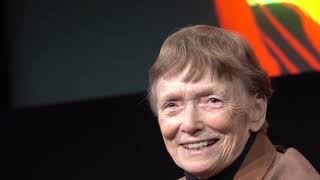
In this brief interview, Zen teacher Angie Boissevain (Roshi) discusses the nature of transmission, koan practice, and enlightenment within her Soto Zen perspective. She explains that there is no difference between a teacher’s mind and a student’s mind; face‑to‑face transmission occurs with everything, not just a person. When asked about koans, she mentions the classic cat and dog koans and the “one hand clapping” koan, noting that Soto Zen does not emphasize a large repertoire of koans, though Dogen frequently references them. Koans are presented not as tests with fixed answers but as a way for a student to demonstrate genuine understanding, which requires dropping self‑consciousness. Regarding enlightenment, she downplays the myth of a dramatic awakening, likening it to a carrot that misleads seekers. Instead, she asserts that the act of sitting itself is enlightenment, embodied in the Zen‑do where no Buddha statue stands but a bodhisattva with a sword that cuts through mental delusion. The interview ends with a light‑hearted closing.
Chapters
Yes.
Thank you for the meditation and what you expressed to us about your understanding of things. Something a little bit different. When you are with a student, you have some individual moments with a student. And can you say anything about one mind or what that's like? For you to be not in meditation with your own mind, but present with a student's mind?
Well, there's no difference. So really there's no difference wherever we go. It's the same mind. And in one-on-one meeting We recognize each other, but it's called transmission, or face-to-face transmission it's called. But face-to-face transmission means it happens with everything, not just a person. It's for everything.
Can you share a cone?
Koan? Well, there's the terrible koan about the cat. Sure. I don't like that one. It's terrible. There's the one about the dog. The question is, does the dog have Buddha nature? And it depends on who's asking whether the answer is yes or no. There are two different koans, and one of them the answer is yes, and the other one the answer is no. So take your pick. One of them is, what is one hand clapping? What is the sound of one hand clapping? Clapping. So there, we don't do many of koans. We do in Soto Zen, actually there's a very fat book of koans, a wonderful book. But we don't tend to do a lot of those. Dogen uses them all the time, so we encounter them through Dogen. They're not a test. There's not a fancy answer to each one, even though there's a book that was published that gives all the answers to all the koans. But that's not the point. The point is to demonstrate to your teacher that you get it. And the "it" is what you have to show. So it's something coming out of you in your life. So it's a real challenge actually because you have to drop your self-consciousness and just be there. That's the whole point. So it's a great practice.
Is the concept of enlightenment talked about in Zen or in your particular school of Zen? Would you like to say anything about that?
There's not so much emphasis on enlightenment. It's so misleading. It's like a carrot in front of a donkey. Oh, come and you'll get enlightened and it's wonderful, this great golden light is going to show and this big blast of something will happen to you and your life will change forever. But it's insanity. It's not like that. It's that sitting itself is enlightenment itself. So we do talk about it sometimes, but in terms of that. In a Zen-do, where everyone sits, there is no Buddha on the altar. There's a bodhisattva of who carries a sword who cuts through all the baloney in people's minds. That's the wisdom that just cuts it off. So it's just about sitting. The sitting itself is enlightenment. It makes it easy. Easier in a way not to get caught by another desire.
All right, last question. We're getting kicked out.