Geshe Pema Dorjee at UCSF, 11/6/23; Healing Regret At End and Middle of Life in Palliative Medicine
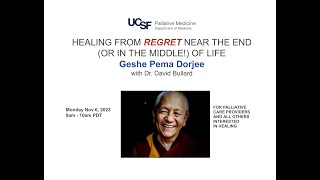
In this hour‑long, moderated conversation, David introduces Geshe Pema Dorjee, a Tibetan Buddhist scholar and humanitarian, to an audience of UCSF palliative‑care clinicians, mental‑health professionals, and lay listeners. Geshe‑la shares his life experience leading the Tibetan Children’s Village, humanitarian projects in Nepal and India, and decades of teaching Buddhism. The dialogue weaves together Buddhist philosophy, practical compassion, and clinical insights to address suffering, regret, and end‑of‑life care. Key points include: the centrality of building deep trust (“heart opening”) in therapeutic relationships; a Buddhist view of regret as a useless mental poison that should be acknowledged, released, and turned into a commitment not to repeat the mistake; techniques for helping patients facing death to focus on positive recollection of good deeds and to cultivate present‑moment awareness; explanations of Buddhist rituals for the deceased (the 49‑day Bardo practice, offerings, prayers) and their psychological value; the foundational Buddhist ethic of non‑harm and helping others as a path to personal happiness; a simple illustration of dependent origination and interdependence to foster compassion; guidance for beginners without meditation practice (be kind, avoid harm, help others); distinctions between problems that are currently unsolvable for an individual versus those that are ultimately solvable; and concrete descriptions of Geshe‑la’s current humanitarian projects (one‑meal‑a‑day program, orphan support, medical funds) and how supporters can engage. The conversation also touches on broader themes of gratitude, mother‑child reciprocity, and the role of compassion in both personal healing and societal change.
Chapters
So good morning, Geshe-la.
Good morning, everybody. Good morning, David.
Good morning, everybody. I'm just going to say a couple of words to begin with to thank our real host, which is Steve Pandelet and Mike Rabow. They're both doctors in palliative care at UCSF. And Steve heads the Division of Palliative Medicine. It's a wonderful group of people that work near the end of life to bring comfort to people. And I've been able to come to a 1-hour meeting of the outpatient group of these doctors and nurses and social workers and psychologists and nutritionists, and it's a wonderful hour meeting in my day. We want to thank them all for allowing me to put this on, and thank you, Geshe-la, in advance for this wonderful opportunity. You and I had tea on Friday, and I don't think I remember laughing ever so much, oh, at a tea before, but it was, was lovely. I'm looking forward to sharing your experience and your thoughts and what you know about with all these people. I should say that the, the people listening include UCSF people in palliative care, but include a lot of other people, a lot of psychologists, psychiatrists, and mental health workers. And we'll get into some aspect of that because Geshe-la has for several years met with therapists in Europe and also people just interested in Buddhism, some of them with quite a practice, quite a bit of experience, and some of them who are just interested. So since it's UCSF, I thought I would read this, if I can find it, this quick paragraph from Geshe-la's friend The Dalai Lama. Buddhists are more of scientists than believers. Buddha himself made it clear that his followers should not accept his word, his teachings, out of faith and devotion. Rather, they should investigate. So in 2,600 years of Buddhist history, many Buddhist masters have checked, investigated Buddha's words. And if we accept his own words, it would be contrary to our own logical investigation. Some people consider Buddha an ancient scientist, so I think you'll be demonstrating that for us today. I won't go over all your credentials, that would take the whole hour. You've been a teacher, you've been the head of Tibetan Children's Village for about 17 years. You've done so many projects to help people in Nepal, children, women, nuns, and just people. You've done so much, and it's such an honor to have you with us today. And I would guess I'd start with when we put out the original advertising for this talk today. We had the title Healing Regret at the End and in the Middle of Life, because those people in medicine and other careers that help people who are suffering— well, we all suffer ourselves too. It isn't just the people we're helping. And I think that's one of the beginning things you mentioned to me at tea about suffering. So I'm going to be quiet. You requested it be more of a conversation, but you're going to be the one getting to speak the most, and I'll try and be quiet. Geshe-la, how would you like to start to greet these people?
And yes, to greet them is a not so difficult, but then give a talk and to convince them, it may be quite difficult. And then also the best way, normally I say best way is to interact with them. So whatever you have some questions or some doubt, and then, then we can discuss, okay? And I will try to share my experience, and I've been sharing my little knowledge to so many places in Europe and in, in Nepal, in India, in the United States. And I have quite a long experience, but still my, my experience is quite limited. Therefore, you can ask questions based on your experience and what you want to listen, and I will be very happy to share. And then of course you will allow me to ask some questions And that will come a little later. So main thing is that how we can help for the humanity in the best way. We all have a potential to do so many good things. We— everybody has a potential to do so many good things, okay? Because of this, we all have very good intention to, to help the humanity in our small way. We can contribute in a bigger ocean of knowledge, and we can take some knowledge from the bigger ocean of knowledge. And in this way, we try to fulfill the people who really need our help directly, whom we meet day to day, day to day, day to day. Okay, think about all sentient beings is quite a big thing, but then we really need to focus to help those who really need our help in front of us. So in this way, this has been my living principle. And one of the important things that so many people are thinking that there are so many problems which are unchangeable, or sometimes they think that this problem is so big and so rigid, and then they become completely tired. So this is totally wrong, okay? Any types of problem whether it's a big problem or small problem, the problems are impermanent by nature. These are impermanent, and this came into existence due to certain sort of cause and condition. So therefore, we have to be very clever to, to how to tackle with this by removing the cause and conditions, okay? And then slowly, slowly, the problem will also go. And it's related with the mental, uh, problems like Now we have a lot of like destructive emotions. In Buddhism, these are the main factor which we deal a lot, okay. Destructive emotion. These are the things which we have to recognize and then we have to try to fight against this by using the antidote, directly antidote. So these things are what I like to talk and if you can ask question. I will be very happy to answer. And if I don't have answer, then you also have to help. Okay.
So the first questions might be back to when you are in a position to interact with and help people who are suffering, who are at end of life or otherwise in pain. Hungry, all of that. What can one individual do?
Uh, of course, the sufferings are so many varieties, okay? And at that time, I was dealing with the tortured, and tortured victim who are prisoner in, in, in Chinese prison, and they were slowly, slowly released, and they And then when we met them, they are physically tortured and mentally tortured, okay? And those are the most difficult, uh, people I dealt. And then there are some people who are, uh, psychologically having some problem and physically some problem. But in general, okay, in general, my approach, my approach is I try, okay, I really try to reach to their heart. I really try to reach their heart means I try to build a mutual sort of trust between me and my client. Once, okay, me and my client, okay, if we have strong trust, very pure trust, and then whatever we say, whatever we do, whatever we instruct or advise, it Everything goes very well. The flow, flow goes very well. So therefore, this is the most important factor, especially in the beginning. If we meet someone who I never met before, I think instead of talking about their problem, first we have to talk in general, try to reach to their heart and feel that that person will be very comfortable with me and I also feel very comfortable with them. And of course, there are many issues which we need to keep in confidential. We have to keep this nicely, have to show that whatever we discuss, it will be between you and me. So there will be nothing. So some sort of like this, we have to make a ground where we say that now we believe each other or we trust each other 100%. So now we both feel very, very relaxed. To expose any types of issue, problem, whatever. Okay. And this is the first step which I pay a lot of attention. And after that, and then we have to see what he really need, she really need, what help they need. Then we can see. Okay. And sometimes maybe today I may not have any solution, then I have to go back and I have to think and I have to read some book and I have to think. Okay. Sometimes, oh, this is now, this is exactly what that person needs. So our knowledge, what we have earned up to now, is we should not think that this is absolutely 100% enough. No, we have to keep on learning, keep on earning the experiences. Yeah, so, and then in this way, uh, we have become more skillful and useful to them.
When we talked the other day, I mentioned that what you just said resonates deeply with psychotherapists. And my friend George Silberschatz, who'd been actually president of the International Psychotherapy Research Society— Society for Psychotherapy Research— said that at least 50% of the outcome of a therapy measure is the relationship. And that's what you're talking about. And I love the language that you use of it's the heart opening. If you were dealing with someone who was older like me— I'm one year older than you, we established that, that I'm I'm your older brother.
Yeah, okay.
And I was looking back at my life with regret. I was feeling like I should have done more of this, or I should have done more of that, or I should have spent more time with my kids. I wish I— they're grown up now, and I wish I had done other things that I didn't do. Is there a particular way you might help that person or help me.
Yeah, yeah, regret. Actually, the regret is quite stupid. Why? Because there's no solution. Only thing we can say that, oh, I made that mistake, mistake which was very bad. Now in future I will not do this again. And that is That is the benefit, okay. Otherwise, if you go on regretting, I think it can also have some negative impact to your mind also, to your psychology. So therefore, regretting, instead of regretting, now this is finished. And this is finished. Say goodbye. I learned something from there and I will not repeat this again, okay. And you are now done, finished. Whether it went very well or very bad or whatever, okay, it's gone. Wrong, done. So I will not repeat this mistake again. That we have to make commitment. And then I think should not feel any regret. This regret can cause quite a lot of psychological problem. So just say goodbye. You are not good. I will not make it, this mistake again. Okay, I will correct myself not to repeat again. And then you are now done, finished. But if I made a mistake, it's done, finished. Okay, goodbye. And then leave your mind peacefully. I think so. Yeah, this is reality.
Yes, reality is now. And I mentioned, I'll mention again for the audience that Thich Nhat Hanh had a story when he went back to Vietnam. He went with a US veteran of the war in Vietnam who had had a terrible 30 years of life since the war because he was a drug addict, alcoholic, homeless, just had a terrible, terrible life because of the guilt he felt of what he did in war. And his buddies had been killed and they went in a village and he killed— he said he killed children. And Thich Nhat Hanh said, those children are dead. War is terrible. But there are children right now that you can help who have lack of clean water, lack of food, lack of shelter, lack of safety. Those are the people, the children you should think about now, not the ones who are gone. And that to me is an example of exactly what you're saying, that we get caught in our heads with things that are You would say not real. You told me something— we'll get to some of the chat questions too— but you told me something I found very helpful, useful, about when you think of something, if, if you can't do anything about it versus if you can do something about it. Could you say a little more about that as those thoughts in your head? Because thinking, your brain thinks you're doing something by thinking. But you're not unless you do something.
I think this is something to do with the problem. And time to time we face problem, okay. And we try to, try to figure out how I can solve this problem. We try, okay. But then our brain or our mind has also limitation. Sometimes we find that, okay, now this problem I can't solve. And then there we have to decide, okay, there we have to decide that we should not regret, or we should not worry, or we should not be depressed, okay. If the problem is impossible to solve based on your own capability, then you have to accept. Of course, you have to use your maximum, maximum sort of effort If the problem is still not possible to solve, then I think we have to think in this way. Sometimes we worry unnecessarily, really, with problem. And then I think the great Indian teacher called Shantideva, he said, if the problem has a solution, it is useless to worry because it has a solution. You apply the solution. If the problem has no solution, at all, and then it is useless to worry. Useless to worry because it has no solution. Why should we worry? Okay, worry doesn't solve any problem. It will not increase our intelligence. Worry may make our intelligence more stupid. So therefore, if the problem has solution, no need to worry because it has solution. If the problem has no solution, it is useless to worry. Useless to worry because it has solution. So this is, I think, very, very scientific. Very scientific. Okay, maybe scientists may not agree with me, but I think ultimately they have to agree with this practically. Yeah, this has been practiced by Shantideva, and all this what is written in Shantideva's text All these are practiced by himself. Oh, they practice themselves for many, many, many years, and then according to experience, okay, earned through practice, and then they wrote the book, they wrote the text, which is called Bodhisattva's Way of Life. And these books are not written by reading another book, another book, and asking few questions from there and there and there, write the book. They didn't write like this, okay. They just practiced by themselves and they realized, and then they write the book, wrote the book. So therefore, these are such valuable instructions. So Shantideva's text, Bodhisattva's Way of Life, especially related with anger, okay, how to develop tolerance. His 6th chapter, the best, okay. His students always say this is the best chapter if you want to develop tolerance and try to remove your anger, and this is the best chapter. He also says, okay, I totally agree. I use this a lot. I think this is enough, David.
Did he say the one about poison? Anger like a poison?
Yeah, anger is poison. Why? Because as soon as anger arises in us, we feel uncomfortable. We feel not happy. This unhappiness or the pain is caused by anger. Therefore, anger is one of the mental, mental poison. Okay. Yeah.
Okay. We have some great questions coming up for you, and some of them will overlap. And that's, that's wonderful because the whole thing, I think, will be about compassion. And I have to have compassion for myself. Right at the moment, because I meant to mention that the other co-sponsors— we have a UCSF co-sponsor of the spiritual care services. But the reason we're all here today with you is because of the Sacred Stream Foundation in Berkeley, and that's run by Isa Gucciardi and Laura Chandler. And they've hosted you many times and been very well— just supported the Tibetan Buddhist community. So much with all, all kinds of their work. And we'll put up the link to their website where they'll see some of your other recordings you can find that you've taught there, and that those are available on different topics. So let's jump right into Jim, Jim's question. Jim Spira is a psychologist working in psycho-oncology, working in people dealing with cancer. And he's a longtime Buddhist practitioner and just on Saturday had a meeting. For those out there who are interested, it's the Bay Area Buddhist-oriented psychotherapy sangha, in a way, that just started. And Jim would be happy to have you contact him about that. So here's Jim's question: Are patients who are afraid of dying often put much of their attention into worry about the future and regrets about what they are losing from the past. What can we do to help them live more fully in the moment?
Of course, when it has come to the end, there's not much you can do. Okay, so Buddhism prepares much ahead. When you started your life, Buddhism teaches us how to live life very simple and honest and more compassionate, and then follow the law of karma in a very correct way, and then try to help others as much as possible with a good motivation. And these are the preparation that when the last day of our life comes, then this will help us in the next life. At the very moment, having no idea anything, then I think it is quite difficult. But only we can say is, okay, now you have to think some positive things. Whatever you have done something positive for the community or for other sentient being, you have to recollect this. And okay, there's no single human being who never did any bad thing, you see, never did any good thing. So everybody does some good things, okay. And try to help that person to recollect all the good thing. When he's about to die, okay, good thing and pleasant things and positive things, and then try to recollect. And then in this way, if that person let sleep nicely, I think this will be the best help. Yeah.
You actually— there's a neurobiological basis for some of what you just said because of a new trauma therapy approach where you get the mind to bring up those positive things that people can think about. It's not just Pollyanna, it's not just thinking positively. It really helps the brain. So your, your background in that is, uh, science is only now catching up some of what you're saying. Here's another one. Could— another question. This is from Tatiana. Could we talk a little about folks carrying regret when a loved one has passed? A loved one has died, and the person who's still alive feels bad. There's no opportunity to do it differently. It again overlaps with what you were saying, and that it seems to really haunt people. Our minds may continue to revisit these painful points. It's a little bit like you just discussed, but anything you want to say about that, especially about someone who's died?
I think in the Western society, there's not much I can say. But in the Tibetan society or in the Buddhist society, and then there are a lot of things to do. Because when someone pass away, And then of course we all go there to say some condolences, what you say condolences. And then we give some money and then say that please do some offerings and some generosity and so on. And so these are the things what we prepare. Okay, there are so many, like say we do about 49 days. Because when someone dies and then that, that mind is transferred to a bardo, which is like medium state, okay? And that is not the real next life. It looks like a next life, but it is a medium state, okay? And that lifespan is only 7 days. And then another 7 days, it can go maximum, like say, 7, 7 days, 49 days, okay? So this, during this time, and then still the dead person is not reborn. So if we do something good things for, for his or her beneficial in the, in the next life, and we do a lot of offerings, okay, we do a lot of food giving to the poor people and save the lives of animal and so on. So to, to make this, by making this, the remaining family member becomes more happy because they feel that they did something very good thing for the departed soul. And then in Buddhism, it, it really helped departed soul. So this is, I think, uh, now these days many of my Finnish friends, they are also sending some money to my monastery. If someone dies, they send some money to my monastery, say, please, will you kindly say some prayers for the departed soul and their name and their date of birth, everything they sent. And then our monks do prayer in the same way as we Tibetans do. And that helps in reality, okay, it helps a living person. And then also we believe, okay, it helps the next, the departed person. Yes. I think this is a very good, very good thing. Very good thing. Of course, this has to be adopted slowly, slowly in the Western society. Okay, now Finnish people are quite now well known. Now they are almost like they are adopting our way of thinking, which they say it helps a lot in the family. It helps.
Yeah.
Okay. Um, Does it make sense?
It does. It's, it's difficult for those who don't fully embrace rebirth and the Bardo. For them, it's, it's exotic, or they don't quite, um, think anything happens after death. There are people like that. But still, ritual also is what you're talking about. We know that there's something deeply satisfying about doing some rituals.
Yeah.
The other is for that specific about someone who's died that a person feels bad about, sometimes asking them, that person, well, what would the dead person say to you right now? And they almost, almost from my friends who are trauma therapists tell me almost always what the person hears or thinks they hear from the dead person is something compassionate. But that may not work for everyone. Um, when you and I talked on Friday when we had our tea, the fact that so many of my friends, and at times myself, we are so In addition to what our own personal issues are, we're so disturbed, so— such a feeling of unrest and horror and terror about what's happening, particularly in Gaza and in Israel. And this is not to turn this into a political talk, but you had some wonderful things to tell me about that.
Yes, yes. So the first thing is that not in this particular situation, but we have to have broader knowledge about the whole world, or samsara we say. In Buddhism we say samsara, okay. We get a bigger picture of the samsara. As soon as we are born in samsara, we bound have so many problems. We bound to face so many problems, okay. And the old age is very cruel. Death is very cruel, okay. And then we get quite often sick and some disease are so terrible and so on, okay. And now we are going through this sort of problem ages, ages, okay. And this is how we are born to experience all these things. And there's not much we can change, okay, in reality. Some people may have little less problem, some people may have little more problem. But after all, death we all have to face, old age we all have to face, and then disease, okay. There's no single person who said, "I'm never sick in my whole life." No one. So these are the reality. In the same way, whatever problem we face, uh, by dying some near one or very close friend, uh, to me when my mother passed away, of course it was quite hard, but we were prepared. She died on the 16th of October and I arrived at home on the 14th, and 15th we have a very good day. My mother was also nun and I was also— I'm also monk. Actually, we don't sing songs, okay? But on that day, 15th, we together sang many old songs which we have been singing for many, many years. We sang so many songs and she was very happy and I tried to make her very happy. We don't know whether she's going to pass on the 16th or not, we don't know, but Only thing we know is that she's going to be passed, died very soon. So we try to do in this way. And then I asked few questions, do you have any regret in your life? And she said, I have no regret. And then I said, what do you think about your life after coming from Tibet and then to India and then spending life with me, okay, 27 years with me? And she's, oh, she said, I'm so happy, okay. I never expected like this, okay? I don't have to worry anything, but I have everything, and you're always there to entertain me, make me happy. I don't have to worry anything about expenses, money. I don't have to worry. So she said on that 15th day, she was, she was so happy with me. And then we have 4 other, 4 other family members, and they were all love her, love her, okay? And, and then we were all very happy. She was very happy. And next day, 15th, early in the morning, 16th, she was quite unstable. And then my niece informed me that now she is quite unstable. This is very unusual. I think maybe, uh, today she might pass away. So we don't know. And then we were very careful, okay? We were just around her. And then when she was about to pass away, we were all around her. She was sleeping in bed, we were sitting around, and we talked quite a lot. And then after some time she said, now I have to lay down. She checked everyone's face, she checked everyone's face. Oh, she said, you look very happy. Okay, you are all very happy, and you took very good care of me. So now I really like to lay down. And we put some pillow and she lay down and she passed away. We, we didn't have any sort of regret. She didn't have any regret. That is, we can say that we, when we are alive, we have to be very nice to each other, sincerely, from the core of our heart. Okay, when we are alive We have to be nice to each other, either it's a family member or neighbor or anyone else, okay. We try to be nice to each other. And then this, if you go on doing this whole your life, your life, your death will be no problem, okay. And your remaining family member will see how happy you are when you are about to die. They will also see this and they will also not be so unhappy. So I think in our life, daily life, we have to prepare. Prepare. The best preparation is to be nice to everybody, including your enemy. We Tibetan encountered a lot of problem with the Chinese, okay. When it comes to like compassion, We have to include the Chinese also. If we exclude Chinese, and then our compassion will be totally finished. So therefore, to be nice to everybody from the core of your heart, whether they are enemy or friend or family member, it doesn't matter. Okay, without differentiating, we have to be nice to everybody, and that will give you the confidence, confidence when you are passing away. And your family member will be also very happy. When she was alive, she was so nice to everybody, and they will have less regret. Yeah, so these are the Buddhist way of dealing. I hope, I hope it will be helpful.
It's a wonderful formula, and it's a wonderful way that you express that.
Yeah, thank you.
Thank you. Thank you. We'll, we'll all benefit. I could feel the ripples from everyone here being able to take that in. Here's, here's another question from a friend, Sebastiano, and he's wondering, can you distinguish between a problem that has no solution And a problem that has a solution but it is not yet in your individual power to solve it. I could do that again, or you—
Yeah, is it answer? Shall I answer?
Yeah, sure.
Yeah, there is not a problem which is designated as an unsolvable problem. There's nothing be. In reality, every problem will be able to solve. I said problems are all impermanent, but it depends upon the person who is experiencing that problem. If the person has no capacity to solve problem, for him that problem is not solvable. Okay, the more wiser, more practice, they may have much more potential to solve the problem. And there are so many people who has not much potential to solve the problem, and for them it is not possible to solve. And that has to be taken as an unsolvable problem for that particular person. That doesn't mean that that person's problem will be never solved by anybody else. Okay, does it make sense?
It, it does, because it also clarifies how We have so much— my Zen friends say the difference between reality— we are all on the Zoom call, I'm sitting on this chair, and then whatever goes on in my head, the thoughts, the thoughts, the thoughts. Maybe be useful. I'm going to ask our wonderful Annette, who's behind the scenes, to post a couple of links to support your projects. And I'll have you talk about those projects in just a moment. But I also— let's see, I was thinking about any general advice you give to people who are— who have not meditated or have not had a Buddhist practice and maybe can't join a sangha, but any beginning advice you would give? We have people on this call who are very experienced, but some who, who have less experience. So when you say preparing, how, how would you ask people to begin to prepare?
I think in short I will say, okay, I already mentioned that one very important thing is that we— or if I say, okay, I have to be nice person to everybody, if possible everybody, okay. Maybe in the beginning there are some people who are very difficult, but I have to be nice. Look, every day I have to be nice to everybody. And then what do we have to practice? First thing is try not to harm anybody. Try not to harm anybody directly or indirectly. Try not to harm anybody. And then if you practice this, okay, on top of this, if possible, try to help others as much as possible. And then this is really possible, okay. Try not to harm anybody directly or indirectly, and then on top of this, try to help others as much as possible. If you go on living your life in this principle, I think at the end you will, you will feel very happy. Of course, this is a big condensed version of Buddhism. In short, okay, in short, why, why we should not harm? Because we don't want, we don't like to experience suffering. If we harm to other person, other person will suffer, and no one likes to suffer. Therefore, try not to harm anybody, and then everybody become, I want you to be happy. Therefore, try to help others as much as possible. If someone helps me, I feel very happy. In the same way, if we help other people, people will be very happy. And then this is our most important true feelings. We don't like to be suffer. We don't— we want you to be happy. Try not to suffer. Try not to harm anybody. And everybody wanted to be happy, so try to help others as much as possible. Yeah, and this is possible, okay. You don't have to believe in Buddhism. Actually, it is reality. This is really possible, everyone of us. And then you all have to feel that we are born as a human being is so fortunate. So fortunate, okay. We have so much skill to express, we have so much skill to receive, and we have so much skill to digest, to think and improve ourselves. Such a, such a big opportunity. You can feel, I'm so lucky, okay. And then try not to harm and try to help others as much as possible. If you live this life, I think everything will be fine. Yes.
You did a wonderful job of condensing that. And you have another opportunity in New York with Robert Thurman at Tibet House US soon to do 5 days of teaching about people who are interested in learning some more. I'm tempted. I know I'll hear a big laugh from you. When I ask, is there a way for you to simplify the two main teachings of sanghapa or non-self and dependent arising? Maybe that's a bit beyond condensing because you're a scholar and you've studied these texts and there's quite a bit of depth of 2,500 years of thinking about this. But I thought I'd ask you anyway.
I think, no, I'm exhausted. You're what? I'm exhausted.
Exhausted.
Yes. I can say, okay, I can say, okay, I will, I will try to explain a little bit. Okay. So in Buddhism, interconnected Interconnectedness and interrelated or dependent arise is a very, very important view. Okay, view. So normal, in a very simple way, I think that I'm existing independently. Actually not. I'm depending upon others, including my clothes. I need to go to someone else. If I need some food, I have to go to others. If I need a medicine, I have to go to others. Okay, the basic existence of me, including everything, education, I have to go to others. And we are so dependent upon the others. Therefore, we have to think that we have to be nice to others. Why? Because without others, there's no way I can exist. Even as a human being, I can't exist. And then to exist as a nice and educated person without others, there's no way. We have to go really deep down and think how our teachers taught us, and our body also coming from our parents. How grateful. And they brought up from a tiny, tiny insect, type of insect. We forget, okay. Especially in the Western education, these are not mentioned, which is very sad. That's so, that's— we should say thank you from words, it's easy. Just to think that, oh, my mother took care of me. So many years and still she worries about me. And this is, I think, we really have to revive. One of the great Indian scientists called Dr. Abdul Kalam, he said, he said, okay, mothers are the funniest person on this planet. Why? She, she bring the baby in the in the womb for 9 months, and then she brings on her arm for at least like 3 or 4 years, and then forever in her heart. This shows how much we are connected with other human being. And then anything like food, clothing, medicine, education, everything is coming from others. So we have to really learn How to respect others. Therefore, we say doing something good for others is a very, very beautiful action. Yeah.
Thank you. Thank you. Thank you. I'd love now, and I think we all are eager to hear because it will uplift us to know what are your projects now that you are helping, that we can help you with? And again, the links are there for any donations. This is compassion fundraising, not just fundraising, but any particular of your projects that you'd like to tell us about? And can we go visit them in Nepal or India?
Yes, it is. Of course, the best is to visit. So these days, to believe or to trust someone is quite hard. I always ask my friend to visit and see, check what we have done and what we are doing and what we are planning to do. And then they are also involved. They are very happy. Today in the morning, I received message from one of my friend from coming from Sweden, and she was selling some bracelet. And the selling the bracelet, the profit is she's giving food, which is called One Hot Meal a Day for old and handicapped people in the village. Every day about 20, 25 old people, handicapped people comes there and they get a lunch free because they have no chance to get a good meal a day. Sometimes they get okay, and sometimes they really don't get anything. So therefore, like, these types of projects are very handy Not very big, but very beautiful. Okay. And then if you say we wanted to support an orphan home, or we want to sponsor a child, orphan child, or we wanted to give a medical fund because we need a lot of medical funds. So many people are coming from remote village to the Kathmandu and they have no money. And then they have to go back again. So if we support their medical expenses, at least they get the medical treatment. So like this, there are so many practical things, okay? And there, of course, I will say best thing if you could visit and I can show. And also, I'm not so good in explaining this, okay? I don't want to advertise my work. Which I don't like. Because this becomes so sort of like business type. I don't want to put so many photos of the so many poor people, or I talk a lot about poor people. This becomes like a little bit like a business advertisement, which breaks my heart. But in short, I think you understood what I'm saying. Okay. And if you are able to visit the remote village, in Northeast India or in Nepal, and that will show you whole picture, okay? And then also what we have done, yeah. And of course you can ask me to send some, uh, story or some link, or that is okay, that is no problem, because these days there are so many links, okay? So I'm very happy to do all these things. Yeah.
Thank you. And just to acknowledge, there was a big earthquake 300 miles west of Kathmandu, I think.
Yeah, yeah.
Have you heard about that?
Yes, I heard, and I made a phone call in the morning to my Nepali brother, and he said it was very, very— of course, it was not— we can't compare with the earthquake in 2016, but it was very big. He said directly, okay, directly they saw that 120 people died, and still they don't know how much really died, okay. They don't have any sort of facts and figure, and the need of emergency fund and medicine, water is very, very intensive, yeah.
And a year and a half ago or so when we had lunch and you made a comment to me that really struck me about, you know, David, $1.
Yes.
Here, can you say something about that to all of us?
Yes. And of course, one of the examples I put this time is that one of my young friends in Finland His name is Tero, okay? And he said, Pema, you are helping a lot, but of course I have wish to help, but I don't have any money. That was in the midnight, okay? And then I was thinking, okay. And then I said, Tero, don't say I don't have money. Don't say. You have money. And then, then I calculated, okay, €1 can feed one person whole day. In Nepal, because it is about 140 something, and that can feed a person in whole day, €1. And I said, I calculated and sent to him, said that you have money, and if you have €1, just let me know and I will, I will report you back. And he said, I have €1, more than €1, I have €5, €10, €20. And then he felt he was also psychologically depressed. He was almost decided to commit suicide. But then because of this incident, he felt that he has a potential to do something good things. And he helped. And I reported. And, and then now he become very good. It helps. Helping is not only helping poor people, but helping also helps us. At least it makes us a good human being. Yeah.
Those of us who've been lucky to stumble into helping professions of medicine or therapy, or there's so many ways to be helpful.
Yes, yes, yes.
Look back and feel full, I think, We can extend if there are no more questions. We can extend the compassion to let— maybe we'll stop 3 minutes before 10. People have 10 o'clock appointments in their day. Their Monday is going to be busy. We can, we can finish up right now. In our meeting of the symptom management of the palliative care people, we always end with a gratitude. Everyone says something they feel grateful for, and we walk out of that meeting feeling so good. I'm feeling that right now. I'm so grateful to you. Thank you for spending this time with us and the other times you spent, and want to help you and want to also appreciate so much for Isa Gucciardi and Laura Chandler, who you're staying at their home, your practically, I think they've adopted you. And so you have another mother.
And they have been helping me many, many years, okay. And they have to feed me, they have to receive from the airport, and then they have to drop me in the airport. And then they listen all my project, and then they try to help, okay. So they have been wonderful, wonderful. And I think best example of good human being.
And they're thesacredstream.com. Yeah, you can go to and visit. And last but not least, maybe a final word about, um, since we're talking about mothers. Was it just 3 weeks ago your mother died, or a longer time?
A longer time. Yeah, yeah.
Um, mother recognition. Could you leave us with that thought of that we are all, we've all been each other's mothers.
Yeah. Yes, yes. I think to me, as long as we are together, mother and children together, as long as we are together, we really have to respect them, serve them, show good attitude, and then serve them out of love. And then one day we have to separate. We can't stop this. So therefore, as long as we are together, parents and children together, and we have to be nice to each other. Yeah, we feel so happy seeing each other. Yes, thank you. Yeah.
Again, on behalf of everyone here, and someone wrote something beautiful, he said, to you, Geshe-la. Grateful for these breaths of fresh air.
Thank you.
I feel that too. Thank you so much. And thank you all for joining with us for this opportunity.
Yeah, thank you.
And recording will be made available. You'll get that if you're here and signed up, you'll get that. So until next time, Yes. Although time is another dimension that Buddhism has, I could ask you about, but we don't have time to talk.
Yeah, yeah.
Okay. Yeah.
Thank you all. Thank you so much, everybody. Thank you. Yeah.
More from David




Learning from the Tibetan Buddhist Experience, Thupten Jinpa, PhD, February 02, 2025; Sacred Stream

Prof Mark Solms and Dr. David Bullard discuss Memory Reconsolidation and Manfield's Flash Technique

Neuroscientist Mark Solms Discussing Memory Reconsolidation and Manfield's Flash Technique.

Brief experience with FLASH TECHNIQUE Lessened Disturbing Memory of Cancer Diagnosis' Impact

Flash Technique Experience for Hospice and Palliative Care Staff and Patients 6 10 24

Professor Mark Solms on completion of the 30-year project: The Revised Standard Edition of Freud

