YouTubeBrianMuraresku/BillRichards/MaryCosimano
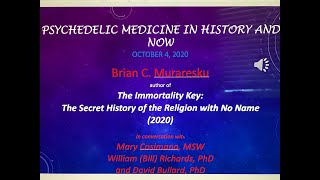
In this UCSF‑hosted panel, moderator David Bullard brings together author Brian Murarescu, who spent twelve years researching the ancient use of psychedelic substances in mystery religions, and Johns Hopkins clinicians Bill Richards and Mary Cosimano, who lead modern psilocybin trials in palliative care. Brian outlines his quest to uncover the secret sacrament of the Eleusinian Mysteries, describing his field work at Eleusis, the archaeological chemistry of ancient vessels, and parallel evidence from Göbekli Tepe and a Spanish Romanesque chapel that suggest ergot‑spiked beer was used in ritual. He emphasizes the historic role of women as healers and the later patriarchal shift that suppressed sacred pharmacology. The discussion then moves to contemporary clinical research: Bill and Mary summarize two‑decade‑long psilocybin studies with terminal cancer patients, reporting high rates of mystical experiences, reduced death anxiety, lasting psychological benefits, and even positive effects on grieving family members. They announce the imminent launch of a psilocybin‑enabled oncology unit and discuss ethical, regulatory, and societal implications of integrating psychedelics into hospice and broader mental‑health care. Throughout, the panel reflects on the continuity between ancient rites and modern therapy, the transformative potential of “the immortality key,” and a hopeful vision of a future where love, spirituality, and science converge.
Chapters
Hello and welcome to this presentation on psychedelic medicine and palliative care. We'll be in discussion with Brian Murarescu, author of the new book, The Immortality Key: The Secret History of the Religion with No Name. Brian spent 12 years researching this book, and he's a scholar in Latin, Greek, and Sanskrit. We'll have additional discussion with Brian from Dr. Bill Richards and Mary Cosimano, two of the preeminent clinician researchers who are from the Johns Hopkins School of Medicine. I'm David Bullard from the University of California, San Francisco, and I'd like to start, Brian, by asking you— several days after the book became available, you were interviewed on a podcast that was seen by millions of people. What was that like?
My afternoon with Joe Rogan, it was an intimidating experience trying to explain the past 12 years of my life, but a very fun one. And I feel like I'd rather listen to Bill and Mary and everybody else here. But what I will give you is a a brief audiovisual.
How about that?
So I'm going to share my screen here and I'm going to open up and show you some of the pictures I've taken along my little journey here. So if I open this, for example, can everybody see my screen? Okay. David, is that coming through on your end?
Okay.
All right. So this is my book. It was just released last week, The Immortality Key. And this is essentially, my effort to try and solve what the great Huston Smith called the best-kept secret in history. And this is the idea about the Eleusinian Mysteries, obviously. And the two main questions that guided me on this, on this journey for many years is whether the ancient Greeks were using drugs to find God. And in that effort, really trying to understand the mystery of life and death itself. And the second question, more controversial perhaps, is whether the earliest Christians may have inherited that same secret tradition. These are traditions that have been kept secret for thousands of years, and throughout the book I argue that whatever was happening in Eleusis, and we still don't really know, it really could represent something that is prehistoric. Isn't that when the search for religion actually begins. Religion itself comes from the Latin religio, to bind back. Not only to bind back each of us to one another, but to our ancestors into the remotest corners of history. So with that, like any good story, it begins in the 1970s. And so we have to appreciate two of the founders of the discipline. This is, this is a great picture taken in 1977. Of Gordon Watson and Albert Hoffman. And together with this guy on the left, Carl Ruck, who then was the chair of the Classics Department at Boston University, they released a book called The Road to Eleusis, in which they claimed that the best-kept secret that nobody had been able to figure out was in fact the secret of the mysteries itself, the secret ingredients of this kukion potion, the sacrament that was consumed by the the ancient Greeks after they made their 13-mile pilgrimage northwest of Athens to Eleusis for what we can believe is close to 2,000 years. Now, we don't know what the mysteries looked like as far back as 1500 BC, but we do know that by the classical period, the best and brightest that both Athens and Rome had to offer were all seeking that initiation, the likes of Plato or Cicero or even Marcus Aurelius centuries later, even after the Greeks fell on their prowess, the Romans kept Eleusis alive, which really, I think, is a testament to the power and prestige of these religious ceremonies. And so I started the journey by going to visit Ruck, who is no longer 42 years old and chair of the Classics Department. He's now 85 years old, and we spent a beautiful afternoon at his pre-Revolutionary War home in Hull, Massachusetts, about an hour or so south of Boston. This is a picture of him overlooking the beautiful Hingham Bay. And Ruck has never really talked about how a theory as controversial as that affected his career, but it did. It's hard to become the drug guy in the staid discipline of classics. And I myself studied classics when I was a younger man. In fact, it's the reason I went to college. I never could have afforded it were it not for a very generous scholarship that brought me up to Providence, Rhode Island to study Latin and Greek and Sanskrit and Arabic and waste my time for 4 years studying dead languages. But it's how I got in touch with my ancestors. And I found it very moving and compelling to really follow in Ruck's footsteps. I was always fascinated by his scholarship, but I didn't know what to make of it for the longest time. Uh, and so I, when I went to visit him, my main questions were why this idea was so controversial, the idea of the ancient Greeks using psychedelics to find God and what it all meant. Uh, because to me it wasn't that controversial. Uh, I did grow up in the '80s with the war on drugs and Ronald Reagan, Ronald Reagan telling me to just say no. Uh, but, uh, I never had any experience with psychedelics myself and didn't know what to make of it. So I wanted to see what the sources said. One of those sources were hidden away in the archives at the botany libraries at Harvard University, and I spent an afternoon in there reading some correspondence that Gordon and Albert had shared in the 1970s. In 1976, Albert penned this, this interesting letter to his co-author Gordon about his self-experimentation with ergonovine, which is one of those alkaloids that is present inside ergot. And what really surprised me is that he described his self-experimentation with ergonovine as 5 to 10 times more effective than psilocybin. And I didn't know what to make of that because no one I'd known had ever experimented with ergonovine. It's, uh, funnily enough, Albert sent some samples in the mail for Gordon to try for himself, and he politely declined and made Ruck self-experiment instead. And Ruck claimed that he never had the breakthrough moment that Albert said he had. And so, you know, this very much remains a mystery. As a matter of fact, to this day, no one has been able to reverse engineer an ergotized potion that produces the kind of experience Albert is testifying to here. So the chemistry is still a bit of a mystery. But I was interested in something else. I was interested in the archaeochemistry. It's a relatively new science that is going into these ancient chalices and these ancient vessels and scraping the organic residue that, that can survive for hundreds and thousands of years. And for the first time, scientists at places like UPenn and MIT are able to go inside these ancient containers to tell us once and for all what what our ancestors were actually consuming. And there's been some really impressive finds over the past 10, 20 years, all relatively new in terms of the slow march of science, but fascinating stuff. And, you know, I'd never read anywhere of anybody approaching the excavator and the archaeologists at Eleusis and just simply asking them, "Can we test? Can we test your vessels? Have you found anything on site here? And if so, what is available for testing?" So I flew over to Greece. This is the main courtyard. At the archaeological site at Eleusis. And this is a beautiful shot in midday September 2018, the same time of year when the initiates themselves would have descended on Eleusis to drink their potion and meet the goddess Persephone and have what's been described as a beatific vision. Plato himself said it was the holiest of mysteries, that he witnessed something, this blessed sight and vision Pindar, Sophocles, almost universally people are talking about witnessing some kind of a vision. And interestingly, on site now you have this juxtaposition of the Christian and the pagan worlds. You know, Eleusis never survived. The Christianized Roman Empire in the late 4th century AD came along and wiped it off the map. And as far as we can tell, the secret disappeared with it. So, on site there, I walked into the museum, and you see interesting things like this, for example, which is a marble sculpture from the 4th century BC of this guy riding a dragon cart, which is Triptolemus. He's kind of like the missionary of these mysteries. It was his job to go and spread them around the Mediterranean world. And here's another similar vessel showing the same Triptolemus. This is the, the great missionary of the ancient Greek mysteries. So that'll come up later. We do know that there was, uh, there was something consumed, because here is something in the National Archaeological Museum in Athens of people making that pilgrimage to the sacred site in Eleusis. And you can see those chalices on their heads, the priestesses carrying the chalices. So we do know that some kind of mixed beverage was, was involved, and we do have the vessels that, that survive from the Classical period. Maybe maybe a Plato or one of his friends or one of the female initiates were actually carrying these 2,500 years ago, preparing to enter the underworld and spy Persephone in the flesh. And so, Kalaipi Papangelis, who's the excavator in charge, showed me her beautiful artifacts here. And I asked the very simple question, is it possible that we can test these? Well, how would you feel about the archaeochemists coming along and scraping these contents and seeing what was in there? Maybe they will find this, this potion that Wass and Hoffman and Ruck talked about in 1978. And the unfortunate answer was that no, we couldn't test them. Not because she didn't want to, but because these had all been cleaned. They'd been cleaned and treated for conservation purposes so they could be displayed in the museum. I asked the obvious follow-up, well, is it possible there are other containers in storage or containers that haven't been excavated? Every time I asked a question, unfortunately, the answer disappointingly was that they'd all been treated and there wasn't any likelihood of a live specimen that we could send off to a laboratory in Boston, for example, or in Germany for testing. It was kind of disappointing. I had to get get creative and think about other ways to test this mystery, because this picture more than anything, I think, testifies to it. This is from the National Archaeological Museum in Athens. And at the bottom there in Greek, you see the beautiful phrase Demeter Ukrates. And we think Ukrates was one of these initiates. This was dug up inside Demeter's temple in the 5th century BC. And this was his way of offering a gift to the goddess. Now, Persephone is the goddess who shall not be named, so he calls her Demeter there at the bottom instead of Persephone, but we think that this could be the head of Persephone with the burnished sun rays emerging from her neck and head, and perhaps this is the vision that this initiate Eukrates saw. It's a really romantic artefact of just the eyes staring into timeless infinity. This is the way that he wanted his vision to be remembered, which always struck me. It's one of the most incredible artefacts that I came across in the course of my travels. And so, with a dead end in Eleusis itself, I started to research the history of beer, because if you think about the that potion, this kukion, this mixed cocktail, the ingredients that come down to us from the Hymn to Demeter, for example, 7th century BC, are 3 very simple ingredients: αίφί, which is barley in Greek, ��δορ, which is water, and βλέχον, which is mint. So water, barley, and mint kind of sounds like a simple recipe for beer, although by all accounts, whatever was happening inside Demeter's temple was something more than an alcohol trip, and which is why, again, Wasson, Hoffman, and Ruck wrote their book about this, about this ergotized spiked beverage. No one's ever found ergot or an ergotized beer in the field, and we have archaeologists who've been out there for the past 20 years looking for it, which is really strange. So I went to all these archaeochemists to see what they have found. If they haven't found ergotized beer, and they are testing things, what have they found? And there's interesting signs at a place like Göbekli Tepe. This is an image of Göbekli Tepe, for example. This is 12,000 years ago. This is some of the first megalithic architecture that we've ever found. And on site there, this in particular dates to the 9th millennium BC, you see barrels and troughs that they think were filled with 42 gallons of beer, which raises a really interesting question. And this long debate, in archaeology about the first biotechnology on Earth. Was it beer or was it bread that first domesticated humanity? And there are those who do think actually that we started growing cereals like barley and wheat because of the beer, that we were drinking our crop instead of eating it. So there's the really interesting possibility that the world's first temple, which is what they call Göbekli Tepe, was actually the world's first bar. And this is, this is 12,000 years ago, but it wouldn't have been something recreational. We're talking about sacramental drinking because along on site there, they found a skull. And you can see there bored into the top of it in the left parietal bone, there's a hole. And they think that it would have been hung ceremonially, ritualistically in some kind of mortuary ceremony, a death ceremony, where the idea being was to con— contact the ancestors. Some think that the German Archaeological Institute, who's in charge of the dig there in Göbekli Tepe, they think that it could have been a cult site for the living to interact with the dead. Again, it begins at the, at the very beginning of modern civilization, 12,000 years ago, and the idea doesn't really disappear. So I talked to next this guy Pat McGovern at the University of Pennsylvania, and there he is proudly displaying one of the 160 bronze vessels he excavated in modern-day Turkey in Phrygia. We think that what he's holding used to belong to King Midas. This is the 8th century BC, and when he tested it in the late '90s, it tested positive for what he calls a kind of mead, tested positive for beer, wine, and honey. So another mixed beverage. It wasn't psychedelic, but the clues are beginning to mount that our ancient ancestors were in fact drinking these ritual beverages. And just like Eko Bekli Tepe, this drink would have been used in some kind of mortuary ceremony. And McGovern himself says that he thinks it was used to usher the deceased into the afterlife. Again, these mysteries of life and death accompanying us in this part of the ancient Mediterranean, in the Aegean, between Greece and Turkey, you can say from 10,000 BC all the way into the very direct ancestors of the Greeks, the Minoans and Mycenaeans. It just incredibly survives for thousands and thousands of years. But all we have are hints and clues, and no ergot. So I'll skip over the Sanskrit real briefly, and, uh, which takes me to Spain, where you don't expect to find Greeks, but there's Asclepius, the Greek god of healing, and it looks like he could be staring out at the Aegean on an island in Greece. But this is northeast Spain, Catalonia, on the border near to France. And what we have here are the beginnings of another mystery tradition in the western part of the Mediterranean. And I started researching this place because it was a Greek colony I'd never heard of, but I began reading these interesting studies by this archaeologist who'd found some amazing things 20 years ago that for some reason were either ignored or underreported. What the Greeks brought with them is Persephone. This is the goddess of the underworld on the left, the same Persephone whom the initiates would have made their 13-mile pilgrimage from Athens to Eleusis to meet after the consumption of that, of that kukion potion, which is really interesting. From the very beginning, the Greeks brought this, this mystery religion into Spain. Further inland, at an archaeological site called Pontos, all these really incredible things are, are popping up in the 1990s. This is a terracotta head from the 3rd century BC. The archaeologist believes this is another Persephone or Demeter figure. You see these 9 Greco-Italic amphorae from the 3rd century BC. Greco-Roman to the core, obviously. And then you see things like this, a thymiateria, which is an incense burner. Again, could be Demeter, Could be Persephone. It's 3rd century BC, and it's in this overlooked archaeological site swimming in the Greek mysteries. This is a krater, a bell-shaped krater from the 5th century BC. It belongs in a dining room in Athens, but we find this on a farm in Spain, and these are people engaging in a drunken revel in honor of the god Dionysus. And then there's this, the same Triptolemus who we saw at the museum in Athens. This is the Triptolemus on his flying dragon cart, and whenever you see the missionary of the mysteries, the fair question can arise, were these mysteries consciously transported from Greece to Spain? What makes this very interesting is that in addition to all these Greek artifacts, and you can compare the triptolemus from Spain with the triptolemus from Greece. And here again, you would see the same triptolemus against the one from Italy. Uh, what's interesting is that these weren't just random objects in a random place. They were in a ritual sanctuary. This is a small house on site that the archaeologist calls a capilla domestica, like a household shrine, and in there, more Greek elements. Like this, for example, which was proven to have originated in Greece. So time and again, all this Greek influence is popping up and popping up, and I find it incredible. The more I read about it, the more Greek it becomes, the more the mysteries are suffusing the environment. And so I call Professor Ruck in Boston, and I say he has to come see this place, because I don't think many classicists know about it. I've never read about this Greek farm in Spain in all my studies. And so the then 83-year-old Carl Ruck joins me, and we transit the medieval cloisters into this 12th-century Romanesque cathedral in Girona in Catalonia, where some of these artifacts are now housed. And there they are, the ones that were dug up in the 1990s. I didn't take Professor Ruck all the way to Spain just to have a look at some pottery. I brought him here because that small chalice in the middle tested positive for the remains of beer in 1997, which is really strange because you can see how small it is. Why, why would you have a shot of beer in this ritual chamber? We think the answer is because of what was added to this chalice. It wasn't only tested positive for remains of beer, it also tested positive for that elusive ergot, the same ergot that Wasson, Hoffman, and Ruck had predicted back in 1978 based on nothing but Albert Hoffman's intuition that the same ergot that he used to synthesize LSD may have been used in the ancient past. How they did it, we don't know. Which alkaloid they were able to extract from it, again, we don't know the chemistry. But the archaeological chemistry is— and the archaeobotany seems pretty compelling that this ritual chalice was in fact filled with some kind of ergotized beer, and this took me about 12 years to find, and it was very emotional to talk about it with Professor Ruck, and so we unveiled this for the first time last week, and this is essentially the entire first half of my book, which is trying to see if there was any evidence to vindicate this scorned hypothesis about the use of drugs in the ancient world. Now, we don't know the relationship between this, this Greek farm in Spain and the Mysteries of Eleusis itself. We just, we, we can't prove one way or the other, but it's, it's this really, really compelling piece of data about mysteries that seem to be dedicated to the same goddesses you find in Greece. And there, in addition to the chalice that was found, was a human jawbone. The bottom right of a human jawbone, and that also tested positive for ergot. So, it argues against the supposition that this was some kind of accidental outbreak or some unconscious relic. As far as we can tell, there was some kind of intentional consumption of ergotized beer, and it calls to mind the same skull cult from Göbekli Tepe. 10,000 years earlier. Again, this mystery of life and death that you see now from Turkey to Greece to Spain was something that our ancestors were obsessed with. And so, all that said, I'd much rather hear from other folks about what they feel about the mysteries of life and death. And so, I have more slides and more stories, but that I can share, but I offer that only as a quick primer on the kinds of things that I was looking for and the kind of adventures that I was on and the privilege it was for me to try and track down these clues and bring them to the world. So, with that, I'll pass it back to David, and I want to hear from the real masters.
Thank you, Brian. That was— Incredible. Were you able to write off the trips? Probably. I hope. We can speak now. I think Mary would like me to have Bill go next. Bill, do you recognize this book?
I do.
I had the pleasure of interviewing Bill for this book just as it came out. And that was my first time talking with him, and it was a delight. And I'm personally thrilled that you're here to share with us about this important topic. In a way, we're going to be using words and concepts and ideas to try to talk about an experience. What is it about the psychedelic experience that can cause such a sense of peace in the people that you've done your research with. I want to also, before I let you get started, was your first experience with psilocybin in 1967 in Germany or 1969?
Actually, it was 1963.
'63, oh, you did beat me. In Ann Arbor, where I was in 1967, I think it was February, a guy named Timothy Leary came to town and gave a talk, uh, in support of a political musician named John Sinclair who had started something called the White Panther Party. And after he left, I had an opportunity to partake of LSD, and that was before it was illegal. And I had a wonderful experience of whatever my sense of myself was kind of melted away, like taking clothing off. And, uh, my ego just kind of left to feel the true, uh, final essence of being just light. The next day I went to my seminar in Irish literature, about 8 people and a wonderful professor from Ireland, and I tried to elucidate what had happened to me, and they kind of looked at me and nodded. Then they went back to the readings. So, Bill, anything you'd like to share with us about your sense of all of this?
It's a joy and honor to be here. I feel Brian is a real pioneer. I wish I had his knowledge of Sanskrit, especially. I envy him a bit. He's a bit like Indiana Jones in disguise. Going through all these subterranean caverns in the Vatican and whatever, and it's delightful. Mary and I, of course, have been doing research at Hopkins for 20 years now with psilocybin, and I did work decades before at the Maryland Psychiatric Research Center, originally in Germany when it was still legal. And, um, I think we would both say there's no question that science, in investigating these alternative states of consciousness with the tool of psychedelics, is genuinely bumping into realms that we call sacred forms, uh, depths of human consciousness that seem to be intrinsically innate within all of us, but most of us don't know that they're there. You know, we think our whole being is our everyday personality, our ego, and the psychedelics open up these other incredibly beautiful and powerful and insightful. And we're finding at Hopkins and elsewhere potentially healing states of consciousness. So these drugs have been around, you know, who knows, over 5— since 5000 BC, if not before. And it's fascinating to see how they may have contributed to early Christianity. As well as other world religions. My hope is that they will stay above ground and we will integrate them wisely into our culture. And we're off to a very good start. I could talk and talk and talk here. I want to give time for— let me just stress it. In case there's any listeners new to this, that this is not necessarily the psychedelic experience. There are many mind-manifesting experiences of other states of consciousness triggered by psychedelics and by meditative techniques and all kinds of other technologies. Um, there's perceptual changes, there's reliving of psychodynamics from childhood, there's visionary experiences where the ego is still intact as the observer, and then there's these profoundly magnificent, uh, unitive states that we hardly know how to put into language. Uh, but they seem to often be the most powerfully transformative. Uh, and, uh, we can come back to talk about how we define that and what their value may be for those of us who are mortal, which is most of us.
Thank you, Bill. We'll look forward to more input from you. That was wonderful. And before this segment is done, I just have to share with you that someone I, I know very well, near and dear to my heart, read your book 10 years after she'd had a journey of a psychedelic substance. And reading your book, she said, made some things click. It integrated something that had happened 10 years before. So Again, thank you for all you've contributed, and it's really a wonderfully written book and touches and moves many people. Now, Mary. I have— what an honor for me to introduce Mary to this group of people here. And I'll start by my— the reason this is being hosted and sponsored by the Division of Palliative Medicine at UCSF is because I lucked out about 13 years ago and got involved with a group led by Dr. Michael Raybould, who's— was probably one of, if not the first, one of the very first outpatient palliative care clinics. And I got to sit in on a meeting of the staff, the doctors, nurses, psychologists, social workers, nutritionists, hospice workers, about 25 of us, for 1 hour a week. And in it, we would talk about people who had died. And I've said this before, but it might be a 38-year-old nurse talking about a woman who died who was 38 who had 3 kids. So it was an opportunity for us to share very deeply some of the sadness that health providers and healers come across. At the end of the meeting, we always end up— everyone goes around the room, everyone says one thing they feel grateful for, and you walk out of there feeling uplifted by having delved into the mysteries of the most sad and difficult and painful experiences people can have and they come right back to the present moment, the joy and delight in being alive. One of the staff might say, "I'm just grateful for the sunrise this morning. I drove my high schooler to school." So, as that little bit of 1 hour a week, I really saw these people as angels and as incredibly heart-filled people who are doing the work in palliative care. But any kind of medicine or any kind of work, if you work with people, means you're, you're helping, and there is human suffering abounding. Mary has sat with people in the study that most of you know about, but she might say more about it, but it's with cancer patients who are experiencing existential anxiety or death anxiety, and they would do the one or two session with psilocybin that Bill referenced, and Mary sat with— I let her say— I think it was in the hundreds of people going through that. And Mary, anything you'd like to say about any of this? But we're just so happy to have you here. Thank you.
Well, thank you. I just want to first just say how Brian— having met Brian, which I did just fairly recently, but one of the first things we talked about just was so meaningful to me because, as you know, Brian studied the classics and Greek and Latin, and one of my brothers studied the classics, and he actually taught Latin. At a school in Washington, D.C. So I've never really met anyone else other than my brother-in-law, who also is, you know, a scholar in that. So that was such a great connection to have. And, you know, I've read not all of his book, but some, and listened to the podcast with Joe Rogan, and a lot of questions and a lot more to find out. It's really fascinating. I just, so that, but I have a big question that I want to ask later, or whenever I can do that, for Brian to talk about. But just as far as our studies go, yes, we had that, we had the cancer end of life. Bill and myself, and we had a number of others worked on that studies. And of course, NYU and Tony Bosis was on that end of it. And a number of others. And, you know, as many have heard, read, as Bill just said, you've said, David, we just continue to see over and over and over these shifts that these terminal— they're not all terminal, but many— but all that we're dealing with anxiety or depression as a result of their cancer diagnosis, having a life-threatening cancer diagnosis, and the majority had a transformative experience, and they no longer had a fear of death, they no longer had concerns about their anxiety, had anxiety over their death, over their cancer diagnosis, they, the benefits, the changes that were made, and some in the last few months of their life because some passed away very shortly, some before the 6 months was up. We're still in touch with many now, what, 10 years later or more, who still talk about the benefits of that. And so just to be a part of that It is— was so, I don't know, so meaningful. I was a hospice volunteer for 15 years in direct care, so I had the honor then also of sitting with people in that realm. And so yes, for this group, the palliative care group that is sponsoring this, I I'm so grateful to be here to talk about this end of it, but gratitude for the work that you do. It's just so beautiful and meaningful. And that's all.
Thank you, Mary. We're going to maybe give Bryan a chance to talk a little bit more, and then we'll get a conversation going.
Sure. I don't have much to say, except for the fact that I'm in awe of everybody here. I will mention a couple of quick things about Bill, for example, who's very much a hero of mine. Talk about sacred knowledge. He stole the title from my book. So I was already at a disadvantage when I began writing this. But interestingly, you know, Bill was He was the very first person I interviewed on the record for this a couple of years ago. We sat down at his beautiful oasis of a home in Maryland, not far from my home, which is really, really weird. There are a lot of weird things on this journey. I think the weirdest of all is this little epicenter of psychedelia in Maryland of all places, not known for being an outlier in the American pantheon. But I feel very blessed to be so close to someone like Bill. When he writes about his— the mystical experience at the core of the psilocybin trials, you know, and it was reading the very first studies that came out of Hopkins in 2007, at least for me in 2007, that really convinced me that there was a mystery here worth exploring. Because when I first read that statistic that has remained incredibly strong, uh, and unbelievably stable, which is that two-thirds of the participants, and actually Roland Griffiths has recently told me it's about 75% of participants who go through their one and only session of psilocybin describe it as, uh, among the most meaningful experiences of their entire lives. And I'd never heard of that before. But when I did read that in 2007, it immediately reminded me of the testimony from the ancient mysteries. Again, especially at Eleusis, for example, which is this once-in-a-lifetime experience where the initiates would have this transformational event, which Ruck describes as something that would make all previous seeing seem like blindness. I mean, what an image. And, you know, and the volunteers that I hear about going through these experiences are saying very much the same thing and about confronting their fear of death and their mortality and entering into what our friend Anthony Bossis calls this timelessness, which he calls psychologically existentially and psychologically liberating. One of my favorite quotes from the book. It's just, it's this genuine mystery. And to cut to the chase, What I describe as the key to immortality is our ability to find that sense of transcendence in the here and now, which is the only place that eternity exists. And that's not a mystic saying that, that's an atheist. I quote, I quote, Dinah Baser, who is one of the volunteers from the NYU trial, who describes her experience as an atheist as being bathed in God's love. Bathed in God's love. I say in the book that I learned more about Christianity from an atheist than I've ever learned from a priest. And it's true. Talking to her, I mean, even talking about it now kind of makes me emotional, as does every single time I talk to Mary, who exudes love and kindness. And I'm just, I'm so blessed to know her and also to be close to her and I'm sad to be leaving the country soon, but I hope that we can all reunite in a post-COVID world to continue exploring these mysteries of life and death, because you have so much to share with people, and I'd like to help in any way possible.
Thank you again, Brian. I'd like to play devil's advocate for a moment, and I'll toss this out to the three of you. For your response because it's a common, uh, a common criticism. Let's take Steve Jobs as an example, uh, to make it very specific. Supposedly at the end of his life, at the very end of his life, at his last moments, at his last breaths, most of you have probably heard what he purportedly said. And I'll paraphrase it, but the words were actually— I won't paraphrase it— it's, "Oh, wow. Wow." Okay, two ways to look at that. The way that I'd like to hear from the three of you about it, but there are those people who say, "You know, at the moment of death, there are these neurotransmitters that get fired off and It's just a uniquely individual encapsulated in that person's brain experience based on a lot of brain changes and activation. Other people say, oh, I think there's a bit more going on than that. Bill, would you like to tackle that one? Unmute.
Well, that's a huge topic to approach. Let's see what words tumble out of my mouth here. Many of our research volunteers have claimed loss of a fear of death. After their psychedelic experiences. Um, what's interesting to me is that, uh, we haven't seen any increase in wanting to speed up the death. There's no enhanced suicidality. Uh, conversely, it's like the the present moment opens up and people start valuing their interpersonal relationships. Sensationalistic as it sounds, we literally had one woman who was lying in bed feeling sorry for herself and depleted, waiting to die, who got out of bed and danced at her daughter's wedding. You know, but it's, it's that magnitude of change of, uh, becoming re-engaged in life. Uh, the cancer patient often becomes sort of a social worker with the family, helping the family talk about the things that are difficult, you know, instead of just feeling, uh, I don't want anyone to see me this way, let me just hide from the world. Until my heart stops beating, you know. So that's, to me, is incredibly impressive that people live until they die. That it's not only fear of death, it's fear of life that we're treating here, you know. Um, the attitudes towards death isn't— kind of changes from anxiety to kind of curiosity, you know, openness. Interestingly enough, not necessarily, uh, being convinced of personal immortality, that my little Bill Richards is going to continue after death, but more that the depths of the psyche, the universe if you will, the creative resources within all of us somehow have an eternal dimension. It's not time continuing into the future, but it's the eternal, the infinite world that's independent of time. And that is felt to be so beautiful and convincing that, um, uh, people feel at home in the universe again. Now, we could put on our skeptical hats and say, well, maybe it's one big delusion of a dying brain, uh, but experienced from within, if you will, there's something so convincing about it that these transcendental states of consciousness feel more real than our everyday life. And, uh, my feeling personally is that it's like, uh, you bet your life that it's true. You live as though it's true. It's like, yeah, how do you know you love your wife and your kids? Well, you just know it, you know. How do you know that this mystical consciousness isn't one big delusion? Well, you just know it. Or in the words of Jeremy Narby, the anthropologist, he says, once you've seen, you can't unsee. And whether it's triggered by psychedelics or deep meditation or natural childbirth or in the middle of creative performance, or the runner's high, you name it. There's many triggers, but when this state of consciousness opens up, it seems to remain in memory and becomes kind of a source of centering, kind of a touchstone of security, no matter what happens in the world.
Any thought about Steve Jobs' last words? Is that unknowable?
I know, I have no idea. He said, "Oh wow, oh wow, oh wow." I guess many people say different things and some say nothing at that juncture.
I love the chapter in your book quite early that's talking about the limitations we have in using words.
That's right. Yeah, the one aspect of this mystical consciousness is what we call paradoxicality. And ineffability. People always say, "I can't put it into words." You know, I'll try because I promised to write a research report, but this is a ridiculous exercise. You know, I died, but I was never more alive. The ultimate reality was one, but it contained everything that is. You know, it sounds like nonsense, like contradicting, but from within, like you're trying to express these paradoxes that it's both and all the antinomies, the opposites of life, the yin and the yang, if you will, are somehow included in this transcendental realm of experience. Yeah, and I think it's what we call waking up or enlightenment. It's finding the Buddha within all of us, you know, and its potential. And that leads into what would the world be like if more of us were aware of the eternal dimension as we chop wood and carry water in the everyday world. Would there be more love? Would there be more world peace? Would there— would there be more tolerance of diversity? Realizing in the— this transcendental state, there's always a sense of interconnectedness, as if every person is part of this unitive consciousness somehow. Pretty idealistic, but it's also hopeful, you know, and it has some religious relevance. I'm waiting for the religious scholarship world to wake up to this frontier, you know, and I trust eventually they will.
Mary?
Yeah, I wanted—
I'd like to ask you a personal question, but don't worry, we've only got about 80 people watching and listening.
Can I just jump in and just kind of play off Bill?
Yeah, I'll hold it.
If that's okay, because it's interesting. The minute you said, you know, about wow, and that's what he said, and what's happening. I mean, obviously I don't know, but it right away triggered when we started our studies back in 2000. We had to recruit, and we were very quiet about it at first because it was such a new field of research to, you know, come back again. So we would just go to groups, and, you know, Bill would talk, I would talk, we'd go, you know, kind of scouting around. And I had been doing a lot of reading about near-death experiences. I had just gotten so, you know, just interested and intrigued, and I was reading book after book after book, and I realized how similar the near-death were to the psychedelic experiences. And then, you know, started the Hopkins studies, and, you know, so often that state. Well, of course, with the near-death, so often when they came back, they had been to this state that they would say, "Oh wow," which is what triggered that, and then come back and have very similar transitions, transformations that we see in our studies, and we hear all the time, "Oh wow, oh wow, oh wow." So whether that's what Jobs was experiencing or not, we don't know, but I know we have We have witnessed that, and in the near-death— because I would go to their meetings, I went to their monthly meetings and, and hear their stories and talk about our studies.
And so that was a very common theme, "Oh wow." So, well, I've only known you a short while, but I know from the people who've known you much longer just what a big heart you have. I'm going to ask you a personal question. It's not the one that people think it might be, but I think it's about grieving. So good. Because of your background in both, can you— is there anything you can help us with? So many people right now are grieving so many different things in life. The restrictions, but also illness and death. And when someone like you who's seen so much death, the personal question would be, is there any way of letting us know what your own personal experience is when people close to you have died?
Hmm.
It's—
Hmm.
And this may not be a proper Yeah, even answer.
So I'm, you know, it's so dependent of course on the person that has passed away, you know, the closeness you were and family and friends. Because I just had two, actually two weeks ago, two people pass away in my life. Maybe David was thinking of that too. There was one very close with and one not, but through a relative, and one was 98, like my other mother. But in her death, she lived such a beautiful life, you know, her gathering with the family and a few close friends was a celebration, a celebration of her life. And all that she touched. The other one was younger and actually had lost— he had lost his daughter also, so it was different, you know, it was— there was this more of a grieving and how do we navigate this now, the loved ones that are left. So I don't know, I don't even know how I'm sounding other than I'm just kind of talking. It's different. For the people, but the bigger picture is that the life that we had, that that person had, no matter what, what was the— let's look for the joy and the life in that person. And those of you here who— palliative care, they have a lot more experience than me in sitting and being in that space of how to grieve with, you know, their patients. So I would really more want to open it to them, even though I talked a lot.
Thank you though, thank you. That was a beautiful response to a very wide-ranging question, given the number of differences between from one death to another. It reminded me of how people, when I first began hobnobbing around with these palliative care wonderful people, how it became, if it's not too medicalized, and sometimes even if it is, it's just the other end of things. Like there's the birth end, and then now we have birth doulas and death doulas, all of that. But back to you, Brian, you wrote the book. You're saying there's an immortality key. And I don't know how many people know this, but in the foreword to the book, when I was reading along the foreword, suddenly, um, he said, and Brian, who wrote this book, has never experienced psychedelics himself. And he called you a psychedelic virgin, which I'd never heard the term before. But given that, he also felt you would have more credibility with this book than he had with some of his books, because he was very acknowledged as having taken multiple, multiple, multiple trips. So as someone in your position, is it like asking you What would sex be like if you were that kind of virgin? Or what have you come to about this whole immortality key? I'd like to hear your point of view. You said you're an atheist, but, um, so maybe it'd be a short answer.
No, I very much, at the end of the book I say, this may sound strange, I very much consider myself a Christian. And, uh, I, uh, went to 13 years of Catholic school, including 4 years with the Jesuits, uh, has led me to always question the roots of the faith. I think it's, it's, uh, it's the most religious you can be is try and get in touch with this carpenter's son who somehow became the most famous human being who ever lived. Uh, it's a, it's a question that, that's always attracted me. Um, so how can I write a book about psychedelics never having done them? Uh, it's, it's a big question. I'm still conflicted about it. And, uh, Joe Rogan and Graham Hancock were, uh, at the very end of our 3-hour interview, each trying to pull me down to the Amazon to see who could get me hopping on ayahuasca first or smoking DMT in a back room somewhere. Um, but I think it's important to have done the work that I've done in the absence of that. I wanted to approach it very objectively. Um, I think I even say soberly, at some points. I'm not sure what I mean by that, but I, I would love the data to speak for itself, and I mean in the most multidisciplinary way possible. So I talk about these nerdy things like archaeochemistry, but the psychopharmacology is, is an equally important part of this book, you know, speaking to folks like, like Bill and Mary and Tony about, about their work and guiding these volunteers over the past 20 years. It's absolutely extraordinary. Um, I just, I can't put it down every time I pick it up because these people are having these transformational experiences and I see it as a reliable, potent way to facilitate a mystical or mystical type experience. Uh, it's, it's that simple. And it seems to be the same kind of experience that's always been available. And I've had those experiences myself. In the absence of psychedelics, which is why, uh, I felt the urge, the urgency to write this book because I do agree with Bill that, uh, there's something in me that, that, that, that feels that if this could be made available in, in, in, in a safe and reliable, uh, a way, uh, as it can possibly be done, I do think it would be transformative. And at the end of the book, I even put numbers on it. Uh, and I say for tens of millions of people in this country, maybe hundreds of millions of people around the world. And I want to be very clear, clear, this is Brian talking and this is my opinion about what happens after the FDA gets involved. This is 10 years down the line, maybe more or less, but I can envision regulated licensed retreat centers, uh, with trained personnel and staff under tightly controlled conditions and supervised settings in which someone takes a couple years out of their life to go through the proper emotional and psychological preparation, just like in the ancient mysteries. To prepare themselves for all their previous seeing to seem like blindness. I think that takes preparation. It's not to be entered into lightly. But I think what we do have here is what Aldous Huxley in 1958 described as a biochemical discovery that would, for large numbers of men and women, make available this concept of transcendence and this deeper understanding of the nature of things. I'm a great lover of Aldous Huxley. And I think we're living at a time when his biochemical discoveries are in fact becoming available. And I would love to see these centers appear sometime within the next 10 years as a great testimony to this beautiful work that Bill, Mary, Tony, and others have, have been, have been treading for years and years. It's just, it's absolutely extraordinary. And I don't need psychedelics to, to, produce this sense of awe in what you do. I'm awe-inspired every time I hear about your work.
Great. I have another, uh, something we have not touched on yet but I think is clearly elucidated in the book that you could maybe say something about, and I'm sure Bill and I'm really sure Mary will want to join in on, and that's the change, and you point out, um, The Trinity— Father, Son, Holy Ghost— I think you said they're all male. There's a male shift that occurred and that women had been the purveyors, the healers who would offer the sacraments, the psychedelic sacraments, but then things shifted when that was seemingly outlawed. Anything about this? Shift from maybe goddess to male-centered religion.
Yeah, it's, it's a big part of my book. I mean, just, just to put it briefly, I didn't, I didn't set out to write the book this way. This is where the evidence led. Where the evidence led, uh, were some of those ritual ceremonies that, that we talked about, um, all the way from Göbekli Tepe 12,000 years ago to the Mysteries of Eleusis to those rituals in early Christianity. Turns out they were often led by women. The Eleusinian Mysteries at the very beginning were only available to women. They were women's rites of initiation. And Pat McGovern at UPenn, this archaeochemist, says that, you know, brewing was probably the trade of women in ancient Egypt and Sumeria. And we can trace that back across the Neolithic into the Upper Paleolithic, tens and tens of thousands of years. It was, it was women who'd be preparing these sacraments. And at the very beginning of Christianity, you also find a heavy female presence, or at least I did. And not just in the Gnostic literature. I mean, in the very canonical gospels and Paul's letters, he's often talking about women, like Lydia, the very first convert to Christianity in Europe, in the Greek city of Philippi. Or he mentions a lot in Rome, like Mary and Persis and Tryphona, and all these other names that I can list. The most obvious one being Mary Magdalene, who I say for at some point in the history of the church was the only member of the church. In, in John's Gospel, she is the first witness to Christ's resurrection, and she is tasked with bringing that information to the world. And so I was just really blown away by the role of women in these mystery traditions, in these mystery cults. And I think, again, it's something ought to be incorporated into this modern-day initiation ceremony. There were lots of victims of the Inquisition, but, but over the years, women were certainly a target of the Inquisition, and in particular women with pharmacological expertise. And I try my best to stick very close to the sources, and it includes my going into the archives inside the Vatican to find documentation for that. And there are plenty of secular scholars who write great books, and the most conservative estimate is that, you know, during the famous witch trials that lasted for a few centuries in the early modern period, as many as 90,000 prosecutions, 45,000 executions. Cullen Murphy, who's a great journalist, he wrote a book, The Inquisition and the Making of the Modern World, Uh, he says that this was a campaign that generally affected millions. It's not about the numbers, uh, has nothing to do with the numbers. It's about this psychological campaign, uh, and what seems to be, uh, a motivation to obliterate some of this sacred pharmacology. Uh, you know, we, we look to the New World and things like ayahuasca and the mushroom ceremonies in Mexico and peyote among the American Indians. The concept of sacred pharmacology really disappeared in Europe, and traditional healing and the things that are at the very center of Western civilization disappeared. And I do think the Inquisition played a role in that. And I think it did impact women's role in both healing and religion. And I think it does go back to a very simple point, which is that, you know, the institutionalized Christianity at some point kind of stepped into the shoes of the Roman Empire, which was a patriarchy and run by male emperors. And it only made sense that the early Christian church would pick up where that left off. And I think it was an unfortunate turn of events, to say the least. But I think that we're living at a time when some of that is being is being corrected. And I look forward to raising my daughters in a world where they can assume some of that responsibility.
I feel like this is kind of a jazz thing and you're each doing some solos. So now, Bill, play that piano.
Well, I mean, there's so many exciting avenues to explore here. You know, I, I, but I know our time is, uh, limited here, and, uh, I don't want to spend it all on, uh, the stereotypes of witches that I grew up with, who may have been very fine, uh, pharmacologists, who know. Um, I want to take us back a little bit to the theme of, of, uh, the psychedelics themselves in, in grief work. We are on the threshold of beginning to integrate psilocybin therapy into palliative care. Within a month, the first offering of psilocybin in an oncology center is going to happen. You know, here in the Aquilino Cancer Center in Rockville. And it's still in a research framework with an approved protocol from the FDA, but it's not in a university, it's in an oncology center, and a very busy one, where they've built a special unit with 4 rooms for psilocybin therapy. Okay. This is the beginning. Okay. And if that is successful, that may spread very rapidly to oncology centers throughout the country and Western Europe. I don't think that's unrealistic at all. But, uh, the first step is demonstrating the value for the seriously ill person, but that may well be expanded in time to also offering a psilocybin experience to one or more of the close family members who are not terminally ill, but to help them do their preparatory grief work, to open up communication in the family more fully. You know, I've learned from my own grief in life, uh, you can prepare so much, and there's a certain dimension of somatic grief almost that just needs to happen after the death. But there's so much that can happen before the death occurs. There are so many illnesses that are psychosomatic-based in origin on unresolved grief work. You know, tense muscles, old bitter feelings, words of forgiveness that were never spoken, old resentments. We feel them in our bodies, you know. If families could open up and trust, let go, be open, interact in meaningful ways, the mental health benefit of that for the civilization as a whole could be immense. And of course, we're working with treatment of depression, treatment of addictions, et cetera, et cetera. But the integration of psychedelics into our society, if done responsibly and intelligently— and we know how to do that now. You know, could be a real boon to the mental health of the world. End of sermon.
Beautiful sermon. And even though I think, Brian, you said in your book that nobody got enlightened from a sermon or reading a book, but I think some of your words, all of you today, have given me a sense of lightening, if not enlightenment. And I'd like to ask Brian, what is that phrase and where did it come from that you'll know that is, um, if you die, if you live before you die, if you die—
I got it. Yeah.
Yeah.
In Greek, it's anpethanis, primpathanis, tentapathanis, or tampathanis, which is one of the most beautiful expressions ever uttered in any language, but you can find it on a plaque in St. Paul's Monastery on Mount Athos, one of the holiest sites of Orthodox Christianity. And essentially means that if you die before you die, you won't die when you die. And if it's anything that I've read about, uh, Bill's studies, it's certainly that, uh, psychedelics seem to create this experience of death and rebirth. In the here and now. Um, and, and I, the, the immortality key that I talk about, uh, I very much agree with Bill that psychedelics represent but one tool in this, in this arsenal. And the, there are those archaic techniques of ecstasy that have existed across time to facilitate that death and rebirth. This is the, the classic shamanic experience. It could be tens of thousands of years old. Uh, the miracle is that it's available here and now, and it's, it's available to, uh, us, or at least me, the religious idiot. The religious idiot can sit down with the right dose and, uh, with, with the right guide and the right preparation, uh, be ushered into, um, perhaps the most extraordinary event of my life. I find, I find that idea, just so compelling and so attractive. And I think it could not only revolutionize the mental healthcare system, I think it should invigorate religion, institutionalized religion. I think it could be not the superficial means to an end, but I think an event like this could really be the beginning of a life, a lifelong spiritual journey for many, many people. And I'm thinking in particular my generation and those younger than me. Who, for whom organized religion has kind of lost its meaning. And I have lots of people in my life who are looking for meaning. And when I look to this topic, I just, I see potential. I see potential within our lifetime.
Thank you, Brian. I'd like to, I'll come back to this at the very end in just a couple minutes. About why I want to also thank George Harrison for having brought this occasion to happen, which I'll explain. But Mary and Bill, I'd like you to have a moment to speak directly to our audience, not only our live audience, but people who will be watching it in the future, especially those who are designated as healers of some sort, but in a sense we all have the opportunity to be healers, whether we're licensed or credentialed or have that kind of education or not. We come in contact with other human beings, and talking about the hidden religion, the Dalai Lama says his religion is kindness, and we can all endeavor to that, especially in such challenging times. Mary and Bill, and then Brian, I want you to have a chance to say anything you'd like to our audience.
Mary, you want to go first?
I think she's granting you.
Okay, go ahead, Bill.
Uh, Pierre de Chardin, the great Jesuit, uh, discoverer of Peking Man, who was both a mystic and a scientist, uh, is fond of reminding us that we really are spiritual beings who are having human or physical experiences right now. And I think that's a delightful perspective, that this spiritual dimension, how— whatever we want to call it, uh, seems to be within each of us. It's a basis for ethics. I think there is love at the core of being, not as a mushy emotion, but as a very intelligent, creative, uh, energy, if you will. That the mystics keep rediscovering. You know, this is the basis perhaps of all the world religions, and we develop our theologies and our traditions, but at the core, maybe there really is what we often call one God, or one ground of being, or one void that contains all reality. Choose your term, but there's something incredibly beautiful and sacred within each of us, I believe.
I'll just kind of go right from there saying I agree with everything Bill said, and, and that the psychedelics often have the ability to show that part of ourselves. I mean, that is what is the real— where the real healing comes, because the psychedelics reveal, if we allow them, let go and allow the experience, they reveal that part of us that is the oneness, the connectedness to all. So I just want to read this one little thing real quick, and then I'm done, just because I was looking through different session reports and things from our cancer study before, and I love this because it was a conversation that I had with our volunteer who had completed her studies, and she said that after this experience, her partner's father went into hospice, and she said because of her experience, she felt connected with him that she hadn't really before, but she also felt ease with talking to him about her experience, and she really said she felt that that helped him in his last days, and it certainly helped her too to have a connection with him. So, kind of speaks to what Bill said about, you know, could the caregivers, could the providers benefit to be able to help navigate this time of someone's life, being with them on that level. So thank you.
Beautiful. Thank you, Mary. So George Harrison, sometime early February when Tony Bosis in New York knew that I would be coming out there, he suggested we go to a Friday evening presentation that included live musicians, guitarists, including one who played with George Harrison of the Beatles, and video, some of it not seen before, from George Harrison's life, who had pursued some real spiritual ends. And little did I know that saying yes to George Harrison meant I would meet Brian, because you came along with Tony. So life has so many magical twists and turns. I hope everyone has a more magic today than even than what we've heard here, the magic in the little things in life. And Brian, you did such a beautiful job in that book that you deserve the last word.
It's hard to come up with something, so I'll quote Chardin, picking up where Bill left off, something that I've been praying every night. Repeating in my head for about 25 years now. He once said, "The day will come when, after harnessing space, the winds, the tides, and gravitation, we shall harness for God the energies of love. And on that day, for only the second time in the history of the world, humanity will have discovered fire." Maybe it is all about love.
Ah, thank you, Bill. Mary, Brian, everybody listening, Tony, Janice, my heart is full and we can all enjoy the rest of our Sunday and stay well.
Bye-bye.
More from David




Learning from the Tibetan Buddhist Experience, Thupten Jinpa, PhD, February 02, 2025; Sacred Stream

Prof Mark Solms and Dr. David Bullard discuss Memory Reconsolidation and Manfield's Flash Technique

Neuroscientist Mark Solms Discussing Memory Reconsolidation and Manfield's Flash Technique.

Brief experience with FLASH TECHNIQUE Lessened Disturbing Memory of Cancer Diagnosis' Impact

Flash Technique Experience for Hospice and Palliative Care Staff and Patients 6 10 24

Professor Mark Solms on completion of the 30-year project: The Revised Standard Edition of Freud

