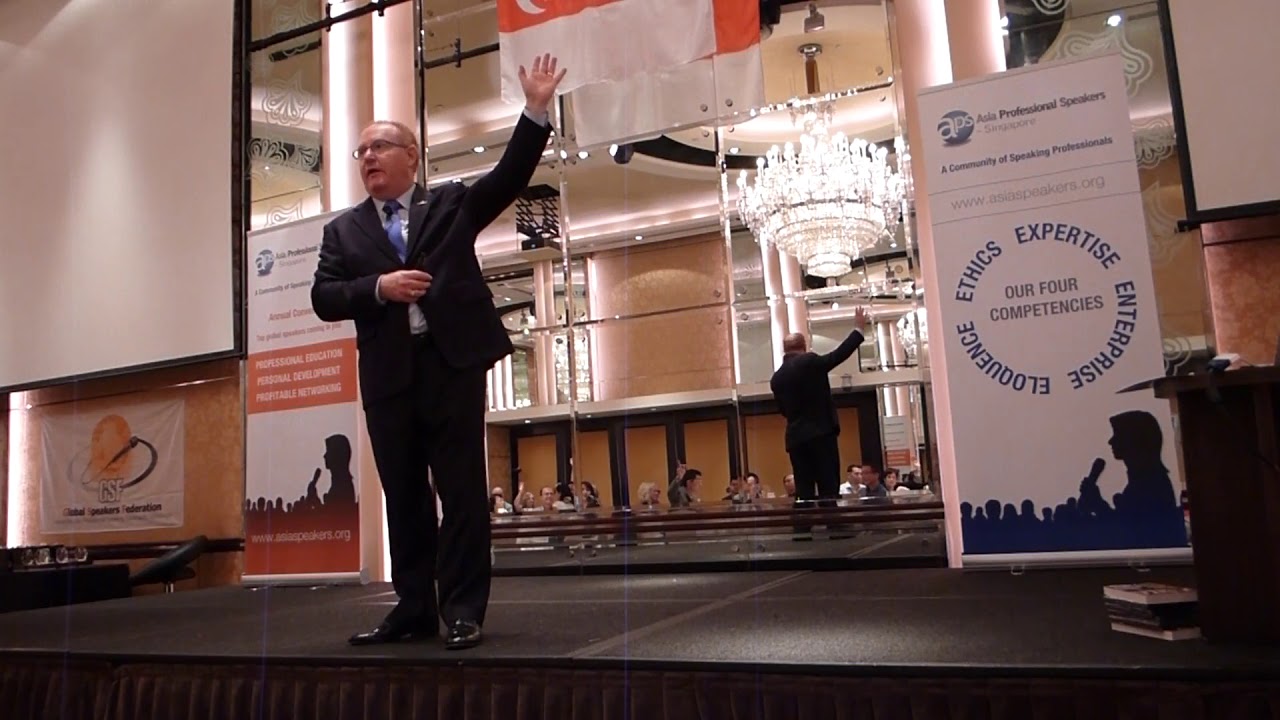
In this keynote, the speaker introduces "decisioneering" – a decision‑making framework for speakers and coaches. He begins with a humorous anecdote about Googling "success" and quickly moves to the core premise: success in the speaking business is driven by the decisions you make and the actions you take. He presents a metaphorical toolbox of four essential tools – a map (context and values), a compass (true north and direction), a telescope (long‑term vision), and a magnifying glass (detail). The audience then experiences the Specific‑Global Continuum, a spectrum that describes whether people process information through a magnifying glass (specific) or a telescope (global). Interactive exercises illustrate how to identify a person’s position on this continuum and how it affects communication styles. The speaker adds a second lens set – facts, feelings, and a tongue‑in‑cheek "Feng shui" factor – emphasizing that individuals naturally favor one of these perspectives. He stresses the importance of self‑awareness of one’s natural lenses to avoid personality clashes and improve client interactions. The second half of the talk applies decisioneering to business strategy for emerging speakers: narrowing market focus from the world to a city, then to a specific building, and finally to individual tenants. He provides concrete examples using Singapore’s Capitol Tower and Republic Plaza, offering a ready‑made list of 52 potential client companies. Throughout, the speaker uses humor, audience participation, and real‑world anecdotes to make the concepts memorable and actionable.
Chapters
Now I sat here and I looked at 3 or 4 perfectly good keynotes, and I thought, why bother preparing one of my own? And so I went to the techies and got the PowerPoints from each of the other people. And I'm going to just— because, you know, retention isn't key, it's motivation. So you're going to see a little bit of what you saw yesterday. Thank you. This morning when I woke up, which was relatively early, I did something for you. I went and visited a place where many of us go regularly, and I went to that place on your behalf. It was Google. And I asked Google, as we all do, just 2 questions. The first question was success, and I put in success. Would anyone like to guess how many hits Google came up with when I typed in that one word, success? 2 million. 2 million. 27 million. 3 billion. Any others? 57 million. 57 million. It was 326 million. Have you noticed Google no longer gives you the exact number? It says about. So it was about 326 million. Now I thought that was just a little bit too much research to do between when I woke up and now. And so I narrowed it down and I typed in definition. Of success, and it narrowed it down significantly for me. For you, and so since I woke this morning until now, I have researched every one of those sites for you, so you don't need to do it. I'm a kind man. Would you agree? Yes. Now I'm what they call in Australia a meat and potato speaker. Now I've asked a few people here what's the Singapore equivalent of meat and potatoes, and I'm told it's chicken and rice. So it just means I'm a content speaker. So we're going to fly through this morning because I have lots to give you. Look at the person next to you and say, fasten your seatbelt. Fasten your seatbelt. We're going to start with a blank canvas, and on that canvas we're going to write one word first of all. We're going to write the word success because this morning I'm going to talk to you about how you can be successful in your speaking business. It will apply to any business and it can apply to your life as well, But success for me is the decisions you make and the actions you take. It's as simple as that. And when I looked through those 106 million, not one was as good as this. And so I decided I'd run with this one. Is that okay? Yes. Fine, good. So that's what we're going to run with. But before we do that, we're going to introduce the concept of decision theory. That's what we're talking about. You see, in my experience as a speaker and as a coach of speakers and mentor of speakers, The reason that most fail— I'll give you the percentage that most fail in just a moment— is they don't make the right decisions. And then they don't take the action that's necessary. I did some research in Australia some years ago because that's where I had access to the figures. Of all the people that have ever been in the National Speakers Association of Australia, what do you think the percentage is of the people who have made it? 1, 2, 3, 4%. 4%. And the way I measured it was very simple, and the statisticians in the audience will say that's crazy, that's not right, and I'm willing to admit that. I never did like stats at uni. But the way I did it was I simply looked at all the people who joined forever and how many were still members, all the ones that I knew were speaking, and it was 4%. 96% had dropped out. Now why is that? It's because they don't, in my view, decisioneer. They don't actually do things. We all have a toolbox that we carry around everywhere. Now I'm big on metaphor and I'm obviously talking about a metaphorical toolbox. I haven't seen anyone carry one of those around everywhere. But we carry a metaphorical toolbox with us and there are 4 tools you need on which you need to lay out your speaking business. The first is a map. Now, it's interesting, this is where yesterday's keynotes were so helpful. A number of people talked about things about a map. We talked about context. Let me write down who talked about context. That was Sam, wasn't it you? No, it was Ron. Ron. Ron talked about context. The context is the map, the tapestry on which you build your business. But you need to know what that tapestry is. And there's the beliefs that Sam's talked about that are also your map. Your values, they're all your map on which you build your business. It's an obvious tool, a simple one. And I don't again expect you to be carrying a physical map with you. This is metaphorical. But you need a map. Where are you going to work? You then need a compass. A compass. And the compass will keep you on track. Stephen Covey spoke in 2 of his books about true north. 7 Habits and Principle-Centered Leadership. You need to measure the true north, you need to find out where you're going, but constantly make sure you're on track. So a compass is a crucial tool for you to have. You need to have a telescope because the telescope lets you see where you're heading. It sees the distance, it sees the end result, it sees the outcome. One of your speakers yesterday spoke about the outcome. The telescope allows you to see See far ahead as to where you're heading. Many people are only looking at tomorrow, and some speakers are looking at lunch and wondering, how do I get there? So the telescope lets you look further, encourages you to look further. And the final one, some of you will have guessed already, is the magnifying glass. And the magnifying glass allows you to look at detail. It's not the telescope that looks into the distance, Looks at the detail. And you need all 4. Would you agree that you need all 4? Yes. They're the 4 essential tools of the speaker: the map, the compass, the telescope, and the magnifying glass. But before we do that, we need to do something else. I need to let you in to a secret. So look at the person next to you and look into their eyes. Say these words aloud after me. My goodness, I didn't notice when I sat next to you how beautiful you are. And now say this to them. And now say this to them. He's going to tell a He's going to tell a secret. Be ready to be shocked. Be ready to be shocked. The secret is a simple secret, and it's this: every person in the room fits into the model I'm about to give you. Now, Ramin, where are you? He's disappeared. That doesn't matter. Oh, here he is. Ramin. Now, Raymond and I spoke earlier this morning, and I found out a lot about Raymond. He's a very, very wealthy man. And we were speaking about the benefits of going to NSA in San Diego later in the year. And Raymond said to me, look, David, I think, you know, I agree, I think this is great, it would be good if everyone in the room could go. And with my 2 good friends, Shirley Taylor And Scott Friedman, the 3 of us will pay for everyone in the room. Isn't that a kind gesture? So I want you to imagine now that we're flying to Los Angeles, because you can't fly from Singapore direct to San Diego. We're going to Los Angeles, and we land in Los Angeles, and there we are told that But our flight to San Diego has been cancelled. And so we get into a rental car. And you're sitting in the passenger seat of a rental car, and someone comes along and gives you 2 maps. The first map is a map of Southern California, very clearly labelled, how to get from Los Angeles to San Diego. The second map that they give you is very clearly labelled, map of LAX access, Los Angeles Airport, how to get from LAX to the freeway. Now you can look at either of those maps, It doesn't matter which you look at, but you will decide to look at one map and not the other first. Make that decision now. I will play some relaxing music while you make that decision. Who has decided to go for this map, the map of Southern California, how to get from Los Angeles To San Diego. Can you people stand up? And can the other people give these people a round of applause? These people are what are called globals. How many of you— and they look at life through a telescope. They see life completely differently. They see life through a telescope. I'll explain that more in just a moment. How many of you chose this map? Can you stand up? And can the others give you a round of applause now? These people are what's called specifics, and they tend to see life through a magnifying glass. Now, that's very general, but we're going to go through a number of things because this is one of the most profound tools I have ever learned. No one has been able to tell me where it came from originally. I know it grew in NLP a great deal. But no one's been able to find out who actually came up with this at the beginning. So this isn't mine, but I teach it everywhere I go, and it's one of the most useful concepts that you'll ever come across. It's called the Specific Global Continuum. Now I put numbers up there, 1 to 10. The numbers don't mean anything other than for me to illustrate it. 1 doesn't mean things are lower than 10. 10 doesn't mean things are higher than 1. It's just a continuum on which we're going to paint a picture. The people who chose the map of Los Angeles tend to be specifics. So they tend to be on the left— sorry, on the left-hand side of the midpoint. They tend to look at things in more detail. The people who chose the map of Southern California are globals. They tend to be on the right-hand side of the midpoint. And the midpoint is the issue. Which side do you fit on? So we're going to play a few games now, and we're going to just see where you fit. So I want you to just get yourselves into pairs or groups of 3, anything small, and I'm going to ask you a question. Decide who's going to answer the question. Make that decision right now. I'll give you the time that I've just taken, so decide. Here is the question. Now, the person listening, listen to the answer you get. Just listen to the answer. The question is this: how do I get to Australia? Answer the question. Just answer the question. Okay, that'll do. How many of you had a person answer the question with something like this? I heard someone say Qantas. For you fly? Who had someone that had an answer like that? Fly. Okay, so which side of the midpoint is that answer? Specific. Yes, it's a global answer. How many of you had a person who is actually still answering the question? You are specifics. Let them go to the midpoint. The issue about global and specific and why there's So important. Roughly 50% of the population is on the left-hand side of the midpoint. Roughly 50% of the population is on the right-hand side of the midpoint. But the people who are closer to the left than the right speak a different language. Mmm. They don't communicate very well. They don't understand each other. They see the world through completely different lenses. The people on the left see it through the magnifying glass. People on the right side with the telescope. They see completely different things. So, I've got a few other questions for you. You have all had this game played with you and upon you by salespeople. Now I'd like you all just to point to the ceiling like that, please. Just point up to the ceiling. I need a volunteer. Oh look, there's one. I'm not a volunteer. Very lucky day. And now, don't move around the floor, Sam. Don't move. Just turn up. I want you to put yourself in your role in an interview with a client when you've gone to sell to a client. Okay, Sam, am I allowed to say that? You've gone to sell to a client. Am I allowed to say that? Not you, Sam. Just say yes, Sam. Yeah, good. And let's just say you have a brochure. Now let's just play 2 parts here. You've had this done with you by really good salespeople if they put a brochure in front of you. So if I put a brochure in front of you, let's just pretend this is your table, David. Okay? I put a brochure in front of you. What would you do with that brochure? Can you just pick it up and do what you would do with that brochure if you were the client? Client is. Okay, now I know that he's on the left-hand side of the midpoint. How do I know that? Is there anyone who's on the far right? It's all you've got to do. See that? He didn't serve around the post. Then he was on the other side of the midpoint. You're on the left-hand side of the midpoint, aren't you? Aya, can you come up please? She does great teamwork yesterday, don't you think? Yes. Ava, here is the brochure. What would you do with the brochure? Just pick it up and do what you would do. There we are, she's got it. Global, thank you. See, really easy. No, that's all. And you might not believe, she just said, I'm not going to read it. I'm not going to read it. Globals do not read. So here's what specifics do. Specifics will pick up a brochure and they'll walk A global always looks at the back first. I can't look at the back. A global always flicks from the back to the front. A specific always does something that a global wouldn't dream of doing. They actually read. Gosh, a brochure with words on, and they read it. Isn't that a turn-up for books? Let me show you what people do with a book. So, Julie, can you come up please? Here's one of George Walter's books. Doesn't matter that it's his book. I want you to pretend you're in a bookshelf, and for some reason— I mean, it's obvious why you would choose this book. George Walter. Just imagine that you take this book from the bookshelf in a bookshop. Do what you would do. You tell me whether she's— see, we've already got the answer. She's global. Can you see how quickly you can tell? Global's always Always turn to the back. Specifics always start at the front. Now, if you're with a client and you're sitting there, find something you can put in front of them, because within milliseconds you can tell whether they are global and whether they're specific, and therefore how you sell to them. Because if they're a specific, what do they want? Details. They want detail. If they're a global, what don't they want? Detail. They want more detail. Now, the other person who didn't answer the question before, you're about to answer the question to the, to the person who answered the question before. Are you ready? Here's the question. Now, how many of you got a partner who's not from Singapore? Make it up. Here's the question. How do I get to here? Just ask the bus, tell the bus. How do I get to here from here? I'll get a taxi. You can actually see me as well. Now it doesn't actually matter whether the person is not from Singapore and doesn't know the answer. You should be able to tell already whether they're global or specific. Which side of the midpoint is the person on? What was the answer you got? Was it global or specific? Who got a global answer? Now, a global answer would have been something like, you get a cab. A specific answer might have been, well, let me give you a number one answer for that question. I'm not going to say, of course, I'm going to make up the answer, but the style will give you a number one answer. So number 10 answer is get a cab. Number 1 answer is, well, we're out here in this room. Okay, do we stand up? We walk to that door. When you get to that door, you'll see a set of staircases just in front of you. Go down there. Or alternatively, you could go to the elevator. It's about 10 minutes long. Now, how many of you are thinking of someone that you now sit in meetings with and they are like this? When you get to the elevator, you get in and you push number And then you go across and then you see the— are you with me? Yes. Now I want you to think about this. There are people who would give that answer, and there are people who would say you get a cab. Now here's the interesting thing. For the person who gives the number 1 answer, that for them is a perfectly appropriate answer. But for the number 10 who would say you get a cab, it's an inappropriate answer. But for the number 10, get a cab is a perfectly appropriate answer. And then we wonder why people in meetings don't communicate. So I want you to think about this. I want you to think in your past to any person with whom you have had a personality clash. Just think about that now. Any person in your life with whom you've had a personality clash. A work colleague probably would work best. My wife. But the personality clash person, I'll guarantee, is probably on the opposite side of the midpoint to you. And that's why we call it a personality clash. It has nothing to do with personality. It's just the way, the lens through which you look at the world. The specifics look at the world through the magnifying glass. The globals look at the world through the telescope. And so— It keeps coming up. Oh, it's a different presenter. I'm pushing the wrong button. And so what you need to know is this: which lens do you look through? Which is your natural lens? What is your natural lens? Is it the left-hand side of the midpoint, a specific, or is it the right-hand side of the midpoint, global? It doesn't matter. Neither one is better or worse than the other. That's good. Neither is good nor bad, it just is. But you need to know your natural lens because it's with your natural lens that you will then be able to filter what you're hearing from other people. And it's so important when you're with a client. We're going to talk about that a little bit more in just a moment. But wait, there's more. I'm going to complicate things. There's not just 2 lenses. There's not just Global and specific. You have a choice of a number of other things as well. But the two main other lenses that you have a choice to use are these: facts or feelings. Now don't try and compare these with global and specific. There isn't necessarily any correlation between the two. It's another set of lenses that you look through. Some people look through the lens of facts. And some people look through the lens of feeling. Just like global and specific, neither is good nor bad. Neither is better nor worse. It just is. And what do you need to know about this? You just need to know what your natural lens is. Whether you tend to look at facts or whether you tend to look at feelings. But here we are in Singapore. There's a third F. This is the F factor. Facts, feelings, and of course, Feng shui. We're in Singapore, we're in Asia. Now I subscribe to feng shui. I've had one of these on my, on the front wall of our house. So I'm not big into feng shui, but I understand it to a certain extent. And I understand that some people will make their decisions very much based on that. But facts, feelings, or feng shui? It's the F factor. Which do you use? And it doesn't matter which you use. You just have to know what the lens is that you naturally look through in global and specific, and what the lens is that you naturally look through in facts and feelings, because that will determine almost everything about how you decisioneer yourself. Leslie, in her keynote yesterday, was speaking about the exit strategy. And it was perfectly obvious as she was speaking that it had involved an enormous number of decisions along the way. Do you agree? Do you think she just made those decisions sitting over at the breakfast table or in the shower, or do you think she thought about them? Thought about them. That was probably either Scott or Lindsay, I would imagine. Scott. She decisioneered her way to that. She may not have used that word, it doesn't matter. But Leslie, I'm presuming you put a lot of effort and thought into those decisions, am I right? Yes. That's what decisioneering is, putting the thought and effort into the decisions so your risk of making the wrong decision is minimised and the risk of making the right decision is maximised. So what you need to do with all of this is know yourself. You just have to know what you do, what your natural lenses are that you look through. But you do need to do this: look at the person next to you and say, "He's going to ask a very difficult question." He's going to ask a very good and difficult question. How honest are you with yourself? How honest are you with yourself? How honest are you with yourself? Or are you? You see, some people look in the mirror and see what they want to see. So many people who are early in this business, emerging speakers, see what they want to See, they sit in the audience and they look at keynoters up on stage and say, oh, I could do that. My answer is, great, do it. Guess what? Most of them are in the 96% and never actually do it because they're not honest with themselves. They don't take a reckoning of their skills at the beginning and then go and top up the skills that they're lacking in. So you've got to be absolutely honest with yourself. So the trick with all of this is This. Consciously look through the other lens. If you're a specific, if you're on the left-hand side of the midpoint, consciously look through the right-hand side lens. Consciously look at the global. More important in my experience, because I'm a global, if you are global, consciously look through the specific. You'll hate it. It's boring. Looking at the detail. If you're a global. But the specifics love it. So how do you do that? How do you look at the facts if you're a feelings person? How do you look at the feelings if you're a facts person? You need to get some help. So, so what? What's this all got to do with your business, your speaking business? I would suggest to you it's got a great deal. Let me give you an example of how you might plan your business. Many people say, and here we are with the new CSP, global, of which I'm proud to be one, many people say, well, there is my market, the world. Well, I would suggest to you as an emerging speaker that that's probably not your market because it's a tiny little bit too broad. So the question I would ask you, if I were mentoring you, is, okay, that's great, hang in the market. And of course the answer is, well, you have to choose a bit. Well, therefore the world's not your market. Let's look at what it might be. It might be Southeast Asia. That's fine. Much narrower market. And so can you see that the global might start with the world, but in fact they have to move to the specific? But even that's probably too big. How many businesses do you reckon are there on that map? Just a few million. A few million? Yep, too big. So you might look at just Singapore. And if you look at just Singapore, there's 133,235 retail outlets. registered businesses here in Singapore. Now, even if 10% of those were your potential clients, that's a lot. That's way too many. What if 1% were your potential clients? Do you think that's more manageable? So the global needs to be more specific in terms of their marketing, in terms of their business strategy. But you could go further. Here's the map around here, and here's this hotel right in the middle of the map. How many businesses do you think are on that map? I don't know, but we can guess. There would be still thousands, would you agree? Yeah. Still too many. And bear in mind that 133,000 includes all the sole traders as well. And they're probably not your market unless you're in coaching. They may well be if you're in coaching, but they're probably not otherwise. But let's draw a circle, an 800-metre circle around that. That's— I've done this generously, I think, for the For the US people, that's exactly a mile. 1.6 kilometers is a mile. And so that's a 1-mile circle. For those of us in the rest of the world, the US is the only one that hasn't made a change yet, it's 1,600 meters or 800 meters radius. 1,600 meters. You could narrow it down there, but you could go even further. Let's look at this building, Capitol Tower. It's here in Singapore. The tallest building in Singapore. There's 53 floors. There are 21 commercial tenants. What if you went in there and had a look at who those tenants were and marketed there? So I'm really talking to the emerging speakers now. This is how you might start. Go right in and just start in a building. Now the tallest building in Singapore is the Republic Plaza. And I went and visited it on Thursday because I happened to know that I'd be talking about it this morning. And I was very cheeky. I took photographs of the distribution board, or the lieutenant board, for you. I managed to get 2 taken before the security guard came. And then I decided that I was a tourist, and so my wife is standing there in the bottom of the photo. And I said, we were just taking photographs of things. And so the Republic Plaza building there, you can't read that. I didn't expect you to read it. There's 2 distribution boards off the tenants in that building. There are 52 tenants in that building. Now, I'm happy to send you the expanded version of those pop-up slides if you don't want to go down and take photographs yourself. And if you're here in Singapore and you're an emerging speaker and you want a client list real quick, there's 52 there. And I'm happy to send that list to you. Then what you'd do is you'd go back and do what? You'd go back to my friend that I started all this with, Google, and you'd Google those 52 businesses. And they're the type of businesses, because they're in that sort of building, who are likely to have on their websites who their key decision makers are. And then you can call and find out who their PAs are, and you can market directly to them. Now the globals are thinking, oh, way too much detail there. That's why globals don't tend to get far in this business until they learn how to be specific. Doesn't mean they have to change from being global, they just have to look through the specific lens sometimes. To find out who they're going to market to. And so here's what happens with facts and feelings, and this is so interesting, and I'll tell you why it's interesting in just a moment. Facts and feelings people, there's 4 issues that I'm going to cover really quickly about how emerging speakers tend to get wrapped in their feelings. The first is colour schemes. It's so interesting when you talk to people and say, I've got this brochure and I just love these colours. And the colours are corporate crap. Corporate world does not relate to them. Now I don't know what it's like here in Singapore, but I can tell you in Australia, brown is not a corporate colour. And yet you get some people who think, I'm going to print my brochure in brown because I like brown. In other words, they fail to look through the lens of their client. So you need to look at colour schemes that are relevant to your client. The second thing is fonts down the bottom. People who use fonts that they like but are unreadable. The bottom right is your photograph. I'll give you the tip I learned years ago, the best way to choose your publicity photos. By the way, get new publicity photos taken every year.










