Why Lung Health is Crucial to a Long Life - with Dr. Stephen | The Empowering Neurologist EP. 132
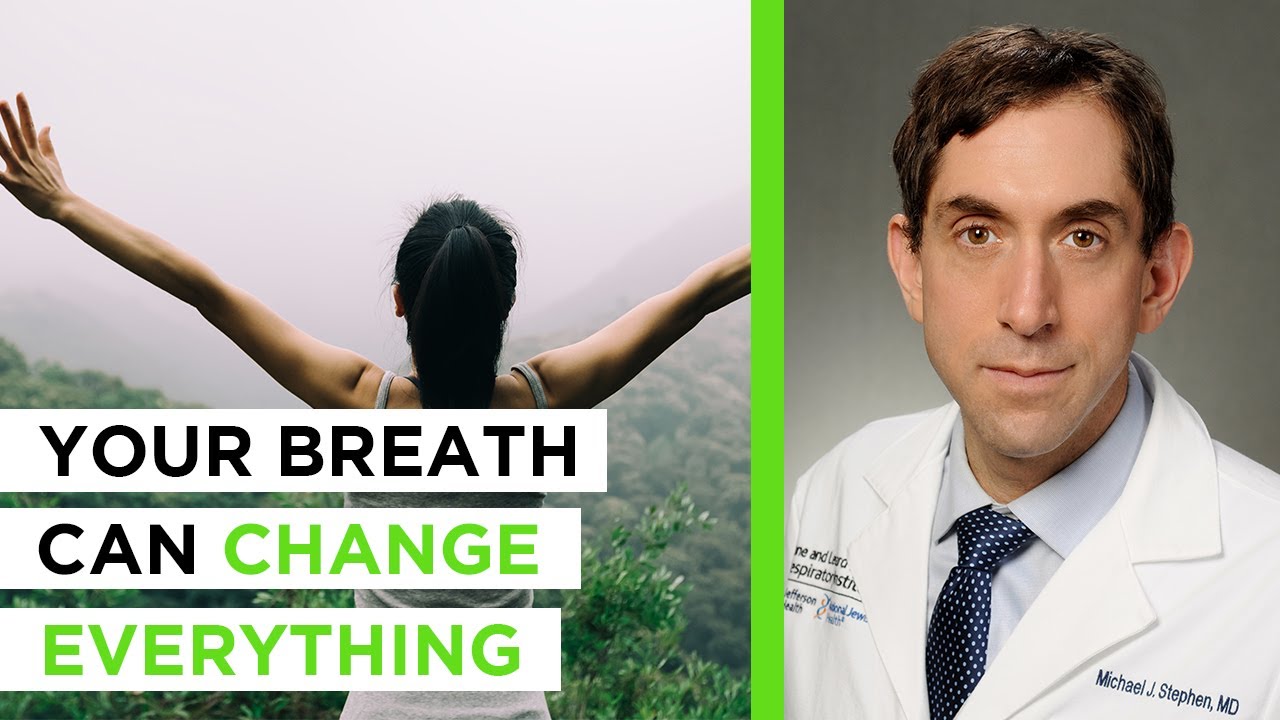
In this hour‑long interview, Dr. David Perlmutter talks with Dr. Michael Stephen, a pulmonary specialist and author of the book Breathtaking, about why the lungs are a neglected yet vital organ. The conversation begins with a cultural‑historical view of breath, moves through the lung’s complex immunology and its own microbiome, and then surveys the multiple modern crises threatening lung health: outdoor air pollution (wildfire smoke, particulate matter, nitrogen dioxide, sulfur dioxide), indoor pollution from biomass fuels and household sources, and the vaping epidemic. Dr. Stephen explains how pollutants damage airway epithelial and stem cells, increase susceptibility to infection, and even contribute to systemic diseases such as Alzheimer’s and osteoporosis. They discuss the physiological impact of deep, diaphragmatic breathing via the vagus nerve, linking it to increased acetylcholine, serotonin, dopamine, and reduced inflammatory markers—an effect likened to a natural Prozac and shown in cancer‑survivor studies. Dr. Stephen shares his personal battle with severe COVID‑19, illustrating the disease’s pulmonary complications. The dialogue then covers specific lung disorders—idiopathic pulmonary fibrosis, cystic fibrosis, asthma, COPD, and tuberculosis—detailing their pathophysiology, current research (including stem‑cell and Yamanaka factor approaches), and the importance of early detection and public‑health measures. Throughout, the hosts stress prevention: cleaning outdoor and indoor air, reducing tobacco and vaping, and leveraging lifestyle interventions (diet, breathing exercises) to protect lung function and overall health. The interview ends with hopeful examples of how reducing pollution dramatically improves asthma rates and lung capacity in children, underscoring that collective action can safeguard the breath of future generations.
Chapters
The vagus nerve is our biggest parasympathetic nerve, and it innervates— the biggest place of innervation is our diaphragm. So when we take nice, easy, deep breaths, that's going to feed back to our brain that all is good with the world. Increases acetylcholine, and then that increases in turn our feel-good hormones like serotonin and dopamine. So easy breaths, all is well with the world, is basically a natural Prozac.
Hello everyone, I'm Dr. David Perlmutter. Welcome to the program. You know, the brain gets a lot of attention, so does the heart, and lately the immune system, et cetera. But why do we not pay very much attention to the lungs? You know, the lungs never really get the attention that they deserve. And I have to admit that I didn't really fully understand so much about what is going on in our lungs, that the lungs are so involved in the functionality of our immune system, that what goes on in the lungs in terms of our breathing can affect our gene expression, and even that the lungs themselves have their own microbiome. Who knew? You know, it's breathtaking. And in fact, that's the title of the book that we're going to talk about today, Breathtaking. Our guest is Dr. Michael Stephen. Let me tell you a little bit more about him. Dr. Michael Stephen is an associate professor at Thomas Jefferson University in Philadelphia, and he's the director of the Adult Cystic Fibrosis Center. He is a leader of numerous clinical trials and has been on the front lines as it relates to caring for COVID-19 patients. He himself contracted COVID-19. We're going to talk about that today. Over the past 2 decades, he has studied advanced end-stage lung diseases and worked with patients at diverse locales, including a Massachusetts prison hospital and even a pediatric HIV clinic in Cape Town, South Africa. He's a graduate of Brown University and Boston University Medical School, and he lives in New Jersey, and we are delighted to have him on the program today. Well, hello, Dr. Stephen. How are you doing?
I'm doing very well, Dr. Perlmutter. Thanks so much for having me on here.
I'm delighted. I'm going to tell you right off the bat, I read your book. It was not what I expected. And frankly, I wasn't sure what I was expecting. But to read about the evolution, the beginnings of oxygen on our planet, the development of aerobic organisms, you know, there was so much in this book that I, again, I wasn't expecting that was just a pleasure to read. You know, when you're kind of nerdy, like many of us are, the sciencey stuff is really kind of— especially the historical science stuff. You know, when you were talking about Harvey and the circulation, all that, I just— it was— Such a pleasure. Thank you.
I appreciate that. And I did want to take, you know, a very broad view to give people a sense of, you know, where our breath has come from, where we are today, and where we need to go in the future. I did want to cover a lot of ground.
Well, we're going— and we're going to cover a lot of ground today. I want to start off by just the notion that, you know, these days, I said in the introduction that there's a lot of talk about the immune system, the brain, the heart, Well, why does the lung really take the back seat? Why does lung and respiration and all that, why is it not receiving the attention that you made so clear in the book is really very important?
I think historically it has received attention in the past going back a few thousand years. You talk about the Hebrew word ruach, you know, the concept of the Holy Spirit in Christianity is the breath of life. It's in chi, it's in prana. I think it's only in the last couple hundred years that we've lost sight of it. And part of it, I think, we see the lungs as somewhat of an unclean place. It's a place that transmits diseases. And, you know, it comes across as a place to be avoided. And of course, we see that today with COVID-19, that we're all covering up our breath today. So I think it's been pushed to the background. Doesn't look like a complex organ, even though it is. You know, the brain, the gut, the kidneys have just all this incredible network going on. I think, you know, we think of the lungs as just this bellows machine that's pushing gas around. But I wanted to debunk that in my book, that it's a place alive with chemistry and immunology.
And you made it very clear. I'm going to reiterate what you just said, a place alive with chemistry and immunology. and what's going on. You know, I'm thinking in my day, we're looking at diffusion of CO2 and O2, end of story pretty much. But when you walked us through idiopathic pulmonary fibrosis and cystic fibrosis and, you know, the various other lung diseases that you covered, Hyaline Membrane Disease, for example, there's so much going on in physics and in biochemistry. And I'm telling you, the lung became— lungs became very, exciting for me the way you talked about it. So let's jump right in. And, uh, I, gosh, I don't know where to start. The world has changed as it relates to our lungs, as it relates to climate change and certainly pollution. Uh, what can you tell us, uh, is happening right now in terms of what we are exposed to and how it's playing out in terms of what we're experiencing in terms of clinical issues?
So there's a number of acute crises of the breath. happening right now, and you've touched on a bunch of them. You know, COVID-19 is one of them. The pollution crisis is another, the vaping crisis, which we saw in 2019. And then there are chronic issues with our breath too, in terms of just massive increases in the amounts of lower respiratory tract diseases, interstitial lung diseases. Asthma rates were 3% in 1980, and now they're over 8% and up to 14% in some age groups. And ethnicities. So there is a major crisis of the breath happening, and the disease is that we're not taking threats to our breath seriously enough, and we're seeing all these different crises because of it. You know, pollution, you know, in 2017, the American Lung Association has documented since then worsening air quality in the United States. Over 45% of us are exposed to toxic air on a yearly basis. The previous record prior to 2020 was 1 billion acres of burn in California. And then in 2020, it was over 4 billion. So there's a lot going on here that we need to pay attention to, but there's a lot of hope as well in there as well.
Well, there is a lot going on when our air is so polluted that at times people are told they cannot even go outside. We experienced that with these fires. that pretty much took, uh, you know, were involving the entire West Coast of North America. I was in British Columbia during that period of time, and, you know, we didn't— we weren't having fires, but we were getting the smoke that was coming north from Oregon and certainly from California. And, you know, at times we were down to a quarter-mile visibility. Well, that's worrisome when you're navigating a boat, but what's going on in my lungs when I'm breathing that stuff?
That's a great question, and You know, the people like you who experienced it firsthand are the ones who know about it. So I don't get that stories from people on the East Coast. I get them, Dr. Perlmutter, from people like you who were there, from people in California who had kids' cross-country running seasons canceled for— and had to stay indoors for months, especially if they had asthma. So these particles, you know, there's 6 big ones. The biggest one from toxin from burning of wildfires is particulate matter. And it can also combine with exhaust and form things like nitrogen dioxide and sulfur dioxide. And that's going into your lungs and that's harming the cells of your lungs. We have a lining to our trachea, to our bronchi. These are squamous cells and that toxicity causes early death, and it causes the stem cells of the lungs to die as well. There are these little cuboidal stem cells that they've discovered, and if you're exposed to pollution enough or tobacco smoke enough, not only will your regular cells die, but you'll lose those cuboidal stem cells, and then permanent lung damage will start to occur. Another thing with these things are is they let infections in easier. So once you're Once these squamous cells get damaged by pollution, then viruses makes their job so much easier. And that's why we're seeing this increased death rate in smokers, in pollution. And people have gotten extremely granular with this detail. If you look at people who live next to a highway for their life, they're going to have worse lung function. They're going to have more lung infections. So unfortunately, like you say, it's all tied together.
Yeah. And in fact, that study, I believe, was done in Toronto. And the measurements were made looking at those what are called PM2.5, so the 2.5-micron particulate matter. And they also looked at their data in terms of Alzheimer's risk and found a dramatic increased risk of Alzheimer's based upon exposure to these PM2.5 particles. by being closer or closer still to these large highways. So what I'm saying is, and in another inflammatory disease, Alzheimer's, as you're talking about lung disease, being related to the proximity that you were to, or that you lived with respect to a highway. And you don't see this, but it's happening, isn't it?
Absolutely. And we don't, it's, you know, the atmosphere is something unseen and it seems inaccessible. It's a place of abstraction. But this thing, this is definitely happening and more and more studies like you're talking about with neurodegenerative diseases are coming out. Lung diseases are not just— pollution is not just a lung disease, it's a total body disease in terms of Alzheimer's, in terms of osteoporosis. There was a big study out of Columbia University looking at osteoporosis. And then of course, this, if it happens in the young and the old, These are the ones who are more susceptible. So we're more and more in tune to patients who have low lung function at an older age, never smoked, but wait a second, they grew up in a high pollution environment, their lungs just never developed fully. And so we're getting a much bigger sense for that, all these things that lung diseases are total body diseases in many respects.
Our viewers are pretty dialed in with the notion that There's this powerful interface between the environment and our bodies, the interface being the gut lining. And, you know, because we've been talking about that for years, we've been talking about what goes on at that lining, what maintains that lining. But I think you gave a statistic in terms of the alveoli, if you were to spread them out, they were the size, I think you said, of a tennis court. And that's an interface then between the outside world and the inside world. So in a very real way, The lungs are in intimate contact with what's going on around us.
And I like that analogy with the GI tract. You know, if you look back evolutionarily, the lungs did not develop from gills, you know, from fish. We do not think that happened. They actually occurred as an outpouching of the GI tract. And, you know, fish were swallowing air and using that to get on land to see what was going on and to utilize resources. And that's still true today. of a foregut formation that happens first, which ends up being your GI tract. And then a lung bud comes out from that. So both the lungs and the GI tract, as you mentioned, are really on the forefront of exposure to the environment. And they're kind of very similar organs in that respect. And they have to absorb things and take abuse from the atmosphere. So the gut and the lungs are intimately joined. There's a lot of data on the microbiome, certainly in the GI tract, which you can speak expertly on. And then that research came to the lungs after the gut, that this is a place alive with dozens of different species that need to be kept in harmony. And I think a lot more research is gonna happen that the diet and the GI diet is gonna affect your lung microbiome, no question.
We can control our breathing, and you called out several studies at a couple points in the book about various breathing techniques that can affect, for example, the balance between parasympathetic and sympathetic activity, that can affect stress level, various hormone levels, and even have an epigenetic role, even affect our DNA expression. So That's old knowledge. I mean, not the biochemistry of it, but the value of breathing exercise is something that people have recognized for a long time. But tell us, if you will, what are some of these effects that we're now seeing with respect to breathing exercise in terms of our physiology?
Yeah, so you're right in that this is knowledge that's thousands of years old. The Buddha in 2,500 BC before the Common Era stated, the only way to wisdom and nirvana is through appropriate study of the breath. So this knowledge has been around for thousands of years, and it's absolutely fascinating to read studies today where these 2 disciplines are being joined. So this very ancient knowledge of the power of the breath and then more scientific knowledge in terms of genetics. And some of the most fascinating studies that I've read about I talk about them in my book, are in cancer survivors. And in cancer survivors who do a dedicated focus on the breath, they invoke their parasympathetic nervous system. The diaphragm is innervated by our— the vagus nerve is our biggest parasympathetic nerve, and it innervates— the biggest place of innervation is our diaphragm. So when we take nice, easy, deep breaths, that's going to feed back to our brain that all is good with the world. Increases acetylcholine, and then that increases in turn our feel-good hormones like serotonin and dopamine. So easy breaths, all is well with the world, is basically a natural Prozac. And we need to take advantage of that more. And recently, you know, researchers like Herbert Benson in Boston have been looking at inflammatory markers. The one I talk about the most in my book is in post-cancer survivors. So So these cancer survivors who had a dedicated focus to the breath for several months lowered their immune system inflammatory markers like C-reactive protein and tumor necrosis factor. So some really amazing work going on right now on the epigenetics of what our breathing does to our inflammatory markers of our body.
That is profound that we can moment to moment affect the expression of our DNA, of our life code, By engaging in a breathing exercise. I mean, you know, I don't know how it was when you were in medical school because it was certainly a lot later than for me, but we were, you know, taught that DNA, our code, lived in a glass case and was indelible, and that was it. And any discussion about modifying expression of DNA was heresy in those days. So, I mean, we weren't quite using leeches, but this was, you know, obviously quite a while ago. I want to go back to a topic I think that many people are obviously interested right now, relates to breathing, relates to the lungs, and it's COVID. You were early on one of the involved in COVID treatment, obviously being a pulmonary specialist. You had COVID, as I mentioned in the introduction yourself. I mentioned that you had it, but you had a bit of a rough go with that, didn't you?
I did. I got— I ended up getting quite sick, and I was surprised by that, not pleasantly. I might add, I'm generally healthy. I take no medicines. And so I have no underlying immune compromised state. But, you know, after 2 months of working in ICUs, you know, I did come down with very serious fevers for a few weeks. And then there was pneumonia lurking in my body and I ended up in the hospital with pneumonia and blood clots. You know, fortunately we have great hospitals and I had access to the best care in the world. And so consider myself one of the lucky ones. You know, I did pass it on to my family. I was not a super spreader. I was sort of a mini spreader. Fortunately, you know, their course was, was a lot milder than mine. But, you know, seeing your 9-year-old daughter with fever of 104 and unable to walk is not a pleasant thing. But we got through it. We stuck together as a family. And, you know, I consider myself one of the lucky ones. And, you know, we're on— I don't know what number wave right now. But we're seeing some crazy things in the hospital, which, which is— and it's still raging.
Yeah. You know, you mentioned you saw your daughter, how it is for a parent to see your— one of your kids be sick. And you had an experience you talked about in the book with, I believe it was the birth of your son with respect to pulmonary issues right off the bat. Can you tell us what that's about?
Yeah, that was, you know, going back a number of years now. And it was a hot day in Philadelphia and we got to the hospital very quickly. Um, but they checked out the baby and then there was something very wrong with the heart rate. It was too low. And with each contraction, it's supposed to drop low, but his was dropping even lower than normal and for longer than normal. So the obstetric doctor, she got us right into the delivery room. Um, and my wife, um, you know, fortunately it was a very quick delivery. And what we found was there was just a very, very tight knot around his neck. Hmm. He had knotted himself up on the umbilical cord. And he was born basically lifeless, not breathing. The job of giving birth and awakening in this world is the job of the breath. All our heart is working, our brain is working, our kidneys are working, but the lungs are asleep and filled with fluid. So in an instant, we need to take a huge deep breath. And he was not able to do that because of this cord around his neck. So they cut the cord and they were on the verge of having to intubate him to get him on a ventilator. But miraculously, he woke up, and deep breath in, turned bright red, deep breath out, a scream. And we recognized that as life, and he's done very well since then.
Well, I just want to say, I pulled that story out and you put it in the book because it's in the context of breath, of taking the first breath of life, of at least after you're born, and how, you know, what that is like, where you're greeted by the outside world by taking your first breath. and hopefully, you know, your first cry at that point. I can only imagine what that must have been like for you. I'd like to, if we could unpack, gosh, you talked about TB, about cholera, idiopathic pulmonary fibrosis, cystic fibrosis, asthma, so many things. I definitely want to get to cigarette smoking as well. But I have an interest in idiopathic pulmonary fibrosis with a friend out west with that problem. Maybe if you could explain what that is, and then towards the end of that chapter, In the chapter, you talk about where we are in terms of understanding and perhaps where we might go in the future.
So idiopathic pulmonary fibrosis, it's not a disease a lot of people have heard of, but it is certainly out there. And if you're touched by it, by somebody you know, a family member or a friend, you realize how very, very serious it is. And it's been described by a patient of mine, Bill Vick, whose story I talk about, as the ninja disease. It just comes in, And takes you out and you don't know what's happening. You sort of— it's a buildup of scar tissue in your lungs, and it generally happens probably over 6, 7, 8 months. And the body's usually able to sort of compensate for it during that time. But at some point you reach a tipping point and you realize something is very, very wrong. And having your breath away is like going to a place where nobody can help you. And I've heard it described like that.
Now, he was the pediatric oncologist, right?
Correct. Well, there were 2 of them. Yeah, there was a Dr. Halligan, pediatric oncologist, who got very serious pulmonary fibrosis. And then there was an ex-Marine, very successful businessman, Bill Vic, who also got it, and they struggled in a very similar way. One got a transplant and one has sort of plugged away with exercise, and diet has been a big part of his improvement, he believes, in his lung disease, cutting out sugar. And getting on the appropriate diet. Where we are—
Now, I'm sorry, go ahead.
No, go ahead, sorry.
In the book, you talk about the Yamanaka factors, and I'm not sure, was that in the context of pulmonary fibrosis?
The Yamanaka factors, describe that for me briefly.
You were talking about how Yamanaka factors are being looked at as a way of reverting cells back to more potential, pluripotential. And I was— I don't know if it was in that section with respect to idiopathic pulmonary fibrosis, but I'm just wondering, and maybe we'll kick this around a little bit, if that might be something to think about in the future. We did have Dr. David Sinclair on the program talking just about his work using the factors in, at least in rodent models. And one wonders if, at least for IPF, if it might be something to think about in the future.
Oh, no question. And I think you're absolutely right. So IPF and COPD are probably the big, biggest 2 targets for stem cell research and the factors that you talk about, taking cells back to their original state and then moving them forward into a lung cell, which they're able to do right now. So they can sort of mimic the Big Bang of embryology and bring these different cells forward to where they need to go for different organs. And the lung is certainly going to be a big target. for stem cells and stem cell research. And I do have, yeah, a section on that.
Can you imagine? I mean, this is the next leap. You know, this is like under— when we first began understanding oncogenes. I mean, this is going to be that quantum of a leap. I remember this is— there's a segue here, give me a second. In my day, we used to watch Yogi the Bear, and Yogi the Bear and Boo Boo Bear, his sidekick, made a commercial And Boo Boo asks, Yogi, why do people smoke? And I think that your description of the addictive nature of nicotine was one of the best I've ever read about that. It, you know, it makes people feel like everything is okay by relating these areas in the brain, the ventral tegmental area, for example, and the nucleus accumbens, which we've talked about with Dr. Lustig in the past in reference to food. But it's, uh, you know, your, your discussion really was pretty profound in that it, it sort of painted a grim picture in terms of the ability that people have to quit smoking because of this nature of the addictiveness of nicotine.
Yeah, it's, it's really extraordinary when you think about nicotine. You think back to that, that Boo Boo Bear question: why do people smoke? What benefit is there here? It doesn't Do
you remember the commercial?
I don't, but I do remember Yogi Bear, absolutely.
All right, fair enough.
But in terms of altered sensation or profound artistic input or anything, it doesn't really do any of that. It doesn't even really keep you awake much like coffee. It's not a stimulant per se. So looking at the biology was one of the most fascinating parts of researching this book. It creates this sensation in your reward center, nucleus accumbens, as you were talking about, much like food, that all is well and all is good with the world and there are no threats to you right now. And the nasty thing about nicotine is that it's not like a cancer where once you quit, if you just cut out a cancer, it's gone. Like once you quit and you're off 3 days, no, there's genetic things that have happened to your brain. There's upregulated receptors that could be there for months, if not years. Um, so it's a, a continuing battle, um, going forward in terms of getting people off and, and keeping them off.
You know, I want to get— just get back, uh, uh, for a moment to the pollution story, because we were talking about, uh, outdoor pollution, uh, fires. Uh, you have a long description of September 11th, Ground Zero, uh, what happened to those workers. But let's talk for just a moment about indoor pollution. What is, you know, what goes on globally with what people need to, how they cook indoors. Beyond that, you know, the idea that we want to have a wood-burning stove or a wood-burning fireplace because of the ambiance. Why is there such a threat with reference to our lungs from this indoor pollution?
So really good question. And part of the story here in this country, I don't think we understand a lot about what's going on with our indoor air pollution. So I think more research needs to be done. But let me answer the question worldwide, is that a lot of people cook with substances that, you know, they'll cook with dung, they'll cook with wood inside, and these create a ton of indoor air pollution. And they're called sort of biomass fuels. And there's billions of people who still cook with this throughout the world. And, you know, the majority of people in India cook with With biomass fuels that certainly begin damaging our lungs at a very young age. So here we have, you know, pipe gas and electricity, which is very clean for the most part. And the number of people who die from indoor air pollution is, you know, 4 million a year. And from outdoor pollution, it's about the same, 4 million a year. So it's great that you mention it because it is a massive problem and it's as bad as outdoor. Air pollution. So we need worldwide, we need to get cleaner ways to cook our food and heat our houses. In this country, you know, there's a lot going on that we don't know about with the breath. And I wonder about some of these, you know, chemical substances, you know, paints and rugs, and people don't go outside that much and ventilation within our houses. And then sometimes they'll cook without a fan. And there's natural things that can get into our house, natural gases like radon. And it's— You know, recommended by the EPA that we check for radon every 2 years in our house. I wonder how many people are doing that. Not, not too many. So I think there's a ton of unanswered questions about what's happening with an industrialized house that we have not answered. You know, we're seeing more patients with lung cancer who have never smoked. So what is going on with our atmosphere within our houses is a huge question.
So the notion of having a crackling wood fire in your living room, there may be a downside to that, both Internal environment and certainly external for everybody else.
That's correct. And I didn't talk about that just now, but absolutely, you know, it's been estimated, you know, in the UK, a third of particulate matter pollution in the winter is generated by people burning wood stoves. And that's been shown in Washington State as well. You know, a third of the particulate matter produced, and, you know, that's more than cars, a lot more than cars producing. And It's an unseen thing.
Let's circle back to inflammation because our viewers are certainly dialed in as it relates to inflammation being a cornerstone mechanism for so many of our chronic issues, be it coronary heart disease, diabetes, obesity, and even Alzheimer's. Inflammation in the lung, I think prototypically we could turn to asthma. Those numbers are you know, certainly skyrocketing. And you introduce the chapter with this kid in the bathroom writing in the steamed mirror, I think, help me, to his mother. I mean, that's like a scene out of a movie because he can't— he can't speak. He
couldn't speak.
Right. He writes help me on the— on the mirror of the bathroom. And ultimately, I think it worked out for him. But let's— let's talk about asthma and why is it becoming so prevalent and What can we do?
Yeah. You know, ancient Roman philosophers used to observe asthma attacks and they said, it looks like they're practicing how to die. And it's a suffocation. So it's called an airways disease. It's not a disease of the lung parenchyma. So there's no problems with getting oxygen in. You just cannot ventilate. There's so much inflammation that is happening in the tubes, the parts of our lungs that carry the air to our alveoli, that That it's a suffocation and it's very scary to see. And sudden death from asthma is certainly a problem in this country. And it's gotten better. You know, our medicines have gotten better. So actually sudden death rates are actually declining a little bit. But the amount of inflammation in our airways is vastly increasing. And we see that with skyrocketing rates of asthma. You know, pollen is probably a part of this. With increased CO2 in the atmosphere, we have more vegetation. There's actually 20% more vegetation, you know, throughout the globe than there was 50 years ago. And that's been well documented by satellite imaging. And our lungs just do not like it. And there's— the seasons are getting longer for pollen. You know, things aren't freezing over the winter. So I don't know where we're going with this in terms of climate change, but it's certainly scary to think about. And, you know, we're kind of playing this catch-up game always in medicine. So things get worse. And so we get better medicines and things get worse and we try and get even better medicines. But at some point, you know, we're going to lose the war here that we need to get back to a cleaner breath and not just better medicines.
You know, again, we've talked about this many times on our program before that what we're seeing is a manifestation of evolutionary/environmental mismatch and that we are ill-equipped with respect to our current machinery to deal with this absolutely sudden change in the environment. I wrote an op-ed on this when I was 15 years old in the Miami Herald. I was in whatever grade I was in, 11th grade or grade 11 if you're in Canada. And because I was taken by the, just the notion that we're not going to have the ability to evolve quickly enough to be able to be appropriately— appropriate in terms of confronting this onslaught. And it leads me to think about another topic we've talked about quite a bit. And that is, might there be, as it relates to asthma, some fingerprint identifiable in terms of the lungs microbiome that might relate to this hyper-inflammatory response? That's a speculative question. I didn't cover it in the book that I could see. But what do you think?
I think that's a great question and something that absolutely needs to be looked into more closely. You know, most of the lung microbiome work that I've seen has been in COPD where you see sort of a radically changed atmosphere within the lungs and you see this prevalence of these very, very nasty bugs. So when we know when the lung is under stress, that the microbiome changes pretty radically. We also see that in cystic fibrosis patients, it's been studied. And then when we give them antibiotics, you see something a little scary happen. you sort of kill off the bad bacteria, but you kill off the good bacteria too. And it takes them longer and longer each time to rebuild that population after you give these antibiotics. So it sort of comes back to your point, you know, at what point do we reach a tipping point with our medicines that we're kind of fighting this escalating nuclear war with our body and with our atmosphere when the solution, as you say, is going to be, let's study the microbiome in a normal patient, And see what's going on in an asthmatic patient and see what's going on when they're having an exacerbation and they need to write, help me. And is there something, some intervention we can do in terms of diet, in terms of what they're inhaling to improve that microbiome in a natural way?
You bring up the topic of TB, tuberculosis, something that many of us, obviously we all learned about it in medical school. You probably have seen a fair number of cases being in pulmonary medicine. But is TB a thing of the past?
It certainly isn't. And I write about it because, you know, it's killed more— it's the infectious disease that's killed more in the history of humanity than any other. Things are under quite good control in the United States. There's no question about that. And, you know, something 70% of our cases or 80% of our cases are from foreign-born. But it is a massive problem. In Africa, you know, I think, you know, over almost 2 billion people are infected with TB worldwide. Most of that are quiescent infections and they probably will not recrudesce. But I believe there's about 10 million deaths each year from tuberculosis and a lot of it is getting multidrug resistant. So, you know, TB is not the smartest bug, but if you fool around with antibiotics and you don't give a long enough course or the appropriate course, it will become resistant. And we're seeing these sort of XDR-TB specimens. So that means sort of resistant to 7 or 8 drugs and then TDR even, total drug resistant. So every single drug that you throw at it, it's resistant and those bugs are out there and very scary. So it's a huge problem, not in this country necessarily. But part of the great thing about TB is how much we've learned from it. The social situations that took to conquer it here in New York City, I talk about, you know, there was a huge recrudescence in the '80s. And I think a lot of those lessons, you know, carry over to COVID. And it's a good reason to listen to public health. And, you know, there's a quote in my book, you get the public health that you pay for. And there's a lot of lessons within TB that carry over to COVID and that it can be conquered through appropriate measures.
You know, it's interesting that you say that because you talked about Dr. Biggs, who sounded the alarm, as it were, about TB, saying that we've got to follow these people, we need ways of tracking where they are and who they come into contact with. And the pushback that came from the public, and I believe certainly from the medical community, I think centered on their rights of privacy, etc. And this was— I forget, this was the early 1900s perhaps. Exactly. And, you know, it does kind of, um, have some parallel, uh, implication in terms of what's going on right now vis-à-vis COVID.
Yeah, so his— he, you know, the TB tubercle, the bacteria was discovered in 1882 by Robert Koch in Germany. And, you know, Herman Biggs, as you, as you mentioned, you know, picked up on this and, um, really lobbied for, for appropriate isolation, for inpatient stays. To put out pamphlets in terms of, you know, cover your cough. If you're sick, you need to isolate yourself. And he printed these in Hebrew, he printed them in German, he printed them in the languages of the people who were sick. And, you know, he invested in, you know, if somebody tested positive in the hospital, that should be reported to the state board so things could be tracked, so this person's contacts could be tracked. And there was absolutely massive pushback, a lot of it from the medical profession. And, you know, not being told what to do, but certainly there needs to be a balance. You can't drive on the left side of the road, right? There's no public health right to do that, you know, so freedoms are not limitless. And, you know, it's encouraging to see that the TB story ended up in a positive manner. And I think a lot of those lessons could be carried over to COVID.
But the pushback, you know, why take the handle off the Broad Street well, right? You know, Dr. White, I guess it was.
Yeah.
But that said, yeah, old habits die hard. And, you know, you're pushing against, you're pushing against people who feel that they have a right. You know, as it relates to COVID, I've often said, as far as it relates to the mask wearing, I'd say, you know, it's very similar to secondhand smoke. If you want to smoke cigarettes, have at it. But when you're around other people, We have laws now that say that in public places you don't smoke. Similarly, if you don't want to wear a mask when you're out by yourself, have at it. But when you run the risk for exposing other people to risk, that's not appropriate social behavior for the group at large.
I agree with you completely. You have no right to go to the mall and give somebody a lethal infection just because you don't want to take the simple step of of wearing a mask. And, you know, rights are not limitless. You don't have the right to drive on the left side of the road, and people need to understand that. I agree.
Unless you're in the Bahamas, of course.
Yeah, right, or Ireland.
Let's segue to a really big trend these days, and you see it everywhere. It's vaping and e-cigarettes. You know, we talked about nicotine and cigarettes in general, how threatening they are. But vaping is becoming more and more popular. And what do you foresee in terms of how that's going to play out?
Well, I'd like to see more controls on it. And it's a huge problem. You know, 14-year-olds, 16-year-olds, 18-year-olds. There was a large study in the New England Journal of Medicine published in 2019. You know, in 12th graders, you know, a third reported regular use of Of vaping, and they don't really look at it as—
A third.
A third.
But they're not smoking cigarettes, so everything's cool.
Right? It's not smoking. They're not smoking. But of course, we know there are, there's a super long list. It's not quite as long as tobacco in terms of toxins in the vape product, but they're in there in terms of big toxins, and the kids do not look at it As it's smoking, it's generally pretty mild. So it's not harsh on the lungs like cigarettes can be. And so they're not thinking about it. They're not counting it as smoking. But it's something that, that makes them feel good. And it's being marketed towards them too in, in a crazy fashion. So there needs to be control on these products. And, you know, they wreak havoc. You know, the freebase nicotine that people inhale and goes to the brain It leads to disordered learning later in life. There's no question about it, and craving inappropriate rewards and doing things at the epigenetic level that these kids really want to stay away from. So it's very scary.
Back in the day, they used to argue that kids shouldn't take LSD because it's going to change your genes. Whether that's true or not, I mean, the truth of the matter is that cigarette smoke and vaping and e-cigarettes are at least Epigenetically changing your gene expression, that's demonstrated. So this is not something that was dreamed up to keep people from doing stuff. This is real science.
Yeah, absolutely. It's freebase nicotine, it's getting into the brain, it's rewiring things. We absolutely know that that's happening. Another scary aspect to the crisis is that we have no idea about lung cancer in these patients who are people who are vaping. And, you know, or COPD, you know, those studies take decades and decades to do. You know, lung cancers come out 40 years after vape, you know, cigarette smoking. Are we gonna wait here and study these people for 40, 50 years to see if it causes lung cancer and COPD? You know, I don't think that's very wise. You know, it took us, you know, 60 years to figure out the nicotine crisis and look where we are today. Still a billion people worldwide are smoking. So we don't have that kind of time here. And we shouldn't spend that kind of time fooling around. trying to figure this out and following these patients forward. I think we need to act aggressively about preserving people's breaths, especially teenagers.
In the 4th century BCE, the Yellow Emperor stated that prevention is the ultimate principle of wisdom. To cure a disease after it has manifested is like digging a well when one feels thirsty or forging weapons when the war has already begun. You know, I thought about that quote when I was reading your book, because most of medicine, most pulmonary medicine, neurology, cardiology is about treating the problem. And now you come out with a book, which is about how people get into these problems in the first place. Yeah, there are idiopathic things like idiopathic pulmonary fibrosis. But, you know, even as it relates to asthma, we know that there's a relationship between things like breastfeeding or not, when being exposed to dirt, the so-called hygiene hypothesis. We know these things are factors, but the big players that relate to lung disease are things over which we do have a lot of control: cigarette smoke, exposure to pollutants. And, you know, that's in the realm of preventive medicine. So, you know, it's really very heartening to see some literature, your book, Now come out and explore and exploit the concepts of preventive medicine as it relates to lung health, because there hasn't been much discussion.
No, there hasn't. You know, if there's very positive things, there's a tremendous upside. And we know that if you do clean up your atmosphere and you remove threats like, you know, viruses and tobacco and pollution, that there's just tremendous benefits to the lungs. I'll give you a couple examples that I talk about. One was— there was a Geneva Steel Mill in Utah, and they went on strike for a year. And asthma hospitalizations in children fell from 80, you know, an average of 80 the few years before, all the way down to 23. And then they started back up at the steel mill, and they went right back up to 80. So it's just this very dramatic example of cleaning up the atmosphere, cleaning up pollutants can have tremendous benefits. There was a huge study in Los Angeles as well, where they followed children from ages 11 to 15 with lung function. And they followed them— one cohort was in 1994, and the last cohort was in 2007. And as air improved during that time period, these 2 groups of kids had vastly different lung function. The ones who grew up later, you know, starting in 2007, were able to achieve much higher lung function levels. And during that time period, the Los Angeles air had also improved tremendously. So we know what we need to do. We know that the big threats out there to the breathing, to breathing allergens, tobacco, pollution, infections, we can get there. And it's not just pie in the sky. We will see tremendous return and benefit to our lung health and to our whole body health by attacking these threats.
Well, let me speak for myself and our viewers and just offer some gratitude for the work that you've done in creating the book and the work that you're doing every single day, because it fills a very, very important void. And again, ultimately, I think your message is very empowering, and especially as you just, just talked about those statistics in, in LA where the air improved and kids improved. So, you know, we can make a difference. So thank you for spending time with us today.
Thank you so much, Dr. Perlmutter. It's been a pleasure.
My pleasure. We'll talk soon.
Okay.
What an interesting story it is. We didn't know all this about the lungs, and now we are really getting a glimpse into an incredible story about both from a historical perspective and certainly as it relates to current science. What a wonderful book. Again, the book is Breathtaking, Breathtaking by Dr. Michael Stephen. I enjoyed having him on the program today and hope to have you all back here soon. Bye for now. Bye for now.
More from David





Newsflash: Alzheimer’s Is Not Caused by What We Thought | Dr. David Perlmutter

