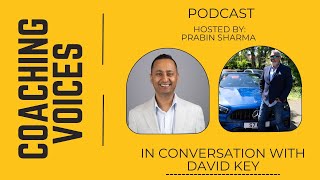
In Conversation with David Key
David Key, a former IT executive who sold multi-million-dollar solutions for Nokia, left that career to build a seven-figure coaching practice serving over 120,000 clients. He blends coaching, NLP, and hypnosis to help people escape what he calls mental prisons created by outdated beliefs. Key stresses that aspiring coaches should prioritize purpose over profit and find mentors, while AI can handle content but cannot replace human empathy.
Chapters
Foreign welcome to Coaching Voices podcast where my goal is to help you gain deeper insights into professional coaching. Here we bring diverse perspectives and expert insights from the world of coaching by engaging in conversation with seasoned coaches and and industry experts. I'm Prabhen Sharma, a coach and consultant. Welcome and thank you for joining. As we get started, I'm honored to be talking to our special guest today, David Key. David has a rich history and profound knowledge of the world of coaching. He's an NLP trainer and master trainer of hypnosis. He has helped over 134,000 people worldwide. My introduction falls short when I'm introducing David's work in the world of coaching. So without further ado, let's welcome David Key into our podcast. Hi David, welcome to the show.
Hey Pravin. Lovely to be here. Thank you for the invitation by the way. I'm honored.
Thank you so much for accepting that invitation. Let's start off by talking about your background a little bit. You've been in the coaching industry for more than like 30 years, I would say. So what can you tell us about yourself?
Wow. I know We've only got 30 minutes for this course, so I'll try and keep it brief so we can share valuable information for the listeners and people considering of get becoming coaches going on that journey or people who are just starting out or even seasoned coaches. My background was I worked in IT for many years. I used to DJ on the side and did a bit of radio work. But my passion was ignited, probably about crumbs in the 1980s. So talking about nearly 40 years ago that I picked up a book called grow rich while you sleep which was written by Ben Sweetland and it got me interested in the unconscious mind. And then I from there got to see a friend of mine perform on stage some hypnosis. He was on a state in a stage show and he did some really bizarre things that I thought he was acting but he wasn't. So I got really interested and curious about hypnosis. So I'm working in the IT industry. My boss was Peter Cobb and he used to run Apple Computers in the uk. He was the managing director of Apple and he set up his own software business and I ended up working for him and he funded a lot of courses someone on body language courses, hypnosis trainings, just because I was interested in the mind. And it wasn't until about 35 years ago that I stumbled across the work of a guy called Tony Robbins who I happened to go and visit one of his events in Belgium And I was blown away. And it sort of lit this spark in my belly. You know, the flames started a roar that I wanted to be in service to other human beings who were suffering because I saw him work with a woman who had manic depression for, you know, decades. And in the space of a short 60 minute conversation in front of 5,000 people, she changed just like that. And I didn't realize at the time he was studying and he was using a discipline, a meta, meta discipline called Neuro linguistic programming. So I went on a journey to study that and eventually trained as a, as a coach with one of the world's largest coaching schools, not Tony Robbins, but another organization. And I was taught models and theories like the grow model and power coaching and lots of different methodologies and techniques. Then I went on the NLP journey, studied that and then trained all the way up to become a master trainer of hypnosis. And incorporating those three modalities, coaching models, Neuro linguistic programming and hypnosis, into my early days of coaching was really, really powerful for the clients that I was working with. So that was, that was the start of my journey 35 years ago. And yeah, here I am all those years later running and teaching and training coaches all over the world about, I think at the last count about 120,000 people have joined my programs, including you, since the pandemic. So I'm extremely honored to be in service to other coaches. But it wasn't all plain sailing. You know, it wasn't always easy. I had a lot of challenges on that journey and one of them was once I qualified as a coach and had the certificate and I was very proud of that. I left the IT industry and set up my coaching practice. And in the first year I made about a thousand bucks.
So I give it.
Yeah, I know, it's like I gave up a six figure income working for, you know, in a senior role in IT industry, selling millions and millions of dollars of solutions around the world. One of my clients, for example, was Nokia and they would spend millions, millions on software. And I left that. I quit. I gave it all up without a plan, just a vision and an idea. I want to coach and I want to help people. And that was the start of my journey. But after the first 12 months and looking at my bank account and seeing that I'd only had one client, I was scratching my head because I found it easy doing business in IT with companies, but working with consumers. I found that a challenge because I really didn't know what I was doing and how to frame what I was doing. So I actually went back after my first year and went and got a job in it again. And I felt really down on my luck. I felt I'd failed. I felt that I was doing something that I didn't want to do. Now going back into it, my mind was on helping people. And after being in this company that I went to like after a year I went back and joined this firm. After six weeks they showed me the door. They said, we don't think you're suited for this role. It never happened in my life. And they were right. I wasn't because my mind was elsewhere. So I had a second chance and I took that chance and I, you know, put in the hours, the time, the reading, the studying, the courses, invested in myself and I hired coaches. I hired coaches that had already achieved outstanding results in their work and I modeled them. I found out how they did that and then I replicated what they were doing in my world. And that led me in my first full year after I came back and my second attempt, I think I turned over around £54,000 all the way back then. And in year two, it was six figures and. And now I'm running a seven figure coaching practice helping thousands of people. But it wasn't always plain sailing in the beginning.
Your story is amazing. The transformative power of coaching has given you those kind of thing that you have ever dreamed in your life. And you talk about this book, Grow rich when sleep. It's a profound book. I didn't get a chance to read it, but there are lots of philosophy that comes out from that book. People are envisioning that I should be making money when I'm brushing my teeth.
Yeah. And I mean it was a vision. Yeah, I have to say, but I didn't know how.
How did you hear about Tony Robbins? I'm so sorry to interrupt. How'd you hear about Tony Robbins? I know that he was very recognized individual. He still is.
Yeah, good question. That was in the later 1980s. Somebody. Well, somebody, my brother in law actually, he gave me a book. He said, look, you're interested in personal development. Think and grow rich was one book. Grow rich while you sleep so you could get a sense was I trying to make money. And that wasn't my focus, it was just that those books appeared. Grow rich while you sleep by Ben Sweetland was written in the 1960s and it was about the power of the unconscious mind. And it seems that the unconscious mind is where. Well, I say it seems it is. It's the unconscious stuff that drives us. And so many of us have so much programming as we're growing up, erroneous programs and stories and ideas that they get in the way. So my brother in law new was fascinated with the mind and hypnosis said, oh, you'll love this book by Tony Robbins. I think it was called Unlimited Power. So I read that book on, I think, in like two sittings, going from my house on the London Underground to my place of work. And I just thought, I've got to. I've got to meet this guy. So I. I was working in the IT company, and one of my colleagues, he was interested in personal development as well. We were in our 20s and I'm in my late 50s now. And I said to him, I said, look, I want to go to Belgium and I want to go on one of these seminars that this guy Tony Robbins is running. And we both signed up and I took a couple of colleagues with me and we went to this immersion weekend and had a whale of. It was like a mix between learning, personal growth, understanding how the mind really works, and entertainment all in one. It was just like going to one big party. It was a fantastic experience. But the challenge is, I came back to the real world and all my enthusiasm and motivation to want to help people, it was like I was interviewed by Success magazine from the Coaching Academy a few years later, and they said, what was it like? And this is the thought that came to mind. I said it was like going on a spa day and you're getting in a beautiful hot Jacuzzi and you just feel invigorated by it. And then if you stay in there long enough and someone turns off the power, eventually the water gets cold. And I felt that my motivation dissipated. So I went back for another event and then another event. And I didn't realize that it wasn't Tony Robbins that was motivating me and inspiring me, which is what I thought it was something more fundamental that was happening inside of me. And I hadn't understood where motivation came from. I hadn't understood about the power of language and how we can get in our own way by the stories we tell ourselves. I hadn't seen the connection between physiology or physiology and your mindset. I haven't. I haven't seen the connection between the principles behind the human experience, that fundamental three principles that are driving all human behavior. And I didn't understand them because no one had taught me those things. So I thought there was something wrong with me because why is the motivation gone? Away. After going about three or four times to Tony Robbins, I undertook a journey with him, training in a number of his different methodologies in NLP and hypnosis. But it wasn't until, you know, over a decade ago that I stumbled across something that's so simple for people to understand that any human being on planet Earth who wants to be in service to another human being, if they were to understand these principles that drive the human experience, drive our behavior, they can have and do and be anything they want in their lives. And I'm not exaggerating, obviously within physical cap. Physical, you know, capabilities, we can't. I can't run the 100 meters in nine seconds. It's like not going to happen no matter how much positive thinking I do about it. But what I noticed that my coaching over the last 30 years has got simpler. Less is more. And I now take that out into the world and share that with my students. Show them what's possible for them as a human being and how they can really quite easily help another human being if they understood the three principles behind what creates all behavior. And when human beings understand that they transcend their problems, they get over their challenges where there's like earning limitations or we talked earlier, limiting beliefs, whether they they've got challenges in relationships or they got habits and behaviors that aren't healthy and that aren't useful for them. Understanding principles as opposed to fixing someone, as opposed to trying to rectify a thinking problem. Just educating clients is a gateway to transcending all psychological suffering. And it's so simple. And that's where I am now. So I've gone from complexity to simplicity in terms of my coaching. No routines of rigma rules or models to follow, just understanding. And then the coaching conversations that we have become more collegial human being to human being, less coach and client, less interventionist and more collegial. Conversations that enlighten people and their problems disappear like puddles in heat, you know, in a heat wave when they wake up and go, oh, man, all my suffering was created by my thinking. Yeah, that's it. Yep. 100% of your suffering is created by the misuse of the principles that you were given at birth and nobody told you. So it's evolution, I guess, in terms of coaching over the last 35 years.
Yeah, we as a human, we're pretty much wired on what needs to be done by not ourselves, but from external forces that impact our lives. And we have this belief system that we just follow it in believing that if we do follow it it's going to do good to us. And in that thought process, we fail to utilize our thinking in a way that there is lots of other thing that we can do in our life as well that can have positive impact. Not just like follow exactly what been taught. We can be our own. Kind of like when somebody says something, we have to put some thought on it. Whether or not that has some validity or no, I believe, well, you know.
Human beings instantly create prisons for themselves.
Oh wow, that's, that's great. Yeah, that's a great thing.
They create, create prisons for themselves with their own thinking. It's like. Or they have a model of the world like a sat nav and they go, this is, this is how the world works. And that's their belief system, their values, their experiences of life. And they go, this is how the world works and they believe it to be true.
I'm a prisoner of my life. In my life.
Yeah. You know, and if we haven't updated our sat nav, we might end up going down a road that they dug up years ago and they didn't, they forgot to update the software and you end up at a dead end.
Yeah.
And an example you said, you know, we get conditioned, we get. Beliefs are passed down to us by our parents, by our grandparents, by our teachers, friends, tv, books, newspapers. And human beings need to really, I think, understand that all of that information goes in. It becomes part of our satellite navigation system. That's how we navigate the world. And often we've taken on erroneous ideas. Let me give you an example of story. There's a story about a, a large family in the States. Around Thanksgiving they all got together and they would have roast turkey and they have, would have a roast ham as well. And when it came to everybody sitting around the table and, and the food being served, there was the great great grandmother, the grandmother was there, the mother and her daughters and granddaughters. So it's like there was a whole generation or no, four or five generations there sitting around the table. And the mother who was hosting the, the Thanksgiving brought out two hams. She'd taken this large ham and it was in two halves and she put it on the table. And one of the, one of the granddaughters said, mom, why, why do you always bring out two hams at Thanksgiving? And she was like, well, we've always done it that way. But why, why Mummy? Why do you, because you bought one ham but you cut it in half. Why do you bring it out as two hams? She goes, well, it's tradition. I learned it from my mother. So the young girl asked her grandma, grandma, why. Why did we have two hams? She went, well, I got it from my mother, the great grandmother, sitting at the table. And everybody looked at the great grandmother as she leaned over, and she said, well, the reason we have two hams is because when I was cooking Thanksgiving, we only had a really small oven, and the large ham to feed a family wouldn't fit in the oven. So I cut it into two pieces, you see? So it's like, finally the daughters are waking. I go, oh, I don't need to cut it because my oven's big enough now I can cook a whole ham or a whole turkey. I don't need to cut it in half.
Right.
Can you see how we can take something that's happening on the outside and interpret it in a way? And then we're running an erroneous belief, something that's limiting us. It's not true. It's a concept. Well, all human beings have those. What's so beautiful about coaching and helping other people is when you really know how to coach and you have gone on that journey to understand human beings and their limitations and how they innocently create these obstacles, these prisons for themselves. We can go there with the key and unlock the prison cell for them and let them free so that they're forever grateful that finally they woke up and go, oh, my God, I'm going to save so much time. I only need to cook the ham once at Thanksgiving. Or I'm finally. I can finally make that money. Because I realized. I didn't realize that I thought people with a lot of money weren't very nice people. And I want to be a nice person. So every time I make money, I sabotage myself. Or you name the belief. Human beings are walking around on planet Earth unaware of the software that's running the whole show.
Yeah, yeah.
You know, the. What's. What's running us. These accumulations of these false ideas, and we don't even know we have them. And where a coach comes in, isn't it. We sit down and we listen to our clients. What do you want? Well, I'd like to have a successful coaching practice, but I haven't. Okay, so we have conversations and we educate our clients, and they start to see they have the same potential as you or me in building a successful practice, helping other people, and having a life of freedom. That's what I love about coaching. And it's different from it. You know, working in the IT industry, it was very Much about. I felt like a hamster on a wheel. Chasing the dollar, ready for payday, waiting for commission checks. Constantly, constantly on that hamster wheel. Whereas I moved into a lifestyle business, which is this.
Yeah.
Fortunately, I only have to work, you know, three days a week max. That's what I choose to work. I could do two or one. Making an impact with courses online, doing talks at events, podcasts like this. And somebody might just hear this and go, I really want to coach, but it's really difficult. I'm like, it isn't. You just have to know what you're doing. You just have to know what you're doing. I had to learn through the school of hard knocks. We didn't have the Internet. Well, we did. It had. Yeah, it was there, but it wasn't being used how it is now.
How many CDs you burn? Right.
Oh man. You know my NLP course that we sell on Facebook for $7?
Yeah.
A lot of people think, oh, it can't be very good for seven dollars. This is what I created. These are 16 CDs. There are eight films and DVDs and 166 page manual for seven bucks.
Yeah.
And people are going, it's going to be rubbish. I'm like, this has been audited by Professor Angus McLeod at Birmingham University. He's a visiting coach and professor of coaching and business at their business school. And he, you know, rated it and.
Yeah, right.
A lot of people think you can't get a lot for nothing or for very little. You know, what is the old saying? There's no such thing as a free lunch.
No, no. And seven bucks for that effort is.
You can't even buy lunch with that.
Absolutely not. You pay attention. Just when you, whenever you try to buy something, you just pay taxes on top of it for seven dol. You know, living with the false belief. I read a story that you mentioned about the bald eagle who got raised with chickens. That story you mentioned.
Yes.
It's a profound story. I shared that story to many people and I think it's an eye opening for a lot of these people. And then this, there's another one that you mentioned about this guy was disabled and the doctors tell him that if he's gonna make it tonight, then he's gonna leave. Otherwise it's not gonna make it.
Yes.
And then he made himself to be awake the entire night. And tomorrow, tomorrow he was, you know, he, he had that belief system that if I do this, this is the resultant. Right. So making your mind in that direction is really essential for us.
Yeah, that was a story, a true story. Milton Erickson, one of the greatest hypnotists that ever lived. He was paralyzed with poliomyelitis. So he's paralyzed from the neck down, lying in his bed. And he overheard the conversation the doctors were having with his mother downstairs. They were saying, we don't. Mrs. Erickson, we don't think Milton. That was his first name. We don't believe Milton is going to live until the morning. And he heard that he was 17 years old, and he was furious. How dare they speak to my mother that way and tell them I'm not going to be alive in the morning. I'll show them. And I think we need that feeling, that philosophy as a coach, like, I will show people out in the world that I can be in service if your heart is in helping other people, and then you'll be able to achieve that. It just might not be instantaneous success. You know, it's taken me a while, but you play the long game in this game, and you'll. You'll. You'll still be in the game when most people have given up. So tenacious resolve is a requirement, I think, to be a great coach. And Milton Erickson, when he was paralyzed at 17 years old, he had tenacity, tenacious resolve. And it was this. He thought, right, I'm going to set a goal, and I'm going to see the sun come up in the morning, and I'm going to force myself to stay awake. But the challenge with that was he had a wardrobe at the end of his bed, and it was six foot six wardrobe, and he couldn't see out the window, so he wouldn't have been able to see the sun come up. And his mother came upstairs after the doctors left the house, and she said, how can I help you feel really comfortable now? Because she was obviously aware of what was going on, and she was extremely devastated. But she wanted Milton's last hours to be comfortable. So she said, what can I do to make yourself feel really comfortable right now? And he blinked out instructions because he couldn't speak. So he blinked with his eyes. An instruction, can you move the wardrobe out the way? And she pushed this wardrobe, she was only a little lady, and she pushed it out of the way so he could see out the window. And he forced himself to stay awake all through the night. And he saw the sun come up in the morning, and then he passed out, and he was unconscious for months, and he recovered, and he went on to become one of the greatest Hypnotherapists that had probably walked on planet Earth. His nickname was the wizard of the Desert.
Wow. Determination.
Well, absolutely. But what he. What he was pointing there, in my mind anyway, in my world, that wardrobe was an obstacle that was getting in the way of him achieving the goal. And in spite of the fact that he was paralyzed and couldn't move it, he still had the awareness to be able to ask for help. He asked his mum to move the wardrobe. If you want to become a coach, find someone that knows how to do it. They can get the wardrobe out of the way for you so that you are free to achieve your goals. And often that wardrobe, the metaphor of the obstacle that's in the way, is happening up here inside your mind.
Right? Right.
And a good coach can help you transcend that. Wake up and see the truth. You have the potential like any other being. As long as you can speak and hold conversations and you've got friends, then you know how to build rapport. With the right training and understanding, you can help anybody with anything. You really can. That's the long game, though. That's the ultimate goal.
We need to see ourselves from inside to figure it out what kind of potential that we're carrying. Right. Lots of people do not exercise that. We live in the outside world. We see things what's happening in the outside. We try to copy that exactly as is, without realizing that you have so much potential.
Oh, absolutely.
David, let me switch a gear a little bit here. Let's talk about someone who is considering the career in coaching, what advice you have for them, and whether or not obviously this coaching career is right. Career for you, what advice you have for those people who are considering the career in coaching as well.
Okay. First thing that comes to mind is if money's your goal, then don't do it. Now, here's the thing. I trained with many people over the years. Zig Ziglar was a. I was a fan of Zig ziglar in the 1980s. He's an amazing motivational speaker. And he said, you know, you can have anything you want in life if you just help enough other people get what they want. So if your focus is on being in service and helping other people get what they want, for example, you might want to help someone with anxiety, not have anxiety, be free, peace of mind, or someone that is struggling with their performance at work, you want to. Might want to help them excel and be a top achiever in the company. If your focus is on that, then you ultimately have got your heart in the right place and the output of being in service and really caring about other human beings and having worked on your own growth and personal development, the output is you can get paid handsomely for it. That's just a byproduct of making a difference in someone's life. So my invitation, if you've been enticed by, oh, I can make six figures and I can do this. Yes, you can. But if that's your driving force, I think you'll probably not make it. But if your driving forces. I really, really want to impact, make a difference in the world, help people, because that fills me up.
Right.
It's a good feeling.
Yeah.
Then you'll get paid handsomely for it because you'll get good at it. So that would be one. One of the considerations that I would.
Have, if I may. What I'm trying to infer by that statement is you have to put your client's interest first than your interest later. Right. Your interest is to make money. If you put that on top of your client, you're never, never gonna make it.
If that's. Yeah, that's the putting the cart before the horse.
Yeah, absolutely right, Absolutely. That's what I mean.
So. Absolutely. 100. I think you can make a lot of money as a coach. There are plenty of seven figure, eight figure coaches out in the world. You know, a comfortable living, six figures for a lot of coaches. And some don't even make the minimum wage. So what are the difference between the people that want to be a coach and they've got their heart in the right place and the people that are succeeding that have got their heart in the workplace, money wise, it's just their business strategy and models, their pricing models. Maybe there are a number of blind spots that the coaches that aren't doing well have, as opposed to the people that are successful. So again, invitation would be to consider hiring somebody that knows what they're doing and that actually can demonstrate and prove their results. You prove it?
Yeah.
And if they can prove it, you know, it's possible for you too, because if you've got the right mentors and coach yourself. So yeah, that would be another thing. You could become a coach, hire a coach to help you.
Absolutely, absolutely.
Coaches out there that have trained to become coaches, but they don't have a coach. I've got like, I'm nearly 60 and I've got Dr. Fransky. I've got three.
Yeah.
All for different, different areas. Because I know I have blind spots. It's that what's so beautiful about Understanding consciousness is that it's infinite, okay? There are infinite levels of understanding. So there's always something to see at every level that you go. Whether you're just starting out as a novice considering it, or you've been in the game for 30, 40 years, there's still always something to see. And that's what's so beautiful about this game. Because if you love, you know, showing up and being an enhanced version of yourself, even though you're already perfect, if you know what I mean, you are perfect. Designed by this universal intelligence at a energetic level. You're just energy. You're a spirit in a bodysuit. And so therefore, you're no different from anybody else, apart from your memories, your attitude, your belief system, your values. If all of those are sorted out and lined up and you've had a coach, you're going to do well. Yeah, you really are. But it's not guaranteed. And what I mean by that is, you know, we don't know what life's going to throw at us. There's a lot of uncertainty and unknowns. So we have to, I think, like any entrepreneur, be comfortable with the unknown and be prepared to take feedback and learn and evolve. Bit like see coaching this way. So what comes to mind? When I first started coaching and it didn't work out, I was feeling really low and in a low mood. I was down on myself. I thought I'd failed, you know, and then I had the opportunity after getting kicked out of my com, the company I was working for, I had an opportunity to have another go, a second chance. And, you know, as I look back, I could never have imagined that I am where I am right now. But one of the things that I didn't see, that I see now that I want to share with everybody is I saw coaching and the business of coaching or having a practice and helping people. As I hadn't delineated that profession, coaching with life, there was sort of a blur and I became boring with my friends. I started talking to coaching all the time. That's all I thought about all the time. It affected my relationships and all of those sort of areas because I hadn't seen this one thing. And if you can take this on board, if you're deciding to become a coach, see coaching as a game, like a board game, like Monopoly or Snakes and Ladders. All right? All you have to do is throw the die, move a few places, and then make a decision on where you go next and you throw the die again. And eventually there will come a time when You've been playing the game for the day, you go home and you go, I'm leaving the game behind and I'm going to go back to my life and I'll come back to coaching tomorrow. So I see any of my clients who are in business, they say, you want to delineate between the game of coaching and the game of life. And that'll really set you apart from the crowd because you might decide, well, I don't like Monopoly. I want to play Snakes and Ladders now. And you can change the game. But what I didn't see is that I got so wrapped on it, it became part of my identity and that wasn't healthy. So, yeah, I see coaching as a game like any other profession.
Yeah. Sometimes when people come to me and ask similar question, whether or not coaching is the right path for me or no, I tell them, you only live once, give it a shot, see what happens. Exactly.
We've only got one life. You remind me of a friend of mine. I was at a local bar having a beer with a friend and I was looking at nice cars and I love cars, but this car I was looking at was a Mercedes amg, like one of the E Class Cabriolets, a beautiful vehicle. And I said to him, I said, it's quite expensive, you know, and I'm not sure. And he said, you know, Dave, you can always have it in your next life. And I went, what do you mean, next life? He went, exactly. There isn't one. Unless you believe there is, obviously.
So some people believe in the real.
Yeah, I believe in reincarnation, but I'll have no memories of this life.
Yeah, absolutely.
I might not be interested in cars in the next life, so I might as well get what I want. I went, I came home to my wife, I said, see, I was speaking to John and he said, if I want that car, I could always get it in my next life. And she went, what do you mean, next life? And I went, exactly. And she went, you've just caught me out, haven't you? Yeah, pretty much. I ended up getting it. But that's a story for another day to go deep on that one. But, yeah, if you're listening and you're considering coaching, you don't have to give up your job to do it. You can still train. You can train in your own time, hang out with people that know what they're doing, join a coaching school and work in your spare time helping people. If you love it, then you'll find a way to transition from one Source of income to another, or you could do both. I have a lot of coaches that they love their day work, working for company and they also have some free time on the weekends and they love helping and volunteering and doing some pro bono coaching. There are so many people on planet earth right now that are suffering, suffering with their psychological well being. Millions and millions of people not enjoying their lives. And happiness is our birthright. Happiness is our natural state. So the people that are unhappy, that's the most unnatural human state there is. So many. We've got a crisis in mental health. What I share these principles will help people transcend any of their suffering from depression to anxiety. By the way, as a coach, I can't say that I'm not a psychologist or a doctor, but what I'm saying is I have thousands of clients that I've worked with that don't have depression now, but they did before they came across the understanding that I share about how the mind, consciousness and Universal thought creates 100 of our experience. And it's created on the inside. As you wisely pointed out, it's. You don't get your joy from anything that's happening outside of you. I don't get joy from coaching, but I get joy from the beautiful thoughts that come into my mind when the client phones me up and says, oh my God, I saw the light and I don't have anxiety anymore. Or if I'm anxious, I don't care about it. Or someone says, I've been depressed for 30 years, I've seen my, my medical doctor and they're winning me off my antidepressants because I finally discovered true happiness inside. I thought my unhappiness was because of my past or my circumstances. And when they see that the, the past doesn't exist, it's a figment of your imagination, it's just a memory. And that they take us down if we don't understand the nature of healing. When people wake up to that, that's the most beautiful feeling in the world. And you get paid for it as well. It's like, that's a bonus, isn't it?
That's a bonus.
Buy a nice car.
That's absolutely, absolutely.
So I hope people listening are getting some enthusiasm for my enthusiasm for changing people's lives. Yeah, that's where the rubber meets the road.
That's joyous, right? Absolutely. And then we're heading to the end of the show. Before we leave, everybody, you've been in the technology industry in the past and the technological advances are always happening. Here with the new AI that's coming into the market these days, what are your thoughts?
Yeah, I used AI today. I took a video that I did while I was walking my dog and I popped it in. I'm not sure which one it was called Opus, I think, and it just produced a reel with text on. I thought, wow, that's amazing. That could have taken years. Or me, I don't even do that stuff. But it would have taken forever to edit it. It's going to save a lot of time, a lot of money. AI is extremely intelligent, can take a video or podcast like this and produce and take out the elements of that podcast that it thinks is going to do really well in social media. That's where I think AI has been really helpful for coaching, helpful for you. Creating proposals, presentations, articulating messages. We run a program called the Lighthouse Mentoring program which is about using AI to craft your messaging on social media to attract clients. It's so beautiful and it's profound. But AI as a coach, AI doesn't have a soul and I don't think AI can ever replace a great coach. So I'm not concerned about AI taking away business. I see it as a valuable asset to utilize in your business.
It's a compliment. And as a companion, I think that tool will go along with you.
Absolutely. But it doesn't have a soul. It doesn't feel. And a coach can feel. You can be with a client. You can be in a really good feeling yourself and that transmits across to the client the feeling, does the heavy lifting. AI can't do that, so don't even worry about it. Not in my opinion anyway.
Well, I mean, that's a great opinion. And with that thought, I'm going to close this session. Thank you, David. Thanks for coming to the show and it was a pleasure talking to you. Thank you.
You're welcome.
Have a great day.
You're welcome. Thanks for everybody for listening as well. It's pleasure to be here. Thank you.
That was David Key, an NLP and hypnosis coach, in conversation with Prabhen Sharma on the Coaching Voices. You can contact david@david.co.uk or by visiting his website@davidkey.com we'll be bringing out coaching related topics in coming episodes from the the InsightIgnite coaching. If you find this content helpful, share with your friends and colleagues and follow our show in Spotify, Apple Podcasts, YouTube and in our own webpage at www.insightignitecoaching.com. please continue to leave your candid feedback that's the only way we can grow and serve our coaching community. Thank you for listening.
You.
More from David

How understanding the principles of thought can transform your life | David Key | TEDxInnsbruck