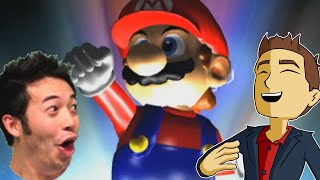
In this 17‑year anniversary tribute, the narrator passionately argues that Super Smash Bros. Melee is the most fun and best‑made Smash title up to its release, independent of its competitive reputation. The video blends personal anecdotes with systematic comparisons to other entries (Smash 64, Brawl, Smash 4). It praises Melee’s presentation—cinematic opening, iconic menu music, and polished art style that faithfully renders the Nintendo 64‑era character designs. The soundtrack’s original themes and stage music are highlighted as memorable. The speaker lauds Melee’s single‑player content, especially Adventure Mode’s varied platforming levels and Break the Targets’ character‑specific challenges, deeming them superior to later games’ offerings. Stage design, item selection, and the GameCube controller are cited as contributing to a balanced casual experience. Gameplay responsiveness, low input latency, and weighty physics are presented as core strengths that benefit both casual and competitive play, contrasting with the buffering and slower feel introduced in Brawl onward. While acknowledging Melee’s flaws (roster size, some character models), the narrator concludes that Melee remains the sharpest, most enjoyable Smash game before the arrival of Ultimate.
Chapters
Super Smash Bros. Melee recently celebrated its 17th birthday, and since it's my favorite Smash game and favorite game of all time, period, I thought it would be fun to make a tribute to it. And of course, please know that this video will be full of my subjective opinions, and it's okay if you don't share them with me. Remember, this is literally a Melee fanboy's video, so it's going to sound like one. Now I'm actually not here to gush about how great of a competitive game Melee is. That topic has been done to death. Instead, I'm here to talk about why Super Smash Bros. Melee is the most fun, best-made Smash game to date, regardless of competitive influence. Keep in mind, as of this video's upload date, Ultimate has yet to release, so I won't be comparing Melee to Ultimate in this video. Of course Melee has its flaws. Flaws, but all things considered, it's "the sharpest game in the series," to quote game creator Masahiro Sakurai. It nailed its party game purpose and is a Nintendo franchise celebration masterpiece. But David, since Melee is the game of choice by the competitive community, that means it can't be fun to play casually. This is a very incorrect notion. Two things can be true at once. Melee can be an incredible game for the competitive scene, which it is, and it can be an incredible casual game too. The two aren't mutually exclusive. It's my mission to prove that today. Melee really nails it in the presentation department. The cinematic opening always gives me goosebumps, reminding me when I saw it for the first time and how hype-inducing it was. I remember before I owned a GameCube, borrowing the game from my cousin when it first came out, and recording that cinematic opening on VHS just so I could watch it back later. That's how exciting it was. It was our first glimpse at our favorite Nintendo characters from different series interacting, beyond what Smash 64 did. Brawl's Subspace Emissary cutscenes were also incredible in this regard. However, the opening of Brawl simply recycled the cutscenes, and kinda mishmashed them together, and it wasn't given the same special treatment. Smash 4 recycled character reveal trailers in a similar fashion for its opening. Smash 64 was really the only other game that gave the opening its own special treatment. [MUSIC] Immediately after you press start on Melee, the menu music plays. There is not a Smash music track more iconic or more well-known than this theme. It absolutely never gets old. The menus are cohesive and consistently styled, and it gives it that slick design and polish that I haven't found matched in any other Smash game. The art style of the characters is also my favorite from any Smash game, with a few exceptions. I'm not going to try and defend Yoshi's appearance, for example. Yeesh. Why didn't they just give him his Yoshi's Story appearance, for crying out loud? But the reason for this love of the characters' designs is that most of them are the Nintendo 64-era incarnations fully realized. Since Melee was a launch title on the GameCube, the source material was largely Nintendo 64-focused. Basically, all of the 3D renders for 64-game promotional materials were more accurately depicted on the GameCube compared to the more limited graphical capabilities of Nintendo 64 hardware. In Melee, Link is Ocarina of Time Link, Bowser is Super Mario 64 Bowser, Donkey Kong is Donkey Kong 64 Donkey Kong, etc. As far as I'm concerned, the N64 era character designs are the definitive character designs and my personal favorite. I think Melee struck that perfect balance between quasi-realistic and cartoony. Where Smash 64 was a little too comic book and Brawl was a little too gritty, Melee found that happy medium. When it comes to the Smash-specific music in the soundtrack, Melee brought so much to the table. An original opening theme, menu theme, final destination theme, battlefield theme, and break the targets theme, just to name a few. Each of them were memorable and iconic. In Brawl and Smash 4, most of these themes were just different iterations of the main game's theme song. Although they were unique tracks, they had the same general melody. Think about Brawl or or Smash 4's Final Destination music just being a remix per se of their games' respective main themes. When it comes to stage music though, I'd say Brawl is probably the biggest contributor to original, new songs, but a higher number of Melee's contributions were more memorable and iconic, at least for me. Trophies debuted in Melee, and it was a significant contribution to give the game its "let's celebrate Nintendo's franchises" feel that Smash 64 only touched upon. I remember spending hours reading about the trophies. And even learning about characters from franchises I wasn't yet aware of until they were included in Smash. Brawl's stickers hit the point of diminishing returns in this regard though, as they didn't have the same impact. There were just so many of those freakin' things. In general, I think Melee's single-player experience is the best of all the games. Adventure Mode was a brilliant combination of series universes with platforming levels and with classic fighting matches. It was something I wanted to replay again and again with every character on the roster. Break the Targets was unique depending on which character you pick. Brawl, by contrast, had the same 5 target test stages for every character. Brawl also had an incredible Adventure Mode story and those cutscenes, but the gameplay got tedious after a while since it was so long. The environments and enemies were more generic than Melee's Adventure Mode. Which was a bit more inspired from the game series. Smash 4 had no adventure mode to speak of. Brawl, Smash Wii U, and Smash 3DS also added a few more single-player modes, but none that I consider as valuable. Melee and Special Melee left plenty of options to be entertained, although Brawl's implementation of special mode was a bit better. But even playing casually, special mode isn't ever my go-to mode. It's all about survival. In terms of character selection, Melee had a decent number of characters. 26 if you include Sheik. Considering there are 58 or so odd characters in Smash 4, including DLC, I suppose it seems pretty small in comparison. So it's tough to argue why this roster would be considered the best, so I'm going to pick my battles. Stages in Melee were great. Plenty of casual favorites like Temple and Big Blue, plenty of neutral stages for when you wanted less disruptive gameplay, and the stage hazards were really toned down compared to later games. I think in terms of net new stages, Melee's contributions were the finest. Items were good too. I personally never played with Final Smashes in Brawl or Smash 4 even casually, so that item isn't missed by me, but I know it's missed by many others. Just like the stages, There were a lot of obnoxious items in Smash 4 that I'm glad are absent in this game. One key aspect I really appreciate about Melee's gameplay is its responsiveness, which is generally regarded as an important quality in competitive games. But I'd argue responsive gameplay is important no matter how competitive the game is meant to be. Party game or serious game, I want responsive, precise feedback from my inputs. Every Smash game has run at 60 frames per second, and Smash 64 and Melee both react the way I'd expect them to. But unfortunately, from Brawl forward, various delays and buffers have been added to the game that really disrupt the flow for me. I like that Melee and 64 were different from other fighting games in that way, and I'm sad that they lost this differentiator. I could go into a whole different video just on in-game buffering in Brawl forward, so I'll save that for another time. The weightiness of the characters in Melee compared to Brawl and Smash 4 keep the game moving. Since in 2001 we only had Smash 64 to compare it to, the game never felt especially heavy to me. If games ever felt like they went by too quickly, you could just add more stocks to each character in the match. Problem solved. Of course, I don't need to go into all the details about the game's physics and movement options that make it flow so well. There are plenty of other videos that can talk about that more in depth. It's also worth mentioning that the GameCube controller, the one that launched with Melee, has remained the de facto Smash controller since. All in all, I love Melee. A lot. And I think too often it's seen today as "the Smash competitors game" and isn't recognized enough for its own merit as a casual gaming experience. So before I launch into Smash Ultimate on this channel, I wanted to give a tribute to what I believe to be the finest Smash game ever released until this point. Until Ultimate's imminent release, I can confidently say Melee is the most fun and the sharpest in the series. Thanks for watching!