TV Dragging in Centralia (1987)
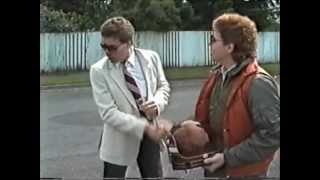
Chris Akanesmaki reports from Centralia, Washington on the sport of TV dragging, where residents tow televisions with vehicles. The fake history traces it back to 1897, when a cow-caused fire was put out by dragging a console TV. The segment climaxes with racer Bolt De Broglie's fatal crash during a 1986 land-speed record attempt.
Chapters
The television. A more iconic appliance has probably never graced the average American household. And yet, what other device can bring so much happiness and pain simultaneously? Even a mild-mannered pastor can be driven to distraction by this fiendish device.
I can't believe it! My Buffalo Bills lost! The Cowboys, the stinkers, they had the refs on their side and they hurt Kelly deliberately. I'm never gonna watch TV football again!
What could possibly cause this kind of anger and frustration? It began in Centralia, a small town where people began using televisions for things for which they were never designed.
Hello and welcome to That's Life, It Stretches, the show where we stretch your imagination and your patience. I'm Chris Akanesmaki, and I'm talking to you from Centralia Video Studios in downtown Centralia, Washington. Where is Centralia, you ask? Well, that's a valid question indeed. Centralia is a very small northern town of only about 11,000 folks, and because of the town's small size and remote location, they've come up with what I think you'll find to be quite an interesting way of passing the time. It's called TV dragging, and in the next 30 minutes, we'll not only explore just what TV dragging is, but where it came from, its explosive growth in recent years, special kinds of TV dragging, including exclusive footage of the tragic 1986 land speed record attempt which claimed the life of driver Bolt Dubrow, and we'll also look at the future of TV dragging. Stay tuned because we're going to find out how it all got started, right after this.
Jack Roberts, what are you doing?
I'm smashing high prices with this ball-peen hammer!
But Jack, those aren't prices, High prices? Those are just glass bottles.
Yes, I guess you're right. I should have listened when you said that if I kept hitting the bottle, I'd crack up. But I just want to show how stupid a commercial could be and still have people patronize my stores.
You mean your 3 stores on 3rd Avenue, Hoon Street, and in the Brock Plaza?
Yes, those are the ones. And I'll bet no one even questioned why you said the addresses for each store, considering you work for me and obviously know their locations.
Oh, Jack, you're such a kidder.
Yes, you're right, but there's one thing I'm not kidding about.
What's that, Jack Roberts of Jack Roberts Appliances stores located on 3rd Street, Hooton Avenue, and in the Brock Plaza?
I won't be undersold!
The year was 1886, and in Washington State, a new town was born. Originally named Centerville, it later was renamed Centralia after it was discovered that there was already a country western clothing store using the Centerville title. Logging was the chief activity of the day, but how interesting are logs? It didn't take long for the citizens of Centralia to grow restless and begin wanting a new form of entertainment. TV dragging burst onto the scene in 1897 quite by accident. A cow in a barn owned by a Mrs. O'Leary kicked over a lantern, starting a fire. Mrs. O'Leary, thinking quickly, realized the only thing large enough to snuff out the fire was her mother's old console TV. Much too heavy for her or anyone else to carry, she tied it to her ox cart and towed it to the barn, where it covered the entire blaze, putting it out and averting what could have been a devastating inferno. The sight of the old TV being dragged along the ground excited Mrs. O'Leary and her neighbors so much that they began dragging TVs just for the fun of it. It caught on and soon everyone was doing it. And where were they doing it?
On the road, down the road.
Here we see a group of happy young lads in a 1912 vehicle towing a Sears 25-inch stereo television. This is an early model of the famous Shelby Cobra. Here, the 1911 Centralia College Community Big Band, towing a 20-inch Sears TV to a gig, is shown proudly displaying their instruments. Notice the driver and conductor of the group, Jerry May, at the wheel of this 1902 Lamborghini. Even public transport got into the act, as this historic photo shows of the Centralia trolley car towing a 25-inch Sears TV with electronic tunings. Train up a child in the way he should go, and when he is old, he will not depart from it. Demonstrating a practical application for these words, a loving father instructs his 4-year-old daughter in the ways of TV dragging. Barks. Walt and Pauline Rogers, longtime residents of Centralia, remember what it was like during those gay times. You remember back when your model takes out firewalls?
Oh yes, when we first moved here to Centralia here, mother and I was coming in from the North Fork of the Newaukum River and we had an old Model T truck and had some lumber on each side of it and mother, she couldn't get out and the doggone thing caught fire underneath the gas tank and I finally got out and decided to gets some mud.
Did you go under the lumber or over it?
I went under it myself, but Mother, she couldn't get out under it or over the top of it.
So, well, now, this fire, was that a result of any kind of TV at all?
Well, yes, dragging that TV along behind the truck, I assume, is what causes sparks to go underneath the gas tank. But anyway, Mother, she got all excited going, trying to get out, you know. And it only had about a, oh, I would say a foot square window in the back. Mother's a pretty good size. So I guess she went through that window and I don't know how. But you know, I had to unload that there truck of lumber in order to get her back in the cab after I got this fire fire put out. And about that time, why, I decided then, dragging that TV along behind us there, there's enough of that stuff, so we threw that off into the ditch.
Did you know that Walt was a TV dragger before you married him? No, heavens no. I didn't know he had any experience like that. Well, what do you think about the modern techniques being employed today about TV dragging? Is it as good as it was in the old days, or have they ruined it by making it so high-tech?
Quite a bit so. I think that they're going overboard on it a little bit, but other than that, we've still got to have our TVs. But on some of the shows that they're putting on nowadays, why, I go for it, but my wife don't. Anyway, that's between her and me.
Well, that's great. You know, it's been wonderful talking to you. Thank you very much for being on our show.
You're entirely welcome.
As times change, so did TV dragging. The advent of new, more powerful engines gave TV dragging the shot in the arm it needed to become the Northwest's favorite pastime. Faster cars, faster TVs, and the Northwest reputation spread around the globe. I'm talking with Audrey Kimball. Now a US citizen, she was born in England, a country that has consistently banned TV dragging. Mrs. Kimball, tell us about your college years, how you felt about the Americans dragging their televisions, and if that had in any way an effect in your desire to come to this country.
Yes, it did. Once I knew that you could drag TVs in the United States, that was the country for me. It was, as you know, banned in England, but some of us followed it very closely. Some of us even had socks And we embroidered "Go, T.B. Draddy" on our socks. And we wore them in secret places. On our legs, of course. But we were in secret places when we were wearing the socks, like underneath pant legs and things. Once in a while we'd show that we had these socks on. And when I found that it was okay in the U.S. of A, I was history.
What did your parents feel about this? This desire to drag television that you obviously possessed?
They couldn't understand it.
Had they dragged anything in their life?
Let me think. They were good, outstanding citizens. They may have dragged an occasional chicken coop during the war, but nothing much.
Well, Mrs. Kimball, I'm just thrilled to talk with you, and I'm excited that that England has people like you that find TV dragging to be not only entertaining but exciting as well. Thank you very much. What did the authorities say? We found out. The police department speaking with Lieutenant Tony Breckel about the television dragging problem here in the city of Centralia. When did you first know that there was a problem or receive complaints about it?
Several years ago. Actually started 5, 6, 7 years ago.
And what were the nature of the complaints?
Was it noise or Danger, just about everything you could name from reckless driving to drinking to lewd conduct, keeping people awake all up and down the cruise strip.
What methods did you use to try to curtail this activity?
Well, we've tried barricading the streets, we've tried emphasis patrols where we actually write tickets for every violation that officers come across, to just ignoring the problem.
Yeah, what do you think the city councilmen think of your methods and their effectiveness?
Right now, we don't know.
Do you see any, I suppose, any chance that this might diminish somewhat now that the professional racers are being able to drag TVs in their races?
That's kind of hard to say until we can do a little bit of a study on the situation. Evaluation and a little more time to actually analyze the statistics.
Well, thank you, Lieutenant Bruckel. It was great talking to you. We really appreciate it, and we'll be back right after this.
Hi, television fans. I'm Fred from Fred's High Performance Television. I'd like to talk with you, if I could, about some of our weekly specials here. When stock isn't enough, you need high performance veneer from Magnafox. Low wind resistance, tough to break. Steering mechanism going out. This is the Magnafox Micromatic steering mechanism. Get you around those hairpin turns with Micromatic precision. $49.95, Specialist Week, $24.95. How about this, high-performance goons? You gotta like it. The Protexall dry chemical fire extinguisher unit. Mounts right up in your rig, protects you from fire.
What can you say?
Rearview mirrors, rearview mirrors, you need one to be street legal, let's face it. Special this week, $995. Think you might be rolling anytime soon? Well, we got exactly what you need. It's a high-performance chromium titanium roll bar, just the kind used by the Bolt Dubrow crew on the Vision One. You'll like it. Finally, what would any high-performance vehicle be without the Hooker header? High-performance exhaust Totally malleable. That, that high temperature picture too. When stock isn't enough, high performance TV fans, you need to come in to Fred's High Performance Television. We got what you need, the prices you want, credit's not a problem, financing's not a problem, nothing's ever a problem at Fred's High Performance TV. See you here.
What you are now looking at is an exact duplicate, a recreation of the fantastic television set in which Bolt de Broglie met his untimely end last year. Let's go back now to last year when I had the opportunity to speak with the technical advisor and Bolt de Broglie himself right before that fateful crash. It's May 5th, 1986, and I'm here with Saint Elmo Newton Jr., one of the technical advisors on the project that has myself and many others very, very excited. That's right, Bolt de Broglie is attempting to set the world land speed record in a console television set. Can you please tell us a little bit about this fantastic machine and what it will do?
Sure, Chris, glad to. Now, you viewers at home, a casual observation, there may not appear to be too many profound differences between the console television which you, uh, are maybe watching this broadcast at home and a racing television. However, I'd like to take a few minutes and go through and point out what some of the differences in fact are. If there's one overriding theme in the racing television industry, it's safety. I think the layout of our cockpit, first of all, will help illustrate that. The steering unit here is of the removable variety. A pull of the lever and the entire unit comes out. In the event of any sort of crack-up, this facilitates the immediate extrication of the driver. Also, Onboard is an auxiliary oxygen supply. In the remote chance that immersion may occur after a crackup, for instance, down a ravine, for instance, where there may be water, this allows the driver an oxygen supply. Down here we have the onboard fire extinguishing unit. Overheating picture tubes have been a problem in the past, and this comes in very handy for that. The restraint system, very similar to that of an Indianapolis racing car, 2-point restraint system using Tahitian bungee rubber attached to the roll bar, standard design.
Oh yeah, mm-hmm.
And windshield, rearview mirror, standard accoutrements on most racing vehicles.
Hey, is that a barefoot gas pedal I see? Just kidding.
Well, we like humor as much as anyone here. It keeps things on the lighter side.
Let me ask you this. What's that big silver tube sticking out of the hood? Because I know some of us who are not familiar with engines aren't really sure what's going on.
I'm glad you asked. I'm glad you asked, and I'll explain that. This is simply a ventilation unit. This is a turbine-powered picture tube. I see. Temperatures in excess of 1,200 centigrade degrees are achieved during high-speed operation, and this simply facilitates ventilation of the interior portion of the cabinet. High impact veneer is used throughout, and also around back here as a weight saving measure, many of the components that you may have in your consoles at home have been extracted. For instance, the radio turntable unit, the back has been removed so that we may be able to make fine adjustments very quickly. This computer interface This panel right here allows us to hook up to the Cray supercomputer, which facilitates exact timing and adjustment of our voltage injection systems.
That's incredible. Golly willikers. And what is that big thing there with all the wires attached?
This unit right here?
That's exactly it.
Yes, uh-huh.
This is the heart of the whole chuterie.
The whole chuterie, in fact. This is the picture tube. You'll see the turbine injector unit right here.
Golly!
Developing over 12,000 electron volts per square inch.
That's unbelievable! Look, I think I see Bolt DeBroglie himself over there. Why don't I spend a moment talking with him? Very nice meeting you. Incredible, just incredible. How fast will it go?
My pleasure. Well, that's a matter of proprietary information. There are other crews, of course, attempting a land speed record for this type of vehicle, and we'll let Bolt do the talking.
Fantastic, thanks again Bolt.
My pleasure.
Mr. DeBreaux, please, if you mind stepping over here just for a moment. Mr. DeBreaux, it's indeed an honor for me to meet you. Thanks a lot, Chris. I've read about you, and I've always wanted to have this opportunity. What a machine, and the car's not bad either. Hey, why don't you just— Thanks a lot. Why don't you just let us know what you're feeling today? I know this is kind of a risky thing. What about your wife and what, 12 kids you have now?
13.
Well, congratulations.
Yeah.
And what do you think about, uh, what do you think about your wife and kids? Do you like them as much as racing?
Well, you know, if I liked them as much as racing, I wouldn't be out here risking my life.
I don't blame you. Speed record today, that's commendable. What a man. Now, how fast do you think you're gonna go?
Well, we don't want to, you know, put any limit on it, but we're going to go as fast as the TV will let us go. It's got the most power out here today, and I'm pretty impressed with the work that Elmo's been doing, and I think we're going to break the record.
That's fantastic. I wish you the best of luck. I think they're ready to strap you in now. I see Elmo over there coming in to help with that restraint system. Let's kind of get a view here so our viewers can see. Just— well, let's put the— wouldn't want to hit your fire hydrant there, would you? All right, well, I'll tell you, it's exciting here. Well, I tell you, it's exciting here. Well, it's exciting here today, and we're all looking forward to some absolutely fantastic racing. So just stay with us, and we'll be right back with the finals. Now, just moments before attempting to set the world land speed record, Bolt strapped in and ready to go, ready to be taken to the asphalt flats just a few miles from here. Bolt, are you all ready? You got it! All right, we're all rooting for you. As you'll notice to my left, you'll see the Mazda pickup, which is one of these starter trucks. This is what helps pull him to his destination. And then he can go by himself once he's underway.
Goodbye, Bolt!
The perfect union of man and machine. Which I'll never see again. Here we are on the flats, and you can see the Mazda pulling Bolt as he approaches land speed record.
He's about 45 miles an hour now, approaching 50, 52, 53. Look at, look at them, look at him go! Look at him, he's grabbing there. That bungee cord is holding him in firmly. There's that header keeping that tube cool, and there's— you can see the smoke underneath the cabinet from the incredible amount of friction generated at these highway speeds. He's now on the longest straight, coming up to a corner, and then he's going to flat it out and see how fast he can go. He's approaching 60 miles an hour, ladies and gentlemen. That's right, 60 miles an hour. He's already broken all land speed records known for TVs ever in the history of the world. But he's going to go even farther.
He's going to push this thing as far as it'll possibly go.
Here he is. He's around the corner now. I think the machine is showing signs of weakening, though. There's some problems with the structure. I don't know what's going on, ladies and gentlemen. He's swerving a little bit. There's a problem with the left door there. He's hanging on an hour, ladies and gentlemen. 62. Oh, he's losing it! Good heavens! The Division One is coming apart! Parts are falling!
They're flying!
Let's get our camera crew. He's losing control!
Bolt!
No, slow down! Bolt, slow down! Oh! Oh, it's terrible! It's the most tragic— this is the most tragic thing I've ever seen in my life! I can't believe the visual is completely disintegrated! Smashing over the embankment, crashing down! It's terrible! The crew now running, trying to get to him. The ambulance speeding towards him. What are they going to do? I can't see any pulse. I can't see— he's not breathing! Is he there, Bolt? Are you even okay? Is anything happening? What's going on? The cameraman looks like he's dropping the camera. We're coming over. Oh, he's even— He's been decapitated! Bolt's dead!
He's dead!
His head's been ripped off.
That's all right, we'll find him another.
The finest man I ever knew lost his head.
Let's take his pulse.
I'll give him mouth to neck or No hesitation. Whoa!
There's his head.
Maybe we can attach it by a microsurgical technique.
He was a great man. He was a great man.
I can't believe it. Is there any hope?
Get the news cameras out of here.
And that's how it was that fateful day in May of last year. Has TV dragging suffered because of the untimely death of this fantastic driver? I don't know, but I can tell you one thing: it's men like that that made this country great. And as long as there are Bolt de Bros in this land of ours, there will be the excitement, the adventure, the daring, and the willingness to take risks to break land speed records in any type of major appliance. This has been Chris Economos Mackey. I'm feeling a little torn up, a little teary-eyed. I hope this has been as moving for you as it has for me. But to all of you TV draggers, keep on draggin' and we'll see you next time. Thank you.










