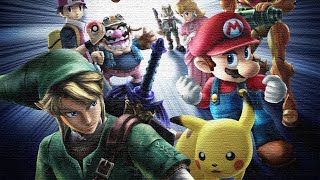
What if Brawl's success let Sakurai make a dream sequel with 70 characters, Melee's competitive gameplay, and third-party icons like Cloud and Sora? The video imagines Super Smash Bros. Deluxe for the Revolution console, released in 2006, with footstooling and pivot grabbing alongside accessibility options for casual players.
Chapters
Welcome to the second installment in the Blessed Timeline series, where we examine a series of blessed "what if" scenarios. In the last video, we examined what a version of Smash would look like if Smash 64 and Melee's development time was combined into just one game release. In this video, we'll explore the progression of that timeline in the form of a sequel title. Firstly, a reminder that if you enjoyed the previous video, much of what you saw can be experienced through the Codename: Melee Deluxe mod for Brawl, which I'll link in the description. For today's video, you can experience what you're about to see in another Brawl mod called PMEX Remix, also in the description. Lastly, please remember that this is a speculative, for fun video that has no bearing on reality and made for entertainment purposes only. And now, without further ado, let's get into the video. Continuing from where we left off in our narrative, the inclusion of third-party characters and a launch title for GameCube would mean Super Smash Bros. was tremendously successful. Satoru Iwata became the CEO of Nintendo several months after the game's release, and his first executive decision was making sure they would put their resources into making an even bigger greater sequel to Smash. Director Masahiro Sakurai was also very pleased with the game's success and was eager to begin work on a sequel. He got to work just 3 months after Smash's release, creating the game's concept draft. Iwata told Sakurai that he had absolute creative freedom to make the sequel he wanted. The president knew it would be in good hands with Sakurai and HAL Labs. Over the course of several years, many third-party companies had reached out to Nintendo, asking if a sequel was in the works. Sakurai would ultimately have say over who made it in, and didn't want to draw exclusively from third-party franchises to expand the character roster or the stage list. "Yah!" An early demo shared internally showed off Mario, Link, Pikachu, and Kirby in a much more realistic art style. They fought on a stage that had a day and night cycle and a large background environment. This would require hardware more sophisticated than GameCube's, so it was decided to adjust development for the upcoming Nintendo Revolution console. During E3 2005, Iwata revealed the Nintendo Revolution console, which was met with much anticipation and excitement by fans. At the end of the presentation, they showed off one final trailer. a video teasing the upcoming Smash Bros. sequel called Super Smash Bros. Deluxe. As you're watching this, you may be reminded of our timeline's version of Melee's sequel, Brawl. Visually, there are many similarities. However, unlike our timeline, the game would feel and play a lot more like Melee, having tons more content, and it would have been released earlier. Let's discuss these differences. Here is the character selection screen. At a massive 70-character roster—74 if you include Sheik, Zero Suit Samus, Squirtle, Ivysaur, and Charizard as separate characters—the team would be hard at work implementing new models, animations, mechanics, and sounds to get everything done on time. Since development began in mid-2002 and wrapped up during Q3 of 2006, That would give HAL roughly 4 years to complete the game. Let's discuss some of the noteworthy inclusions. All previous characters from the previous game that didn't appear in our timeline's brawl, like Dr. Mario, Young Link, Roy, Mewtwo, and Pichu, would be added, as well as the third-party characters Shadow, Banjo-Kazooie, and Cloud, all in the context of this realistic art style. This would make this game the Blessed Timeline's first instance of "everyone is here." First-party characters added as a result of fan requests from the poll would be Daisy, a semi-clone of Peach, Waluigi, King K. Rool, Toon Link, Dark Samus, and Black Shadow, a semi-clone of Captain Falcon. Sakurai inclusions, where he deliberately pushed to include a character he personally wanted to see in Smash ever since the beginning, Included: Geno from Super Mario RPG, Pokémon Trainer, Navarre from Fire Emblem, Palutena, R.O.B., Little Mac, and Sookapon. Characters added due to wanting to promote a recent entry in a series were Blaziken from Pokémon, Ike from Fire Emblem, and Isaac from Golden Sun. The remaining newcomers were all negotiated with third parties, ranked by how popular they were in the character polls and characters Sakurai felt like would fit in the game. These additional third-party characters were Knuckles from Sonic the Hedgehog, Sephiroth from Final Fantasy VII, Simon Belmont and a semi-clone, Richter Belmont, from Castlevania, Alucard, also from Castlevania, Ryu and a semi-clone Ken from Street Fighter, Kazuya from Tekken, Terry Bogard from Fatal Fury, Sub-Zero from Mortal Kombat, Mega Man, Pac-Man, and Bomberman, each from their respective namesake series, Erdrick from Dragon Quest, and Sora from Kingdom Hearts. [MUSIC] Gameplay-wise, Sakurai desired to make this game play just like its predecessor, but even more refined. He was aware of the growing competitive scene for Smash, which he wholeheartedly supported, and was pushing for Nintendo to pay more attention to it. To cater to the scene, he adjusted properties like hitstun and hitlag values, increased the window for short hops, made tether recoveries easier, and modified ledge grabbing for balance. He added some new abilities for some characters, like crawling, which was previously only available for Snake and Samus, gliding, and wall clinging. Sakurai wanted to include additional hidden techniques and advanced mechanics, including the ones he had introduced in the first game. To add to the list of existing advanced mechanics, he added footstooling, dash attack canceled up smashes, pivot grabbing, and B reversals. [Japanese] At the same time, he also desired to make this game more accessible for new players. He implemented multiple controller options, included optional motion controls, and a return of the single-button gameplay special mode. The flagship single-player mode, Subspace Emissary, would be even bigger and more grand. Taking cues from the expanded adventure mode of this blessed timeline's first Smash game, with a larger involvement in the universes of the characters' series, including worlds from third-party characters. Here's a bit more of the game in action.
[FOREIGN] Rest in peace. Go away!
Heya!
Heya! ¡Mucho!
If all this looks cool to you, check out PMEX Remix, where you'll not only find these stages and characters playable, but even more if you can believe it. I hope you enjoyed this video, and if you did, please comment, like, or subscribe so I know. Thank you for watching, and God bless.