What if Melee was the first Smash game?
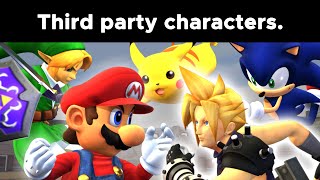
What if Melee launched the Smash series as GameCube's flagship game instead of the N64 original? The creator imagines a 41-character roster with Sonic, Snake, Banjo-Kazooie, and Cloud from day one, refined mechanics, and branching Adventure Mode paths, all designed to drive console sales and attract third-party support.
Chapters
What if Melee was the first game in the series, had 4 times the amount of development time, and was pitched as a flagship marketing play by Nintendo? Strap yourselves in, we're about to look at a version of Melee that never was, and is also the most ambitious iteration of the game we've discussed yet. But before we get into that, here's an actual quote from Sakurai. "The first objective of this game was to propel the GameCube forward. I started by thinking, 'What is the best method to sell as many GameCubes as possible?'" "I didn't want just one game to draw all the attention, but rather to have a game to push the GameCube as a whole forwards." "And to accomplish that, I decided to create Super Smash Bros. Melee." This is an actual quote from Sakurai shortly after the game released. But now imagine a timeline where Nintendo and HAL Laboratory took this idea even further. Quick disclaimer: this is purely conjecture and simply an imaginary scenario created for entertainment purposes only. It should also be noted that in this video, I use a variety of Brawl and Melee mods, so check out the video description for more details if you're curious. In this universe, the original Super Smash Bros. was only ever a prototype, with development beginning in late 1997 and shared internally in 1998, never receiving a commercial release. After HAL's presentation to Nintendo, Iwata convinced Shigeru Miyamoto and Hiroshi Yamauchi, who both took great interest in Sakurai and Iwata's project and believed it would do quite well commercially, especially in the West. With the ambition building, Smash would soon move from the Nintendo 64 to GameCube as soon as dev kits were available in 2000, and HAL and Nintendo would pour all they had into this title. Yamauchi would see Smash not only as GameCube's flagship launch title, but also as a marketing tool to attract third-party developers. They were recouping the loss of Square and the Final Fantasy series on the Nintendo 64, but this time around, GameCube's mini-discs could hold a lot more data than those cartridges. Nintendo's leadership team was determined to win third parties back, and even show more of the third parties they worked with, like Rareware. As the series debut, the title of this game would be Super Smash Brothers. Seeing as this game would have all of the development time of Smash 64 combined with the months leading into 2000 and nearly all of Melee's development time, this game would have it all. If you haven't already, I recommend you watch the 6 Months video on my channel to get a sense of the additional content and a theoretical extended version of Melee. In that video, I go over an extended Adventure Mode, additional songs in the soundtrack, additional items, trophies, and a few other changes, many of which would also be present in this version of Melee. In terms of game mechanics, Hitsun would probably be somewhere in between Smash 64 and Melee. Assuming Sakurai had time to refine his vision, many of the mechanics we know and love in Melee today would still remain, as it would be much later that Sakurai would change his position on including hidden advanced techniques in Smash games. Smooth landing or L-canceling, wavedashing as a byproduct of directional air dodging, and glancing blows, also known as phantom hits, would all remain, as each were deliberate and well-known inclusions for the Melee we got in our timeline. That being said, many oddities in Melee would be fixed, such as Game Watch having proper aerial attacks and a fixed shield, name tags vanishing properly during Sheik's recovery, removing Mario or Dr. Mario's cape teleport glitch, and other issues, some of which have been commented on by Sakurai himself, admitting these were oversights and with more time would have been resolved. Production on Melee's opening movie would have started much earlier to drum up excitement for Project Dolphin and Smash itself as the flagship title. The movie would be finished in time to play at Spaceworld 2000 instead of E3 2001. Sakurai would be tasked to create a poll on Nintendo.com the same day as Spaceworld 2000's unveiling, asking Nintendo fans what characters they'd like to see in a crossover fighting game, and then work with both first and third-party developers to add as many of those characters as possible. The idea here was that a third-party character's inclusion in Smash would incentivize that developer to create more games for GameCube to capitalize on that audience. Of fans. Not only would Yuji Naka and Hideo Kojima reach out to Sakurai for a Snake and Sonic inclusion respectively, but many other third-party creators would as well. PAL and Nintendo were prepared with a plan for handling third-party inclusions and had agreements ready. And now the moment you've been waiting for: the new roster. Wario, Diddy Kong, Charizard, and Wolf would be included due to their popularity, just like in the 6-month scenario. However, King Dedede, Meta Knight, and Ridley would also be added as popularity picks. Sakurai would confer with Iwata to make sure King Dedede and Meta Knight inclusions wouldn't be added as a result of Sakurai's bias, but as a true reflection of those characters' popularity. Pit would join the roster as another Famicom character. Lucas would be included to promote Mother 3, which was already released as EarthBound 64 in this universe. Miyamoto would insist on Captain Olimar as an inclusion to promote the then-fledgling Pikmin series. We'd also get 5 third-party characters: Sonic the Hedgehog and a semi-clone, Shadow the Hedgehog, both as Sega representatives, Solid Snake from Konami, Banjo and Kazooie from Rareware, and Cloud Strife from Square. This roster would be massive at 41 playable fighters if you include Sheik as a separate character. With this larger character roster in mind, the stage list would differ also. Only larger franchises would receive multiple stages, whereas smaller franchises and each third-party character would generally receive just one stage. Pokéfloats would be replaced with Sprout Tower, as was the original plan. Fire Emblem would get the cut Akanea stage, Castle Siege. Some of the Nintendo 64 stages would return, like Hyrule Castle, Kongo Jungle, and Saffron City, but would be visually improved from their Nintendo 64 counterparts. Mushroom Kingdom would bear closer resemblance to 64's iteration of the stage rather than Melee's. Green Greens would completely replace Dream Land, Brinstar would completely replace Planet Zebes, Corneria would completely replace Sector Z, and Yoshi's Story from 64 would be replaced with Melee's Yoshi's Story. Meta Crystal, or Metal Cavern, would also see an improvement and be the stage during the Metal Mario or Metal Bros fight in Adventure Mode while also being an unlockable stage for Versus Mode. Rainbow Cruise would be called Rainbow Ride as originally intended. Kongo Jungle would be the name of the N64-style stage, whereas Kongo Jungle from Melee would be renamed to Kongo Falls. Mushroom Kingdom 2 would be renamed to Subcon to more accurately reflect the source material. New first-party stages would include Bowser's Castle, Mario Raceway, Wario's Castle, Forest of Hope from Pikmin, and Sky Palace from Kid Icarus. Here are some of these new stages in action. Bowser would have some new animations and a fireball neutral beam. Mario Raceway would borrow from Mario Kart 64's design and feature your multiple Toads racing on the track as hazards.
Yeah!
Wario's moveset and animations would be inspired by the Wario Land series. Yeah!
Yeah! Wah!
Wah!
Ah!
Ah! Captain Olimar would use his Pikmin voice and sound effects, since Pikmin would be launching around the same time as Melee. "Olimar, olimar!" Pit would use his Melee trophy design and his mallet from the Kid Icarus games.
Ah!
[FOREIGN] The new third-party stages would include Green Hill Zone from the Sonic franchise. Franchise, Crazy Gadget from Sonic Adventure 2, Shadow Moses Island from Metal Gear Solid, Spiral Mountain from Banjo-Kazooie, and Midgar from Final Fantasy VII.
Here we go!
Now let's take a closer look at the characters. Luigi would have a different voice since there'd be enough time to record special takes just for Luigi. Down special would be completely new with Poltergust 3000. [SPEAKING JAPANESE] Here is one example of how clone fighters would be more unique from their base characters.
Aha! Wah! Iho! Wahaha! Yah! Iho!
Young Link would differ from Link in a few ways as well. Ah! Probably the biggest example of a declone fighter would be Ganondorf from Captain Falcon. Early development would be a carbon copy of Captain Falcon, and then over time, more unique moves and animations would be added, to the point where he'd not even be recognizable as a Captain Falcon clone. "Oh yeah!" Mewtwo would be improved, allowing its Confusion attack to reflect items and granting it the ability to hover. Charizard would be upgraded from a Poké Ball Pokémon to a playable fighter.
Come on!
The Star Fox characters would receive their English voice actors for the North America and international releases, as there would be enough time to record all of those additional performances. Hands off my prey!
Ugh! Ugh! Ugh! Ha! Fire!
Wolf would be similar in appearance to his design in the Melee opening movie and be voiced by Jock Blaney. You're good, but I'm better! Diddy Kong would have a few more nods to Donkey Kong 64 in his moveset. Kirby would be substantially buff. [FOREIGN] Meta Knight and King Dedede would both use their Melee trophy designs and Japanese voice actors.
"Kamehameha!" Cool, cool, cool, cool, cool.
Samus would have some new abilities inspired by Super Metroid and the upcoming Metroid Prime. Fans' reaction to Ridley's appearance in the opening movie would solidify his inclusion as a fighter. While not originally considered for the roster, E3 2000 would change that. Lucas would use his EarthBound 64 appearance.
No! You can't fire! You can't fire! No! You can't freeze! You can't Yup!
Roy would have unique moves from Mark.
Ah!
Each Yoshi costume would get its own egg color.
"Nuh-huh!
Nuh-huh!" And finally, the third-party characters. Banjo and Kazooie's moveset would be inspired from Banjo-Kazooie and Banjo-Tooie. On their stage, Spiral Mountain, notes would appear as collectibles. Once 5 notes were collected, Mumba would emerge and use his magic to rotate the mountain.
"Ahh!" Uh-oh.
Cloud would be voiced by Steve Burton, which would be his debut rather than Kingdom Hearts, which was still several months out. Cloud's moves, including his Limit Break functionality, would all be inspired from Final Fantasy VII.
Linking my Limit! Good! Get up! Kept you waiting, huh?
Solid Snake's moveset would be a collaboration between Sakurai and Kojima. Metal Gear Solid 2 was releasing around the same time as Smash, so his appearance would resemble his appearance in that game. Additionally, the tranquilizer gun would be his signature weapon. But to pay homage to the first Metal Gear Solid game, Shadow Moses Island would remain the stage representing the franchise.
Get ready. Huh?
Sonic's moveset would be inspired by his first game and Sonic Adventure. "Oh yeah!" He'd be voiced by Ryan Drummond and would use his Dreamcast-era design. On his stage, Green Hill Zone, Tails and Knuckles would be seen in the background, with Metal Sonic appearing occasionally as an Easter egg. Ready?
Go! Let's go!
Ready?
Yeah! Go!
Shadow would originally be designed as an Assist Capsule, but eventually be reworked into his own playable character. He'd be considered a semi-clone of Sonic only nominally. His moveset would be drastically different.
"Bang!" Come here! Go here! Yeah! Go! Yeah! Ouch! Yeah!
Adventure Mode would have branching paths, including new sections for hidden fighters that would be unlockable as new stages before the fight against Bowser. Here's what Assist Capsules, Deku Nuts, and timed mine items would have looked like. Different Poké Ball Pokémon, including one from Smash 64, would have also been added. Also, Sakurai's vision for Final Smashes from Smash 64 would also be Included. I'll take the sky any day. Time for an old payback.
Let me show you my real power.
Super Smash Bros. would release as a GameCube launch title on September 14, 2001 in Japan and November 18, 2001 in North America. It's fun to think what a Melee like this would have done for Nintendo and GameCube. How many more console sales would this version of Melee have driven? It's certainly fun to ponder these what-if scenarios. I hope you enjoyed this video, and if you don't mind, hit a like and make sure you're subscribed. If you saw something interesting on screen, check the video description for more information. Since this is just a concept video, most of what you're seeing isn't actually possible within Melee yet. Regardless, I'll provide links to as much of it as I can. I'd also like to mention I have a second YouTube channel you can subscribe to, full of tutorials, livestreams, and other bonus content. I'll make sure and include a link to that in the description as well. Thank you so much for watching, and I'll catch you guys on the next one.
[MUSIC] [MUSIC]










