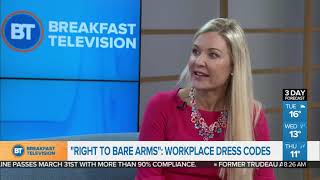
Rez talks with HR expert Debbie Carot about what dress codes employers can legally enforce. They discuss the B.C. legislature incident where female staffers were told to cover bare arms, plus rules on heels, tattoos, and religious wear. Debbie advises employers to consult employees and create inclusive policies, and tells workers how to push back on unfair rules.
Chapters
824 welcome back to BT. The debate surrounding dress codes heated up last week inside the BC ledge after a number of female staffers were told to cover up his bare arms were considered unprofessional workplace dress codes. A hot topic. HR expert Debbie Carot joining us right now. What was your reaction when you saw the buzz behind the story?
I was floored when they were actually pulled aside and told it was unprofessional. It felt like we'd gone back 20 or 30 years in time for sure.
So what's fair game for an employer to dictate dress code?
So as a general rule, they can dictate dress code as long as it doesn't infringe on health and safety legislation or human rights legislation. So for example, in 2017, the B.C. government implemented the no high heels can be mandated at work because it was a safety issue. And then on the human rights side, what employers cannot do is anything that infringes on prohibited grounds. So anything based on gender, ethnic origin, marital status, any of those kind of things, employers cannot weigh in and have a dress code that contravenes it because.
There'S some creative examples out there, like take for example, shaving of how that etiquette works in the workplace. How do they set that?
So that's a good example is it actually can be a challenge if you have a clean shaven policy because there are some religions that actually require you to have a beard or to have facial hair. So that could be an infringement on the grounds of religion.
Tattoos, I know is an interesting one. And some corporate offices encouraged to cover up. Where do you draw the line there?
And that's a great one. Again, if you look at human rights, it's actually not legislated in human rights unless the tattoo has something to do with your religion.
Okay, what about wearing hats? Some people have company branded hats in the workplace too. How do you get around that?
You're starting to show it's actually quite tricky to make dress codes these days. You cannot mandate a hat either because some religions require headdress or the fact that you're actually not allowed to wear anything on your head. So that one again, is a tricky one to mandate.
There's a lot of factors to consider. So with the discriminatory factor of this, if you're an employer out there, you want to establish culture, you want to establish dress code. How do you do it? In a way you're not going to be facing backlash with discrimination.
So the first thing I always encourage employers to do is to actually bring in some employees and have a conversation about it and just say, this is the professional image that we'd like to portray to our clients and to all of our stakeholders and to our customers. Let's talk about what this means for us and what's going to work for everyone. And then if you have the team that's actually part of the conversation, you can talk about some of the trickier ones. So if you really want to be professional and conservative, you can ask the team, how do we feel about wearing jackets? Or how do we feel about having long sleeves? And maybe have some options too, because there's different body styles. And a lot of employers get themselves in trouble when they either have things that look good on some people and not on others, or if people identify as male, female, non binary. We need to really make sure that we're getting input from everyone. So the dress code can work for all parties involved.
And when you do that and you have all the consultation, let's flip it to the other side. Say you walk into the culture and the work's been done, but then you still feel a little slighted that you know what it is off, what's your recourse of how to speak up and help to change what's happened?
And that's really important. And that's actually what I thought was great about the BC Ledge example, is that the women banded together and they actually together did something. But the first step, I would always say, is go to your HR department or go to your manager and have a great conversation, but come prepared. So understand what the legislation is, bring some examples of some other businesses that are similar to yours and what their dress codes are to come with solutions, not just with complaints. Most often, employers want you to be comfortable. They want you to look professional and they want you to be happy. So they're going to listen.
So when it comes to dress code as a theme overall, and especially with the story that's reignited the debate, whether it's the workplace, whether it's schools, and I know that's been a hot topic of debate as well, what's the big thing to keep in mind with dress codes?
Well, my favorite way to approach it is I like to have a dress for your day policy, which really means use your common sense and depending on what you're doing that day, dress appropriately for it. So if you have important meetings or events, you may want to dress up a little bit more or be more conservative. If you're behind your desk and you're not going to see anyone except for a couple of your co workers. Maybe it can be a more casual day and really sort of use that as a litmus test and. And go from there.
Okay. Good tips to keep in mind. Obviously this debate not going anywhere anytime soon. Debbie Carrero. Great follow online when it comes to resources in the HR arena. Debbie, thank you.