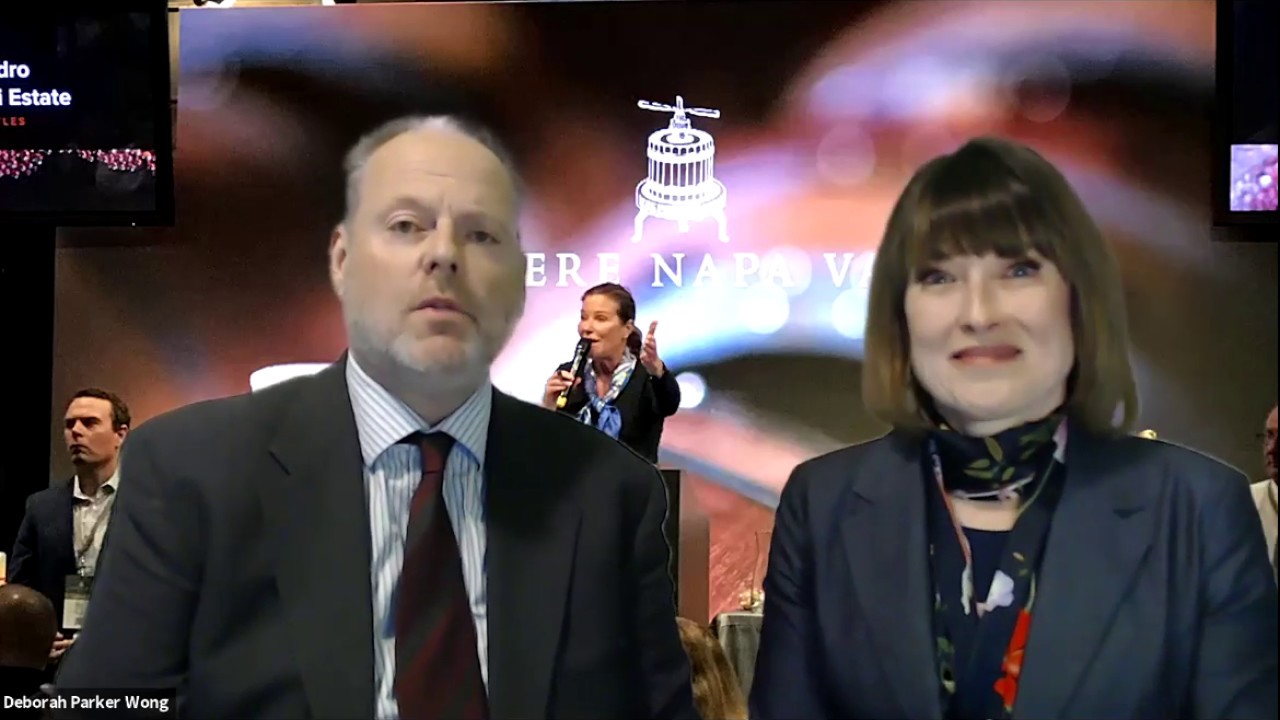
In this live interview recorded at Grandi Langhe 2026, host Stevie Kim talks with Deborah Parker Wong, a professor, journalist, and wine consultant who teaches large Gen Z cohorts at San Jose State University, two junior colleges, and a WSET school. Deborah explains her 18‑week "Wine Immersion" curriculum, which blends sensory physiology (olfaction, gustation, transduction), the Wine & Spirit Education Trust systematic tasting method, and a focus on finding a "gateway wine" for novices. Classes are three hours weekly, with about 55 students per section and a total enrollment of roughly 500 students per semester. She uses the Tasty AI platform to collect students' SAT notes, generating real‑time sensory wheels that calibrate the cohort’s perception. Her research shows that 85 % of students become "wine likers" by the end of the course, and many can test out of WSET Level 2. Deborah advises Italian producers to introduce sweet, low‑alcohol wines (e.g., Brachetto) as an entry point for Gen Z, positioning them as bridges to drier, more tannic wines like Barolo. The interview highlights logistical solutions for large classes, the educational philosophy of enjoyment over trade‑focused training, and the broader goal of cultivating a new generation of wine consumers.
Chapters
Okay, my name is Stevie Kim for Italian Wine Podcast. We are the media partner this year once again for Grandi Langhe 2026, and our first international guest of today is Deborah Parker Wong, who I've met in the very beginning of my wine career. And I had— I haven't seen you in a very long time.
It's been a couple years, but here we are.
Yeah, I even came to your house.
Yes, I remember very well.
I would never forget So, Deborah, for those who are less familiar, tell us what you do in the wine world.
Well, I have a number of different— I have a number of different roles.
Like a small version.
Okay, a number of different jobs, but my primary activities are those of professor, educator, journalist, and then of course I do some consulting work as well too. Currently teaching at one university, 2 junior colleges, and a WSET school. school, in addition to writing my long-standing columns in the Somm Journal and Tasting Panel magazines and for other trade outlets, um, and doing some consulting work on the side, right? Judging wine competitions, some speaking engagements, master classes, and sensory work.
Are you sure you don't have like a twin sister?
I like to stay busy. We Type A people, you know.
You sound super busy.
I am busy. What is your primary, like, Well, you know, I had to develop an infographic to communicate my role, particularly for the PR people so they could see how I spend my time, but about 75% of my time is spent teaching.
Okay, so where are you teaching? Tell us a little bit about that. Who are you teaching to? What are you teaching? Where are you teaching?
Okay, well, the quick breakdown and the most exciting cohort that I'm teaching right now is the Gen Z cohort I have. Gen Z, it's 21 to 28-year-old novice wine students at San Jose State University, which is the number 4 public business school in the country. These classes, these sections are over-enrolled with students who are wine curious. Wow.
So how many students?
Well, total I have about 500 students this semester alone.
Holy crap!
Yeah, well, you know, when you love what you do, you do what you love, right?
So we really need to talk to you about Gen Zs and how they're approaching. So you were saying like most of these students are— it's their first approach to wine studies in a way?
Absolutely. Well, these students have just turned 21, which is the age in California that you can actually begin buying alcohol. You've probably been drinking it before then, but at any rate, students are enrolling in 18 weeks in a semester-long class with me who say that they have never tasted wine or they don't like wine, yet they're signing up for 18 weeks.
How many hours?
Wine Immersion. Well, the classes are actually rather long. They're tuned close to 3 hours every week. So once a week for 3 hours. So I really do need to keep them— there's edutainment happening, I can tell you that. But the primary thing is, is that Making sure these students find a gateway wine, a wine they like, and approaching them with the concept of enjoyment, which is very, very different from the trade education model. But they still have to learn the grape. They will know Nebbiolo, they will know Piedmont, they will— but they will drink Brachetto. So there you go.
So like, how do you go about— like, you have 18 lessons Well, it's 18 weeks, right? 18 weeks.
Yeah, not counting the fact that some days are test days and whatever.
Right, but that's very, very intense. What are you teaching them though? Like, you know, not to understand your lesson plans exactly, how do you start?
Okay, how do I approach? Well, we start at the beginning, Stevie. We start with how our bodies work, sensory physiology, yay! Olfaction, gustation, Teaching them how transduction works. How do volatile aroma compounds become electrochemical signals that we process as aroma and taste? Okay, well, once they learn that, hey, we have a superpower. I actually can smell things, a lot of things, and I actually can describe it. And then teaching them the Wine and Spirit Education Trust systematic approach to tasting.
So you incorporate WSET?
Oh, WSET. I'm a diploma, of course. is the foundation of my curricula. But hang on a minute, there's a twist. I've done a research study to prove that the systematic approach to tasting is the preferred training method for this cohort. Because when I started with these students, I wanted to make sure that I had— that I could use the training method I like, the rubric lexicon method, They love it. They've chosen it over other methods that include gamification and AI. So now I know I've got the right training method for them, but it's what I do with them after they've learned how to assess the quality and style of wine. We start by introducing them to the historic sweet wines of the world. No problem in France, no problem in Italy. Now when we get to New World countries, it gets a little Harder because there's no history of sweet wine becoming dry like we have in Valpolicella or like we have in other places where historic sweet wines have now become dry wines of the world. In New World countries, it began dry and it's remained dry, right?
So it is quite technical in a way.
Well, they have to— in addition to tasting the wine and learning how to write tasting notes and separating Their ability to discern quality from their like or dislike. We've got to get that baseline down because then they can navigate, they can figure out what they like. Once they know what they like, then we can start to teach them more. But they're curious. They want to know about production method. Well, why is Ricciotto so good? Or why is Brachetto so good? Well, it's the grape. It's the production method. They want to learn these things. They want to. They want authenticity and transparency, and that's very, very easy to give them when you're talking about DOCG quality wines. You know, it's a no-brainer.
So in the grand scheme of things, how many wines are you tasting?
Ooh, well, that's a great question. If you think about the fact we taste 3 wines per class, multiply that by 16, you know, it's a pretty good cross-section of wines, right?
Yeah, about 50 wines.
Yeah. Okay.
Just under 80. And how do you— how many are in the classroom typically?
Well, yeah, these classes, for wine classes, they're large. I have 55 students.
Oh, how do you manage that?
Well, I have a great setup in my classroom. You know, students do their own housekeeping. They get their glass, their spit cup, their napkin, their whatever. They set up for themselves. I have dishwashers, you know, industrial dishwashers in my classroom so I can do glassware. Anyhow, logistics are not a problem, but the students are interacting during class. They are taking their SAT notes in a tasting program called Tasty AI that was developed by 2 Frenchmen. And what it does is once they put their SAT note in, we get a cumulative infographic, a sensory wheel that shows the students a visual of their collective tasting note, right? Because with the systematic approach to tasting, we're seeking consensus. We're seeking calibration with me. And so when the students see that that visual represents what they experience, there's this connection that's phenomenal. And they can see, oh yes, that's the wine. That's the wine I tasted. That's exactly how I described it or what we agreed this wine is. And it's just become very interactive, which keeps things dynamic and fresh in the class.
But would it be safe to say that by the time they finish the 18 lessons, circa 50 hours wine appreciation, their equivalent— their wine knowledge is equivalent to Perhaps WSET Level 2?
There you go. Well, I do have a WCT school. I'm an approved program provider, and all of my students come directly from my junior college and university classes. My students— and I just had an example— can test out of WCT Level 2 after my class.
Okay.
And many do because they want to get jobs in hospitality, and that on a CV will get you a job in a heartbeat.
So then, then they move on to Level 3?
No, these students These students are there to begin their wine journey, to discover wine. They're not there to be wine professionals. They're not there to work in wine, though they're introduced to all the jobs that we have in wine and that wine can be a career, right? And that wine is, it is a career. It's been mine. But they largely go on, they're from all disciplines at the school. We have engineers, we have physicists, we have—
Business.
mathematicians, we have musicians. I have students from every discipline at the school, only a few from hospitality and tourism.
So like after, after, um, your class, yeah, right, how many of them in percentage continue into a wine career?
Well, that research hasn't been done yet, right? But the research that I do have, which is exciting, is that at the end of 18 weeks 85% of the students have found a gateway wine. They like wine. They are wine likers, bona fide. And that number has been very consistent every semester. 85% are wine likers, and that's the goal. So we're killing it.
You know, I feel like you have, you have the Holy Grail to the Gen Z, you know, speaking to you just now. What is one suggestion that you would like to give to an Italian wine producer regarding how to speak and communicate with Gen Z?
Well, if you're a maker of dry wine, please introduce them to your neighbor who makes some wine that has residual sugar.
Aha!
Because that wine—
So sugar?
Well, but we're talking about authentic wine, wine made from a grape, from a place with intention, quality fine wine. But it's not just sugar, it's enjoyment. And if we can use that wine as a bridge to dry— if you're a producer of Barolo, that wine liker of Brachetto is your future customer. I suggest you start talking to them right now. They are not ready for the tannin, the astringency, and the acidity of your wine, but they will be once they fall in love with Italian wine.
Once the door is open, Wow, okay, I think that is actually a very, very interesting approach. Let's think about how to approach in approaching Gen Z, and it— this is a good way to close. Thank you for joining us today.
You're welcome.
Deborah Parker Wong, she wears many different hats, but primarily she's been teaching to many, many Gen Z students, and that is exactly where we want to be, to promote Italian wine, and of course, coming live from Grandi Langhe 2026. Ciao ragazzi!
Ciao! Thank you, Stevie.
Okay, and it's a wrap.