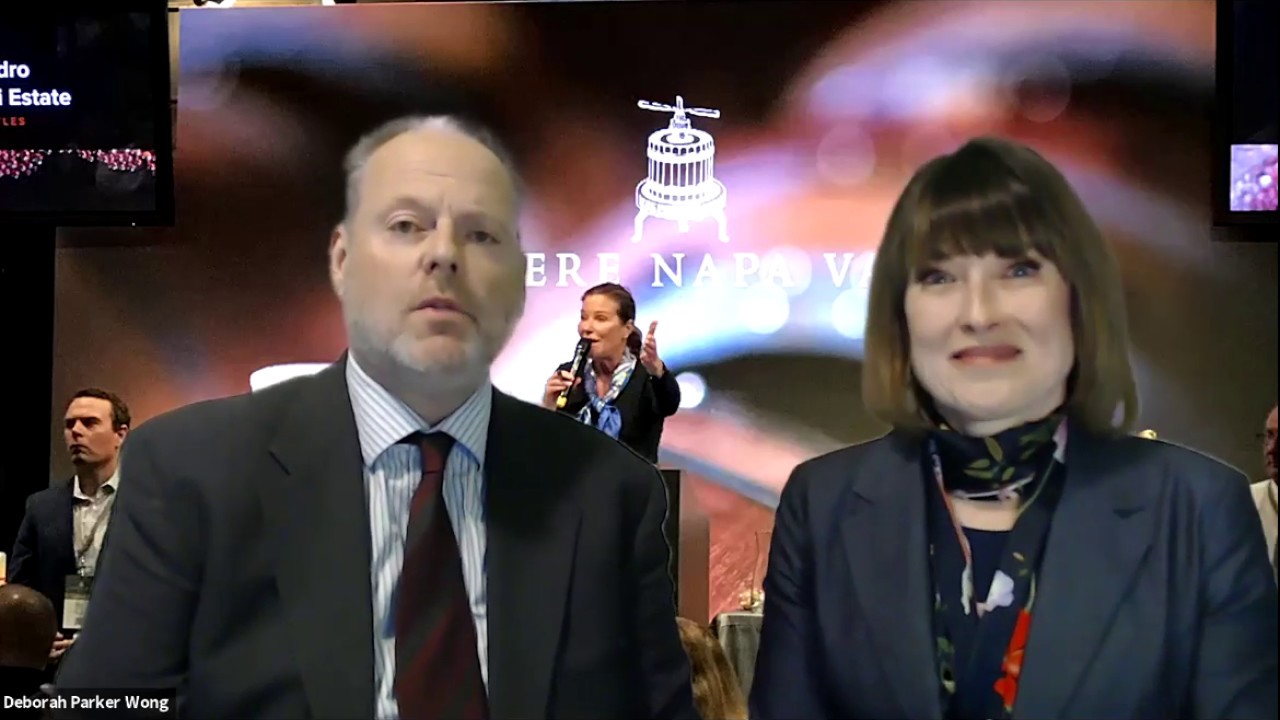
In this virtual tasting for the Slow Wine Guide 2021, host Deborah Parker Wong interviews winemaker Diane Snowden‑Sess of Snowden Family Vineyards. They sample two wines: the 2019 Sunning Hill Sauvignon Blanc and the 2017 Estate Cabernet “The Ranch”. For the Sauvignon Blanc, Diane explains the vineyard’s history (named after her grandmother), its high‑elevation, cool‑aspect site on a 650‑ft valley overlooking Lake Hennessey, the switch from a frost‑prone Cabernet planting to Sauvignon Blanc in 2008, and the likely use of Clone 1. She describes a unique foot‑stomping maceration that boosts aromatics, the wine’s bright acidity, stone‑fruit profile, and its gold‑medal win at the 2020 Concours Mondial du Sauvignon in France. Production is tiny – about 1 acre yielding ~550 cases per year – and the vineyard is surrounded by forested land kept for ecosystem health. The conversation then shifts to the Estate Cabernet “The Ranch”. Diane recounts the extreme 2017 heat wave (temperatures hitting 120 °F) and subsequent wildfires, which halted sugar accumulation and forced manual pump‑overs. She references a UC Davis study on heat‑induced lignification that blocks sugar transport, explaining the delayed ripening. The wine was pressed after the fires, underwent an extended 18‑month élevage, and the blend now contains 19 % Merlot with the remainder Cabernet. Diane emphasizes “living grapes” over high sugar numbers, resulting in a more tannic, Bordeaux‑style profile with pronounced tannins but still youthful polymerisation. She notes vintage variation across 2015‑2017, describing 2015 as warm and ripe, 2016 joyful, and 2017 darker‑fruit, less red‑fruit driven. Finally, they discuss future additions to the guide, mentioning other single‑vineyard designates such as the east‑facing Ricos (1 acre) and the larger Brothers vineyard, both on the St. Helena AVA. The interview ends with mutual appreciation for the insight each brings to Napa Valley viticulture and winemaking.
Chapters
Okay, welcome to The Slow Wine Guide 2021. I'm here with Diane Snowden-Sess from the Snowden Family Vineyards. She's a winemaker and one of the Snowden family members, and we're here tasting 2 wines today. Very exciting. She's with us from France, from her home in France. We've got the first wine up.
I've got it too.
All right.
I'm excited actually. So I haven't tasted, I was not able to go for bottling because of travel restrictions during COVID So this is the first time I've tasted the Wine Coast bottling myself.
Cheers. Great, cheers. Salud. Ah, the 2019 Snowdon Hill Sauvignon Blanc. So Sunning Hill, we need to know about Sunning Hill.
That was from my grandmother. She was from Virginia where all of the properties had names, and so she always, while my grandfather referred to it as the ranch, she referred to it as Sunning Hill, and was the only person who would make that name stick. But in honor of my grandmother, we decided to call the vineyard Sunning Hill.
Well, I assume that's because it gets plenty of sun. The aspect is perfect for Sauvignon Blanc.
The property does. Sauvignon Blanc is actually on the coolest in the vineyard. Which is why we, I mean between the altitude of 650 feet, and that it's in a tiny valley on the backside of our property overlooking Lake Hennessey.
Okay.
And so that's what brings all of that lovely acidity, and even some real structure, some minerality structure, is from that site. So it was actually, it was planted to Cabernet Sauvignon, and it had been a frost pocket. And so we just eventually decided to give up on and planted the Sauvignon Blanc instead. We had been purchasing Sauvignon Blanc from the valley floor, and it was just a huge dramatic quality shift as soon as we went up by 650 feet and to our own property.
So elevation and aspect here are utterly unique. There's very little Sauvignon on that side, and it's a different animal. I'm just, it's peaches. I just got a glass of white peaches. Is this Clone 1?
You know, I don't know, I don't know, I'll have to get back to you.
We can do some digging on that.
Yeah, we planted it in '08 and I don't know the clone.
Oh, okay. Most of it, you know, most of the Sauvignon in California is Clone 1, sort of by default. Yeah, there's some Muscat, there's some Muscat, but this doesn't seem Muscat-like. It's just, no, such gorgeous stone fruit. It's like the It's like a mixed basket of the most perfect stone fruit. It's just extraordinary to me.
Yeah, and I've been crushing it for the last couple years, foot stomping it, and I actually think that's made it even more aromatic. Well, you might expect a little bit more tannin, and I think it probably— there's a little bit of savory tannin, but something about that tiny maceration has really made the aromas pop.
Absolutely, the phylles, it's all the good stuff's coming out.
That's great.
I had no clue. I had no clue. That you were doing that. So extraordinary. Well, a tip of the hat to the winemaking and to the site selection, because this wine won a gold medal in the 2020 Concours Mondial du Sauvignon competition that was held in Blois, France, in the Loire Valley, and was the only California wine of dozens.
Yeah, thank you, Deborah. That's really thanks to you, because I certainly would never have been so brave to expose my wine to Europeans. And yes, it was at your invitation and suggestion And I was sweating bullets and couldn't be more delighted that our wine got gold.
Very proud of you for carrying the flag for California. And it's easy to see why. The wine ticks all the boxes and has lots of bells and whistles.
So it's delicious.
Thank you. So we're looking forward to featuring it in the 2021 Guide. And I know there's not much of it made.
No, we have 1 acre. And so we make, you know, 550 cases or so every year.
Well, that's enough. That's enough for people who want it, can get it, and drink it. Well, I'm excited about the site. And you know what's on my shortlist is to see the vineyard.
Yes, no, absolutely. Whenever you can make it, whenever we're allowed to travel more freely, we would love to have you up there.
It'd be great. I definitely want to see it. And you can see like Hennessy from the top of the hill there, I'm sure.
Yeah, well, there's a lot of— you can, but there's a lot of trees and shrubs in the way. But if you're brave enough to kind of go through, yes, you can see Lake Hennessey.
Brave enough to work in the brush?
Yeah, no, well, we've decided we have 160 acres and only 25 are planted to vineyard, and the rest we've kept as forest. And that is a punishing economically choice, but I think in terms of having for quality and a healthy ecosystem, it definitely is to the benefit of our vineyards. But once you get outside of the vineyards, it's pretty wild, and there is poison oak, and so you have to be a little careful.
Wear pants.
Yeah.
Don't touch poison oak. All right, those things are manageable, but I definitely now I'm in. I've got to see it with my eyes. Okay, all right. And now this is the Estate Cabernet.
The Ranch.
The Ranch.
The ranch, yeah. Yeah, wonderful. Okay, so I have a little sample bottle because I opened this for the tasting notes which I wrote last week, and then kept a little more for this today.
Well, now this is the 2017 vintage. We've been talking a lot about 2017.
Yes.
So we want to know right away that your fruit was in before things got—
Okay, so I'll tell you the whole story. 2017 for me was marked more by that heat wave over Labor Day, And so I was here in Burgundy and we had some temperature sensors all dotted all over the property, and one of our vineyards reached 120 degrees. Which, you know, I grew up in Napa, I have never ever seen temperatures like that. So I pretty much, you know, I always try to do as much as I can in Burgundy before going to California. I dropped everything, went over to California, and it took me a while to wrap my mind around what was happening in the vineyard. So some things That were close to being ripe had to come in quickly. And one of the Merlot and one of the Cabernet vineyards that's in this blend were in that category. So they came in quickly. And then, wait, was it Merlot? No, there's no Merlot in this blend. I'm sorry. Shoot. I have to check that too. Anyway, 2 vineyards came in very quickly and And then after that, you know, things were kind of frozen at 23, 24 brix. And for the following, for the following 2 weeks, they never, you know, they digested a bit of the water that we threw at it during the heat wave, but they really didn't move.
Mm-hmm.
And so I then dug through my UC Davis notes and came upon a study that I had sort of had a vague recollection of, that when there's an extreme heat wave, the hormone signals in the plant lignify the peduncle. And at that point, sugar can't get through into the cluster.
Right.
So when I realized that that's what was going on, then I pretty much called it. I waited for the flavors to develop a little bit more. I had everything in before the fires and almost all pressed off, with the exception of my brother's tank. That was supposed to be pressed off the day of the first day of the fires, and then our winery had no electricity, And they were doing pump overs by hand with a pitcher. And we pressed off 2 weeks later, and I ended up really liking it. You know, at first I found the tannins terrifying, but then 18 months of élevage later, I'm now giving Brothers an extra 2 weeks of tank time, thanks to this learning curve from 2017.
Wow.
So everything was in, I was not waiting, most of Napa Valley was waiting for kind of classic numbers, I was waiting for flavors, and I really, one thing that's very important to me is to pick living grapes. And I feel like you can feel that in the wine, you know. That's something I want. Not to say that, you know, something that's uber ripe isn't delicious in its own way, but it's not what I'm looking for. So I'm really looking for living grapes, and the numbers are less important.
This is fascinating. This is the most interesting conversation I've had about 2017 in the dozens of conversations I've had. So Thank you so much for sharing.
Yeah, sure. No, sure, it was a bizarre, surreal experience. And because I was talking to my neighbors and they're just kind of thinking that everything was fine, and I was like, am I going out of my mind? The sugars are not budging. And so everybody was sort of waiting for that when the fires came through.
Well, I've tasted 3 successive vintages of Snowden. And this is my 3rd successive vintage of tasting this vineyard. And yeah, this, the tannins here are the most pronounced of any of the wines I've tasted to date. Yeah.
So the Ranch, the Ranch, well, the Ranch got pressed off in time. But I do think that yeah, it probably is more tannic. It feels quite classic. Kind of in a Bordeaux, the most close thing that I've ever made to a Bordeaux Cabernet.
Okay, no, I didn't mean tannic, I just said more tannic.
Yeah, I agree with that, it's true. The Ranch usually is a bit blousier.
Well, they don't feel like they've started to polymerize yet. It feels like, yeah, they haven't really started to link together. Maybe I was tasting wines, previous vintages that had more bottle conditioning, possibly. Add a little more?
Oh well, I mean, okay, so '15 was really warm and ripe. '16 was just joyful. It never got hot and it just had a nice long ripening. The alcohols weren't particularly high, but it was really red fruit driven. '17 is not. '17 is not red fruit driven.
Definitely darker fruit. Yeah, medium plus tannin for sure.
Yeah, so the Ranch is a blend, and this is ridiculous because I just wrote my blending notes yet last week. Yes, it is Merlot. It's Merlot, it's 19% Merlot and Cabernet. My poor brain.
Oh, I know, we're inundated.
There's something that's happening, I think it's just the latent stress of what we're living through. I find myself making tiny ridiculous mistakes.
That's what tech sheets are for, right? You just look at them. You know what Einstein said? You're really not required to remember anything you can look up. And I said, well, that's not entirely true, but some parts of it is true.
Yeah, yeah, no, it's handy when you can just come up with it. Anyway, it's back. Yeah, I'm so happy with these wines, especially because I don't think I'm going to ever get something like this again. And I think part of what's interesting is seeing, you know, so this is a cuvée rather than a single vineyard, doesn't it? Seeing a cuvée express itself differently in a certain set of conditions. And that's, you know, that is what people come to Burgundy for, to see one vineyard express itself different ways every year. And they come over and over and over again. So I'm, you know, this I think is a very interesting expression of the Ranch Cuvée.
It's showing vintage, it's vintage variation at its finest, right?
Yeah, and stylistically it happens to be right up my alley.
So no, It's working perfectly for me as well. I'm gonna pop this into the decanter, get a breath of air, and see what it tastes like later tonight when I sit down for dinner. So fantastic. So we've got 2 wines, can we ever expect a 3rd from you?
I'm sorry, I thought you were getting 3. Something went sideways.
Oh, well, let's make sure we get the details on that 3rd wine, but And what would that be?
I thought we were going to taste the Brothers as well. I don't know, yeah, there must have been a mix-up somewhere along the way. But if we had to do, if we're limited to 3, it should definitely be the White, the Ranch, and one of our 2 single vineyard designates. You tasted the Ricos, which is probably, I mean it's beautiful, it's so feminine, but it's also tiny. We only have 1 acre. The Brothers is bigger in every sense.
Okay, well, we'll track that down.
Yeah, yeah.
And that'll be a new addition.
If you don't find it, we'll send it immediately.
That'll be a new addition to the guide. Great.
Okay, well, there's a new addition. I mean, if you can keep— put 4 in, they're nice to try side by side. The Ricos is our only east-facing vineyard because we're on the east side of the valley, but we have a little valley. And so it's just so different, and it's right on the St. Helena AVA. It's quite floral and pretty, and the Brothers is just in length and chiseled.
Right there at the narrowest point of the valley, that vineyard is, right where it is at the bottom part of St. Helena, or right at the southern border?
Yes, the southern border of St. Helena.
Yeah, yeah, it doesn't narrow till the middle. Well, it's really fascinating to explore the Napa Valley floor with you because I think you have insights, you bring fresh insights to something that we all think that we know so well.
Yeah, yeah, yeah. Well, thank you. Great.
Thanks so much for your time today, and we look forward to seeing you in the 2021 guide.