8 Stages for Rolling Out a Social Selling Program
Bryn and Roderick walk through eight stages for launching a social selling program with AI. About 67% of buyers now move forward without a rep, so the framework focuses on mapping them through LinkedIn, personalizing content with AI, and building dynamic playbooks that sales reps actually use.
Chapters
Absolutely. Well, I'm excited to be here. And so we'll start from scratch now with the eight stages of rolling out a social selling program. Before we jump into this, I just want to talk a little bit about the concept behind this and why it's been re revisited. So in 2013 I had put this program together, eight stages to rolling out social selling program for four companies in order to ensure that every single step in the process was covered. And you know, it was great but what I was missing was the sales enablement side of things. And so when Roderick and I were chatting, I'm like, oh my gosh, he's the yin to my yang. He's. He's absolutely the piece that was needed in order for this whole program to really come together. So I am thrilled to be presenting this in a whole new light with my friend Roderick. What this is about, it's really about what do sales leaders need to do to ensure that their sales professionals, their reps, their BDRs, their SDRs, their account managers, all the way up to regional leaders are doing this in the voice of the company and really doing it right. So Roderick, great to be here with you.
Great to be here with you.
So why don't you start with why social selling and AI now?
Yeah, well, yeah. Double tapping on what Mark and Gerhardt were saying and that is the world has shifted and I don't think it's a surprise to anybody what may be surprising exactly how fast this is is happening and the fact that and we were talking in, in the pre conversation here, that what you did a month ago, six months ago isn't the same.
Right.
And, and for example Chad GPT, we've all used it and now I actually did something yesterday in, in framing a blog and for the first time I got a new plugin. Maybe I'm behind on this, but I'll throw it in there. I said to Canva, my second best friend behind you Brian, is create now a graphic for this. Boom. It was done in a heartbeat. All the things that we have to used to do either create these things or go and find them no longer. And the same thing has happened with the buyer's journey. Right. According to serious decision, 67% of people say that moving forward without a rep and I think it may be even higher than that now is the fact that they don't need us the way that they used to need us. Right. It used to be about information. Information's everywhere now. It used to be about delineation. They can figure that out. On their own. They want to know why you, why now, why us together? And how do you move forward? And why should they spend that tight budget that everyone has with them? The next piece is we all live on phones all the time. Some of us. Okay, I raised my hand. Hi, my name is Roderick. I've got a problem. Right. But from a business perspective, 85 times a day is what Nottingham Trent University says we do to check our phones on a daily basis. 85 times. I think mine may actually be slightly higher than that, unfortunately. But when you're checking that, so are your prospects. So are your customers, are they finding you or are they out on social media and playing around, or are they looking at your competitors because they've been contacted by them and now that's pushed you further behind? And it's no surprise that sales is not what sales used to be. Right. It used to be about giving you a presentation, telling you the amazing things about my company, talking to you about our products and services. No one cares about that anymore. Now it comes down to three. Two things. How can we help our prospects and customers to increase productivity and efficiency or B, decrease pain, Anything outside of that. They're not open to talking about things with you. So I want you to reshape your mindset and say, I'm no longer the portal of information. What I am now is an opportunity to have a conversation with my prospect, not giving them a presentation. Bryn, let's move forward.
I love that. So let's talk about the eight stages and then we're going to go deep into each of them. So the first one is establishing goals and KPIs. If we don't have the right KPIs in place, then we can't measure the right things and we don't move the right things. So we have to make sure what are our goals and do our KPIs align? And KPIs are going to be different when we're talking about social selling, because it's really got to be based on the data that we can gather and we can get. So it's got to align appropriately. Next is buyer mapping. Buyer mapping along with LinkedIn and AI can really help you hone in on the right people. People selecting your tool stack has changed. So there's two problems here. Number one, we have too many tools not being used. And number two, we have a gap in the AI tools. So it's very confusing for sales leaders right now. And what do I do? Because I already have too many tools. I need more tools, but we need more of the Right. Tools and less of the ones we're not using. And so that's really important. Content strategy. Now, I know social selling, we think content, but content strategy is very different for sales than for marketing. And we have to really make sure that we've got that right. We need a customized playbook. You can talk about process, cadence, sequences, whatever you want to call this. There has to be customized to our voice and our products and our. Our. Our process. We need to rethink our profiles. These are landing pages for our business. If you have 100 sales reps, that's a hundred landing pages. Are those pages value centric? And is it doing its job, which is. Is it converting your visitor to a conversation? To. To Rodrick's point, then we need social selling enablement. How are we rolling out this program in a way that it gets adoption and then measure and coach for improvement?
Thanks, Bryn. So social selling is not new. As you said, you kicked off yours way back in 2013, right? Over a decade now. But as with everything else, it's not the same anymore. And the. The fact that it is required, not a nice to have anymore, really speaks volumes about the direction it's going. We know we've all made cold calls. People aren't answering calls. Right. But there are ways to get to your buyers directly, right? Because a lot of people that I know, everyone I know is on LinkedIn. 69% of B2B buyers are using LinkedIn. It's not just about connections anymore like it was at one point. Now it's literally about connecting, right? And making sure that you have a personalized, customized way to get directly to your buyer as opposed to the generic AI pieces don't work. It's kind of like back in Covid time where, you know, we were saying, how are you and how's your family? It all feels disingenuous now. Now it has to be a personalized, customized feel. Otherwise, they're like, you didn't even write this thing. Somebody. This was an AI bot that sent it to me. There's no surprise that there are far more decisions now than ever before. The question is, how do you aggregate all of those? How do you touch all of those different folks that are. First of all, how do you find out who's in the buying cycle? Secondly, how do you make sure you touch them? And then thirdly, how do you speak to them in a language that. That now resonates with them? Right? And so it's about value. As it says, 74% of buyers, and I won't read the whole thing. But what it comes down to, and I love what Mark and Gearhart were talking about, I will give you content. No shortage of content. It still requires you as that human to provide the context. And that context is how can we help you either increase productivity and efficiency or decrease pain. Where are you going? And how do we become a partner that will grow as you grow? I know it sounds kind of marketing, but it really matters more now because although we've got all these tools, people buy from people. So Bryn, what exactly are random acts of social.
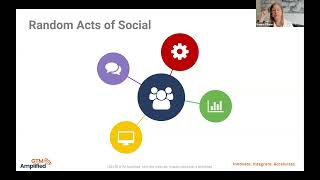
Exactly that. Right. This is our problem generally. And this is a sales problem generally. But we show up, we share something, we like something, we accept a connection request, we ask to connect, but we don't have a problem process. And if our goal is to start trust based conversations without being over sales, you know, the connect and pitch, the, the, the immediately, hey, I want to share how I can help you do this and I don't even know who you are yet is really broken. And so our goal is to start trust based conversations without being salesy. And we can't do this in random acts. We've got to have a process in place. So are you taking this? Am I taking this?
Is you Go ahead.
All right, so establish goals and KPIs. I started talking about this in the beginning, but I'm just going to kind of go a little bit deeper. What does success look like? And I know this is a big question we've heard a million times, but when I say what does success look like? How many new clients did we bring on at what value? And then how many conversations do we need in order to, to get to that ultimate goal? Right. We've got to look at the whole process and I just skipped a whole lot of KPIs in the middle. But we want to make sure that we know every single step and how that builds up to the, the actual goal that we want. What are the actual activities that we need and what are the results from those activities? So we can say I want them to reach out to 100 people a day, but is that really what you want or do you really want them to talk to five people a day? We have to really look at that. We're not just handing out activities, but we're handing out the activities that convert to the results that we're looking for. And it's got to be in the best interest of the rep, the team and the company. And it all has to kind of drill back down into the ultimate goal. So when your board of directors and your CEO get your reports on your KPIs, they make sense and they're leading in. So buyer mapping. I'm going to hand this over to.
You, Roderick, but next.
All right, well, buyer mapping is one of my favorite things. And this is where LinkedIn and AI can have a big impact. We've got to identify all the stakeholders. Now, with AI, there's lots of different ways to go in and say, you know, who are the buyers for by title in this, in industry, who are the people that are involved? And we can really learn a lot. But we can hop into LinkedIn. Once we understand the titles and even the keywords, we can hop into LinkedIn and map out all of the stakeholders inside of an organization by name, not just by title. Right. So once we've identified and developed that icp, not only can we identify all the decision makers by name, and we can leverage that when we're working with our champion. I may be jumping ahead, but one of my favorite things is we have been taught as salespeople to say, so, champion, who other than yourself will be involved in the decision making? And they go, oh, no, it's just me. But if we have this list of the right people, we could say, so, champion, Typically, our next step is to invite these three titles in. I see Jane, Fred and Ann.
Can I ask you, do you have access to their calendar so that we can arrange the next meeting? And all of a sudden, when we've got those names, we've taken the power back just a little bit and said, this is the. We're telling them we're taking control of the sale and we're telling them what's next. The next step, going back to AI, we can help to pinpoint all the business challenges for each of those stakeholders so we can have the right conversations at the right time. Yeah.
So before I jump to this, there's a couple things that come to mind. One, we've talked about. No, go ahead forward, Bren. We've talked about the right goals and KPIs, we've talked about how you get access to people. Now, I want to talk about the tool stack, but before I do, I was remiss in the beginning. To those out in the audience, if you have questions, please drop your questions into the chat piece right now, because we don't want this to be a presentation. I want to make sure that you can get the answers to the questions that you came to get out of this thing. And the other thing, I want to talk about is the tool stack not only has shifted, but the way you use it. You know, there was a time where we had the learning management, content management, we had marketing and all those are important. But now from a LinkedIn perspective, it's more about utilizing AI, no different than we use PowerPoint, Excel and Word and that is as a productivity tool. And the same thing relies here that doesn't know, and that is what you get out of it is only as good as, as the prompt that you put in. So now it's making sure that you can do not just do more with less, but utilize automation to do things that you would have done before and use it so that it now opens up more time for you. Things like calendly and Grammarly and AI platforms and other pieces and Gamma and all these things and they're coming so fast. And I want to go back to something that was said earlier and that was that you said, Brennan. That was there's so many tools out there. Bear in mind, every tool does not need to be used by you. Just because it's shiny does not necessarily mean that it works for you. Just because your peers are using it doesn't mean that it works for you. Align things like these tools, like your CRM, like LinkedIn, and utilize it for how it now works best for where you are in the maturation process and growth of your company. Now, the, the LinkedIn piece, the free piece versus the premium piece, sure, it's like anything else. If you get it for free, it's going to be only so far, it'll take you. But when you get into the premium piece, the things that Bryn's talking about, of drilling down and finding exactly who you're looking for, how you utilize it, and then how to best use that moving forward, you gotta stick to that next level. Bryn, is there anything you want to add here?
Yeah. So I will say as you're picking out these tools and the reason that this is number three, is they should align with your KPIs, whatever you are choosing, including your CRM, including, you want to make sure that all of those tools fit nicely into the sales process and that every time your sales rep is using them, it's working toward your goal, not against it. Because a lot of our tools take up way too much time and it actually hurts our productivity. And I'll just say, you know, I have a relationship, deep relationship with LinkedIn. Sales Navigator is by far the most powerful sales tool available to us today, hands down. So if you're, if your team is not leveraging Sales Navigator or if you tried it and it didn't work, it's because you didn't have the right sales enablement program around it. I'd love for you to really think about revisiting it because it can significantly reduce time to market. For sure.
I love that, Bryn. And before you go into content strategy, something I want to say really quickly. All those tools, the buyer mapping KPIs, all lead to your content strategy. And before you can actually implement this, remember, social selling has to be woven into the fabric of your company. It can't be a one time spot thing that you try or do it inconsistently. And by the way, it has to start from the top down. If you are sales or a marketing leader, don't forget what's important to you is imperative to your people. So you need to own the adoption, the execution, but most importantly, the positive modeling of what you want your people to do. So with that, Brent, talk to me about content strategy.
Yeah. So the first thing we need to do is identify what content will move the prospect forward.
Marketing has their own process, right? There's, you know, excellent content, often from the first call on, but rarely does that content start conversations. So when we're thinking about using content in the sales process, we have to make sure that that content is leading to our solution, not with it. They are researching what are they looking for and are we the ones that are coming up? Rodrick mentioned that and it's probably more 67% of that buyer's journey is without a sales rep. So we have to make sure that we're our content is leading them to us. So when it's time to have a conversation, we have developed the right content strategy that moves them closer and closer to us as a solution. Another piece that's so important and then we can move on, but is we've got to identify the content that follows your buyer's journey. And this starts with what's happening before they even know they need us, what's happening in their environment, what challenge happens that triggers them to start looking at solutions before they even know we exist. And we've got to have content that starts there because that's how we start to earn the right to be their.
Vendor of choice.
Handed to you on customized Playbook, my friend.
Absolutely. I love this piece because it is literally the foundation of building a house. Think about this as the post tension slab and that's making sure that all of your activities, all your scripts, everything that is moving consistently is done that way consistently. And A Playbook allows you to make sure that not only do you have the steps, but that it gives you an opportunity to iterate as well. Because as we talked about earlier, change is the only thing that's constant today. So as you're looking at those, those phone scripts and messages and you're looking at a B testing what works and what doesn't, make those adjustments along the way. Don't be that company that waits until, you know, three, six months later. You have to be proactive, you have to be personalized, you have to be customized right now and you've got to stay current. Bryn, anything to add here?
Yeah. So I think it's really important that we're bringing AI into the Playbooks now. I mean there are, there's amazing, I think salesably is, is someone that's speaking in this program that has literally will customize Playbooks based on all your assets, on all your having AI involved in developing your Playbook. And you know, we do LinkedIn playbooks and we do, you know, all of those fun things, but making sure that this is scalable and repeatable for each rep and, and the ability to customize those messages on demand is what AI now brings to these Playbooks. You know, I love, love building out prompts. It is like my, my go to habit, it's like my addiction now.
And it's what I do in my spare time. And when you can as a company develop scripts and messaging and content frameworks that now a sales rep can now plug into the Playbook, all of a sudden it's this dynamic opportunity here. So I just really can't stress how important having these Playbooks available for your reps.
Your reps are. I'm going to quickly touch on this because we're like, we've got a few minutes here and we're only on number six, a value centric profile. I'm not going to go through all these steps, but the bottom line is this is your landing page. Every single one of these reps is representing your company as a landing place, as a landing page, as a brand. And you've got to make sure that when people get here that it's doing its job, it's converting your visitors to connections and your connections to conversations.
Thanks, Brandon.
It's all you.
I'll quickly get through this. One enablement is about multiple channels, it's about multiple modalities and everyone not only learns differently, but in today's world of AI, you have to bring your content and your context in multiple ways. Right. And I Said customization, I don't know how many times, and I'll say it again, you can't use the generic pieces like we used to be able to do. You know, the, the webinars like we're doing now. The classroom and all the, the just in time and the guided learning paths that we used to make all matter, but they're now all, now no longer separate. They're peaceful puzzle pieces. Excuse me. And you've got to make sure that you're using all of them the right way, at the right time, with the right message to the right people. And you have to do it over and over. One time will not work the way it used to.
Love that.
So measurement and coaching. This is the piece where I get excited because now it gets an opportunity to really reinforce. And this is one of the pieces that get left. We talked about the strategy, we talked about it at a tactical way. Now how do you reinforce it? One clearly starts with leadership. That's where the rubber meets the road. And as I said earlier, they need to own the adoption, the execution, but most importantly, the positive modeling, which now leads to leading with data. Look, we can make numbers say anything. Data doesn't lie. So make sure you take out the emotional piece of I think or I feel in your conversations and let the data do the talking. Right? Focusing on what are real deals as well as how do you get them moved. And that means something Brandon said just a while back, focus on the buyer's journey. No longer is about your sales motions, your sales strategy, your sales methodology. It's finding out who buys, how they buy, when do they buy, and then reverse engineering backwards and the next is, it used to be AB is enough. No, not anymore. Now it's about where should we start, what should we stop doing and what's working well, that we should continue doing and also enhance those pieces.
Brent, anything you want to add?
No, I, you know, I absolutely love this and this is an area that I think a lot gets dropped, right? Like we, we train, we throw a tool or two at the reps. We, you know, we think we've enabled them and then we move on. And what happens is if 2 or 3% of what they learned is still being used in a year, that's, that exceeds anything I've seen, right? Like this is the piece that, that continues the, the journey to success. And if we are not implementing that coaching side, that ongoing support side, what's working, what's not working, whatever program it is, is going to fail. And so, and folks will say all the time. Like yeah, we had training on that, but nobody's doing it. Did they like the training? Oh, they loved the training. It was fabulous. But nobody's doing it. That's because this piece was missing, in my opinion.
So in recapping and then we can open this up with our 35 seconds left. But in recapping, in order for a company to truly be successful, they need to roll out a program in these eight stages. Your, your KPIs, your buyer mapping your the right tool stack, that right content strategy, a dynamic customized playbook value centric profile. Make sure that your enablement is clear and in place and includes not just onboarding but ongoing support and then measure and coach for improvement.
So sooner or later, next steps. Yeah, Mark. Unfortunately I can't see the questions, but I understand there are some questions out so I want to make sure that we address those. Can someone please, please read the questions for us? Yes, I'll be happy to share the question. The question is, hey, how do you feel about using Zoom Info and D and B in addition to LinkedIn?
You want to? Sure. So I like Zoom Info. I really like Apollo IO. I am not in any way affiliated to it, but it has some great information. Look, anytime you can get great information.
Great data that can help you reach the right people, I'm all for it. My first real job out of college was Dun and Bradstreet. So I'm going to just say yay, go D and B. But you know, really that's deep, deep research. Like you're getting the financials of a company through Dun and Bradstreet. You're getting their pay, how they pay, right? Like how, what are their terms and how late are they in payments. Like you get some really great information that not all sellers need. So you really have to decide what is the content and the data that I need to move forward. And once you do that, once you have that and when the right.
Platform to do that to get the information you need, then that's what's going to be right for you. I only need Sales Navigator and.
My LLM platform, Ask SSL like that. That's all I use and I don't need anything else for my sale. But if you need more information than that, there are also wonderful companies like Relpro that will tell you what you know, where people bank and what their liens are out on their assets. Like there's amazing data available. You just have to figure out what data will help you move the sale forward.
It's about contextualizing right? And how deep you need to go.
More from Gerhard



What Selling Looks Like When Your AI Agents Have the Context Your Sellers Do

Better Conversations, Smarter Support: Wearable AI in Business






When Scarcity-Built Systems Meet Abundance - The Judgment Gap in AI-Powered Sales Leadership
