Ahead of the Market: How ADP Put AI Where Deals Get Decided
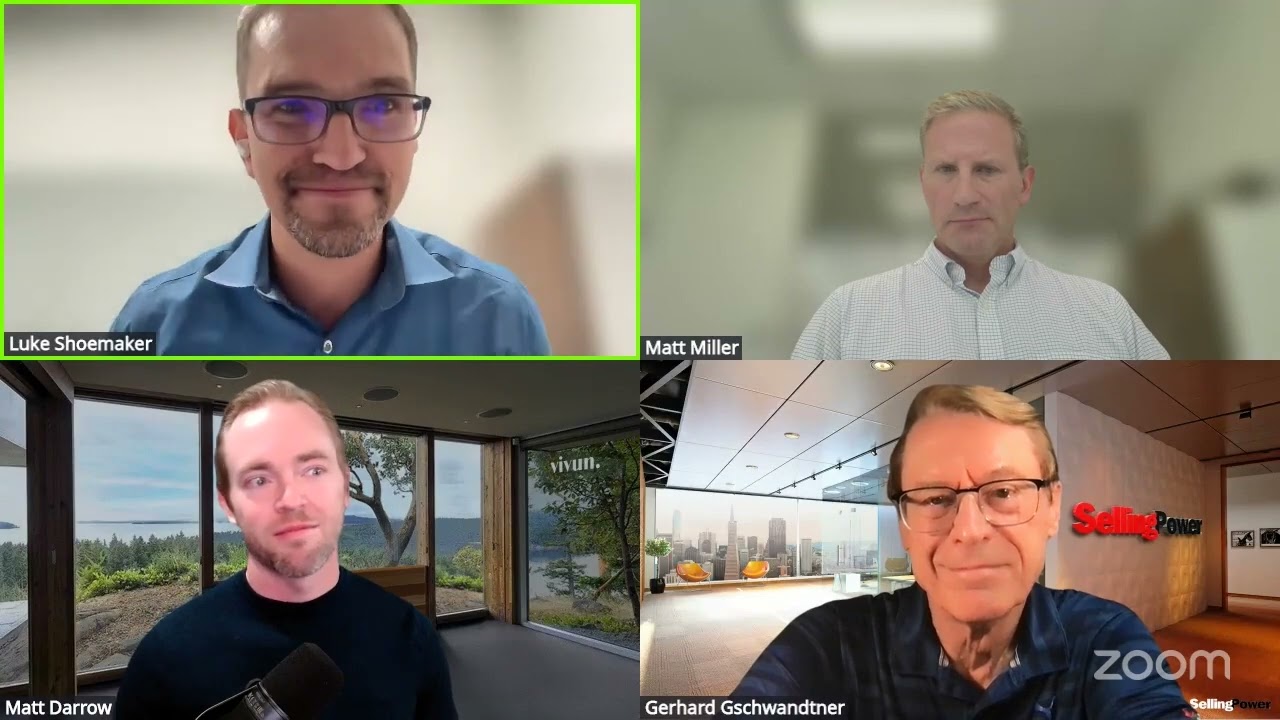
In this live‑panel session, host Gerhard moderates a conversation with Matt Darrow (CEO of Vivint, the maker of the Ava AI sales teammate), Matt Miller (Senior Division VP of Sales Operations Strategy & Planning at ADP) and Luke Shoemaker (Director of Strategic Initiatives for Pre‑Sales Integration at ADP). The discussion centers on moving AI from the traditional pre‑call preparation and post‑call analysis stages to the real‑time moment of a sales conversation. ADP’s journey is described in detail: a methodical rollout that began with a small proof‑of‑concept, progressed to a pilot, and then scaled to thousands of sellers across a highly regulated enterprise. Key challenges such as AI confabulation, product‑knowledge accuracy, and maintaining seller presence are explored, with the solution involving a dual‑mode interface—“Whisper” on‑screen guidance and an optional avatar that can answer aloud. The panel shares concrete outcomes, noting measurable productivity lifts, higher win‑rates for users versus non‑users, and unexpected ways sellers leveraged the tool for pre‑call prep, debriefing, and cross‑team collaboration. Real‑world anecdotes illustrate the AI answering complex benefit‑enrollment questions on a live call, earning buyer confidence and accelerating a deal. The conversation concludes with practical advice for skeptical sales leaders: start with targeted use‑cases, involve frontline reps early, and let the technology evolve through their feedback.
Chapters
Welcome everyone. Michael, what are you excited about in this session? Hearing about results.
This is going to be a results-focused conversation.
You know what's interesting to me is that most AI investments in sales over the last couple of years have gone to 2 places. One is call preparation before the conversation and the second, the recordings and the analysis after the recording. So what has gotten very little attention, in my opinion, is the live conversation itself. You know, the actual moment where a seller is on the phone or in the room with a buyer trying to answer the questions. And my vision was always, how do we create that omnipresent seller that is truly aware of what is going on at every moment in the conversation? And that gap has been addressed by Vivint.
Yes.
And I'm— we are joined today by Matt Darrow, who is the CEO of Vivint, and he's going to host a conversation with us and, uh, with a team from ADP. Uh, we have Matt Miller. He's the Senior Division Vice President of Sales Operations Strategy. And Planning at ADP, a very critical function. And we are also joined by Luke Shoemaker. He's the Director of Strategic Initiatives for Pre-Sales Integration, also at ADP. And I want to— cannot stress enough that integration has become the keyword to success when it comes to AI implementation. So, and as everybody knows, ADP is a highly regulated organization that needs to execute every step of the sale like a Swiss train. It has to be on track and there are guardrails. So, Matt, I want to turn it over to you. I want you to guide the conversation. and help us discover what can we learn from that massive rollout with ADP.
Well, thanks for having me back this year too, Gerhard. I love this conference. And briefly for the audience who might not know Vivint, we're venture-backed by Accel, Menlo, and Salesforce. We've built the world's most powerful AI teammate for sales, not to help you book meetings, but to help you work and close actual deals, as Gerhard mentioned. And I'm thrilled to interview Matt and Luke from ADP because they've gone from strategy to pilot to full-scale rollout. And hearing that experience is what every sales leader is craving right now, not theory, but real enterprise results. So Matt Miller, ready to get into it?
Let's do it.
All right. So when you looked at the AI landscape for your sales organization, what did you see from your seat that the rest of the market was missing?
So, Matt, it's interesting. We didn't put a lot of focus on what we felt the market was missing, but more so what we needed to do to move at the speed of change that we felt the technology would afford us, right? And so we tried a lot of things and we failed fast, you know, and for ADP, it was about going out. It was about looking at what, you know, the future was trending towards. Taking a look at what elements, you know, aligned with where we felt our critical needs were and getting involved with companies that allowed us to run POCs, test pilots, understand did the technology work, did it fit what we need, you know, and ultimately, you know, move forward with, you know, a group of individuals that allowed us to actually test, you know, hard quantifiable metrics, which is, you know, how this partnership between your company and our company formed.
Well, I love working with you guys as well because you're always pushing the envelope on what's possible and where AI can be inserted. And to Gerhard's point, even from the beginning, like going after the moment where sales actually happens, which is what we're all doing right now together. We're on a live conversation. And maybe Luke, that's a good transition to you. Like you sit closer to the sales calls at ADP than nearly almost anyone. What made you think that the live conversation was where the next move had to be?
It's such a great question. I mean, I've been paying attention to this for the better part of 10 years. And one challenge that I think is still consistent, especially, you know, pre-technology with our sellers and solution consultants, is what happens when you're in a meeting, you get asked this question that you don't know. And if you look at the market, we saw a lot of innovation helping sellers prepare before and after. And that's great, and those are valuable. But the reality is those most important moments, they happen during the meeting when you have captivated attention. And so I spent a lot of time talking with our associates. We ran surveys, and their answers were pretty much all the same, which is this, right? If a difficult question came up, either brought somebody on the call with you, not a great use of resources, right? You tried to plan ahead. You'd pause and research the answer. You know, maybe you had a break and 10 minutes later you'd bring it up, but you lost the question and the momentum. Or you'd take it away, which is like worst-case scenario as the speed of AI is increasing. So, you know, our goal was to not delay momentum with the customer. And what excited us was the opportunity to provide support in a moment. So, you know, right now we're living the dream, if you will, right? We literally get to see guided answers as questions come up in real time. And it's really exciting.
Yeah, I think a lot of that, to your point, like not having to delay a deal cycle, not having to wait for additional expertise and resources. Um, you guys can attack your market faster, better, with more expertise than anybody out there. Uh, and that's just been, uh, amazing to watch. And I don't, I don't wanna hog all the questions cuz I know Gerhard, when you kicked off, you talked about ADP being a, yes, they're a very large company. Yes, they're regulated. What's on your mind there?
Well, I, I wanna reflect on what Luke just said, uh, because it reminded me that, uh, I had a conversation with a Forrester analyst about a year ago. And he said, this cannot be done. I've studied this for 24 months now, and there's no tool out there that can rise to the challenge. So, um, I wanted to ask Matt Miller.
Yeah.
ADP is such a large, highly regulated company. Um, what did it take on your side to get comfortable with running this inside your sales organization? When analysts say it can't be done?
So great question, Gerhard. We, you know, so we've had a multi-year relationship with Viven from the CRM side. And within our pre-sales organization, we made the decision to deploy Ava and the AI technology to our solution consultants because we knew about Viven's passion for sales and pre-sales. And immediately we saw positive results, right? We had people that were salespeople, but they were highly technical, so it brought this great cross-section of expertise to allow us to test and improve the technology. And from there, we quickly saw productivity accelerate, and we also saw a lot of time savings gains. In addition, what was nice is that because there was a technical background within this population, We had the opportunity to allow them to make a lot of changes to the technology on the fly, which is critical when you're in a sales organization. We didn't have to wait for the vendor to do anything. We could just do it ourselves, and it was very intuitive. So as we were going through this process and looking to do more with, you know, our frontline sellers, we saw a terrific opportunity to introduce this product to our frontline salespeople and It took off immediately, right? They had the exposure within pre— working with their pre-sales partners to see what it could do. Now we were putting it in their hands. But back to your point, given the nature of ADP, we did take a very methodical approach, right? So we started with a POC with a very small group of people. We collected information to understand, you know, are they using it? What are their— what's their takeaways? What's their feedback? Then we expanded to a pilot. And then ultimately, we went to a larger population of a few thousand people, identifying those areas and knowing from the data where we could get the biggest return, right? And that's how we operate in a very controlled and regulated environment. And that's how we've been able to maximize our investment in this particular case.
What was the chief worry that people expressed to you when you were at the pilot stage?
You know, to Vivint's testament, you know, a lot of people were were skeptical about how well the technology would be able to not only understand the depth of our product based upon the information we were feeding, you know, the brain, so to speak, but how it could then pivot, right? How it could pivot on the fly based upon the type of question that was being asked and adjust itself, and it performed tremendously. And I think once, you know, both our sellers as well as prospects that we would have on the phone with the product saw that, You know, it gave people a lot of confidence and, you know, selfishly speaking, reflected very well, you know, on ADP.
So my worry would have been confabulation, that AI makes things up. So, look, when it's live on a sales call, that, that risk is very real. How did you get past that?
Yeah. So I think the good news here is the longstanding relationship we've had And we didn't do it all in one day. I mean, when you think of it, right, we've had this technology in place for over a year in a text-based format, and we gave ownership to our solution consultants where if they saw something that wasn't correct, we taught them how to change it, right? For every single product we have, we really taught them the mindset of, you know, let's make this technology work for you, and it created that shared ownership model. So we took a very practical approach to validation, especially as our sellers Started to come in mind, and we expanded the technology. Really simply, we identified the most common questions that our buyers were already asking our sellers, and that became our golden question set. I think that's a term, right? The ones you don't want to do hypothetical testing; you want to do real conversations that happen every day, and that's where it came into the pilot, right? We knew if we could answer those questions correctly, we'd solve meaningful problems. We know. you know, the questions our solution consultants were answering on behalf of our sales teams, and we really focused on bringing that expertise into the AI. So I'd say the final piece was really context, and something I really want to compliment Viva and the Ava technology is they added product lines. And if you know ADP, we have a lot of products. So in the very beginning, we had to work into the product question, right? Like, hey, how does this product cover this? Now you could preconfigure that, right? So we have a dedicated product knowledge for each of our sellers, and that's been a big impact. So it's been an amazing journey, and we're really happy with where we're at today.
You guys continue to push us in all the right areas as well, whereas Matt mentioned, like, the brain, right? That becomes, you know, our own really unique reasoning model that has that context engine for the company, especially across all the product lines. And I'm sure there's audience members, Gerhard, out there right now that are like, This feels like 4 steps, 5 steps farther ahead of where a lot of folks are thinking about deploying AI. Luke, can you make it a little bit more tangible for them too? So we're talking about, you know, AI working with sellers on live calls in the moment. Seems futuristic. You guys are absolutely nailing it. And you've told me about these scenarios where Hero showed up at just the right moment. Can you talk about that to the audience maybe? What happened on one of those calls?
Definitely. I'll give you one of my favorite stories. And so we had one of our pilot sellers, quick adopter, meeting with a type of a technology startup where, you know, they're investing in AI, ADP's investing in AI. You know, not only are they interested in ADP's AI technology, but seller's idea was let's bring Ava into the call because it was a great opportunity to show how ADP was leveraging AI to support customer conversations. So during that meeting, We had the owners, we had the IT group, and we had Ava live on the call. And we had Ava introduced to the customer. They could ask any questions they want. And I remember this one clear as day because the buyer asked Ava directly, and we're talking about benefits, payroll time, multi, you know, new logo sale. And the buyer asked, can Ava, or can open enrollment be set up through carrier connections? Now, that seems like a simple question. But it's complex technology, and essentially it takes carrier connections, takes your open enrollment information, and transfers it to your existing benefit providers. So Ava explained that open enrollment's typically managed through the benefits platform itself, and the carrier connections transmit the information. Now, that seems simple to say out loud, but so many times I've seen our sellers trip up with that. And the fact that Ava answered it so simply and everybody was like, wow, like, yeah, that's great. Great. Moved that sale forward and it resulted in a win.
What did— when you debrief with the seller after the call, what did they have to say about it, Luke?
I mean, well, first of all, they became one of our biggest raving fans, right? But I think what was interesting is that seller could have explained that. They were a very good seller. But I think we've all experienced this. There's something about AI when it explains something, it creates it from a neutral point of view, right? When you have the confidence, when you have the trust, So what I think we were really impressed about was, you know, everybody was on camera. We saw the buyers' faces. We saw how impressed they were. There's plenty of skeptics out there who are waiting for the AI to not work. And not only did it work, but it took something that probably would have been harder to explain in person and said it in as little words as possible. And it resonated with the customer, right? They were really appreciative. And, you know, we were able to use that. You know, we had our salesperson joining some of the kickoff calls and becoming a A good example of what good looks like. So it's just super exciting.
That I love that story because it talks about how you guys are pushing the envelope and demonstrating your own sort of use of AI as differentiation. Because, and for the audience out there too, like when we talk about an AI sales teammate helping in the moment, there's multiple ways that that can happen. And the most conservative way is. Sort of this discreet help behind the scenes that is purely for the seller. It's their Iron Man suit, right? The buyer doesn't really even know that that assistance is being given. And then the other end of the spectrum is the story that you just told, Luke, as well, where there's a full-blown materialized avatar-enabled teammate with a face, a voice, a persona that has a very specific ADP look and feel. That's a real teammate on the call that's part of the conversation. And I think that that whole spectrum has been fun to work with because sellers and customers are on different phases of that journey. But you guys have seen the entire gamut. So incredible positive surprises for yourselves, your customers, your prospects. But Matt, how about for you when we go back to the rollout? Surprises about the rollout. What have sellers been doing with this that you didn't expect?
Yeah, so it actually, Matt, it touches upon something you just mentioned, right? And that is that that face-to-face interaction, right? So when you kick off a project like this, you have, you know, you have hypotheses, you find your problem, you find a potential solution, and you say, okay, it should solve for X, right? But as we started to roll, you know, Ava out, what was really interesting was not only were our sellers using it for the areas in the sales process that we expected them to, but they were using it before the sales process, right? They were, They were taking advantage of it to do their pre-call planning and prep. They were training themselves to be ready to answer questions. They were training themselves on how to understand the AI. They were training themselves on how to coordinate the conversation with the partners getting on the phone with them before they even got on the sales call. And then after the sales call, they would leverage the technology to do a debrief, right? And understand what next steps they should take. And it was really interesting for us because not only did we see it as an opportunity to help our sellers while they're selling, but there were learning opportunities, there were partnership opportunities, there were opportunities for us to bring in, uh, and incorporate other parts of the business that we didn't even initially think of during our, you know, primary business case. And that for us was, um, was a win.
Yeah. Well, and, and, and actually, Matt, just whatever you're comfortable sharing, I think so much of that can, can roll into, you know, time back to sellers, deal outcomes, you know, all this adoption that you're talking about. What results did you track and the differences that you started to see? And again, whatever you guys are comfortable sharing. Yeah.
So it's interesting. We start off, you know, the first thing we do is we make sure that, you know, people are using it and that people are comfortable. And then as we get rolling and we get a consistent cadence with utilization, you know, 2 things we're focused on, productivity, right?
Right.
First and foremost, and then time back, right? Anything we can do to convert that time within, you know, let's say an 8-hour workday to be more focused on selling, we want to do. And, you know, I can't get into specifics, but was in terms of specific numbers. But what was interesting because of the way that, you know, Viven would integrate with our CRM, we could digitally identify where it was being used, how often it was being used versus not. And there was an extremely strong measurable lift that we could identify in terms of who was using it, what their win rates were, you know, by populations or cohorts of people versus those, you know, who are not. And it made for a very simple business case as a result of that.
Yeah, thanks for sharing that. Uh, to Matt, just around when you have the best teammate by your side, that's our whole strategic goal too, is how do we not only give time back but then allow you to go and pursue more deals, win them, win them faster? Yeah, I want to be mindful of time because I know that we had till 20. Uh, Gerhard, you had a couple, I think, closing questions too. I didn't want to make sure that, uh, we had, uh, we could turn the ball over to you too.
Yeah, um, I want to ask an audience question. Somebody's asking, um, Can you tell us, ADP, that is, how involved were the frontline salespeople in the decision-making process from the beginning?
So, you know, I'll take that one. It's interesting. We, you know, when it comes to technology and, you know, trying to get salespeople to use tools, it's usually a little bit of a tug. Right? You know, think about populating CRM, salesforce.com, and so forth. In this particular case, you know, they came to us. They saw our teams in pre-sales using it, and it was, when are we going to get it? Right? And then once they had it, the power that they saw in it was so strong that they would come to us with use cases, and we would say, hey, listen, like, that's on the roadmap. We're talking about it. But let's start here. So it's really nice when they can come along on the journey and be involved in that way and help then shape the roadmap as they become a part of the rollout.
Awesome. Look, I think that question is for you. Mike is asking, how do salespeople use a tool without losing presence? He says so many reps don't listen very well. And they aren't present. How do you make this not just another distraction?
Yeah. So I'll take that one. It's something we were paying really close attention to. And I'll say, as Matt Darrow mentioned earlier, there's 2 parts of the technology. There's Whisper, which is like on-screen guidance. And then there's the avatar support, which is I can call on the avatar and it could answer. The combination of those 2 technologies make it natural, right? And it's one of the things we saw in the evolution. So the most common question we got in early pilot was how do I know what the avatar's gonna say, right? So Vivint listened, they delivered a Whisper experience, and essentially what you get to see is the answer that you see. And now you yourself as a salesperson can say, I'm gonna take it. But sometimes, you know, it's better for the avatar to take it and the AI to take it. And that has really been the biggest difference maker and something, you know, we identified by plenty of our sales teams early in pilot. We made a quick adjustment and now to the point where the Whisper is the new favorite technology that's available. So that's how we answered it.
That's a great answer. You sold me on that one. And I have one more final question. There are hundreds of sales leaders in the audience right now and pre-sales leaders. And they heard, you know, the message about a year ago and they were skeptical and they're still skeptical today. What would you tell them?
So I'll jump in. Oh yeah, yeah, go ahead, Matt.
Oh, okay. I think, you know, I would say, you know, certainly take the time to find your targeted areas of opportunity when it comes to, you know, leveraging this type of technology. You know, it's once you find them, it's— there's a lot of opportunity to be had. But that being said, Put it in the hands of your sales teams, if you know, and you'll learn a lot about what they need and other ways that you could apply the technology. You know, whether you have 10 sellers or, you know, 1,000 sellers, you know, they'll help guide you along your journey and your roadmap. And what you think you may learn is a lot different than what you will actually learn. And, you know, as a result of that, you'll drive adoption. You'll find ways to integrate with new technologies because they'll bring ideas to the table about other solutions that they're using. And it's really, you know, a nice way to, you know, let them be heard, find out what's really troubling them in addition to some of the things that you've, you know, identified as, you know, manual processes or time-consuming processes. And, you know, that to us helped, you know, build momentum and drive adoption.
That's awesome. Thank you for sharing that insight. For all those skeptical people out there that have questions, Tomorrow we're gonna have a surprise for you at 12:40 PM Eastern time. We are going to have a live presentation of Vivint. So tomorrow is Demo Day. And Matt, I hand it over to you. You've done a fantastic job enlightening us with an example of AI that really works and helps the salesperson create more customers and put more money in their pockets.
Gerhard, thanks for the opportunity to co-present. And obviously thanks to ADP, phenomenal partnership customer, and just love being part of where you guys keep pushing it and can't wait for our demonstrations tomorrow and then just the continued stories. Thanks for having us again, Gerhard.
More from Gerhard



What Selling Looks Like When Your AI Agents Have the Context Your Sellers Do

Better Conversations, Smarter Support: Wearable AI in Business






When Scarcity-Built Systems Meet Abundance - The Judgment Gap in AI-Powered Sales Leadership
