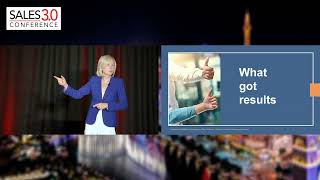
Perry (presenter) recounts a classroom experience where applying a simple neuroscience insight—encouraging forward/back and side-to-side movement—transformed a struggling student (Jim), who rose from repeated failure to an 84.7% course grade, honor roll, and eventually teachers college (and a teaching career). That single insight catalyzed Perry to develop a questions-based coaching/education model, which was adapted and tested in corporate sales teams (A/B-style rapid tests using live sales metrics). Corporate pilots reportedly doubled one team's sales and produced a neuroscience-informed sales model with tested rules (e.g., buyers buy emotion justified by logic; story and question engage; acknowledge dual emotions; structure stories with emotion in sentence 1 and 3; avoid speaking more than four consecutive sentences). Perry closes by noting they are integrating these methods with AI (small "baby AI" tools) and asks the audience to pick one research-backed change to try.
Chapters
I remember the day when I first learned that the little bit of neuroscience can make a huge difference to performance. It was the second Monday of my teaching career and I was given a business English class. There were 23 students. Sixteen of them had learning challenges, and many of them had been in the class before and failed. And they needed the credit to graduate. So you can imagine the pressure was on for me, and I did everything I possibly could based on what I had learned in my classes in teachers college. But you can probably imagine it didn't go so well in those first couple of weeks. So what I did is I racked my brain and I kept on thinking, what can I do? What can I do? What can I do? Then I remembered a conversation I had with one of my professors. It was a side conversation. What the professors shared with me was that when we move, we actually cause the corpus callosum, which most of you are probably going, what in the world is that? The corpus callosum is a connective tissue between our right and our left hemispheres of our brain. All right? And when we move, we actually cause the brain to function better. And on top of that, it causes you to think better and to actually perform better. Have you ever noticed when you're doing some deep, deep thinking that you fidget, move, or pace? Anybody notice that? Yeah. Okay. What you're actually doing is activating that part of the brain. So let's back up, back to class. So the Monday morning, I come to class, I share the research with the class, and I share with them this added piece is that it's a forward and backward movement, or it's a side to side movement. And so I ask the class for a volunteer. And in the back of the room, a student raises his hand and he says, miss, I'll do it.
And now this is Jim. And give you a sense of who Jim is. He's somebody who the kids liked, the teachers liked. He was a captain of most of the sports teams, but he was one of those students who had been in the class multiple times before.
But here's the other part that comes with it. His dream of dreams was to be a high school teacher. But because he was doing so poorly in school, his teachers had taught him to give up on that dream.
So I said, jim, if you don't mind, if you could please stand up. So he stood up.
And I asked if you could just open the book anywhere and just read from the book.
So he started to read.
And he stumbled and stuttered over almost every word.
And then I Said Jim, if you don't mind, stop now. And what I'd like you to do is a little test.
And that is just to rock forward and back and side to side and see which one feels more comfortable to you.
So.
He moves forward and back, side to side.
And he says, miss. Forward and back. Great, Jim. Now if you can open the book and turn it to another page. And what I'd like you to do is start moving forward and back as you do it and just read aloud for us. Is that okay? Yes, Miss. So he starts to move, and then he starts to read.
And it's perfect.
Absolutely perfect. No stumble, no stutter. Absolutely smooth.
And he didn't stop.
He kept on going.
And tears started pouring down his cheeks. The other students in the class, you can imagine what happened for them, too.
And I'm guessing you can probably tell what would happen to the teacher. Yes. So that day changed Jim's world.
We actually, to simulate the forward and back movement, we got pedals under the desk for everybody.
He got them at home. The students borrowed them for other classes and took them up and down the hallways.
Jim, at the end of the semester, in that class, he didn't get 60%, not 70%. He got 84.7% at the end of the class. And then at the end of the year, he got on the honor roll. He finished high school, he got into teachers College and is a teacher today.
So.
One piece of research.
The irony of the whole piece.
Is that he.
Was doing exercise and movement outside of class, right? And all the sports teams. But he wasn't doing it by design in the classroom. That was what the piece of research was about. And then all of a sudden, he unleashed his potential.
And so for me, that day taught me to never underestimate the power of one idea of one piece of brain, brain research, to change someone's world.
Fast forward. I continued. That caused a catalyst for me. And as a teacher, I started to research, read as much as I could. I tested my class with my testing ground, and I discovered a few things. And I discovered that when I lectured, it didn't make a difference as much as when I asked the class questions. And I ended up developing a model of education based on questions. And I didn't know because there wasn't the term then. It was a model of coaching. And I ended up teaching other teachers how to teach. And at one of these large educational conferences, I'm presenting and I'm talking about the work and teaching them how to do the same. And there was one person in the audience that looked a little different than everybody else. He was wearing a.
Tailored suit, and the rest of the teachers were not. And when I was finished, he came up to speak with me and he said, perry, you have no idea what you're sitting on. You have to take this to corporate. And I went, no.
Well, he was persistent. He won. That summer, I worked with him and his team.
One day a week for six weeks. And at the end of the six weeks, he came to see me. And what I taught them was all about coaching. Well, actually how to ask better questions. So I taught the leadership about coaching, and I taught the team how to ask better questions. And when he came to see me, he said, perry, he said, you have no idea. He said.
We'Ve doubled our sales. And it was. It surprised me, it surprised him, and it started a new career. And he was a cheerleader. So he gave a Referral to a VP who had 700 salespeople.
I loved this VP because.
She liked the idea of testing for me, if you notice a theme, it's research test, research test, research test.
What I did was I hired four neuroscience grad students to comb through the literature to find everything and anything that we could to improve the quality of the sales conversations.
And.
We then took that and we tested it. Now, the neat part about having a large sales team, some of you probably are very familiar with this. There's a large ticker tape, like apparatus on the board on the wall that gives you all the numbers, almost real time. And so the neat part is we could take the research.
Test it, and find out what worked and what didn't work, and we would know within an hour.
If it was something that we would continue doing or not.
We did that, and we discovered and came up with this model. And notice, research test, research test. And a model came out of it.
He then. Or, sorry, she did, then gave introductions to more people, and we continued to test in different environments, face to face phone calls, and then later in teleconferencing calls, we came up with this model.
Would you like to know some of the tidbits of the research that we discovered? Yes. All right. So what we've discovered, there's actually. And as I share this with you, part of what I think may be helpful to you to.
Think about is what is that one piece of research that will make that difference for you and your team? All right? And do not let the simplicity of these ideas take away from the power. Just like with Jim, there's one idea made the difference. Okay. Number one, what we discovered, which you probably are well aware of, is that we do buy an emotion justified by logic. Yes. Two, what we discovered is there are two things in particular that actually emotionally and logically engage people, and that is story and question.
Number three is that with both story and question, there is one piece of research that's really important to be aware of, is that we experience two emotions at the same time. Often one is conscious and the other is unconscious. So, for example, think of a moment where you were given an opportunity that really excited you. Everybody got it. Just give me a thumbs up to let me know that you're excited. Great. Okay. Now in that moment, did you also have. And just raise your hand if you did another feeling that was like maybe a little nervous, a little anxious, or maybe even fearful. Any of that. Okay. So this is an essential part to put into the sales conversations. All right? And then when salespeople ensure that the questions they ask cover both the dual emotions, they do better. And then number five is when salespeople tell a true client success story, not one that's made up. All right. When they true success story that actually includes the dual emotions that the client is actually experiencing or the prospect, they actually sell better. Now we're going to take that a bit further with number six. Number six, what we discovered is that if you put one emotion in what the team member shares as a story in the first sentence and the second emotion in the third sentence, they will actually do better.
With their results. And then finally, those who've watched the video some of you have already chatted with me about, it is number seven is that we. When a salesperson speaks beyond four sentences.
Sales go down.
So when they speak more than four sentences about their product at a time, the sales will go down. So beware of that fifth sentence.
So in closing.
We then, we're now in the world of AI we've covered 40 years now. So we're now in the world of AI and have we embraced it? Yes. Are we testing it? Yes. Are we doing research? We've had three team members who've worked with it. And what have we done is like we've done before. We've taken our strength from before and used it in the new world that we're in.
And so we've taken the neuroscience of selling, which is that body of knowledge that we've created. And then we've taken the strength of our clients. So I ask you, how can you take the strength that you have and the strengths of whoever you serve, put those two together. And we've created a baby AI to serve people better in that regard. So, so I ask you this question.
What is the one thing and whether it be from what I've shared, I have a little bias. I hope it's a little bit of brain science. But what is the one thing that you're going to do differently? Like Jim did.
Like we did, we tested one thing at a time and we could see the changes. We can see the difference. And we've seen in terms of results, we had one. The largest results we've seen is with a team of 154. They didn't just double their sales, they didn't triple it. They just slightly over quadrupled their results simply by incrementally improving the quality of their conversations. So on that note, what's the one thing that you're going to make a difference with? Thank you. Great to spend time with you.