AI Doesn't Fix Broken Sales Behavior
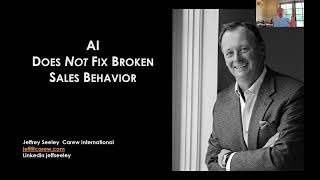
In this 90‑minute presentation, Jeff (Carew International) argues that artificial intelligence is a powerful tool for automating back‑office and transactional sales tasks, but it cannot fix poor sales habits, weak work ethic, or a lack of strategic thinking. He likens AI’s current stage to the early internet – useful but limited – and shares personal anecdotes (e.g., his GM internship, a bamboo‑rice discovery, and Nordic travel) to illustrate his points. Jeff demonstrates the unreliability of large‑language models by querying ChatGPT, Claude, and Gemini about Carew’s competitors, showing that AI can hallucinate or provide outdated information, underscoring the need for human expertise. He outlines the shift from transactional selling to an “interdependent” strategic partnership defined by trust, credibility, rapport, and respect, and stresses that AI should free salespeople from administrative work so they can focus on deep customer insight. He introduces the concept of “understanding the customer’s why” – drawing on Maslow and Viktor Frankl – as the core of value‑added selling, and explains how AI can support pre‑call research but cannot replace the human ability to synthesize insight. Jeff also discusses cultural change, leadership development, and the classic “monkey‑on‑the‑desk” problem‑solving model from a Harvard Business Review article, describing Carew’s upcoming sales‑leadership programs that teach culture‑building, coaching, and accountability. Throughout, he warns against over‑reliance on AI for creativity, citing examples of AI‑generated recipes that fail in practice. The talk ends with audience Q&A on managing changing purchasing teams and a personal reflection on balancing business and personal excellence.
Questions this video answers
Jeff explains that salespeople must build relationships beyond the purchasing department, become advocates inside the organization, and understand the end‑users’ needs; relying solely on purchasing is risky because their primary goal is cost reduction.
Jeff mentions three dates – April 13, May 27, and November 9 – describing the programs as leadership‑focused, culture‑building courses that teach coaching, accountability, and the monkey‑problem‑solving model.
Chapters
As you think about AI right now, and it's to me kind of the old guy sitting on the side of the porch sometimes, AI to me, it looks a little bit like the first generation of the internet. And the good news is, is we've seen what this story ends and evolves to, which is amazing. But the first part of it gets a little tricky because, you know, you get fear, number one. And I think back to, I, I just wrote an article for Leader to Leader that's gonna be published. And one of the things I talk about is one of my first jobs was, you know, people think, oh my God, AI's gonna ruin everything. One of my first jobs was, I was an accounting major and I worked for General Motors. And my internship job was I got to work in the property department of a giant General Motors plant. And there were 12 people with college degrees whose total job was to take these journals and handwrite the depreciation, amortization, all this other stuff every month and create a journal entry to put into the financial system. Well, when I use that analogy right now, people are like, "Oh my God, people actually did that?" Yes, they did. And guess what? Computers and everything else got rid of all that stuff, made it easier, automated it. And it didn't have any negative impact on our workforce, on the ability to get a college degree, none of those things. So I really don't believe AI is this thing where everyone's gonna be sitting at home, you know, eating, you know, blueberries and wondering what they're gonna do next. So I just think it's gonna be an incredible tool. So let's kind of talk about that. And I just mean it, it has, I say the potential to be an incredible sales tool. And it really comes to the person and the sales behaviors that are going to make it this incredible tool. So if you have bad habits and you have a lack of a work ethic and you don't have a skill and a process, the reality is AI is not going to do anything for you or make you better and frankly might even actually eliminate your job potentially. But using creativity and curiosity and intellectual brainpower, Sales is going to be a very different profession than it was. If you think back to the '60s, '70s, '80s, even '90s, it's like, oh, they went to college, they really didn't know what to do, they were really good with people, they went into sales. Well, those days are gone. And really what drives this, and I just find this just so fascinating, and I've used this slide in other presentations before, people worry about the capacity of AI, which is to a high degree unlimited because of the large language model, those types of things. But the reality is the human brain is more sophisticated than any AI installation individually or even combined. There are 100 billion nerve cells that we create, have in our brain, and that uniqueness is really shaping our identity and our ability. Well, AI can't do that because if you think about all the interconnections and just think about how you think and how you do things as a human, the reality is that you can't— you just invent things that are just not ever thought put together. And one of the things I like to think about is, you know, the printing press, which— think about what printing press changed our world. To this day, even though it's not a, you know, true press, but the printing, the dissemination of information, the printing press was created by two very crazy unique things, the ability to, to have a malleable metal and a wine press. And when that was invented, those are the two thoughts that came together. And I would challenge that. I don't know that AI has the ability to do that yet. Now, maybe someday it might, but who knows? But here's one thing about this is that we know that behavior change, which we do have to have with AI, is difficult. And it's really difficult if you don't have leadership that, you know, reinforces it, creates the culture, all those things. And so if you think about this little statistic, 8 out of 10 people who have a major heart incident do not appreciably change their lifestyle. So if you think about a life event, which is truly life or death potentially, is not gonna change your behavior, how will software or how will the ability do this? So what it does is it has the ability to potentially change your favor. Your behavior by feeding what interests you. And we call this the social media effect. And right now, I mean, not we, they call it the social media effect. The reality is, is you look at all the things that are going on with Meta and all these different things about how social media is driving behaviors and creating behavioral change because it's activating the dopamine rewards effect in your brain by what you view. Well, I would challenge that I think you can create behavioral change by activating that dopamine reward system inside of the sales, you know, culture as you create. So what you're doing is creating a reward system that encourages use, encourages exploration, encourages different things. And, you know, doing some research, Johns Hopkins Med basically said that frequent social media use changes parts of our brain related to our emotions and our learning. So I think as you think about the culture, that's what's required to create that change because you think about those 100 billion neurons and culture change, that's what brings together the behavioral change. So I would say this, that AI has this profound impact on things like the predictive supply chain, sales demand, understanding the implications of competition, and market data, all those things. It becomes a powerful tool to kind of to a high degree take back office things or things that used to be calculated and creates that information to be better. So, but what I will tell you is AI agents drive information based upon— I mentioned that large language model. So for this presentation, I tried a little something. I tested ChatGPT, Claude, which you may know, and Gemini, and there's a lot of other ones out there. You could choose a, you any one of them you want to, but I chose those 3. And I gave it a simple text, text question. Who is Carew International's largest competitor? And so I'm thinking about this for a second and it's like, okay, if I'm gonna be in the sales world and I'm gonna go understand something about one of my customers, I better use my brain a little bit with this because here's what came back in this question. From ChatGPT, it was, "Kurru International operates in the sales training leadership development industry, fairly fragmented. Here's 3 competitors: Aslan Training and Development, Wilson Learning, and Rapid Learning Institute." Interestingly enough, I know 2 of those. The 3rd one, I have no idea who they are. I've never come against them. Our team's never come against them. And that was our cited competitors. So if you're doing research on Kurru International, try to sell us something, and this is the information you got from ChatGPT, You actually might be barking up the wrong tree without doing your homework with one of our team members to understand more about our competition. Interestingly enough, Claude said some potential competitors in this space are Sandler, Dale Carnegie, Miller Heiman, now part of Korn Ferry, which is up to date, Richardson Sales Performance, and SPIN Selling organizations. All much higher quality people we compete against regularly, people we think about regularly. Except for SPIN Selling. I'm not so certain SPIN Selling is still around. I think their content is, but I really haven't seen much of them. So it's like, okay, now let's go to our good friends at Gemini at Google. Crew International operates in the field of global logistics and supply chain management. We compete against DHL Supply, XPO Logistics, Kuhn Nagel, and UPS Supply Chain Solutions. Guess what? None of that's true. So I don't know what drove that, but that's what I got from AI. So now I'm thinking to myself, if I don't do my homework and I don't know who Crew International is and I don't do my brainpower, I could really be, you know, finding things that it makes it difficult to be successful. So, but here's some, you know, people I say, what can say I, as AI do, Jeff? What are some of the sales behaviors? I love the, you know, sales back office functions, sales administration, compensation, measurement tracking, marketing program administration and development, customer communication and ordering functions. All those things can take— or being taken over by AI to me, which is really then providing more data, more information to make our company, our sales team more marketplace ready. The other area where I see it is, and there's salespeople out there and some of you may be in those companies that I'll call are more transactional sales. They take more orders, they're kind of managing inventory at their customers' levels and those types of things. And I'm be honest with you, if you aren't bringing much value, but other than taking an order, AI should replace you because I can use, you know, RFID codes, I can use weight, you know, scale measures, automation, and basically know how much to replenish on a regular basis, send that to the customer and make sure that it's done. So those are kind of behaviors it can replace right now, quite honestly. What it cannot do is create more time interfacing with actual customers. And so if you take away the sales administration functions, that actually gives you more time that allows sales professionals to actually interface and work with their customers. And basically, I would say that sales roles that don't evolve to this more strategic partnership direction or relationship are going to really be open for, frankly, market share loss. And I like to say if there's a strategic partner test, and this is a pretty simple one, and it goes both ways. It's if you look at that little diagram there with the, equal circles pointing back and forth. That's what we call an interdependent relationship. An interdependent sales relationship has 4 elements: trust, credibility, rapport, and respect. And I always find it interesting that when I ask this question of a salesperson, I always say, so do you have this kind of relationship with your customer? And inevitably they always say, of course I do, Jeff. I'm an outstanding salesperson. Well, I laugh because I don't think they have asked the customer, do you trust me? Do I have credibility? Do we have rapport? Do we have respect? And if the answer is no, going both ways, I am not ready to transform my relationship with my customer to a strategic partner. I'm still a vendor. And vendors honestly are probably at risk. So this changes the behavior to be more strategic, more thoughtful, not just transactional, not just creating value or adding value and all these other things. It requires us to be different. And I'm going to talk about how do we be different here in a minute. But if you think about the sales behaviors and you think about AI, I ask this simple question: Does your team understand the business environment of your potential or actual customer? Do they really know who their competitors are? Do they know what the risks and implications in the competitor's market is today? Not their market, not us as a, as our company, but in our competitors. Do we understand the impact our product or service is having to create a competitive advantage or disadvantage? And do we understand what does the firm bring to the party to make the customer a better marketplace competitor? And I'm going to give you a very simplistic answer to that or example of this. We work with a client who sells a lot of different things, and one of the things they sell is they, they work with auto body repair companies. And, you know, if you crash your car, take your car to these types of companies to get the fender replaced or fixed or bumped out or painted, whatever it is. Well, they sell a million little parts that are all— but we don't see in our cars holding our car together. One of them literally is an attachment that allows the fender or the bumper to stay connected to the other parts. And one of the things we were talking about them is, is they're expensive. They're little— these little parts are expensive. And number one, if you don't actually account for every part, then the insurance companies just give you basically a global reimbursement, which comes nowhere near making up for the cost of these parts. So what happens is, is people get too lazy. They don't want to, you know, understand every part. So they buy the cheapest thing they can and try to, you know, cover the cost that way. Our client comes in and actually shows them, creates a software for them to show them, you know, how many of these particular, you know, attachment devices are needed, where they're, you know, where they're done and what the impact is so they can get full reimbursement. But the other side of it is what they found or was able to do is tell their customers, hey, let's take a look at your reviews. And one of the things that comes back on reviews a lot from automotive companies or automotive repair is it was not fixed right. Something was loose, something didn't work right. And what they were able to attribute that to is using inferior parts to repair the car. And the consequence of that was the part didn't hold. So the fender's a little loose, something's not attached right to the grill, whatever it is, the headlamp or the taillight doesn't work right in terms of how it looks on the car or how it's set. Well, think about that for a second. That simple little piece of supply, say, on average costs $0.75. If you think about that, though, that suddenly you get $200 less reimbursement and you get bad Google reviews And, and, and it's what happens is, is you don't become a preferred supplier to the insurance company. People read about you and the impact on that little piece at 75 cents to a buck, $2 or whatever it is, is exponential. And so it's like understanding how your part fits in the greater scheme is part of this. And that's something where the sales behavior and AI can come together to understand where it is with your customers. So that's really kind of, you know, as we think about this, this is where these little behaviors come. And I love this quote. I've used it a lot, but science gives man knowledge, which is power. Wisdom is control. Science deals mainly with facts. Wisdom deals with values. The two are not rivals. And this comes from, you know, Martin Luther King. And I think about that right now. And if I were to plug AI in there, and sales behaviors, they are not competitive. They're together. And together they make us better marketplace competitors. So if I could rephrase this in a way that I could take credit for it and not give Dr. King credit for it, I would. But I think, you know, the fact of how he says this really is whether it's science, AI, whatever it is that gives us knowledge, which is our power, but it doesn't give us the wisdom and the value systems that are needed for success. And to me, that's when we really start thinking about what's the power of AI in sales behavior, sales skills. And one of the first things I'd like to talk about is understanding customer needs. And it's just not understanding them at this superficial level. Here's what you do. Oh, we do that. We can do it cheaper. We can do it less, blah, blah, blah, blah, blah. That's all a bunch of BS. The reality is, is understanding customer needs get us to a level of understanding their why. And I'm in the process right now of writing a book. And one of the things that we talk about a lot in that book is the psychological impact of being a great salesperson as opposed to just the selling skills. And one of the things I did some research and wound up kind of starting this book talking about Maslow, and then I wound up then really getting into Viktor Frankl. And if you haven't read the book called A Man's Search for Meaning. It's a very old book. It's about Viktor Frankl when he was in, you know, Auschwitz and basically survived Auschwitz and created a psychological theory which is called logotherapy. But it's the why. An exploratory process is really about understanding the customer's why. So to me, AI is a really beautiful way to start doing extensive pre-call planning. Gathering information, understand the competitors, who's going on, everything else like that. This becomes the conversation. I hate to use the word starter because that sounds superficial, but it's the only thing that came to mind. It becomes the way that we see things as we go forward and how we start true conversation in the customer's operating reality, not our own. So that overview becomes our conversation starter. AI is a huge benefit to do that, although you better make sure, you know, using your own brainpower that it isn't, you know, Crew International Logistics versus Crew International Sales Skill Development Company. That's where we kind of start this process and understand customers is showing the customer we care enough to understand what's going on with the implications or competition, what's going on in their business. Then we really want to focus on not what's happening today, which is where Honestly, most salespeople love to talk about what's your budget? What are you doing? Who are you using? Why aren't you using us? Who are you using? Why are you using us? Blah, blah, blah, blah, blah. All in their reality. And I like to say, if you're trying to sway a customer from moving from your, to you from one of your competitors, and all you're talking about is what's actually going on, unless you go to the race to zero on money, you're probably not going to win. So the best way to start is understanding what does the customer's ideal state look like? And again, AI can't necessarily do that for you. You have to do it. You have to understand their why. Where are they going? What are the greater problems? What are the implications of the problems they're dealing with? What are the implications of market movements? What are the implications of AI on their business? What's the implication of customer changes? All those things become conversations where frankly your customer's talking 3 times as much as you are. And the reason you're doing that is simply this, is you want to understand the reason behind the why behind the customer. And that becomes a different conversation. That's a strategic partner. Talking about what's going on today is not a strategic partner. That's a vendor. And I never want to be a vendor in my life and I don't want to start now. But more importantly becomes the concept of insight. And I could talk a lot about this. The first thing is, is if you don't have that interdependent relationship I talked about with trust, credibility, rapport, respect, the customer doesn't care what you know because they don't think you care about them. So you have to have, build that relationship to start providing insight to customers about information or things they may not know but we know as an expert. And I'll go back to my simple little body shop, you know, supply company. They have insight on insurance reimbursement. They have insight on customer reviews and, and insurance reimbursement, insurance recommendations, insurance referrals. All these things come into play in that business. Well, by the way, I say that's a small little business. That's a multi-billion-dollar business of car repair, of just body car repair. Throw in the other, you know, non-body stuff, it's even bigger. But you think about this multi-billion-dollar business can be so impacted by a simple little $1 part. That's insight that you can give your customers to how to be better marketplace competitors compared to Brand X, Brand Y, and why you're doing it. And it really starts getting them thinking and you thinking about new possibilities or opportunities to really partner together to make them our customer a better marketplace competitor. That's insight. I like to say this, you know, there's a lot of talk about value-added selling. To me, focusing on the ideal is value-added. When you provide insight, you're creating value. And that's both the sales professional and the tools they bring from their organization. It takes the combination of both. The tools come from the idea, hey, yes, we can do this. Oh, here's how we do it. The insight is using your brain, those 100 billion neurons to give the customer information that they did not necessarily think about and using things like AI and all these other tools to then be able to present in a way that makes sense to the customer and has application to the customer. So that's kind of the exploratory process. You wind up at being asking the one question that's different from all— you think about what we want to do is be asking or talking about the things in that orange question mark versus all the gray question marks, which is nothing but the rest of the competition. Give you a quick story. I'm actually out in California right now, and this just literally happened 2 days ago. Served the dish at this resort I'm at and it was bamboo rice. Well, I love food. I never knew, I've never known what bamboo rice is ever in my life. So I Googled it. What's bamboo rice? Bamboo rice came back as being a bamboo juice-infused rice. Hmm. So chef comes out, starts talking about it. This was the bamboo rice that I particularly found, which was 74 cents an ounce, basically. Not more expensive than you think, but not wildly expensive. And this is the bamboo rice version of the rice soaked in bamboo juice. Comes out green, beautiful. Well, then I found out talking to chef, this is the real bamboo rice. Bamboo rice is literally bamboo seeds from a mature bamboo plant, which goes for $5.14 an ounce, which is what we were being served. Now, if you are selling bamboo rice, per se, as a chef, as a supplier, someone's talking about this one and you're selling this one, but the two aren't even the same product, which becomes kind of that whole insight as to what this is. And when you got the insight, this is very heavily fibered, very much a more of a nutrient, really an amazing whole grain. Healthy for your body as opposed to this one, probably not so much. So when you think about how we sell the value, you have to ask yourself, is your value obvious? And the answer is probably not. And was the value of this dish understood by the restaurant serving it? No. It, you know, it's, it's a very simple product, but highly differentiated. And I always tell people, you know, we have customers who sell cardboard boxes. They're still highly differentiated between cardboard box to cardboard box. It is not the same thing. So your products, whatever they are, are highly differentiated. Your job as a sales professional, as a sales leader, is to understand that differentiation and go forward. So you have to be careful here about a couple things. One, how do you navigate the challenge of AI to reduce costs without diminishing the value of human contribution? That becomes an important thing. How do you bring new professionals in who used to start at that bottom level to learn our business at that visceral level and develop them into super, you know, incredible contributors as they, you know, as they grow and gain more experience and move into the workforce? How do we make sure we don't give up our innovation and creativity? Are we aware of relying on AI for creativity and original thought? I mean, people are writing books with AI right now and getting them to the market. In less than 3 months as self-published. I'm not so certain I want to read that book because it winds up creating atrophy and reduces productivity because we're always relying on this tool. And it can't be the old, you know, every, you know, if you only have a hammer, everything seems to be a nail. Well, we don't want AI to become our new hammer, so to speak. One other kind of last story I'll share that I find really interesting is the impact of AI on online cookbook and recipe. Blogosphere and even the New York Times and chefs and everything else like that. If you're any kind of a cook, you know, the New York Times has an incredible recipe per week. You get a couple every week. And one of the things that's happening right now is people are going out to AI and finding recipes that have never been trusted, never been tried. And you think about a chef and the people who are creating these recipes, they've tried them. They know what works, what doesn't work. AI is giving you recipes most likely that have never been tried. And have a much lower success rate, quite honestly. So suddenly you're bringing a bunch of people over for dinner and you create this new recipe you got off AI and it tastes like crap. It's because it hasn't been tested. So that's where to me the human element of creativity, trying it becomes important. So how do you proactively use AI? Customer creation and service delivery, I think is important that the technology complements not replaces human intuition and effort. To me, those are critical. And last thing I'm going to do is basically AI and the customer experiences, data insights that impact your customer's business, predictive analysis for pricing, volume, economic impacts. Those are great decision support. I happen to love one of a person I met quite some time ago here at Sales 3.0. OneMind is doing some incredible things with sales, but so are other people. But I gotta give Amanda her shout out. She's, she and her team, Ross, are doing a great, incredible job of that. Unboxed is another one we're actually starting to work with, which is a role play model for AI, which we think is gonna be pretty phenomenal. You know, customer data, those types of things that gets sales professionals to up their game dramatically, which is gonna be critical. I'm gonna skip through these cause I've kind of covered most of them. But I would say most importantly, AI is not a substitute for understanding people and the customer's why. It's a tool to get there. And innovation and giving a shit, excuse my language, about your customers is still gonna reign supreme. So with that, Gerhard, I'm gonna turn it back to you. I think I made my thing. I've got a QR code up here if anyone wants to learn more about me. You can find me at LinkedIn or Carew International and as part of our Selling Power always working together with you guys. We're offering a $500 off thing for coming to see our leadership course or admissions course we do for some for-profit and not-for-profit education. We've got virtual classes, but if you scan that QR code, you can get $500 off. And you can find me always at jeff@karoo.com or on LinkedIn. So with that, I'm gonna wrap this up, Gerhard, and thank you. Fired through a fire hose.
Very, very insightful, practical advice. Quick audience question from David here. How do you keep up with the big corporations that change purchasing teams very often?
That's a great question. And, you know, part of the problem with that is, is that a lot of times if you're not leveraged or networked inside the negotiation, inside the organization beyond purchasing, that's where problem number one starts. And we always tell people, obviously purchasing is trying to keep you away from the users, but the reality is, is as a great sales professional, you've got to be able to, to manage both sides of that equation. The people are actually using your product or service, how it's working, how important it is, and purchasing then becomes your advocate, becomes inside the organization, not the purchasing organization. And if you're in Your only advocate is purchasing. Purchasing's, you know, number one job is to try to figure out how to get things at the lowest cost, not the most effective use. And that becomes critical. I could tell a story about Dow we work with. They do a lot of work with Apple, and early on in the iPhone world, Dow was not involved in the design and development. Now they are because of the things that they were able to tell Apple about how to make their screens better that Apple didn't realize was possible. And they were almost thrown out the window because, you know, Apple figured out they could get it cheaper someplace else.
So, um, I'd be interested in learning a little bit more about your excellence in sales leadership. Um, you have, um, several programs coming up. Um, one starts April 9th.
April 13th.
April 13th. Got it. And the other one, May 27th and November 9th.
Yeah.
Tell us what, what kind of program is that and what kind of sales leader should attend?
This program is really designed around leadership, not management. And we really focus on how to create culture, successful culture inside of your organization. And we do this not only for sales, we also have a regular results-producing leadership for non-sales leaders. But we teach people how to create culture and how to develop their teams. And so we've created a performance continuum. We teach them how to coach, we teach them how to counsel, and it's around how to build stronger and better teams. And the germination for this really came from Honestly, in my own career, I've had a chance before Carew to be very successful in the corporate world, and it was all around building great teams. It wasn't because I was smarter than anyone else or more capable or harder working. I just created really great teams and really great culture. And this is really how do you do that? And there's a— we use one of the things, it's a classic Harvard Business Review article about the monkeys and what we find even more in technology. A monkey is problem, somebody else's problem they keep giving you as a leader. And one of the things that we have found is in today's world, people are trying to give you more monkeys. And so we actually teach them a problem-solving model to get the monkeys off of your back and keep them in the zoo, so to speak. So, and, and then that becomes a developmental tool for people as well. I always laugh, I mean, the, when we do this, the number of things that you time, you talk to young leaders or experienced leaders and they go, Man, I have helped this person 26 times with the same problem and I don't understand why they don't get it. Well, I laugh because I said, I exactly understand why they don't get it is because you don't teach them. You just go solve the problem for them and tell them good luck. So then there becomes no accountability, no learning, no nothing. And you know, most people think accountability is like a 4-letter word. And the reality is accountability is something that people can take. Once they know that they own it. And if you don't own it, why would you be accountable? Your problem, not mine. So that's a brief summary of it.
That's good.
I remember it was William Oncken who originated that analogy in his Harvard Business Review article, and he talked about how subordinates would come into your office. That's the term he used, and set the monkey on the desk and then leave. So now you own the monkey. Yeah. Yeah. Great analogy.
And the amazing thing about that article, Jim, is that article has been republished. I think that is the number one republished article in Harvard Business Review. It's been updated, obviously, but I think it's the number one republished article. And I think the original— I might be wrong— I think the original article was from like 1968 or '69. Yeah. And here we are.
I remember when it first came out. I'm old enough to remember that. Yikes. Yeah, he and Ken Blanchard wrote a book called Managing the One Minute Manager Meets the Monkey. Hilarious. Well, we've, we've run out of time. We got to give folks a break so they can get a snack or take a stretch before our next program. But thank you, Jeff. This was awesome. And we appreciate your being with us today.
Always a pleasure. Great meeting you, Jim, and Gerhard, great seeing you again, and great success the rest of the day. We'll see you down the line.
I have one final question.
Oh, good.
You, you were visiting Nordic countries. You went to Iceland and Norway and Finland. And Finland, right?
Yes.
Out of the three countries, what was your favorite?
Honestly, it was probably Norway. And again, because it was— each one was a different experience. Iceland was a 100% adventure. Finland was 100% adventure. I mean, Iceland, we were doing, uh, ice caving, and in Finland we were doing dog sledding and snowmobiling and all this other Arctic water floating and all this other crazy stuff. Norway, we were at one of the most beautiful— the most beautiful hotel I've ever stayed at in a fjord. And, um, my partner and I, she and I just had the most lovely time, and the people were amazing, and we just were really, and honestly, it's like anything else. The experience you have sometimes is obviously with the person you're with, who's, she's amazing. But we'd met, we wound up having dinner with 10 Belgians in the, in the, this boathouse in this area. So just a dinner for 12, private dinner for 12. And it was pretty amazing just to listen to them and talk to them just at a personal level, a business level, interpersonal level. And this 3-hour dinner, literally people shared stuff with us that you wouldn't probably normally share with someone you've met, you know, 20 minutes ago. But it was just really kind of an amazing experience. And I think through the 3 countries, we had those everywhere. But I would have to say the most challenging one for me was Iceland, just because of the ice cave. Crawling through, I mean, I'm, can't necessarily tell you until I'm a big guy on this thing, but I'm 6'4" and I weigh 230 pounds. I'm a big guy. And the reality is, is I crawled through, I felt like a mouse going through a quarter. So, you know, this hole the size of a quarter into a 100% dark cave that was, had all these ice formations in it. There were lava tubes is what they were. And, um, they're just that moment of fear kind of tried to overtake me and it didn't. And I'm just really excited to, to say I went through it. And it was kind of like, you know, that and, and doing Kilimanjaro are two things in my life, very different. And I'm like, wow, that was, it was a lot more to that mentally than it was physically, quite honestly. And that just told me again how powerful our brains are.
So, well, I, I've been to Iceland and, and I think it's probably, and I've been to Norway, but I, I would say Iceland is the most surprising country in the world with, with all that, um, ice and all that fire. So many volcanoes in the, yeah.
And we were in the north area of Iceland, so we weren't near the resort Blue Lagoon and all that stuff. So we were way up north, and if you watch Game of Thrones, it's actually where the, the, uh, where the Game of Thrones was filmed. The place where the ice cave was, the people who owned this area also— the Game of Thrones, all their stuff was filmed on their property. So we got to see the, uh, some of the different things. If, again, if you watch Game of Thrones, you know the— some of the famous scenes where, uh, you know, things happened and, uh We got a chance to see the famous mineral bath.
So, and I think that I want to close with one kind of thought that popped into my mind when I heard your story is that true leaders like yourself, you try to find a balance in life between business excellence and also personal excellence.
You know, and it's funny you say that because I probably didn't do a good job of that my first many, many years and over the last 3 or 4 years. And actually, you know, I remember when I first met you, you know, I don't want to say how long ago, but we were talking and your children were young and everything else like that. And you guys went skiing down in Chile. Yeah. And I was thinking, oh my God, you know, how does he take the time and we get the whole family to do this? I mean, This guy's a brilliant entrepreneur. He's always moving. And, over the years, I've learned a lot from you, in all honesty, and this is not a kissing your ass comment, quite honestly, is to do that. And, I'm laughing because I'm sitting here and I'm in Vista, California at a health spa called CalaVive. And, I've been here, so I brought one set of decent clothing, the ones you're seeing, to be here for a week and hike every morning. This is the First morning I haven't been able to hike because of this, but hike every morning, work out, and just, you know, really take a mental break. And if I could write a book on leadership about just balancing, I think is critical. And I give our younger generations of workers coming in right now, and I think a lot of organizations don't understand that. We actually talk about that in this Excellence in Sales Leadership, is they don't understand that younger generations, not us old-ass boomers, but that they, that they understand the balance way better. And organizations are struggling with how to deal with that, not because they just don't know. And that's really important.
Yeah, they, they know how to, how to fight the stress more effectively, and we can learn from them. Thank you, Jeffrey. Fantastic job. And I hope that some of the members of our audience will sign up to either your Professional Selling Skills course or the Sales Leadership course.
Cheers, everyone.
More from Gerhard



What Selling Looks Like When Your AI Agents Have the Context Your Sellers Do

Better Conversations, Smarter Support: Wearable AI in Business






When Scarcity-Built Systems Meet Abundance - The Judgment Gap in AI-Powered Sales Leadership
