AI Edge: Taking Back Your Time
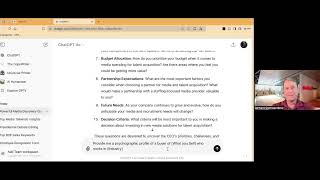
Anthony Iannarino walks through AI prompts salespeople can use to save time on discovery questions, buyer profiles, outreach emails, and contract review. He shows how to generate industry insights with citations, build a prompt library, and always humanize the output before sending it to clients.
Chapters
Foreign.
Okay, so let's talk about what we need to do. So if you are a salesperson, if you're a sales manager or you're a sales leader, you should be using AI. Now, I don't care what, which brand you want. So maybe GPT. I like that one. I think Gerhard likes that. I like Gemini and I also like Claude quite a bit because it gives you a lot of room to actually ask a question or put a very large prompt in, and then you can do a lot of work with that. So what I thought I would do here is I'm going to share Chat GPT for me, because that's the one that's easiest for me to do. And I'm going to show you how to get some time back in your day so that you have more time to talk to people, because that's what we're really doing. No matter what we're doing here on Chat GPT, it is not a buyer. It is not going to buy what you're selling. So what we need to do is get our time back so we can spend time with the people that we need to spend time with. Okay, so I'm going to show you my first prompt. Give me an industry media. So now you can see the prompt that I have here, which is pre. Please provide me with 15 tailwinds in media. So now when I hit this, what's going to happen is it's going to take this very large prompt and it's going to do my research on AI in media. So you're seeing, number one, that's the one of the 15th. And then what you're seeing here is the statistics and the source. So I want to make sure the source is there, because if I use this with a client, I want them to think that this is credible and that they could go out and find.
This on their own.
And then what I asked it to do is to give me examples of where this has been used with a real example. So Netflix uses AI to personalize recommendations, significantly increasing viewer engagement. And that's what Netflix wants. And the same thing with Spotify. The second thing, I'll just show you a couple of these.
These are the tailwinds.
So these are the things that are.
Going to be helpful for you in creating an opportunity.
The second one is mergers and acquisitions.
And you can see that here M and A in the energy sector alone surpassed $100 billion in 2023. The merger arbitrage yields have exceeded 10% for the average North American merger deal in 2024. And again, I've got the source.
So I'm showing you these because if.
You took this and you said, I want to understand media because I've got a client say it is Spotify. If I do this work and I study these things and I decide that there's maybe five of these citations that are worth sharing and five insights that are worth sharing. I've done this now in this much fine. I mean, it's so easy. I have a text expander, so I only have to put in four.
Letters.
And I get this whole thing. So this was tailwinds. I like tailwinds because I think most of the time we're always worried about the client's problems. But you want the problems and you want the opportunity. So let me show you what it looks like when we do this another way.
Do you want to stick with media or you want to change?
That's fine.
Media. Okay, we'll stay with it.
Okay, same thing. Except for this time, the negative part of this thing. Okay, so here we go. These are the headwinds.
Rising media costs.
Here's the examples. Bud Light, Face to black. Black backlist from a purpose driven marketing campaign. I remember that one. That didn't work very well for them. PNG adjusted its ad spend strategy due to increasing media costs during peak event seasons. So you can see this. And then I've got a source on every one of these. I'll pull this up, up. So this one I can't use because there's no citation. So that means I have to do something different. I will never use one of these that is not cited.
Yeah. So you always want to verify the source, even if the source is given. And that's something that I found. Like do research on something and say cite the research and give me the link to the research. And then it goes to a 404 page.
Okay. Now we'll get into a couple other things. So let's go to.
A prompt that I call disco.
CEO is the person in the industry will be.
Technology.
Yeah.
Is buying. What are they buying? Let's say media. Put that there.
Yeah.
This is a pretty simple.
Prompt.
Okay, here we go.
This is a very important.
Prompt that you should have and that you should work with. So this is 10.
Discovery questions that you could ask. How does your company currently leverage media to support your overall business strategy and growth objectives? Did you like that one?
Absolutely.
Yeah. What are the biggest challenges you're facing in attracting the right talent through your current media and branding efforts? I like this one a lot. What key performance indicators do you use to measure the success of your media and advertising efforts in attracting top talent? Now, this is the first five of these. You would decide which of these that are going to be most important to your client or that you believe will be most important to them, especially if you've had a, an early meeting with them. I like these future needs. As your company continues to grow and evolve, how do you anticipate your media and recruitment needs will change? All of these are really good questions. So if you're one of these people that really wants to prepare for a meeting, all you have to do is ask it to give you 10 powerful questions to ask your client. What I did on my prompt is I ask it to give me the title of the person in the industry. Because if you give more context to GPT or any of the AIs, it turns out that you'll get a better response. So this is another way that you can get your time back. If you have.
A meeting coming up, very easy to just do this. Pick the 3 or 4 or take the whole list with you. But I would probably try to pick three to four very powerful ones that I think will work because that's the best way for you to do something like that is just choose what you want to do.
I think it's great because you're bringing the meat and potatoes that clients need in order to make a decision. And you have enriched conversations because you armed yourself with.
With. With a net that captures intelligence.
Yes.
Easy, right?
Yep.
Very, very, very easy to do this. Okay, so the next one that I'm working on you should see at the bottom here. It's a. Provide me a psychographic profile of a buyer of.
What do we sell?
CRM software.
CNC software.
CRM. Cr.
Oh, CRM.
CRM Software.
And what's the industry manufacturing.
It will figure that out anyway, right? Okay, so here we go.
Job titles. Likely roles include sales manager, marketing manager, customer service manager, responsibilities, overseeing sales process, customer relationship, core motivations. Most will be in efficiency and automation, customer experience, data driven decision making, integration and collaboration. Pain points. Everybody wants the pain points, don't they?
Right.
They want to know what I should ask about this. So complex sales processes, fragmented data. That's not good. Adoption and usability. I don't know why people don't like the cra. I don't know why that. I think it's the best thing that we ever had. I can't remember everything that I had in a meeting, but if I put it in the CRM it's there. Although I will say a couple other things about the CRM. You should make it strategic. Like if you took a client from a competitor, then you would want to put that in a way that somebody can say, how did we displace them? And it's going to. They had this problem. This group can't get it solved for them. Now I'm going to go after every single one of those people. So I want to make you a pitch here because Gerhard started it here. He started it with the CRM. I think it's one of the best things that you can do is make sure that your memory is not up here by itself. If you put it in a CRM, you're in great, great shape. Attitudes and beliefs. Value driven. Quality over cost. Sometimes. Right. Sometimes it's cost over quality. Customer centric. And then buyer behaviors. Research oriented. I think everybody's that way now because even though we go out and do research on our clients, they go and do the research on us. So we know that we have to make sure that we're doing all the things that we need to do to give them what they need as they go out and look in our websites and personal traits. Analytical technology, technologically savvy, risk averse, but progressive and results oriented. That's what you would expect, right.
So if you want to give your time back, what you would do is go do something like this and then you can read this and you can say, what kind of questions might I ask that person? Or you might ask Chat PT to say, what kind of questions should I ask this person? This buyer's profile? And it will do that for you perfectly if you ask it to do that.
So far, pretty good, huh?
It is. It's very impressive that you not only have a playbook for your substantive conversation, but also you have a personal playbook on how to deal with the psychographics of the customer.
Yeah, I think that's really helpful and I think this one might work. Provide me an approach for a buyer who is buying.
Stick with CRM.
Right.
Who works in health care.
Yeah. Different industry. Yeah.
Okay. So I'm asked to give me an approach to this particular person.
So identify the specific role of the buyer, such as chief information officer. And then it gets a little bit more granular as we go here. Align your conversation to address the primary objectives such as enhancing patient engagement, optimizing appointment management, reducing NO shows, improving communication between departments, and things like hipaa. If you didn't know anything about.
Medical or health care, this will give you A way to have a better conversation going into this. So if you are paying attention to what I'm showing with you. I started with the industries with headwinds and tailwinds, and then I started working into the conversations that we're going to have and how to approach the clients that I'm trying to acquire. This is one way to get your time back. And if you have a robot that can do this for you and you build a set of prompts, I would tell you build a set of them, not just one. And don't, don't do what a lot of people do. They write a prompt. For one thing, if you're going to write a prompt, what you want to do is write a really good prompt. And if you get in trouble and you can't get the prompt to work for you, what you do is you ask the prompt to make you a better prompt. Say, how do I improve this prompt? And, and let it do that for you. I've got a couple of these that I was unable to get the result, but I asked the prompt to make its own prompt. And it turns out that it's very good at that. It, it will tell you what you need to put there. And it's a very easy way to do this thing.
Now if I were to take something like this, what it just gave me right here.
And I type this edit and then I paste in what we. We've got there and I hit this.
Now this is going to edit whatever I put in front of it. So if you are writing a letter to a client or you're making a pitch and you want to make sure that. Have you ever had this happen, Gerhard, where you put a slide deck up and it has the wrong company's name on it because you forgot to do that. If you would edit it with something like this and say, make sure that it says selling power. And instead of what was there before, it will go through and find every place where it needs to say selling power instead of some other word. I'm always.
Very unhappy when there's the company's wrong or there's an edit that I missed or something like that. The robot is way better at this than we are. So if we let it do that work, it turns out to be very, very helpful for us. And I'm not a good typist, so I, I have a lot of errors that show up because of my poor typing.
Well, the truth is that my first year in high school, they took me to typing class and about the third day, there they said you can just go to study hall because you're never going to be able to type.
That is true.
So can you go back with. To the headwinds and, and grab that information? Do you have that, do you still have that information?
Yeah, yeah.
You want the headwinds?
Yeah, just the headwinds.
And.
And I believe that was the, the media industry.
I got me media tailwinds. And then maybe this is it. Yeah.
So, okay, so can you, can you take this.
Cut and paste that?
Let's take the approach to the CM buyer. Okay.
Which one?
You want the, the. The C. And you know, scroll up.
The healthcare CRM.
Right, the healthcare CRM.
Okay.
Detect that entire paragraph.
Yeah.
And.
And put it back and say, can you craft an email to get a meeting.
With.
The buyer in my industry? And here's the description.
In what industry?
In the healthcare industry.
And.
That will result in a meeting.
Right. And. And give him all the.
You know, the information that you already.
Got from ChatGPT.
Oh, that's cool. Yeah.
If you had to write that, how long do you think it would take you?
Probably an hour.
Yeah.
Right.
And you, you might not keep this the way that it is. It's got things in brackets and stuff like that. You should always edit your robot, your robots. Good, good. It's a good editor. But you want to make sure it sounds like a human wrote this. If it sounds like a robot wrote this, people will know. In fact, one of the stories that Jeb told in this book is he was sitting at dinner with a guy and he got a. An email from somebody that was doing a. A.
They were doing some sort of an ad or something that he had to look at. And as soon as Jeb read it, he said, a robot wrote that. He said, the client said, no, they wouldn't do that. And he called and they said, did you just have a robot do that? And they said, yeah, we did. It's cool, huh? He's like, no, it's terrible. It feels like a robot wrote it and not a human being. So one of the things that we have to do if we're going to do something like this is make sure that we feel like this is human and that you care about it. I'm very concerned over a technology I have been for a long time, because I think it's too transactional. And I think what we should really be focusing on is building relationships and building the business for the client. I think that's what we should be doing. So I wouldn't want to do Anything that would cause somebody to think, oh, you're just trying to use CHAT GPT to do this stuff because you're too lazy or you're not smart enough to write a good letter like this or something like that. I think it's important that we try to be as human as we can in a world where everything is.
Still very, very much.
Transactional. Okay, I have, I want to comment.
On that because it brings to mind that the ChatGPT tools, whether it's Cloud or you know, whatever AI you're using.
That tool is like a wild horse that you need to tame it, you need to train it and you need to teach it to deliver the information that you need. So.
You, you AI has all the information somewhere hidden and it's your challenge to tease out the best so you can be the best.
I think that's right. I got a couple, just a couple more. Is that okay?
Yeah.
I'm just going to expand these so you can see them and I got a couple legal prompts. I'm just going to show you what the prompt looks like so you can see.
How you might do this. I get a lot of contracts. I've got three businesses and so I get a bunch of contracts. And before I ever do any reading on that, the first thing that I do is I start with a prompt that says you are a world class contract lawyer who is conserved conservative about signing contracts. What risks should I be concerned about in this contract and why? And then when I have a contract in here, it will say these are the things that you should be concerned about. Then I can go look at this. And if I say, oh well, their, their payment terms are 120 days, that isn't going to work. They have an indemnification clause that is not reciprocal. So I'm going to have a problem with that. And I can go through that. And then if there's anything that's a, a deal stopper, then it's a deal stopper. And then I don't have to spend. I'll tell you today, the one that I got 80 pages. 80 pages. Do you want to read that? I don't want to read that, no. So I will use a prompt to say find all the things that I told you I don't like about a contract and it will give me that. And then I have a second one. I don't, I won't have to put it up here. But I will tell you how I do this. I have a prompt that changes the clause from not being Reciprocal to being fair and reciprocal. If you're telling me I have to indemnify you, you indemnify me. And I just have a prompt to do that. So those are the things that I do. And I'll just maybe show you one other thing before we get done here. I'm just going to show you the prompt if anybody needs help with this. This book is full of prompts like you. You will get a maybe 200. I'm thinking something like that.
And then I have some edit prompts and I've got people that I. I'm. I'm using. So Dryer is a guy from Random House. He's a great editor. And I have a. A dryer. I'll just drop it here and then.
Nope, I lost my mouse. Sorry. So. Nope, I got it. I think I got it.
Yeah. You are the editor, Benjamin Dreyer. If you haven't done this before, this is how you should do this. You should tell the chat GPT who it is. It's the copy chief at Random House. And you've decided to help a salesperson improve their writing. You will invite. You will edit the text for spelling errors, missing words, grammar, syntax problems, and tone. You will only make changes to the text only when there is a problem. And I have maybe 10 of these with different people. So I've got different editors because I read a lot of books and I know who the editors are. And like, Gottlieb's really good, cleans things up. There's a whole bunch of things like this. Okay, so any questions before we adjourn?
No, we. We still have some time.
How much time do we have?
We have four minutes.
Four minutes. Yeah.
I. I like this. You know, specifically mention an editor and then have your email written in a way that it looks totally professional. It doesn't sound like, you know, AI wrote it.
Before. Now let's talk about the sales manager. How do sales managers use AI effectively.
To, let's say, coach a salesperson?
I. I think I don't have a prompt for that, but I've done that one. I don't tend to do that when often because I have my own structure for coaching. I would say I have a salesperson on my team. He has a lot of potential, but he's not accountable for his work. What kind of conversation would I have with this person to help them understand that they need to be accountable and that will help them reach their goals. And not just their goals here, but the goals for bringing income home to their family? And I. I Think if we did a prompt like that, it would give you a, a number of, of strategies. Because it doesn't run out of strategies, it just doesn't run out of things to say. I will say one other thing about this. A lot of times we ask.
Chat GPT to do something for us, but there's a better way to do this is to say what am I not seeing? Or what am I missing right here? What else would be helpful? I ask that all the time. Like I, I made a list of 10 things and I thought two of these don't work. I asked, gives me six more and I can decide what I want to do. So you can ask it to tell you what you're supposed to know rather than asking the, the GPT or whatever AI to give you the answer.
Yeah, that's interesting. So ChatGPT can help you not only source material, write material, but also refine the material that you have harvested in a certain style that fits the demographic. So you, you have a, like four dimensional way to craft messages that are super targeted and that hit, get, get straight to the person's heart.
Yeah. And I, I have, I have this thing called text expander and if you haven't used a text expander, it's really nice. So on any of these things it's more like a dot and then three or four letters and it will launch the prompt. I think if you would build out what you do daily using GPT, it's very easy to do this and then it's very easy for you to get your time back. And that's what this book is about. Thank you Chief for letting me put this here and you're always helping me with books. I appreciate that and I hope this was helpful for people.
Yeah. I love the way you use AI not just to improve your productivity, but also to expand your creativity. And that's what AI is designed to do. And I hope that a lot of you that are out there listening to this.
Take notice of this. We are recording this so you can actually review this session with Anthony. And when you buy Anthony's book, you get a few hundred prompts. What's not to like about that?
There's a lot of prompts in there.
More from Gerhard



What Selling Looks Like When Your AI Agents Have the Context Your Sellers Do

Better Conversations, Smarter Support: Wearable AI in Business






When Scarcity-Built Systems Meet Abundance - The Judgment Gap in AI-Powered Sales Leadership
