AI Flywheel: Building the Self-Propelling Sales Engine
A sales leader walks through AI adoption from basic assistants to fully autonomous agents, with a BDR case study that boosted response rates from 15% to over 50%. Includes a checklist for running quick experiments and the foundational questions you need answered first.
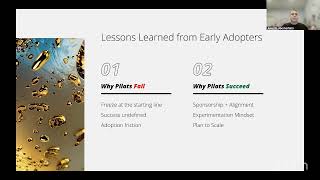
Thank you for having me on. It's such a pleasure always to to be with you and to this audience. I've been part of this community now for a few years and have really enjoyed the relationships I've built. And above all, and I'll say this now at the end of three amazing days, what a great community this is. And I'm such a I feel very privileged to be a part of it. I will not claim to have the best presentation, but I promise to do my best to share how everybody can get value from this. And as I was thinking about all of the learnings over the last couple of days, I walk away with a lot of things to think about. But I think one of the things that we can do here is talk about where to get started, what to do now, what do I do on Monday with a vision of what's it going to look like a year from now? I think that's the idea. Today I'd like to share some practical things about where to start small, but also a vision of what this might look like a year or two down the road. So you kind of know where you're heading. Last year, for those of you might have joined, you may have seen this slide, but I'm going to cover it again. We have this perspective that AI is either going to lead or co lead the sales process or it will co sell with your seller across the sales process end to end. And where you have very large customers and complex offerings, it's more likely to be a co seller. You're going to need humans talking to customers and dealing with ambiguity, judgment, risk complexity where you have simpler offerings and simpler customers. Self service already reigns and AI is just going to be another channel for customers to engage in that sales process end to end. And what we want to talk about today is what we've seen over the last year and what we see coming over the next year in terms of how this is coming to life. And one way you might think about it, here on the left you'll see you've got kind of three swim lanes. You've got customers who've got a buying process. You know they're trying to discover and evaluate and buy and then get value from the products that they purchase from you. You've got sales executives who have many steps in that process and occasionally those steps include engaging with that customer. But often it is administrative activities or even value added activities like research and planning and prep and coaching necessary to deliver value to that customer. And where we've seen success is and I'm sure many of you are here, which is launching some version of an AI assistant, whether that's using something from ChatGPT Enterprise as an example, using Copilot, using Einstein, Agent Force with Salesforce, some aspect of an assistant that will help that seller through that process. And we're trying to help reduce administrative effort at CRM. So we might be automating tasks, we're trying to provide insights to seller and we'll talk about a success a client has had. We're trying to automate tasks. But I think there's an opportunity with agents and agentic workflows to really rethink this. And we're starting to see enterprises do this across the enterprise and now with the sales function and this image tries to bring that to life. And a couple things have changed. One is you've got multiple AI agents at the bottom and some of those are autonomous and work on their own within guardrails that we set up. And some of those are assistants that would help you like we've just described. But what's different is now the AI, the agent is orchestrating your sales process. It is taking you from what's our account plan or which prospect should, you know, has the right signals to, to orchestrating the steps of that sales process end to end. And what it does now is it frees up that sales executive to really focus on those moments that matter with that customer and, and spend more time building relationships, more time on, you know, building alignment within buying centers, more time talking to customers about value, more time helping them drive value, post the sales process to drive, cross sell and upsell up opportunities. And the agents need different set of skills in order to do this well. So if agents are driving an end to end selling promotion, you're now using a variety of AI capabilities and we've just talked about that today even there are a range of capabilities that you can use. Descriptive analytics have not gone away. Machine learning is still valuable with determining which prospect to call next. Generative AI and generating content obviously is there and then agentic workflows which is allowing an AI to actually reason and play the role of a worker. And we'll get into that more. It's taking actions with humans in the loop or humans are really required. So let's think about what you ought to get out of this. Let's start with the value and what's at stake. Ultimately there's three things we're trying to do. We're trying to drive revenue growth. How do we increase our funnel? How do we Drive more conversion. How do we improve our cross sell and upsell attach? How do we decrease our ramp time so that how do we increase our customer facing time? We're trying to drive growth. Number two, we're trying to be more efficient. How do we drive EBITDA growth? So that can come in the form of better deal pricing. It could be the right bundles that are being proposed to the customer, but it could also be decreased acquisition costs, reduce cost for all kinds of selling activities while improving the effectiveness of your sellers with those customers. And three, it's really enabling new and different customer experiences. We can do new things with customers that we couldn't do before. When we think about what an autonomous agent can do with voice or with text, bundled with other channels that you already have, we can tailor the engagement with customer to micro segments or accounts or specific opportunities in ways we never could have before because it took way too much effort to do that. We can reduce the time to value for the first use case for customers in ways that we couldn't have done before. So it's an opportunity to rethink about your value proposition to the customer and the experience that you deliver. Not only what you used to do, but what is possible now that wasn't before. So I thought we ought to spend a little bit of time thinking about the lessons learned from early adopters over the last year. And we've seen lots of pilots at large companies and some have failed and some have succeeded. And there's really some trends that we're seeing. One is pilots fail when we start to freeze at the starting line. In other words, which technology should I use? How is this going to create value? The ambiguity of the situation or expecting too much from it stalls the pilot before it starts. We definitely see that to success being undefined. So we pick some tools, we deploy them out to sellers and we say hey, you have a co pilot you can talk to now. You have an agent force agent you can use to talk to. You can talk in Slack to your agent and update your CRM. We're giving you emails that are pre filled out that you can send a customer. We're throwing lots of features at sellers but we haven't defined really how they're going to use it. And we haven't certainly defined the metrics, baseline or target that are going to give us the gates to then scale. And three related to that is the adoption friction. So when we do that and we haven't really rethought the role of the seller and how they use these Tools, the human behavior doesn't change easily. It takes a lot of effort and it's going to take time before sellers go from never using AI to being experts with it. And we consistently see organizations underestimate the adoption that's required. So more hands on training, more office hours, more learning from those that are doing it well to those that are slower to adopt is required to get these adopted. And when we see it succeed, we're seeing sponsorship and alignment. So executive sponsorship that we are going to go try this alignment between IT and business on the tools that we're going to use. We see an experimentation, mindset. Let's try it, let's measure the baseline, let's measure the results, let's do AB testing, let's see the results of people that are using the tools and not using the tools. Let's understand what's working and not, and then a plan to scale what is the foundation. So we need to, we can try without making hard decisions on technology, but over time we need to think about where our data is going to live. We need to think about what our AI orchestration is going to be. We need to think about which LLMs we might use for which use cases. And we need to think about the interaction layer. How does the user interact with the AI? Because if we throw too many tools at them, we know what happens. They won't use any of them. So where do you start and how do you get to this idea of AI orchestrating your sales process? There's sort of three stages here, but there's a path that we're starting to see. And it starts with AI being an assistant. Right. It's a support tool that is helping your seller to improve how they interact with customers or to augment their ability to do administrative tasks faster. Then we start to move to semi autonomous agents where you have agents that can perform actions, they can reason they can perform actions, but humans are in the loop before those actions are taken more often than not. So they can take actions independently within a certain set of guardrails. But more often than not, you have humans in the loop. An example would be we generate draft emails and certain emails for certain customers. We might send other kinds of emails for other kinds of customers are going to go to the human before they send. And then we start to move to fully autonomous. And this is where you have an agent or even many agents that start to work together. These are AI agents that can reason, that can take actions, that can function autonomously and that can decide where we need to have humans in the loop because we are defining what they're allowed to do and what they're not allowed to do. And it's, it's really valuable to think about this as a maturity curve and understand where you are. Most of our clients are somewhere between one and two here, somewhere between having deployed AI assistance, starting to use semi autonomous agents and then thinking about how they're going to scale an agentic enterprise down the road. So if we think about where to start, like maybe you've spent three days here and you're bought in that. Okay, I've got to get going. Where do I start? What I would say is start with AI as an assistant and there's, there's lots of value to be created here and it's easy to deploy. So this is using your zoom to, to transcribe your meeting minutes, it's integrating that with your CRM and allowing agentforce to identify actions and to create tasks. It is really the basics. It's allowing activity capture and salesforce to create records or augment and update records. It's integrating your zoom info or other data provider to better understand your customers so that your agent force can recommend the right prospect to go after this. Lots of easy to deploy integrations because these are all really connectors that are out of the box. You take your subscriptions that many of you already have and you just connect them together and allow easy to deploy solutions. The second thing here that's really important is teaching your sellers how to prompt. Teaching them what they should be doing in the sales process across each of these steps by thinking about what they're trying to accomplish. If I want to understand my customer better, I can provide a daily news brief, I can provide signals. I also need to teach my agent, my human, how to talk to my assistant, what prompts to ask given the situations they're in and how they can use that. There are some hands on training required here to get people to prompt better. But if you're not doing these things here, I would suggest starting here, updating your CRM, connecting it with your data providers, connecting your calendar, your teams or slack your trans your transcripts of your calls into your CRM and teaching your reps how to leverage the assistant that you give them to query that information and use it in a sales process. There's a ton of value to be created just by doing that. And then, then you start to think about agents and I want to just anchor on like what do we mean by an agent? AI agents are digital workers. You should think of them as employees. They are digital workers that are now part of your sales organization. And if you deploy a new type of sales role today, you would have to think about the roles and responsibilities of that person. You would have to think about how to train and onboard them. You would have to think about what data they need to be successful. And you would have to think about how do they work with others. And that's no different. When you start to deploy AI agents in your organization, you have to redesign the workflows and really think about the jobs of your existing roles and how they're going to work with these new roles that you might have. Because the role of a direct sales account executive changes when you have a seller that's engaging customers directly or when they have an assistant that is building the account plan that you don't no longer have to do as an account executive. There's really a couple ways that we think about this on the right if you look at that image, one is that you've got autonomous AI sellers that can engage with customers directly. And the one that we see most often is some kind of inbound voice or text agent that is interacting so you can go to somebody's website, interact with a text agent. We're also seeing voice where you call and you're talking to an inbound voice agent or video agent outbound. We're starting to see some of that, but it's a lot less. But certainly these are opportunities for digital sellers to interact directly with customers. And voice technology has gotten to a point where this is viable. Now, number two is AI as an assistant, either supporting your sales rep, supporting your channel partner, who you should think about as your as your sales organization, or an assistant that is helping your sales and partner ops teams or your enablement teams. So the type of agent, the degree of autonomy you want it to have, and the role that it has is what's fundamental to designing these agents and making them productive in your organization. So what are some examples? The one that everyone starts with is a BDR agent, you know, prioritizing and scoring leads, collecting customer insights, generating emails, and even doing autonomous outreach to customers. Pre qualifying leads. In some cases, that has been the one that we've seen the most value from. And I'll show you a quick case study here shortly. AE agents, you know, generating product recommendations, generating pitch content, automating CRM activities, helping with the quoting process by particularly large companies that have complex products and bundles. Helping sales reps do that based on the information we know about customers and what we're hearing from customers on calls, we're starting to see lots of assistive agents helping sellers for enterprise sales. And then you can see the other ones here. Customer success agent. How do we do the manage the post sale process, particularly automating the renewals process, but also thinking about where we have accounts at risk and what we can do to solve them and then on the right agents that can help your sales ops teams, your partner ops teams, your enablement teams around coaching and enablement broadly. So I wanted to make sure I got to the case study. This was an organization that was looking at their BDRs and you can see the responsibilities there. They were new business and lead generation. They were customer outreach, relationship building, initial relationship building, qualifying if a potential customer is a good fit and then handing it off to a sales executive. We've helped them build an AI agent that started as an assistive agent and now has moved into more of a semi autonomous agent where it interacts directly with customers and it first enriches the data. It collects all their internal data as well as zoom info data to understand the prospect better. Two, it generates product recommendations that are specific to that customer, like which product does this company should pitch to this customer and why and what would the value proposition be a quantified value proposition be based on that it will score and prioritize prospects for reach out. It will draft emails and then the agent will also make a recommendation based on the market segment, the size of the customer. Do we have existing relationships? Should this go through a human or should I reach out directly? And what they immediately saw even as a semi autonomous agent, was a drop in the amount of time that their SDRs and VDRs were spending on administrative tasks, including value added tasks like research. They were doing much less of that. But incredibly they saw a massive response in improvement. And so for their pilot population they went from a 15% response rate, which was already on the higher end, to to 50 plus percent response rate. And what really drove that was a they were now calling on four or five people of the buying center at the customer using the data they got from Zoom Info. So they were identifying who to contact much more programmatically. And then maybe the BDRs were doing before so calling on the right people. And then two, they were providing a quantified value proposition back to those customers in the initial outreach and to say, you know, we can save you X dollars and we've done that for our customer. And being precise because you understand who this customer is and the market that they're in drove a significant value for them. So this is something humans could have done. But it's very hard to get a large BDR or SDR organization to do this consistently. It's much easier when you have an AI agent helping those BDRs or SDRs. And we're starting to see this now deployed at scale at this organization. So maybe I'll just. Right over, we're going to wrap here. So maybe I'll, I'll leave you with how you might think about what to do next. At the end of the day there's kind of two, two vectors to look at this. One is how can we rapidly experiment and we are big proponents of this with our clients. Test to try, pick small AI use cases. Build agents that do a small set of tasks. Identify either new opportunities or things that humans are doing today that are not value added, that AI can do and try it. Deploy it with the tools that you have or that are easy to deploy and see what challenges you run into. Because you're going to identify where you have data problems, where you have adoption problems, where you have culture problems, where you have technology issues that you wouldn't otherwise. It's really important to experiment. And then two, you need to start to think about the foundation. How are we going to manage data? How are we going to orchestrate agents? Where will sellers interact with my AI? What is the interaction? Do they sit in CRM? Should they be in Slack? Should they be in in gong? Should they be in many tools? Because I've also bought, you know, five other tools. How do we manage that? Interaction layer becomes very important. So sort of short term, long term thinking. And lastly, where do you start? If you spent the three days here, you're bought in, you're ready to go on AI. My recommendation is pick a motion, pick a Persona and pick a process to improve. It could be the BDR process, it could be your AES. Think about where you have the most value to go gain. Define the owners and stakeholders in your organization because adoption is really important. Baseline your KPIs. I can't say this enough. So many AI pilots are being deployed and there's no defined success criteria because they never baselined the KPIs. We don't know where we were, we don't know where we're headed. When you define the success criteria, think about a B testing or use the degree of adoption so those reps that have adopted versus those that haven't and see what the difference is on engagement with those accounts. Listen to the phone Calls if you have transcripts and see how they're different. Select your technology to pilot. If you're a salesforce customer agent force is quite easy to deploy. You might have chatgpt that you've deployed to your to your enterprise. But select technology to pilot. While you think about the foundation in terms of your data and how you're going to orchestrate agents and then build your pilot population. We're going to pilot with how are you going to enable them? But in the next 30 days, aim to get some kind of pilot out if you haven't already. And gear hard with that. I think at the end of the three days, that's what I would leave everyone with. It was like, this is the time to get started if you haven't already.
That was awesome. You really laid out a blueprint for any sales leader to embrace AI, to take the next steps cautiously and judiciously. And you showed with the case study that the outcome can be spectacular. I have a quick question. You know, you work for Deloitte, you studied AI. How do your partners internally use AI to be more productive personally and professionally in the service of the client?
So we've deployed many agents. So first of all, many AI tools. But. So we use the. Everybody uses the word agent, but assistance. And I would say that when it comes to customer research, structured thinking, mining, our internal data has been one of the most valuable ones. We have lots of internal data and how we can get the most value for the internal data and structure that back out to customers. We've built agents to do that. And that's probably been the primary use case where if you think about 300,000 people in 130 countries, it's very hard to get all the insights from them. But if we can mine that and provide it back in ways that also protects the confidentiality of our customers and our clients, it can be quite valuable. And so that's been the primary use case. But every step of the process, whether it's how we use it internally or how we use it with customers, how we build content, how we identify the right content, how we research for customer conversations, there is an assistant being used. And what I would say is that human behavior change is hard. It's hard at your organizations and it's hard at Deloitte. And there's a range of adoption. Some people are early adopters and they're all in. And I tend to be one of those people. I've always been like, look, I want to tinker and gear hard. I know you are even more than me. And there's others that are, you know, you have to kind of drag them into it. And I would say it's for it's worth for my practice, when I get a question that somebody could have answered, you know, using an agent we built, I usually point them back to it, even if I know the answer because I'm trying to change the behavior.
So tell me the secrets on how do you make us slides really stand out and not feel there's a slight overload and not feel like this was done by a fifth grader.
Okay, well, thank you for saying that. I think ultimately I just try to think about what message we want to deliver and how to create as much value on the page as possible. And I'm hoping, I'm usually hoping people are taking pictures or screenshotting because it's something that they're going to want to go think about later. And if I haven't done that, at least on some slide, then I usually feel like I didn't succeed. But it starts with a lot of just thinking about the message, to be honest, and then, and then trying to design the best and easiest way to deliver that message. And after doing it for 20 years, you're already just getting used to people.
Do you have a design tool? Do you use Canva or.
We, we do have some design tools but we're pretty conservative in terms of protecting customer information so we don't use a lot of what's out there. So I'll give you an example. Gamma is a pretty good tool to build PowerPoint documents and presentations. We do not use that. I didn't get to use that here because we are quite careful about how our people take customer data and put them on cloud based platform. So we are building our own. In most of those cases we have tools to build our own slide decks and things like that. I don't think it's as good as Gamma quite yet. So we're still working on it, but we have a lot of data to protect.
Yeah, content is king. Content catches customers and content, good content leads to change. And I think you're one of the, the best presenters of at our conference when I not to be critical of other people, but a lot of people can learn from you thinking a little deeper and making sure that that page is, is sculpted and arranged in an artful and useful way so that people can grab that screenshot and build something with it. So that requires a very sort of a love for turning ideas into action and I think that distinguishes a good consultant from an average consultant, because it's not just about the advice. It's about the percentage chance of somebody taking action on what you're saying.
That's a good summary of the last three days, don't you think? Erhard? I. I hope that that's what people walk away with. Ultimately. Let's take some action.
Well, a lot of people said a great session, great advice, and we want to end with this. If anybody wants to get in touch with Abe, connect with him on LinkedIn or go to Deloitte, an amazing website with amazing content. Thank you, Abe.
Thank you. Thank you, Gerhard. And thank you, everybody.
Good weekend.
More from Gerhard



What Selling Looks Like When Your AI Agents Have the Context Your Sellers Do

Better Conversations, Smarter Support: Wearable AI in Business






When Scarcity-Built Systems Meet Abundance - The Judgment Gap in AI-Powered Sales Leadership
