AI Is for Closers: Why the Best Will Thrive and the Rest Won't Survive
Justin argues AI amplifies top salespeople instead of saving mediocre ones. He identifies two core problems: $5 jobs and human middleware, then walks through how agent-driven automation handles tactical work and integrates tools. A three-phase rollout improves inputs, outputs, and economics with measurable ROI.
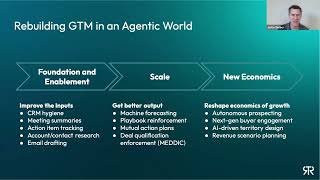
Sure. Well, you mentioned the title of the presentation is AI is for Closers. That actually was inspired by a conversation I was having with a CRO and they were talking about where they thought the greatest impact to AI was going to come. And they said, you know, at the end of the day, I feel like the people that are going to benefit the most are the people that already know how to sell. I thought that was an intriguing point and maybe a little bit counterintuitive to some of the conversations that have been having related to how AI can help everybody, even your bottom performers. And that's the topic that I wanted to explore in the presentation today. So let me go ahead and take you through, first of all, the agenda. What is some of the flawed thinking that's out there right now in terms of rep performance and rep productivity? How does AI actually impact organizations? Want to talk a little bit about a structured approach that companies can take when it comes to AI and how to implement it. And then lastly, and most importantly, does this stuff actually work and can you get a measurable roi? The answer is yes. So we want to spend the last part of the presentation talking about how companies are actually seeing value come out of their investments in AI. All right. By way of background, I've had the opportunity to work with some great companies. The CROs at these organizations, the heads of Revops. The insights that I want to share with all of you today come directly from experiences that I've had through personal conversations, through helping them to implement their AI journey. And in many cases, it's been a learning process for all of us. And so hopefully, I know we're early days. I go back to the year 2000 when we were trying to figure out the Internet. So many questions unanswered. And really, it was the community that figured things out together. We're right back in that place now. So to the extent that we can tap into the collective knowledge of what's working for people where people are struggling, that allows us to avoid some of the mistakes that other people are making and capitalize on the wins. All right, Universally, what I'm hearing today, growth is still at the top of the agenda. But if you were to go back to the late teens, early 2000s, it was all about growth at any cost. That is not the case anymore. Today, CROs are saying, I have a mandate to grow, but kind of paradoxically, I also have to cut costs while I grow and improve the bottom line. So the mission is improve both the top and the bottom line growth. So this is A little bit of flawed thinking that I want to share in order to get to that state of being able to grow while also improving margins. Inevitably, the conclusion is, well, I gotta get my sellers to sell more. How am I gonna do that? What we have been talking about over the past 20 years is grounded in this graphic right here. This is a bell curve that shows the average distribution of selling skills within an organization. And what it tells us is that our selling skills kind of peak around average. This is where we have the most reps. We got some amazing reps, but fewer. And we got some reps that are kind of struggling. And there are fewer of those as well. And so the promise that vendors have been giving the customers is, hey, if you deploy our tech, we're actually going to shift the bell curve to the right, meaning we're going to take a mediocre rep and we're going to turn them into a good rep. Good rep turns into a great rep. So what we did is we went out and we invested in a ton of technology. If you look at the sales stacks today of the average selling organization, they have exploded relative to they were back where they were back in the year 2010, 2015. Again, this mindset is if I simply give my reps more tools, that's going to make them better, it's going to shift the bell curve, everybody's going to be more productive. So, great, mission accomplished on step number one, which is deploy the technology. And now the question is, are reps actually most more successful, more productive as a result of that? Well, unfortunately, no. Average quota attainment is at an all time low. And the question is, how could that be? I mean, we're giving people all these great technologies. People are able to do things with tech that they couldn't do before. How could it be that the average quota attainment is dropping? These are actually benchmarks based on technology companies. It's a wide swath of companies large and small, also across different facets of the technique technology industry. But I think that you could see a similar trend across most industries today. So clearly this idea that if you deploy tech, it makes the reps better is flawed thinking. The reality is, and this kind of makes intuitive sense, if you have a rep that struggles, they're a poor rep. I mean, they could be driving a Hugo or Ferrari, they're still going to be a poor rep. The tools don't change the rep. And this is what gets to the heart of the topic of the presentation today, which is AI is for closers. Jim Collins has A great quote in his book, good to great people are not your most important asset. The right people are. And I would also argue it's not just about hiring salespeople that drives growth. It's about hiring the right salespeople. Jim's kind of an academic sort of guy. For those of us that are swifties. Taylor said it a lot better. Seller's gonna sell. If you know how to sell, you're gonna sell even if you've got poor tools. So the question then is, what impact does AI have in an environment where you've got a mixture of sellers, great sellers, poor sellers, sellers in between? What we're starting to realize is that AI is for closers, meaning if you take your best rep and you equip them with a set of agents, you're actually cloning them. You're expanding the capacity, the surface area that they can cover. And that's the magic. That's the secret to productivity that's unlocked through AI. It's not so much about taking a mediocre rep and turning them into a good rep. Mediocre reps are hard to manage. They're always going to struggle, man. If you could take your best reps and just increase their capacity, that's the name of the game. So let's talk a little bit about how AI solves the problem of essentially cloning your best reps, allowing them to cover more surface area. As I've talked to companies, what I've learned is that there are two major areas where AI nails it. It really addresses the inhibitors of productivity, particularly for those people that skew towards the more skilled end of the spectrum. First, problem that it solves is what I like to call the $5 job problem. We all know that in sales, there are any number of tactical activities that need to get done. These are the things that monopolize the calendar. I call them the $5 jobs. They're not needle movers, but you still got to do them. So AI is going to address that. Secondly, and this is a problem that maybe is a little less known, it's what I call the human middleware problem. The more tech you deploy to improve the productivity of the rep, the more you make the reps work as the human middleware layer to string all that technology together. And that's actually a productivity killer as well. So I'm going to drill into each of these problems a little bit, and then we'll get to how AI addresses them. All right, let's talk about the $5 job problem. You don't need to read all of this wall of words. But we went out, we did ride alongs with reps, and we just mark down all the stuff that they were doing over the course of the day. They were surprised to see the list because in many cases we take these things we do for granted. But it's things like I gotta summarize my previous call and capture action items, and I've gotta document success stories and I've gotta give my boss an update, an executive briefing. These are all things that a great rep does, but it's not taxing even, you know, one tenth of their brain. Meanwhile, when we sit down and we talk to CROs and heads of revops and we ask them, tell me, what distinguishes your best reps? Always comes down to the same thing. These people know how to build incredible relationships. Number two, they understand account strategy. How am I going to get from point A to point B? And inevitably, sales is riddled with problems. And these people are problem solvers. They think out of the box, they run through walls and they figure it out. But then when you look at how much time the reps are actually spending on the, what I call $5,000 tasks, what you realize it's only 20% of their time. So this is the irony, this is the great disconnect. What makes a rep great, they only get to do 20% of the time one day out of five. And what anybody could do, they're spending four out of five days focused on. So the first thing that agents do to flip the script is they take all these $5 tasks and they, they just get them done. I call these things on the left the sales chores. Agents are great at doing sales chores so that reps can focus on the things on the right, which, I mean, maybe 10 years from now, agents are going to be able to do that. But at least for today, your job is safe. You're still going to be able to do these things. And so you've switched from spending one day a week to four days a week doing the things on the right hand side. Now, if you can equip reps with these kinds of agents, you take your best reps and suddenly you can say, hey, you've got a book of 30 or 40 accounts. Let's give you 60 or 80 accounts. If you have a series of agents behind the scene working for you, doing all the tactical activities, you're not going to have a problem covering a larger book. And by the way, things aren't going to fall through the cracks. So that's one of the really exciting things that agents do. And I want to show you in a minute a couple of examples of how technology actually puts this principle into practice. Before I do that, though, the second thing that I want to talk about is this human middleware problem. Fans of the Simpsons will recognize this graphic. Poor Homer, stuck between a rock and a hard place. Sometimes as reps, we feel this way too. We've got multiple applications CRM on the left. We've got our email and our calendar on the right. We're bouncing back and forth between the two applications. We're cutting and pasting. We're trying to figure out what is here and what's supposed to go there. And again, this is a huge productivity killer. It shouldn't be this way. Let me give you actually a tangible example of what this looks like in real life. Engaging key stakeholders. We all know that the more stakeholders we have involved in a meeting or in a deal, the higher the likelihood is that we're going to close the deal. And yet reps, on average are pretty poor at multi threading. Why is that? Is that that they don't realize that multithreading is important? No. Is that that their bosses aren't all over them telling them that multi threading is important? No. That's because of this problem right here. If I want to multi thread into an account, here's what I got to do. I got to go to Sales Navigator and I got to research all the people. Then I got to pull them into CRM. Then I got to find their email and their phone number. Then I'm probably on the web researching who they are. Today I'm going to dump a bunch of information into chat GPT so I can write some really good email copy. And then I got to cut and paste that into LinkedIn or into email. Now, maybe if you're super fast, that doesn't take an hour, it takes at least a half an hour. And that's for one contact that you're trying to multi thread into. Now, if you're trying to get to 20 contacts, that's like half of a week. And if you've got 20 or 30 accounts that you're covering, well, suddenly it's not a mystery why people struggle so much to multi thread. This is a classic example of the human middleware problem. In an effort to make reps more productive, we threw six different applications at them and then asked them to bounce back and forth. And in an effort to make them better, we're actually taking time away from them. And that's the opposite of what we're trying to do. All right, let me give you a quick overview of a couple of agents in action and kind of what this looks like in real life. So I'll switch over to a demo here. And I lost my screen. The beauty of living in the world of zoom. All right, so this is an application. This is a deal view. One of the challenges that I think all revops and sales leaders have experienced is rolling out a sales process. Sales process is hard. You gotta configure it in CRM. You gotta pull the team out of the field in order to teach them how to use it. But the linchpin is reps actually have to go in and they have to fill in all the fields associated with the sales process. Most reps don't see value in this. If you're a good rep, you already know how to run a sales deal. Filling out fields isn't going to make you any better. It drives the executives crazy though, because they need visibility. It drives rev ops crazy because they're trying to implement a standard process. It's a broken system. So with agents coming to the rescue, that whole thing changes. A five dollar job would be, I just got off of a call and now I have to take the information that was exchanged on the call and I need to update CRM. The agent can do that much better. The listener on the call captures all the information. The agent is able to lay out all the stages in the sales process in CRM and then it's able to come in and actually propose to you what the answer to the milestones in each of the sales stages are. In this case, you're supposed to identify pain points. The agent's going to come in and say, yep, we did that. These are the pain points. All I got to do now as a rep is accept that answer and. And the system is updated. Great example of how we took a $5 job and we let an agent do it. And now rather than spending who knows how much time every week updating CRM, the rep just snaps through it like that and they get back out into the field and get deployed. So that's an example of a $5 task being eliminated. You multiply that by five or six agents and suddenly you're off to the races. Let's talk about the human middleware problem. Now. I talked about that multi threading example where you have to go through six different applications, spend 30 to minutes to an hour to get a particular job done. Agents can make this so much easier. So here's an example of a deal. I'm working with a few people to get this deal done. The first thing that an agent can do for me in the background is find out who's not in the deal that should be in the deal. The agent has access to all the deals I've closed in the past. It knows who got involved, and it's going to jump in and do some research for me, and it's going to say, okay, based on who's engaged, I can see that the CFO isn't present. I went out and found you the name of the cfo. It's Noah. And if you want to get to Noah, I can even get an email for you so that we can send them a note. And I noticed that Mary's connected to Noah. So why don't we go ahead and write an email that Mary can send to Noah? All of these things are being done by the agents rather than by the human. And it's all being done in one place. So literally, with two mouse clicks, I've reduced a process that used to take me 30 minutes to an hour to two mouse clicks and maybe 30 seconds. Another great example of how agents are eliminating the human middleware problem by working behind the scenes for you. All right, so next question. Does this stuff actually work? Is it measurable? Because we're not going to go to all this effort to deploy agents if, at the end of the day, it doesn't drop dollars to the bottom line. The answer to that is definitively yes. Well, the caveat, you're not going to see massive impact overnight by deploying these agents. It's actually a building process. So one of the things that I've been spending a lot of time with with CROs and with RevOps teams is really observing how they're deploying successfully agents and the framework that they're using to think about prioritization and what it really comes down to. There are three phases to deployment. In a successful deployment, the first phase is building the foundation, and that foundation focuses really on improving the inputs. There is massive skepticism right now on around the quality of data in CRM because most of it is entered by humans that are going to be biased or just don't have the time to do a thorough job. So using agents, we can really nail the problem of improving the inputs. In addition to that, one of the most exciting things that's happening is all the unstructured data that's being collected on calls, through email, on the calendar that can be incorporated into the system as well. And agents can be used to capture that. Once you've got really solid data, you can then focus on the outputs. So, number one, we can drive much better forecasting with machine forecasts because we have great data and we can put AI on the problem using predictive models to determine where you're going to land. Number two, Revops knows what the playbook looks like. You can use agents to reinforce in an appropriate way how to use those agents in a deal. And, and you can also use all these sales qualification methodologies like Medic or Band to determine whether or not you really know upfront what you need to know. And the agent can step in if there are gaps and help you to fill those gaps. So the first two stages really set the stage for what I think is the most exciting phase in an agentic rollout. And that's when you can completely reshape economics, meaning you can see that growth that you aspire to achieve, but you can do so with a much smaller cost basis. How do you do that? Well, you're using agents to perform a much wider swath of the sales function, autonomous prospecting that leads from identifying target accounts all the way through to helping them with discovery and exploration of the solution before the sales rep even gets involved. Another exciting development are these what if scenarios. If, if I were to deploy these products to these regions, what would happen? What if I could shorten sales cycle times for my enterprise team by 10%? What impact would that have on my business? These are things that are really driving productivity and helping us to make smart decisions about where we are placing our resources. That's the framework. The next question is like, great, I'm bought in, but do I actually build this or do I buy it? And so again, with the help of some CROs, I put this framework together. This is kind of how some of the leaders are thinking about it along six dimensions. How much resource do I have to put into maintenance? How quickly do I need results? What kind of budget do I have to throw at this? There's also a question about the, the use cases I'm trying to solve. Are these specific to my business? Are they going to take really deep internal expertise? And do I have that expertise? And lastly, how much customization do I need on the first areas? If those are important to you, you're probably going to buy. And if the last three areas are important to you, you're probably going to want to deploy this internally with yourselves. Gerhardt, I see you coming back in to, to the session. Let me give, let me wrap up with one final slide and then I'll turn it back over to you.
Okay, I got a couple of questions. Yeah, go ahead.
This is the show me the money slide. So assuming that I go through this, what kind of results are our company seen? Well, first of all, with respect to phase one, which is improving the inputs, what companies are seeing out of the gate. When you're automating tasks, when you are improving the quality of data, you're freeing up sellers and the amount of time they have to be in the field, the follow up time that they're able to achieve is increasing and the amount of complete data in CRM is improving. Then the outputs improve, win rates are going up, pipeline coverage goes up, you're starting to see movement in your forecast accuracy. And lastly, that new economics, you literally see changes in the profitability of your business. How much are you spending to acquire customers, how much revenue are reps generating and what kind of net dollar retention are you achieving? This is the destination. It's a three part journey to get there. But again, going back to the original premise, AI is for closers what you're doing. And at the end of the day, the magic here is you're able to free up your best sellers to focus on spending more time in the field. That dramatically changes the economics of your business and at the same time it improves the inputs and the outputs that you're using, the instrumentation that you're using to drive your business. And that's what gets me most excited.
You talked earlier about the the best people. Is there a tool to attract the best.
That you from a recruiting perspective or are you talking about specific tools that sellers like to use?
Well, what can a company do to attract the best people and also retain them?
Yeah, I think that's a great point actually. When people put ROI models together, one of the intangibles that they're seeing coming out of agents is lower attrition when you are interviewing a rep. And I always found this ironic, I would spend so much time trying to find that unique rep, that thought out of the box, walk through walls, did whatever it took to get the job done. And then on the first day they started, I said, now I'm going to send you to a class and teach you our process and I want to make sure you follow all the rules that we prescribe for you. The best reps are not wired like that. So if you can bring them into your organization and say we got agents to do all the sales chores for you, they're going to love that. They're going to stick around because they get to do pure selling.
I also like the, the lower attrition factor when sales people can focus on pure sales and not paperwork.
That's right. It's a huge seller selling asset. And I think more and more rep, the best reps are going to get to the point where they're going to say, hey, if you don't have the agent set up, if you expect me to do that myself, I'm out of here. I'm going to go work for a company that's got all of that taken care of.
Barry, you want to share your perspective?
I've thoroughly enjoyed this and I love.
The direction that you're putting forward.
No, sales teams do not like to do all the administrative stuff that the agents can be doing.
So that's excellent.
I notice our timeframe. We need to start wrapping up. So I'll leave that to you.
Gerhard. Where can people learn more about you? Justin.
Teret AI We've got some incredible resources up there. We've got frameworks, we've got some best practices that we've distilled from all of the different folks that we've been working with. Also, feel free to reach out to me on LinkedIn. Happy to continue the conversation there and share whatever resources and ideas that I've got.
You have the last slide with your URL on the slide.
I don't have the last slide, Gerhardt. I forgot to put that in there.
That's okay.
I'm going to have to come back to selling power 4.0. This is three in a row for me now, by the way. So I haven't gotten it right yet. Invite me back and we'll have that slide for 4.0.
T e r r e t.AI right.
T e R. It's a palindrome so everybody can remember it.
Right. And that is to the tool. Delete the horse.
Carrot is the ring on the side of a horse's bridle. The rain passes through that and that's how the jockey guides the horse to the destination. We love that metaphor because we're all on a horse going for revenue. And hopefully this is the platform that helps you to do that.
And without a terror, you can't win.
Exactly.
More from Gerhard



What Selling Looks Like When Your AI Agents Have the Context Your Sellers Do

Better Conversations, Smarter Support: Wearable AI in Business






When Scarcity-Built Systems Meet Abundance - The Judgment Gap in AI-Powered Sales Leadership
