AI-Powered Sales Mastery: Moving from Future-Ready to AI-Enabled Success
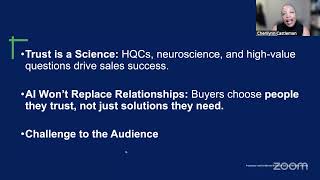
Sherilyn argues top B2B sellers need Research, Relationships, and Right Accounts, with AI integrated into each. Trust drives sales through neuroscience; AI-powered discovery emails jump from 12% to over 40% open rates. She recommends a Win Likelihood Score to prioritize accounts and practical steps like triangulating three data points and uploading 10-Ks into AI tools for audience summaries.
Questions this video answers
87% (from Salesforce's State of Sales report, as cited by speaker).
About 5%.
Open rate rose from about 12% to over 40% on the first email; the campaign's second email achieved ~20% open rate.
2019: $750,000 gross revenue; 2020 expected $300,000 but achieved ~$2.9 million after changing questions; 2022: revenue had tripled (relative to earlier baseline).
Example WLS win probability cited: 73.5%.
Chapters
Thank you, Gearhart. And you're absolutely right, Gerhardt. Last time, every single time I give an AI presentation, I go back and I read the last one. I was like, oops, that has changed. That's not the. That's not the focus. So I want to start today by talking a little bit about what I've discovered. And I. And before I used to talk about integrate, integrate, integrate. I mean, adapt. We don't want to adapt, we want to integrate. And the three things that I've been talking about over and over again are there are three behaviors that the top sales professionals in 2025 are doing. And I call it the three Rs. Just like reading, writing, arithmetic. It's the foundation. Research relationships and write accounts. But what I'm going to do today is we're going to talk about how do we integrate AI with that. So let me begin by asking you to think about the most impactful or the best relationship that you have. Business relationship. All right. So Joe and I have this incredible business relationship. And yes, we tease each other, that we adore each other, we love each other, but it is a business relationship. Stop for a second and think about the most incredible business relationship that you have. And then think what makes it different? What makes that relationship.
Different than any other one.
And if you think about it, when I think about my relationship with Joe or my relationship with Gearhart.
Words that come to mind when I do this in trainings, people think about trust, respect, honesty, fun. I mean, when Joe was coaching me, we would laugh and we would play and he would tease me. And every time I've done a podcast with Gearhart, we have a good time, we trust each other. That's what sales is about. So we're going to talk about are the three Rs today. Relationship research, as well as the right accounts. Those are the key behaviors that top performing sellers have. And I'm going to give you tips, actionable insight, things that you can do immediately to leverage or integrate AI in able to do these. So the first one has to do with what I mentioned is what does trust have to do with sales? Well, Salesforce's state of sales report tells us that 87% of almost every single salesperson, 87% of B2B buyers, expects sellers to show up as a trusted advisor. Well, I've been saying this for over a year now. I really understand what trust is and I have to thank AI for that. I've done some research and that came up and if you haven't read her book, you're not familiar with that. Check out Jane Dutton's Dr. Dutton's research. She's from the University of Michigan. And what she says for trust is there's four ways to build trust or four pathways of trust. So when I think about Gearhart and Joe, it is respect. It's a respectful engagement. We listen to each other, we are present. The second one is that we help each other. Just like I said, Joe helps me succeed, I help Gearhart succeed. We are committed to helping each other succeed. The next one is we have good intentions. There's nothing, there's nothing hidden. I know that Joe and Gearhart want me to reach my million women by 2030. That's my mission. I want both of them to be successful. And then the final one is that we have a good time at it. There's some levity, we laugh, there's creativity. And Dr. James Dutton's research talks about this. So if you want to learn more about this, this is so critical. So how do we drive high trust relationships and build loyalty with clients? Because her research shows us that leaders and sales professionals who make a high quality connection with their clients sell better. We're going to talk a little bit about why that is and how that happens. Why that is is because of the endorphins that we get. Think about the last time that you fell in love, or I even just think about how much I enjoy working with Joe. There's a, my oxytocin gets released. There's a trust hormone. When people feel valued, your dopamine is released. When there's a high value conversation, when you feel connected, I always, people say, well, how can you help me overcome objections? How do we move somebody forward? If you have a client that's not moving forward, they don't trust you. Their fear endorphins have kicked in and that's what's causing them to re to resist. If you think about the neuroscience of trust, it is when somebody's in fear, what do we do? It's fight, flight or freeze. So when you have a client that's frozen, how do we move them fast past that? And that's where AI comes in. AI can help us shift the type of questions that we ask. And this is moving from transactional to transformational questions, or what I like to call high value, high quality questions. I have a client that's in the sells insurance and she used to ask her clients questions like, tell me about the first time you discovered that you had to buy insurance. What has changed with your insurance? After coaching she went to AI and she put in her discovery questions and she asked convert these to high value or high quality connection questions. And the question that AI came up with was what is it about insurance that causes you fear? That is the first question she has started asking. Every one of her inbound calls, her sales has shot through the roof because she starts with a high.
Quality connection question. What is it about insurance that you fear?
So we a lot of times will ask our clients, what challenges are you facing? What about what's one challenge, if solved would change everything in your business? You see the deeper question, here's another one my favorite Peter Drucker always asks what, what question if answered would make the biggest impact? Well, instead, what's one insight you're not getting from AI and how would that help you make decisions better? Questions elicit emotion, emotions connect us with our endorphins and endorphins anchors us and connects us to a salesperson. And that's where the trust happens. So here's my challenge for you is how can you take your discovery questions and make them more high impact? Here's a list of high impact questions that I got from using an AI tool. One of my colleagues, who's also a coach, a career and sales coach. Her very first question that she asked people is when was the last time you cried about your career? Or when was the last time you wanted to cry about something in your career? Now think for a second. Can you see how quickly you connect with a coach if they ask you that.
You know, when was the last time you felt truly valued or seen?
What is it that, that people often misunderstand about you? And I know you may be sitting here saying, I don't know if I can ask my question. My, my clients, these questions or prospects these questions. It's not. My challenge is not for you to ask these questions. My challenge is for you to take the question or your normal discovery questions and ask AI to make them high quality connection questions you can even put in the prompt I use is Dr. Jane Dutton has done research called H QC High Quality Connection. Rewrite these so that these questions are high value and high connection and I promise you it will make all the difference in the world. I have another client who works in the auto space. She collects data and she gets dealerships to give data. And she used to have about a 42%.
She used to have about a 12% open rate. She moved to high quality connection questions in her first email and moved to over a 40% open rate during, during a Drip campaign. Her second email had a 20% open rate. She's just blowing everybody else in the team out of the water. So that's, that's just an example. This is an actual case study. Now, he didn't use AI, but he did hire somebody to help rewrite his questions. And so in 2019, he did $750,000 worth of revenue. This is gross revenue. In 2020, with the pandemic, they expected to do 300,000. He did one thing with his sales team. He had them start asking high quality connection questions. That year, they did almost $3 million, 2.9 million. In 2022, they had tripled their revenue, and that was the only thing they changed. So if my examples don't. This example should challenge you. So it won't. AI won't replace relationships. Remember, trust is a science. It's about neuroscience. It's about driving sales success. So here's my challenge to you. Because as I've said repeatedly, one of my mentors, Bill Green, the former CEO of Accenture, said to me, Cheryl Lynn, when you criticize people, you raise their defensiveness. But if you challenge people, you raise their game. So my challenge for you is take one of your discovery questions, put it in a, I have it, rewrite it, and ask it to make it a high quality, high value connection question, or make it a high quality connection question and try that with your clients and let me know what happens. All right, the next one is write accounts. We've talked about research. The next thing we're going to talk about now is write accounts. And I have done segmenting with my clients, and a lot of times we talk about generative AI. And generative AI helps us do exactly what we do. Generate better emails, generate better questions. There's this whole model right now called hyper personalization, which clients expected. When I, when I first started talking about AI, we were talking about hyper personalization. I believe we're beyond that. Everybody is. Every email I get is hyper personalized. They know where I've spoken. I'm going to get emails after this conference, and somebody's AI tool is going to have listened and watched my presentation, and I'm going to get the perfect email. That's not what it's about. That hyper personalization is happening every day. Open my email, I'm getting phone calls from people hyper personalized. They sound like they're my best friend when they call me. That's what, that's what people are doing. But how do we use AI for predictive and to help us Do a better job. I talked that I talked to last time I was here. We Talked about using AI every morning for 15 minutes to improve your efficiency and your effectiveness. Today I'm telling my clients you should be using AI every 15 minutes, every hour, all day long, every hour. You should check in what, how can I make this more effective? How can I, how can I get this better? What task can I take off my plate? It is, I am moving from once a day for 15 minutes to once an hour. Us. If you and your team are not using AI every single hour, that's where you need to be. When I'm coaching with my clients, the first thing every one of my clients do is they open their AI tool. We use AI every day during the coaching and we use both the predictive as well as.
As well as generative. So here's a generative AI tool that I encourage and I help my clients use to help them get to the right accounts. And this is a WLS when likelihood score. And so why is this important? Because the most successful sellers are working on the right accounts with the right message to the right people. So you've written great messages, you've got amazing questions. You know how to build relationships, you know how to build the, the right connections, you can talk to the right accounts and this is how you do it. So you don't want your team wasting their time on low probability deals. You want them prioritize on shortening the sales cycle and making and increasing the deal size. And here's how you do it. This is a predictive model that will leverage historical data, engagement signals and help you build your pipeline. And what you want to do is you want to look at what criteria you have. It can be how important, how closely does this lead fit the product that you are selling? What is your engagement like been like? Have they been opening your emails? Are they engaged on LinkedIn? Are they responding on LinkedIn? And the great thing I like about this is that if you have a CRM, if you have, and it doesn't matter which CRM, if you have a CRM and you're leveraging it, this data is in there, you can pull it even if you don't. You can do this with, if you have small accounts, you can do this without a CRM, just do it with a spreadsheet. You can just say they're highly engaged, they're moderately engaged, they are not engaged, they are a good fit, they're not a good set. That what is the white space? What is the deal size? What is the potential? And give it a score. And, and then how involved are your decision makers? One of the things that we've discovered that AI has showed us is that buying committees are getting larger coming out of the pandemic. Buying committees are getting larger for three reasons. One, AI makes it easier and technology makes it easier for more people to.
Give us input into major buying decisions. Number two, people are used to doing the research because they weren't in the office or doing the research. So we've created a culture of doing research. And then the third one is that because there's so much knowledge, most companies are making these decisions before they even contact a seller. Most of the buyers journey only, only buyers are only spending about 5% of their time during the with as during the buyer's journey with a seller. So because of this.
More decision makers are involved. So how many of those decision makers are involved? What percentage are they involved? And the other one is where they are in a sales cycle stage. Each one of these should be weighted. And you'll see an example here that I gave them each a weighting. You give them a score and then you, you multiply all this out and, and if it was a perfect 10, it would be 100% in this ex. The win probability is 73.5. If you do this for all of your accounts, you will know based upon your win likelihood score where which accounts you should be focused on. So the first place we want to start with is relationships. You want to leverage what we know about neuroscience to connect with people. It's not just about personalization. It's still about connection. Last time I talked about what I was good at is good at taking lots of of data and bringing it together. I don't care how good it does with that data, it will never make the connection that people do with other people. People want to connect with you. That's all it is. People want to connect with you. I even have clients who are writing high quality connection questions. When they're interviewing, they're asking, one of my clients was asked.
What'S one thing that's not on your resume as a way to understand that? So that's the other thing is that what leaders are making connections. People are interviewing to make connections. And so leveraging data to make better connections, leveraging this data to do predictive analytics.
So here's how you build one. First of all, identify the key metrics that are important for your products and your solutions. Assign a weight to each of them. Come up with a scoring model. You can Use Excel or any of your CRM tables, then validate it, test it, test it with your team. And one of the things that, one of the things that.
Train your team on how to interpret this, train your team how to implement this. Now, last time we met, I talked a little bit about.
Ask me something in five minutes. I encouraged you at the end of every agenda, at the end of every team meeting to have somebody on your team teach everybody on your team what they're doing with AI to raise the awareness. We talked about doing hackathons with AI to come up with ideas. Those are great ideas. But what I want you to focus on today and what has changed is it is critical that you integrate. You make it simple until everybody on your team is doing it. So if you're going to do something like this, you're going to do the WLS model, I want you to implement it slowly and get everybody on your team engaged. Yes, it's important to share the knowledge, but I think it's more important. What I'm discovering is that it is actually the integration. And the only way to integrate something is to anchor it to an existing behavior. So think about something that your team is currently doing and how do you just make a small tweak to that to integrate AI. And that's why I said every one of my coaching clients, we every single question, everything we talk about, we leverage AI. How can you use AI? How can you use AI? Start doing that with your team every time you have a conversation, every meeting, have an AI exercise, push them into using whatever AI tools that they're comfortable with. But it's so critical that it's integrated. All right, so we've talked about relationships, we've talked about the right accounts and leveraging predictive analytics, we've talked about leveraging generative AI to not hyper personalize, but to connect with people. All that hyper personalization and emails and outbound. It's great to get people to, to connect with you, but what do you do once they connect with you? So the first thing you want to do is be able to have those great questions so that their brain gives them the endorphins so that they connect with you. It's kind of like falling in love. You want your clients to fall in love with you, then how do you transition to solutioning? And that is having a pov, having a point of view. If they want you to show up as a trusted advisor, as an advisor, you have to have an opinion. I don't care if your opinion is wrong, you Got to have one. And that's where you gain the respect. So start with some assumptions. I know the stakes are high. Challenge your clients. It's okay as long as you can back it up with fake facts and data and just move ahead with 100% conviction. Believe in your point of view.
And so here's how you pull it all together. So to position yourself as a trusted advisor, come up with a hypothesis, and I'm going to show you here in a second. I use AI all day to triangulate. I take three data points and I will go in and say, triangulate these three data points or these three pieces of information and develop a pov. I then tell it to simplify the pov, summarize the pov, make it conversational, humanize it. I push on it and then I tell it to make it sound like me. And that's how I start my conversation with clients. That's how I start my conversations with prospective clients, is by having an opinion.
It doesn't. So when you're doing your client research, you, what you want to do is you want to do the qualitative as well as the quantitative research. And then whether it is social media, SEC documents and Form 10K, the proxy statement, whether it's analyst reports, it, you can go, you can get. Today you can get all of the.
All of the ratios, the ratios, you can get them anywhere. Most, a lot of companies are sending them the information to you. You can, it's easy to find. AI can get this information for you. So I usually go in and I say, pull me information about this person and then tell me a little bit about what's going on in this industry and what are the current trends. And the final one is pull me any numbers about what's going on, what are, and then what are people in this role looking at? And then I pull together three pieces of information and I say leverage triangulation and develop a POV that I, that works with this person. And so now I have either information from a discovery interview or information because I've immersed myself in their information, in their world, or I have industry trends, or I have, I've read their LinkedIn profile and I know their social style and they're an analytic or they're a driver or they're an expressive. I put whatever information, but it's always three because I wanted to triangulate. That elevates you. You don't just walk in and said, I read your 10k. You don't walk in and say, I know you're an analytic. You don't walk in and say, I know that you sell into the government and you may be losing funding. No, I'm going to pull all of that together and, and I'm going to come in with a POV and I start the conversation that sit by saying, I have an idea to run by you. I've never had somebody tell me, don't run an idea by me. If you say to them, I have an idea to run by you. And then after you have built this connection, after they are in love with you, after they think you are the greatest thing and they trust you and there's respect, then you've had a little levity and you've got a connection, they're going to listen to you. They may challenge your, your point of view, but they're going to talk to you and you maintain your respect. That's what's so important and so critical. And I know that looks like we have a question here. I'm going to let Gearhart or Joe grab that for me.
So I wanted to include a couple prompts here for you. So here is. And again, I don't do the heavy lifting. I have, I have had, I've developed POV and this used to take me a couple hours to get ready for a client. Today I can do it in minutes. I will just say summarize or analyze the key auditor changes, the legal proceedings, all of these sections of risk factors management discussion from the 10K. You just take the 10K as a PDF, you upload it and you just say summarize that. And I say summarize this and I have my standard prompt written and I'll say summarize it. I am a coach. I do sales training and I want you to summarize this for the chief training officer that I will be meeting with or the chief people officer that I will be meeting with at this company and then summarize it specifically for that audience and the product I'm solution I'm selling. Not just summarize it, but summarize it for that audience. Here's another prompt I use. Can you summarize any and analyze any key findings from Value Line? Our Value Line is my favorite place to get trend information. It comes out quick, quarterly. You get at your library. It is free. Everybody libraries have it. It's very expensive. You try to buy it, you can download it. A lot of large companies actually brings this information in for their sales team. If you don't, don't have it. Go to Value Line every Quarter whatever industry you're selling into, grab the analyst report, drop it in here and same thing, summarize and analyze the key insights related to what I'm selling. And this is here and here's the person I'm selling it to. I then the final thing I actually say, how can for example T mobile leverage AI technology based upon the company information you just analyze the industry information you just analyzed and the notes from my discovery call or the AI. I had an AI to record our conversation during our discovery interview. Throw it all in. And here is my pov. And that is how I use it to help me do the.
Bringing it all together. So again, AI is not here to replace sales professionals. And I've said this over and over again, Gearhart, that's one thing that's not changing. I do not believe that AI is going to replace sales professionals. Now they might. Our roles are going to evolve. Our roles are going to change. I've been in a lot of discussions about what happens to BDRs and SDRs. And yes, there are a lot of bots out there. And one of the tips that I tell people is that if you're using a bot, say so at the bottom of my signature block, if it says Sherilyn, I wrote it, I sent it to you. It may also say written by my bot. Give your bot a name and say that. And so just to summarize it is it's not just hyper personalization, it is adopting it. Start small and and scale smart. That's what I see going on with AI.
I think that Vivian was just asking how do you upload 10k in ChatGPT? Isn't that for pay version only?
So.
That is a good question. And if you can't do it in Chat GPT, do it in Copilot or another one. So I know Chat GPT has free, they have a paid and now they have a power user. So have three I. So there's a couple ways to do it. You can attach a document. If you can't then just copy those sections. So there's in in the slide there, the five sections. There's a risk. There's the business copy those five sections and just paste it in there. I've been doing that before you could upload documents. So just paste those five sections. A 10k beat can be 200 pages. You don't have to unload upload all to all 200 pages. Just copy those short sections, paste it in there, tell it to summarize it and then go to an analyst Report from Value line. Take that, paste that in there, tell it to analyze it, then put their LinkedIn or anything about the person you're talking to, put that in there, do it separately. Now you've got three sets of information. Then say, triangulate this and come up with my pov.
What about perplexity?
Say it again.
Perplexity. AI, I think you can upload documents like a PDF.
Yeah, there are, there are, there's more AI tools coming out there in my. And what I'm. What I'm learning and discovering is it is not so much the tools, it is learning how to use them. Okay. And I think I said this before, a fool with a tool is still a fool. It is mastering the tool, it is building relationships, it's leveraging AI and mastering and getting really good. I don't care which tool you use. So many tools out there.
Yeah. Just yesterday I, I uploaded a PDF from a research paper that I got from. Exactly. About sales compensation. So I put it in there and say analyze it and create a 600 words summary. And, and it was really good. But then I continued and I did some other work and I uploaded a different PDF.
Said, summarize that. And in that summary it had some quotes from the previous PDF. So you got to be very careful. It.
Well, you have. Yeah. So you have to tell it. Ignore this one. You also, at least with Chat GPT, you can turn your memory on and off. So turn your memory off if you don't want it to remember everything that you do. I have some threads that I've had for the longest. And so like I said, when I'm doing POVs, I keep it in there because I want them to, I want them to remember what, what I'm doing. Every morning I go in and I say, help me be more efficient. That thread, I just keep going because I wanted to know the different things that I've done to become more efficient. So you do have to be careful with that. You don't. That you don't integrate that. But, but the cool part is what I'm going to challenge you, Gearhart, is when you ask it to summarize, tell them what you're going to do with it. Summarize this because I want to put it in my magazine. Summarize this because I'm going to do a presentation. Summarize this. So tell them who the audience is, what you're going to do with it, why you want to do with it, and what else you should be thinking and what other questions they ask. So don't just ask it to summarize. Challenge it to make it really relevant to you. So summarize this so I can explain it to my 12 year old daughter. Summarize this so I can present it to a bunch of chief technologies officers and sound like I know about technology. That's what I'd love to see you do.
I love it.
Yeah.
The key is in the context, Thierry.
You're right 100%. But I think, I don't know. One of the things that you said that just hit me really hard, and I think it's so important because we hear AI, AI, AI, and everybody wants to learn all of this AI. And you said something that just really hit me, and you said, implement it slowly so you understand it and you know how to work with it. And that's so cool because when you're doing it like that, listening to you, you're. You've partnered with AI. That's your, that's your partner. And they don't eat much, they don't sleep much, and that's a cool thing.
And they don't get snarky, and they don't get.
Yeah, but I love that. So you now have your a partner, and I love that. You, you, you have the human connection and you're leveraging AI. And that's a home. That's great.
Thank you. And I challenge sales leaders to do exactly what your sellers like I do with my coaching clients. Every time they come in, open your laptop, pull up your AI, let's use it. Every time you're on the phone with my Zoom, tell them, I tell them, open up your AI. Let's ask that question. Let's. Let's find out how can we do this better? What should we be thinking about? Ask questions and ask more questions now make that more technical. Now make that simpler. I had a client, she was writing to dealers at car dealers, and they weren't opening their emails. I said, tell AI to write it at the third grade level. She had it written at the third grade level. She sent it out, her open rate shot up. They're too busy to read that, that, that email. And so, yes, it was personalized, but then make it so it works, and then just keep integrating. And I think the key. If I had said one word. Joe, you said it best. It's integration. It is integration. It is making it part of your everyday. It is your partner.
Wonderful.
Brilliant. Brilliant.
Yeah. You get so many nice comments. People love you. Sherilyn, thank you. Thank you so much for the best ever presentation that you have done. Every time you come here, you have something surprising, new, relevant, useful, practical, and actionable, and I thank you for that.
Thank you. And I had a great coach. Joe, thank you. So amazing on camera. I really appreciate it.
More from Gerhard



What Selling Looks Like When Your AI Agents Have the Context Your Sellers Do

Better Conversations, Smarter Support: Wearable AI in Business






When Scarcity-Built Systems Meet Abundance - The Judgment Gap in AI-Powered Sales Leadership
