AI Sales Pipelines, The Future Of Your Revenue
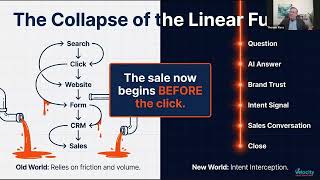
In this masterclass‑style presentation, Thomas Ross, President of Velocity Sales Solutions, explains how the rise of AI‑driven search (ChatGPT, Gemini, Claude, etc.) is fundamentally reshaping the buyer journey and rendering traditional website‑first, click‑based marketing obsolete. He introduces the concept of "zero‑click" AI search, where buyers receive synthesized answers before ever clicking a link, making the seller’s presence in those AI‑generated answers (share of answer, AI visibility percentile, AI citation frequency) the new critical metric. Ross outlines a three‑pillar AI sales pipeline infrastructure: Answer Engine Optimization (AEO) for visibility, Generative Engine Optimization (GEO) for content synthesis, and Agentic AI activation for autonomous lead detection, qualification, and contextualization. He contrasts this with legacy, interruption‑based marketing that relied on volume, paid ads, and slow nurturing. The presentation details the audit process (AI sales report) that measures where a brand appears in AI answers, its share of answer, and gaps in structured data, schema, outcome proof, and authority citations. Case studies across SaaS, healthcare, finance, and manufacturing demonstrate that companies adopting this pipeline see 2‑3× higher conversion rates, 25‑40% shorter sales cycles, larger deal sizes, higher close rates, and lower customer acquisition costs. Ross emphasizes that AEO cannot succeed without a solid SEO foundation, and that Agentic AI—detect, qualify, contextualize—feeds a continuous, 24/7 pipeline, allowing salespeople to focus on high‑intent conversations rather than chasing low‑quality leads. The talk concludes with a call to action for a free AI sales audit and a 90‑day masterclass implementation plan.
Chapters
Well, thank you, Gerhardt. And I want to say welcome to everybody and what an amazing event it's been already and what an opportunity to learn how AI is impacting sales. And you know, today what we're going to talk about is really the shift that's happening in sales. Sales is sales. But marketing and sales have really now come together in a way that they never have before. In fact, I talked a little bit about this on a number of articles that I published. And I had a CMO most recently come back to me for almost two days of discussion back and forth on Reddit about why this is more a marketing thing than a sales thing, or it's more of a sales thing than a marketing. So we finally came together in the end to realize that, that it's all about sales, because it's all about one thing, and that is revenue. Right? And that's what counts. And marketing and salespeople, those professionals in both areas have one job, and that is to produce revenue. And what we need is to bring that together. And today we have a technology that allows us to do that in a way we've never been able to do before. And what we're going to talk about today is, is a shift in how the overall sales process works by way of marketing that you may or may not be familiar with. But after today, you'll have a much better concept of it and an opportunity to learn even more. So, hello, my name is Thomas Ross, and as Gerhard said, I'm the president of Velocity Sales Solutions. I've been involved in sales training, sales implementation, go to market strategies, and most recently AI strategies in sales for a couple of decades. So I've been doing it for a while and certainly very familiar with what it takes to be effective throughout the process. Today we're going to talk about a portion of the process that has been very difficult for many organizations for a long time. And now we have a tool that we can use to make it easier, and that's for lead generation. So let's begin that conversation if we could. So there's been a dramatic shift. Buyers no longer start with our websites. Right. And this is really important. So three to four years ago, your website was the starting point. And your buyer, who had a problem might have Googled what they were looking for, got one of the blue links, landed on your site and filled out a form that funnel made sense. And that's what everybody's worked to over these many years. A lot more than four, probably more like a decade and longer. That is what no Longer happens today. Operators and buyers no longer behave in the way they did today. They don't just go to Google, they go to ChatGPT or Gemini or Perplexity or Claude or whatever other tool they're comfortable or used to using. And that changes the process. Now they're asking Chat GPT what is the best solution for this. And ChatGPT, or the AI they're using, which could be Gemini inside of Google, comes back with an answer and it might name a couple of few vendors and it compares them and the buyer is able to form an opinion right in that conversation. With AI, this is long before there's been a click. It's long before there's been a salesperson in the mix. So the brutal truth is that AI assembles these answers and your brand, or the answer that you hopefully brought to them is either there or it isn't. And therein lies the opportunity. Let me see if I can get this going. There we go. So this is a great graphic because what it shows you is how traditional marketing has worked in comparison to, to how today's AI search works. So traditional marketing is basically dragging an anchor across the bottom of the ocean to grab whatever it can by way of pay per click, paid advertising, and it's generally speaking to the masses. Now we may have applied our ICP to some degree to that, but for the most part we're really targeting anything and everything that we can. And 90% of that is a passive market. So they not, they're not necessarily people or buyers or customers in the market for what we're doing, looking to help them with. So what AI search does is it focuses on that 5 to 10%. These are the active buyers. They have budget, they have urgency, and they have a problem right now and they're asking for the answer. AI, AI intercepts that intent before you ever see a click on any dashboard. So by the time somebody visits your website, that short list is already formed. The question is, were you, are you on it? So the difference between companies that are on that list and the ones that aren't is not advertising and it's not the spend and it's not how much content you throw in every direction. It's what we call structural visibility or structured visibility. So let's talk a little bit about that. So this kind of paints a pretty clear picture of the old pipeline versus the new pipeline. Everything you want to know most about sales. And it's frustrating that you today is on the left side. So you can see that methodology that we've all come to be familiar with is very leaky. It hasn't been effective. We've been losing velocity. Great word, by the way, and speed and, you know, time to get customers on board and in our system more and more every day over these last couple of years, as AI has gone from 4% search to today, approaching 74% to 70. Where will it be tomorrow? Well, it's not going back down to four. So these are the considerations we need to take in place. So the fundamental. The fundamental problem with the old model is that it's built on interruption and volume. It casts a very wide net to capture but a few, and then it tries to nurture them accordingly. So it's expensive, it's slow, and it's increasingly ineffective as buyers have trained themselves to ignore it. How many times have you googled something to get 27 pages of blue links interspersed with ads? Have you gone through all of those? Nobody does. And that's part of the challenge. Now, when we look at the right side, this is the new model. It starts with a question that's asked by two AI. The. The AI delivers the answer that hopefully includes your brand. The buyer builds trust in you and your brand before they ever land on your site. Then they signal intent, and by doing so, they have the opportunity, and we're going to discuss how that works to engage with your sales team who does the great work that salespeople do in terms of helping them understand and buying, completing the transaction, and closing. So the bold statement in the middle is the sale now begins before the click, because it never was a click. And this is what we're going to talk more and more about. And that changes the game, and it changes it in a way that we really have to talk about. So this talks about attribution. And what is attribution? So that's a marketing term. And not everybody in sales is as familiar with it as marketing professionals are. But what it really means is the measurements of all of those elements that between when we used to have our sales pipeline doing paid advertising, where people went to our website, they clicked on a certain click or page on our website, they filled out a form, and they took all those steps. Well, all those steps, from CTR to impressions to bounce rates, all of those things were part of what we called attribution. And the measurements we used to see how effective our SEO was. Here's the problem. Those metrics no longer exist. Those are no longer relevant. They no longer matter because they're not representing the behavior of our customers and our buyers. Here's why. AI search is what we often call zero click. A buyer types a question, gets an answer, builds a mental shortlist, and then they may type in your URL directly into their browser. Your analytics might show a direct visit, but it has no idea that AI sent them to you. So attribution misses that influence layer entirely. So what do we measure instead? Well, if we look at the right side, what you can see is now we're going to measure share of answer, we're going to measure AI visibility percentile, we're going to measure AI citation frequency. And last, we're going to be measuring something called AI Source SQL. And that becomes what we really want to talk about today, because that's what we do on behalf of our clients, is we create something called an AI sales pipeline. And this is how it works. So defining how an AI sales pipeline works, I don't want to get into the weeds too much with this, but it's still important that you understand that there's a whole new infrastructure, right? So I don't want to get into the weeds, but this is how your new AI sales pipeline is going to work. So this is not about a new chatbot on your website. It's not about CRM automation. This is not about a new email sequence. Those are tools. What we're describing now is infrastructure. This is the underlying system that creates and determines what, whether AI platforms are recommending you or your competitors. This infrastructure has three pillars. The left pillar is AI search and a E O answer Engine Optimization as compared to Search Engine optimization. That's your visibility layer, making sure that you appear in AI answers when buyers ask those questions. The center pillar is geo, or Generative Engine optimization, which is about optimizing how AI synthesizes and describes what you do. And that's less important for us, but it's very important for machine language and for AI to find us in a way that's optimal. And lastly, the right pillar is a gentic AI activation. This is where shite happens. This is where we're really interested, because this is the part that brings those opportunities into your new AI sales pipeline. This is an autonomous system that detects buying signals, qualifies customers and routes them to your sales team. So the foundation holding all of this together is the revenue infrastructure. And this alignment between AI decision systems is what we call your sales motion. So this is sort of a new term that we've coined with one of our partners, deepluman.com and it's M2AI, or marketing to AI. And the whole goal of this is, is to persuade and influence AI and those folks using AI to get our answers. And that's critical. Right? So we need to know that this is no longer traditional marketing. This is an entirely new model. When you market to humans, you're using visuals and emotions and storytelling as well as brand aesthetics. All of that works beautifully with people, but it's completely invisible to AI, which is now doing most of that work. So AI reads structure, it reads content, it reads verified outcomes. So the pyramid you see here starts with the base machine readable context. And that's really important. That means structured data, schema, markups, identity, definition. AI literally cannot parse what you do without this. The middle layer is what we call outcome proof. AI is trained to synthesize credible, verified information. Raw positioning came, we are the best, does not move the needle. Right. AI is looking for documented results. And if those aren't there, along with those phrases that we might have created, AI may or may not use us in those answers. And lastly, structured truth, which is where most trusted brands live. AI treats them as the authoritative sources. When buyers ask about their category, they are cited by name. And that's what we want to be building towards on your behalf. So that was sort of an over 30,000 foot view of how that works. But this is why, and this is where we want to be with you as a brand and with you as a company so that you can begin to feed real results to your sales teams and your sales professionals so they can do what they were trained to do, which is talk to your customers. Right? Do we really want our salespeople spending 30, 40, 50, 60% of their time chasing people and opportunities that may or may not exist on the basis of the bottom half of that iceberg? If you remember when 80 to 90% of people are not really showing intent data yet or yet interested in buying, but those coming from AI, they asked that question, they are looking for that answer. And what we want to do is to help you feed your sales teams with a method and a process that allows you to do that. And the first thing we do is to create a report. And this report is what we call the AI sales report or audit. And, and this is critical because this is the diagnostic and this is what we can't live without. It's like going to the garage with your car and telling the mechanic that it won't start. Well, that's great, but what's happening? What else happened before then? What were the circumstances? And then expecting the mechanic to be able to diagnose that without opening the hood, without looking at the engine, without asking more questions, and. And without better understanding the nature of why it is that may have happened in the first place. Same process. The only difference here is we are looking at you as a brand and we need to evaluate and do an audit. So most companies that we audit have never asked the key questions that we need to know. Where does my brand appear when buyers ask about my category? Or a solution is related? How am I positioned relative to my competitors in those answers? And what is my share of answer? In other words, how often do I actually come up in those answers relative to my competitors? Am I in the top 10%? Am I in the top 80%? Once we run this audit, we are able to visualize it in a Google search and actually compare where you are and where you're getting your best results. In addition to this, we want to know what questions your customers are asking so that we can align those with your ICP and the Personas that you may have created to better understand your ideal customer profiles. So the consequence of invisible revenue loss, of not knowing the answer to this is you're likely losing many deals you didn't even know you might have been in the running for, because AI is recommending your competitors instead of you. So in this one, we want to talk about the next phase, which is what we call answer engine optimization. And in this phase, we start to build out what you need as an organization for your brand in order to actually start answering those questions wherever they're asked and however they're asked. So we may find that there were 150 different questions that people may ask about your category, your solution, you, your product, your company, or whatever you're focused on by way of filling your sales pipeline. We need to know which ones are the most important, where they're being asked, who's asking them, so that we can begin to build what's necessary for you with your new AEO strategy. So, SEO is about ranking documents in a list. AEO is about selecting and being selected as the answer. AI doesn't show you a list of 10 blue links to let you choose. It synthesizes everything into a single response. Your goal is to be in that response. So the anatomy of an AI block has. Or AEO block, sorry, has four components. First, the answer. First, content block. Every page on your site that targets a buyer query needs to open with a direct and concise answer. No preamble, no ongoing verbiage, just the answer. Second, structured FAQs and what we call schema markup. This is a machine readable layer and it allows AI to find as quickly read us instantaneously. Lastly, authority citations. So verify data sources, external references, internal links that establish your credibility as a source. And lastly, entity consistency. Your brand needs to present the same identity, the same name, the same description, the same attributes, everywhere that AI will index it. Inconsistency creates confusion and AI drops it. And that's really the bottom line. And I think what I really want to stress here is that AEO is not SEO 2.0. It's a whole new decision engine process. AI rewards clarity and not volume. But I want to make one other point here that's really important and that is everything that you've done to this point, by way of all the time, money and energy and systems that you built with SEO, is just as critical today as it was yesterday. Because here's the thing, AEO will not work without SEO. So they come together and they integrate to create the process that we're describing. Because SEO has done a lot of the preliminary work. Great at the links, it's great at many of the citations. It's certainly given you authority and it's put the brand, if you've done a great job, in the right place. Now what we need to do is to answer those questions and tie it all together with aeo. So lastly, and this is the part we'll hear about this, this is what's really important. Last but most important is the agentic AI activation. And why is this important? Because this is the process that's feeding your pipeline. This is what's bringing leads and customers right to you all the time. 24, 7. Now to the point, depending upon the nature of your solution and what you do, that you're going to have to augment that and make sure that you're able to follow up in a timely way. Because let's be honest, and you know this as well as I do, and your customers certainly do, if we don't get an answer quickly one way or the other, that is to say we're not here now, but here's some information we will follow up with you first thing in the morning, or whatever the case may be, because it's after hours or we come to them right away within 5 to 10 minutes, believe it or not, you've got to respond immediately. This changes our process. So we need to be realigned with respect to what this creates. So it's really important to understand that this is where the pipeline gets active. Phases one and two, built your visibility and the structure or structure. But phase three creates revenue and it creates the opportunities. Agentic AI means AI that acts on your behalf. So it's basically AI that we've built along with what we're doing in our, in our process to actually look for the intents and those customers that we've qualified using the agentic AI based upon the specific pages they visited, the query patterns, the content, engagement, and all of those elements that we use to qualify the opportunity and route it to the right person on your team so that it can be put together with the proper follow up. So the three nodes or aspects of this process are detect, qualify and contextualize. Detect as the intelligence laboratory layer. I'm sorry, quality is the routing engine and contextualize is what makes your sales team dangerous. This is allows them to walk into every conversation already knowing what the buyer has researched, what questions they've asked, and what objections they may have already raised in that process. So just by way of contrast, CRMs record the past, AI tells you the future and that's the difference. So this is helping you shape the decision before the conversation even starts. So the economics of a AI sales pipeline, these numbers have held true across about 18 clients that we've finished this process for already, from start to finish. Everything from I'm going to show you an example and some numbers thereof from a SAS model to healthcare to a financial organization to manufacturing. So this has held true right, right across the board. And the opportunity with this simply cannot be ignored. And I think it's really important that we understand that today we have this opportunity to make our salespeople probably somewhere between 5 and 10 times more productive than they ever could have been on their own, and certainly on the basis of the marketing and the systems we've used in the past. Right. So let's talk about what this produces economically, because ultimately that's what matters. Companies that build this infrastructure can see conversion rates two to three times higher than their previous baseline sales cycles that are 25 to 40% shorter, deal sizes that are considerably larger, close rates that are much higher, and customer acquisition costs that go way down. That's the language we want to hear. And those percentages are reflective across the board. But I will say, of course, every product and solution is different. And there are elements within that process that we need to monitor and manage and make sure are happening in the way they should be. And I want to be very clear that at the bottom of the slide it says buyers are no longer being persuaded or pushed they're being told and confirmed and that's a huge difference for all of us. So when a buyer arrives at your sales conversation, they already know who you are, they've already compared you to the alternatives that were provided and they've already decided to a large degree that you're likely the right fit. Your close rate goes up, your sales cycle collapses. Right. You can skip the education phase to a large degree, but not entirely. And your deal sizes generally increase because the buyer arrives with intent and not curiosity. So I was telling you before about one of our case studies and this was a SaaS company and I won't mention the name here right now because we're still working with them, but this is what they've seen prior. They were getting about a 2% conversion rate. They had very long sales cycles and they had a very high outbound dependency. In other words, they were doing a lot of call outs, emails, the standard outbound sales and marketing process, and they were not getting great results. We started working with them about two and a half months ago now and now they're in the top 80 percentile by way of the ICP based queries, that is to say their ideal customers asking the questions that we identified, they are in the top 80% of those questions. In this case, there's about 12 questions that we identified that were critical for them. Their sales cycles have dropped incredibly and that's really great. Their increase in qualified inbound sales has been dramatic. Something interesting though that I'll throw in there that I'm not showing here. The actual amount of total leads that they're getting from the process actually dropped almost by half. So they were getting more leads from their former systems by way of marketing and paid advertising. Problem was those leads were not converting and they were very poor leads that simply weren't qualified and getting results. So while they're getting half of the leads they used to, those leads are closing, they're getting much better deal sizes and their teams are very busy doing what they love to do, which is talk to customers. And that's what we want them doing. We don't want them chasing opportunities that are nothing more than vapor often. So this is something that we really want to focus on. So last but not least in the process, one of the things that we really stress with people that we work with is what we call sales training. So this does not, and it's critical to get this point across. This does not change our need for professional, well trained, skilled sales professionals. What it does do is it means they are now going to be talking to a lot more people a lot more often and they need to be on their games. And what I mean by that, you know, one of the things one of our partners expresses so much crystal clear is athletic professionals, football players, Olympic athletes, you name it, they don't get where they are accidentally. And by showing up every now and again to be effective, they get there by practicing and training like the superstars they are every single day. So one of the things that we really stress and make sure that we do within this process is to make sure that we're also helping you train your sales teams every single day. 15, 20 minutes to role playing with AI daily will keep the bankruptcy court away. That a good way to say Gerhardt. Now Gerhardt, I did want to say one more thing before we go and I'll just say this really quick. We're doing a master class. So we want to take what we've talked about today and put it into action with you and your team. And by team, I mean your leadership team. Right? We want to show you how to do this. And if we can get that opportunity, you're going to spend a couple of few hours with us and you're going to learn how to create your own blueprint. You're going to learn how to gain your own visibility assessment. We're going to give you a 90 day implementation plan. We're going to give you an agentic AI strategy and we're going to create the KPIs. As a bonus for anybody who registers for this, we're also going to give you an executive playbook and an e book that lays this out. And this is going to be your tool during the masterclass that you're going to implement. And in that masterclass we are going to be talking about you. Not us, but your brand, your, your icp. And we're going to show you how to figure out what questions your customers are asking so that you can create your AI sales pipeline immediately thereafter. So join us for our master class.
Awesome. Thomas, you got a lot of comments and I just want to pick up one quick question. With buyers increasingly asking AI instead of visiting websites, where are we now in the structural shift and what should organizations prioritize today?
Well, you know, what they need to do is to figure out where the heck they are in the process you just asked. That is to say, where are we today? So do we come up when our customers ask those questions? Number one? Number two, what questions are they asking and are we answering those questions in our content? In our website, in our presence, in our. In our. In our posts, in our information. Are we answering those questions? 97% of companies today, brands today are not aligned with AEO.
And somebody said something about your presentation and which is excellent and they want to get a recording of and to share with other team members. And so I want to encourage you, look at the chat. I dropped Thomas's email address in the chat if you want to get in touch with him. Also, if you want to learn more about the Master class, get in touch with, with Thomas. And we also have every session that we record, we have those available on demand next week. And there's a link in the chat right now where you can click and get access. And one more quick question, Thomas. Which is the difference in Geo AEO positioning by yourself and doing the process with specialized companies like Velocity Sales Solutions?
Sure. So you can do this yourself, but it's likely going to take you and your team who are not yet prepared or have the tools or yet the knowledge and experience to do it, somewhere between 12 and 18 months to get that done. What I'm here to tell you is in 12 to 18 months, it's probably too late. It's going to cost you a lot more and you're not going to get the same results. Well, what I'm also here to tell you is I can get you there in 90 days. Right. And so can other groups like us with the training. We're not the only folks, but I think we are the best. There's no question about that. One other thing I want to add to that is that our masterclass is a combination of Velocity Sales Solutions and Selling Power. So Gearhart is part of what we're doing with our masterclass. We are coming together to deliver this because at the end of the day, this is a selling power opportunity.
Awesome. Thank you. Thomas. We need to close. Excellent presentation. And I encourage you to go to velocitysales.com as well and check out sales
solutions.com velocity sales solutions.com and visit the sponsor booth. And I think you're going to get a free AI report. Free AI sales report, is that right? Yes. There you go. Thank you. For anybody who wants to get a report about where their brand is now, not a full report, but at least a tertiary one, we will do those for you. That's terrific. Thank you. Thank you.
More from Gerhard



What Selling Looks Like When Your AI Agents Have the Context Your Sellers Do

Better Conversations, Smarter Support: Wearable AI in Business






When Scarcity-Built Systems Meet Abundance - The Judgment Gap in AI-Powered Sales Leadership
