AI Strategy That Delivers: Business-First Implementation Framework
Jonathan Carford outlines a seven-step framework for deploying AI in go-to-market teams, starting with defining business outcomes and ending with measurement. He contrasts fast grassroots adoption with enterprise-scale approaches, warns against buying tools first, and names Shopify, Ramp, and Cursor as models for AI implementation.
Chapters
Well, I want to say first off, thank you, honored gear for let me be here. Steph, I'm nothing but humbled to be able to even work with you. So really excited for our class. This summer will be fun. And were you guys ready? Should we dive in? Should we go rock and roll. Yeah.
Rock.
And as a note to whoever's keeping time, let me know when my five minutes is there. I'll make sure we don't miss anything.
Give five minute warning.
Awesome. Love it. All right, well, welcome everyone. Thank you for this. This is going to be a high level. I'm going to do my best job to go over strategy in. In 25 minutes, which I usually need a couple hours for this. We're trying to go through it pretty quickly. All right, so a couple things what I wanted to do real fast is kind of go over a quick agenda. I want to go over an intro of myself and an overview of what we're going to be going over. And then I want to go over the the seven steps of AI strategy and then answer any questions. If they do come up, please ask them in the chat and then the team will get them to me. We can kind of go over them if we want to. All right, so this little bit about me. My name is Jonathan Carford. I have a nickname of Coach K. Long story short, I worked at a place that had like eight johns and the marketing guy was tired of having all of us respond to him when he asked for John and so he gave me a nickname of Coach and kind of just stuck because my last name is hard to say and unlike the real Coach K who had a also hard name to say, I kind of got that name and suck. So really excited to be here. I'm the founder of gtm AI Academy, co founder of AI Business Network and I'm the head of Growth at Momentum, which is a data orchestration AI agent platform for go to market teams. The places on the bottom are teams I have either consulted or advised for. So Luster, Kiwi, Spiky, gtn, Buddy, Recapt, and Simbi. There's a few others on here as well that I didn't have room for. And then Lastly, I teach AI101 at Bryant University and Stephanie and I will be teaching the AI for sales this summer which would be fun at Bryant. So that's a little bit about me so you know who I am. I've been doing this now for five years and been in go to market teams, run sales for 25. So a little bit about Me. All right, let's move on. So why does this matter? Here's the question. Why? Why do we care about or why do we need an AI strategy? My opinion is, oops, sorry about that, is that in this world we're in right now, the old playbooks are not going to work anymore. Even like a two year old playbook, a one year old playbook, it's shifting really, really fast. Second is the. The reality is with or without AI, pipeline gaps are widening and the expectations for both leaders and sales reps are greater than they ever have been. And then the benefit of AI is obviously it can multiply the output without multiplying the same amount of costs. So I kind of go over two different strategies that people talk about and give you examples of each. One is obviously top down, the other one's bottoms up. So top down is what I'm going to spend most of the time today going over, which is it's larger organizational change, there's cross department collaboration. You have a line velocity and it compounds. And then that's the benefit, is that you have a lot more obviously organizational benefits and the. I don't know if it's a downside, but the reality is it takes more time. Now if you go from the bottoms up where you're enabling your frontline teams, obviously the individuals know their pains pretty well so they can solve the use cases and you empower them, it works obviously faster. You have. The downside is you have lots of tools to manage. It can create silos and security concerns, but it's faster because it's able to be executed quicker. So I'm going to go over a couple of different motions with this, one of which is really recent and that is with the latest news from the Shopify CEO. And I'll get to that in a second. As soon as my wheel of death stops turning, before this switches, I want to make sure I can cover. I'm going to be talking more about the top down because I feel like the bottoms up is something that happens kind of naturally right now with AI tech. And so I won't spend a lot of time on this. But there are advantages to it, which is why I wanted to take a second to talk about it. So forgive me, because my slide is like taking a second to spin. I don't know why it's taking so long. So give me a second and we'll get going here. There we go. All right, so this is. I don't expect you to read all this. This is screenshots from the Message from.
The Shopify. Oops, sorry about that. The Shopify CEO who reached out and talked about AI. So Tobias is the CEO of Shopify right here. And you see he sent a message where he's talking about AI usage. So I'm going to point out some things that I want to highlight, one of which is right here. Reflexive AI usage is now a baseline expectation to Shopify. So looking at this, we have learned that so far that using AI is a skill that needs to be carefully learned by using it a lot just to like unlike everything else, the call to tinker with it was the right one, but it was too much of a suggestion. This is what I want to change here today. We also learned that as opposed to most tools, AI is a multiplier. So these five items are now the requirements that the CEO of Shopify requires of his entire team, which is AI. Effectively, as a fundamental expectation of everyone, Shopify AI must be part of your prototype phase. AI usage questions will be part of a performance review. Learning is self directed, but you need to share what you learn and then before asking for headcount and resources, you have to have a reason why it can't be done with AI. And lastly is this one, Everyone, meaning everyone, including leadership, has to apply the same methodology. This is very much a bottoms up approach which there's a lot of strengths to it because I think it's good to empower your team. But there's some, some weaknesses. And I'm not saying that Shopify does not have a larger AI strategy. I'm just saying that's if you only did bottoms up, there's some weaknesses with it is what I just said before of like it can create a lot of kind of chaotic tool usage. So in general, why most AI initiatives fail that I've seen over the last couple of years and a few things. One is people come to me and they ask the question. Usually the first thing they ask me is what AI tool or what AI tech should I buy? And I personally believe that is the wrong question to ask. This is from obviously March of 23, this is from September of 24. And this isn't even scratching the surface of how much tech is out there. Of all the technologies that is available from both AI to AI agents, to orchestrators, to automations, it's very, very easy to get overwhelmed and I'm sure you all overwhelmed of all the news and stuff like I am. There's just so much going on, it becomes incredibly difficult to both understand and know where to even apply AI to get the benefits. So some of the reasons why things fail is because of lack of data quality. So the quality of data in your CRM, for example, is not very good. Or the org itself is not ready for change and, or the change management as a whole is just poor. People think that just throwing a chatgpt tool at someone's going to make them automatically perform better. And it's not necessarily the case. So here's the reality of why things fail. Now, kind of moving up to the bottoms up.
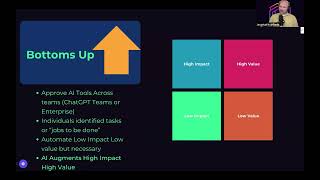
If you wanted to take this approach, my suggestion would be you pick an AI like ChatGPT or, or gems or sorry, Gemini, who has Gems or Claude and you get it across the team and then you have the individuals identify tasks or what we like to call jobs to be done. And then you use a matrix which is right here, the high value, high impact, low impact, low value matrix where you figure out, okay, of all the tasks I have to do, what are the ones that I can automate because they're necessary to get done using some sort of AI automation or AI agent. And then lastly is the high impact, high value human specific tasks. How can I use AI to augment and do it better, faster, easier or cheaper? So this is a bottoms up approach. The weakness with this, if I can add this, is that you need to be able to have a governance or understanding of how the teams are interacting with the AI tools. And not every enterprise level tool like ChatGPT gives you information on how things are prompted, what's going in, what's going out. You can buy other tech that does do that. But that's one of the weaknesses lastly is, is that unless the entire organization, each individual is using it for high impact or low impact things, a lot of this depends on someone's skill level of AI to be able to execute appropriately. So there's a lot of challenges here. It doesn't mean it can't work, it absolutely does help. It's just making sure you think through those challenges. You can do this approach hopefully better than most people do. All right, now, top down, I'm going to give this version as a high level and we're going to walk through each one of these scenarios, which is this, I call it a, what I call the scale model. It comes in this seven steps. So identifying your target, doing some sort of gap analysis, assessing your data and tech and process readiness, matching your capabilities to your needs, evaluating your organizational readiness, implementing in phases and then measure impact and optimize. So obviously this takes a lot more time than 15 minutes to go through, but I'm going to try my best. And again, if you have any questions, please let the let the moderators know and they'll let me know. I can double tap into something.
So one is this is defining a target. A lot of times I feel like that some people suggest looking at problems first, which there's some wisdom of why you want to do that. However, I think that problems need to be prioritized by the goals we have as an organization. I've said many times that I believe that there should not be an AI strategy. There should be a business strategy that is using AI to get it done better, faster or easier. So you want to have a clear target. So as example, the question you want to ask yourself is what is the measurable business outcome we are wanting to improve? Such as obviously revenue like do you want to go from 25 million to 30 million the next year or do you want to improve your win rates or whatever the case might be. So I like to bucket them into five buckets which is increasing revenue, is it reducing costs, is it increasing profitability, is it improving customer satisfaction or is it reducing risk? Those are my five categories that everything I do in AI I try to make sure aligns to one of those five buckets. And then the output here for this step I try to. Just so you're aware, on each one of these slides I have the same format of, of what question you need to answer, what are some things in the middle you need to be aware of and what's the output you need to have from this step? So the output from here is 1 align and agreed upon goal and it should be a larger business goal like improving revenue that everyone can get behind and and understands they're part of it.
Next up is step two which is your gap analysis. So the question here is if we're wanting to go from 25 to 30 million, where are the inefficiencies or the gaps in between that? So it's the real world challenges of how to get you to the next level. So a good way to do this is very simply saying okay, what's the current state and what's the future state? What's our process, what's our workflows, what's the KPIs and how we go from there. I would add to that an example of this for like a sales team. Since most of your sales leaders, I would say that you use your revenue numbers like saying you want to go from 25 to 30 million. If you take a Step backwards from there I would use the KPI of sales velocity, which is your average win rate, I'm sorry, your win rate for your closed loss, close one, your acv, your number of opportunities and your sales cycle. The four main sales metrics and you take a look at, okay, we are currently at 25 million. If we want to hit 30 million, that means that those four metrics of sales velocity must change in order for us to get there. The question is to dig down to each of those four metrics and understand where are we weakest or where do we think we can improve the most. Like for example, if it's average sale, sale price or average contract value.
You want to dig into that and figure out, okay, why is that the case? Is it down to value selling? Is it down to the ICP fits? Like what is it that's driving the acv and how can we use AI to help amplify that? That's one example of many from a sales world. The output from this is that you able to create a workflow map with, with two or three friction points. As a side note to this, after this call I'll send over to Gerhardt and the team. I created a free course in the academy that anyone who's here can access. And I'll have both this.
Deck as well as all these outputs like a workflow map and some GPTs I made. You can use it inside of us to create your own version of your strategy. So just want to put that in as a note. But the goal here is to have some sort of workflow map that gives you a gap analysis of like where are the two or three friction points that would make the biggest difference based on our, our overall goal. Next from here is we want to assess the data readiness. So there's three sections of this which is tech, data and process. So for me, my question for you to ask yourself is can our current tech do this? A lot of times people have technology that they're not fully implementing or they don't know that they have AI capabilities inside their current tech stack. So I always have people start with can we do this now with what we have before we go buy another tech? Next is do we have clean, accessible data? An example of this is your CRM. Most CRMs are not very clean, nor are they very complete. So that's probably usually the first place I have people begin and then next is is our process defined and documented. This is why enablement I think is so important is because it's really hard for an AI to automate something where you, if you don't communicate what the process is to automate. So that's the question. Unfortunately, you can use ChatGPT or Cloud to help you identify the process, but it absolutely needs to be documented to help operationalize it. So there's things you can look at here. Like for example, where in your team do you have things like manual entry? Or where do you have things like data sources? Like where a classic example is your sales calls, are those being automated into your CRM? Do you have the data sources? So you have your zoom info synced with your CRM, that's synced with your conversational data. Where are the holes in the process and how can we mitigate some of those. Those problems? And the output is you want to have some sort of audit report and say, okay, we have 10 tech stack in our, in our tech stack right now, which most people have more. Let's just say you had 10 of those, which ones are helping us get to the larger goal? Or of those, which ones do we think there's possibility of using more? Or of those, which ones we need to get rid of? And look at other AI technologies.
All right, so 4 is matching and governance. So this is where you've, you've got your goal, you've now identified your gap analysis and you've looked at where are your readiness for data. Now we can look at, okay, now that we understand what we need, we need to ask what AI tools match the goal and problem to solve. Remember that map I sent you before? There's so much tech out there. This process helps you narrow down the technology that you need that will make the biggest difference for your business. So then you're not just buying tools to buy tools, but you're buying tools with a very specific metric and problem to solve so that you can both prove ROI and get real business outcome out of it. And then the, the question you want to ask on top of that is what is the risk, the security and the governance plan of some kind. So obviously questions like SOC2 compliance and others you want to make sure you have involved, but also like, how do we know how the team is using the AI technology? Which is again, one of the weaknesses with the bottoms up approach, but it's a strength of the more holistic strategy approach.
So here you want to be able to align the pain points to an AI ability. A classic example is sales reps have to manually put in data into the CRM. That is a pain point that impacts a lot of different people. What AI Technologies can mitigate that problem. Then you want to have like, what's the boundaries of AI and humans? So do you want to have the AI completely take over serum automation? Do you want to have the AI serve up the data for the human to be able to edit before? There's a lot of options, but it's really understanding for your team what are those boundaries and have you communicated that and can the technology support that? And then lastly is your compliance and security needs, making sure that the technology is such that can be secure with your data and help you manage your, your infrastructure. So from here this is where you build your AI capability roadmap, which again, I have some of these things in a governance checklist to help you kind of execute from here. Again, if you want that afterwards just I'll send the link and you guys can get that for free. All right, next up is organizational readiness. This is the human side. One of my favorites because my historical background is in enablement. I love this step. So here is, are the people and the systems, and I don't mean technology systems, I mean the human systems, are they ready for AI? Do we have the education path? Do we have the change management plan? It's really asking the question, what do we need to have adopted? Because there's a lot of AI tech. If you don't know this, there's a lot of AI tech that actually does not require a lot of adoption because it runs in the background. And then there is AI tech like a ChatGPT where it does require some learning and adoption of how to speak to it in order to get the benefit out of it. One crucial step I would have here is that any AI tech you do get, I would say to design a partner team, meaning that you find your internal team members. I always tell sales leaders to find in your top 20% of your sales reps who is respected the most out of the team, like from a cultural standpoint. And then obviously make sure they're in your top 10 to 20% of performers. Grab five to 10 of them, depending on how large your team is obviously. But grab a few of them and let them be your tiger team so that they can both prove out the AI tech and then be internal champions so that when you roll it out to your team, it's. It's not just your enablement team or you saying, hey, this is a cool tech. This is top performers who the team trust saying this is a really cool tech and it makes the adoption way less, a lot less friction. And from here is obviously Your change management and AI activation plan, which part of that is having your Tiger team ready to go. Few minutes left. I'm going to try and get through These is step six is pilots. I'm a big fan of pilots or POCs or trial runs. So I believe that you should be able to run some sort of pilot test with your Tiger team and then prove out the AI model so that you can then scale it pretty quickly afterwards. So the question is, what is the low risk, high value test that we can run? And this is why I like doing it with smaller teams, because to make sure that as for an example, if you have an AI tech automating data into your CRM, that you don't launch it out to your entire team until you know that the model works and then you'll launch it to everyone else once you can trust that it can do what you need it to do. And then there's adoption again not necessarily required for your Tiger team. You want to use them as much as possible. And then again here is you want to have your, your, your scaling mechanism with your plan. Lastly is this, which is your measure, optimize and impact. So the very last step is once you have your Tiger team, you've mapped out your AI tech to your main goal and the problems to solve and you've tested it, you're working well. Then you start measuring your different metrics which is going to be things like obviously your business outcomes, your driver KPIs, your operational KPIs and your usage metrics if it is something they need to use. So the question here is, is AI moving the metric needed? And from here we want to look at outcomes, driver KPIs, operational. And the output here is obviously the performance tracking. So we can see like, okay, we've implemented this AI tech. Have we seen any change after two months, three months, six months, whatever the criteria might be for you in your, in your assessment. But you should be able to see impact pretty quickly. Even if it's like if you have an enterprise sales motion, I would say if you're not seeing value within the first month implementing AI, something is horribly wrong. It doesn't matter how long or short your your process is, AI should impact very, very, very quickly. But I would say the one caveat to that is it all depends on if you're using an AI tech that requires a lot of adoption like a ChatGPT with prompting, or if you're getting other technologies that kind of run in the background and work with the team as they go all right, that is my spiel. Any questions come up from the audience, we'll make sure we have time for that.
And if not, I can show one tool that I'll send out to everyone, if that's okay.
Jonathan, I think that everybody is really interested in the, in the tools. And you mentioned that you have something on your website, GTM Academy.
Yeah, I'll be sending. Well, there's two things. So in the academy, I have the AI demo tools library. There's 55 plus technologies in there. It's not all of them, obviously, but there's some demos you can see for free. I did that just so people can see that. The other one is in the AI business network, we have the AI agent that looks through technologies. We have 722 tools in there that someone can prompt and the agent will tell you based on your prompt what tools you should consider.
But yeah, but I obviously, I would say don't go tool crazy yet. Make sure you know what you're trying to hit first and then go tool crazy. So.
Yeah, exactly. Yeah, yeah. So the strategy comes first and you gotta focus on what do you want to accomplish.
Yes, correct.
Now, where do you say people really get stuck?
Right now I'm seeing two things. One is integrations or current tech stack. Just because some teams have historical legacy tech that isn't moving fast enough. But sadly the, the startup technology doesn't have SOC2 compliance or something. So there's a gap between the readiness of a smaller org to a larger one and then secondly is trust. Honestly, a lot of people don't necessarily trust what the AI is doing in the background. So it's helping someone understand where AI can be trusted and where it shouldn't, and then use it where it needs to be in both places and think.
Is really doing well. Is there an industry, is there a company that you say, wow, you know what? They get it, they're doing it and they're seeing great results.
Oh, there's, there's a ton, there's. Ramp is probably a good one. They use a ton of AI tech. So if you ever go look at what Ramp is doing, they're, they're a phenomenal example. There's a lot of other technologies you could use, like cursor, They've, they've scaled like crazy with only 30 people. So they're using it really well. I think it depends on the use case because some like in, for example, banking, they're restricted or healthcare, they're restricted by laws and other stuff you can't necessarily use it as much. So a lot of people are using things like a custom GPT that the entire healthcare place shares. But it's, it's secure. But that alone is making improvements in their outputs. You know, I'm seeing a lot more though of people kind of doing their own custom.
Custom knowledge based chat. So like they're kind of grouping all their information one spot. So it makes it really easy for anybody in the company to use. Like Glean's a great example of that, you know, giving people the ability to do that. So there's a lot, but I'll have to get a list of companies I think are doing well, but Ramp is definitely one of them.
So now if somebody works at a company and the company's not really adapting or adopting AI yet, what, what should they do if they say, I see the value, I want to do this, but we don't really have anything in place. But I don't want to miss out.
Yeah, it kind of depends on the policies of the company. I know some companies are very much anti AI usage of any kind. I would say that obviously be ethical and don't do dumb things with your company's data. But I would be using AI as much as possible elsewhere because I use AI for me everywhere. Like my personal life, cooking to helping with my kids to obviously work and creating content. Like the deck you just saw, all the visuals were made with AI. So I was like, I use it everywhere I can, you know. So I would say be careful. Company data, obviously don't use it, but I would still use it as a thought partner as much as possible.
Which tool did you use to create.
The images those graphics were in? ChatGPT actually the new image generator, which is awesome. So.
So what are the three biggest fears that you hear from people that are reluctant to adopt AI?
Oh gosh. One is just the need to change. Um, because there's a lot to learn. It's not an easy topic to understand, unfortunately. I think AI is getting, I should say AI companies are making the models easier to use but still a lot to learn. Two would be there's a fear of being replaced. I think that's a legitimate concern. So if I use the AI model, am I just going to be replaced later? That's a good concern. And then three would be.
Probably overwhelm both from how much information is out there as well as like where do I even begin? You know, it can be extremely overwhelming when you have 20 bajillion tools launching a week. You have no idea where to Start, you know, so that's why in the academy, I try to break it down saying, let's just start on one use case and make that work well and expand from there.
And how do you propose that people educate themselves without feeling that they're wasting their time?
Well, transparently, I'll give some things that are free. YouTube's a great resource because there's tons of AI stuff there. OpenAI just released their academy. It's all free resources on AI education. Claude has a lot of, I should say anthropic has a lot of stuff on there as well, and so does Google. So all the main AIs have tons of free training. The academy. I have a lot of free resources in the academy itself for people just to start off prompting. There's a lot of free resources. I think what I'd say more so is you have to prioritize it and make it a time thing you do, because even though it may take you time, it's kind of like that slow, smooth, smoothest, fast. When you take your time to learn AI, you may feel like you're slowing down, but as soon as you capture some concepts you like, accelerate way faster than you would have before. So I think it's being comfortable with slowing down a little bit to speed up.
So if people are thinking, you know, I want to go online, I want to go see some of these resources.
Yep.
They don't even probably know what to look at. And what we know about learners is that new learners, they think everything's really important, so it's hard for them to prioritize. Is there something that you would say, you know, if you're just getting started, just focus on this? Or would you say, you know, head over to the DDM Academy because we're already curating the content on a journey that's there to help you.
Well, obviously come to the academy. But besides that, I would say.
If the worst, I shouldn't say worse. If the. If the one thing you did was use one tool like ChatGPT, and I think it's the most flexible, get the free version and just start using it instead of Googling things, take what you would have Googled and put in a chat cbt, and start interacting with it. If that's the one thing that people do as a beginner, that'll be fine. They'll learn more about that than anything else. This kind of goes back to Shopify's CEO saying, we learn by using. So the only way you can get comfortable is by using it.
Yeah, that's Right.
Do you have an agent that talks to people on your website?
I do, Yes, I do. It's through a friend of mine, but I have an agent there. I'm looking into creating an agent that actually teaches. So it'll be like I have loaded in all the content from the academy. It can literally show slides or do demos or teach. Like, it's not ready yet, but I'm really excited when it does happen. But, yeah, there's agents all over the place, so.
So you. You could actually send your agent to Brian University?
I could. I could probably do a better job than I would, but maybe. Maybe not as good as Stephanie. She's a pro, but probably better than me. Yeah.
It's really exciting to think about how AI is going to transform learning.
Yeah.
And offer learning coaches and help people at their own rate. Yeah, it's. It's exciting.
Yeah. I'm excited.
Stephanie, are you worried that it may take away your job?
No, not my job.
No. Not working.
Not Steph. Me? Yes. Not Steph. Yeah. No.
I mean, AI is such a great resource, and I think it's going to be like computers and it allows us to maybe do a little bit more and, you know. Right. Like, take out some of those mundane tasks and, you know, help us to do all the things that we all were supposed to be doing anyways, that we just kept having our list of things to do pile up and make us stressed out, you know, maybe it's going to help our mental health.
Yeah.
So, Jonathan, I'm curious about how you use AI for cooking.
Oh, my gosh. So I'm a mediocre cook at best, even though I love cooking shows. But the other day I was like, I want to make chicken Alfredo and make it, like, legit. So I had. I used ChatGPT and I put on the video and had it and I. And I walked it through my process and it gave me a. I showed it what I had in my fridge, in my pantry as far as ingredients. It gave me what I could make out of it. And I showed the video of it all the way through, and it told me how much salt to use or not use and kind of walked me through the process. And I made this amazing chicken Alfredo. And my family was like, how'd you have to make this? Like, oh, you know, I figured it out by myself with AI. So it was. It was amazing. Like, it was a concept that I was like, I'm just going to try this and see how it goes. And I think that's the mentality people need to have is that playing with AI like all I do all day long is play. And I just asked the question, I wonder if I can do this with AI. Yeah. And I just try it. Sometimes it bombs. And I'm like, oh well, cooking didn't work with AI. I know that now. And other times it's like this is amazing. So it's just being willing to try and just see what happens.
Yeah, I. I second that. I love to experiment for our next global sales transformation Sales acceleration summit on June 25th and 26th, I woke up with a crazy idea. Why not do a sales pitch competition for just for AI? And so I asked AI how would you structure it? And he came up with a plan. And the same afternoon I send out an email to about 10 companies. I already got three companies signed up. But then I went further and say, how would you judge those presentations? And I want you to be one of the judges.
I'll do. I'll judge it. I'd love to.
Yeah. And Stephanie, I want you to be one of the judges as well.
Did the AI give you a judging score? So I just have to fill out the AI?
Absolutely. We actually I asked AI to give me a spreadsheet for seven contestants. And you, you have scores on seven different criteria. And you.
Awesome.
As a charge, you rate a rank each one of those criteria on a scale of 1 to 10. Then you have a total per contestant and then you have a gradual. And then you know who is the winner. And the first top three get a hundred dollar Amazon gift certificate. So it's going to be a lot of fun.
I love it. Good job doing that. That's great idea, Gerhard.
Thank you.
I love it.
Thanks for accepting being a judge. I love that.
Bring it on.
We want to be contestants, Gerhard. I guess we can. We have.
I. I'm thinking about that actually. That the presenters of the next event need to do a one minute pitch and have other people judge you.
What are we pitching AI? I'll pitch AI all day long.
No, we. We cook. We how to cook chicken Alfredo.
Okay, I'll do that. Bring it on.
No, you pick the topic. Whatever you're passionate about.
Nice. I like it. Let's do it. I'm down.
All right.
More from Gerhard



What Selling Looks Like When Your AI Agents Have the Context Your Sellers Do

Better Conversations, Smarter Support: Wearable AI in Business






When Scarcity-Built Systems Meet Abundance - The Judgment Gap in AI-Powered Sales Leadership
