AI: The Double-Edged Sword
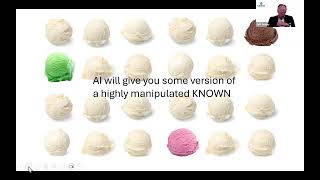
Jeff Seeley argues AI is a powerful tool but can't replicate human creative combinations. Over-reliance risks organizational atrophy and lost creativity, even as AI boosts productivity in supply chains and sales. He uses Apollo 13 and Michelangelo to show why human intuition and emotional intelligence still matter most.
Questions this video answers
October 9, 2024
Three days
About $1,700 (after $750 off)
$750 off
About 20 participants
Chapters
Foreign.
Here, and maybe I'm kind of in the old Monty Python now for something completely different. I'm going to talk a lot about AI, but not so much in the applications of AI because there are people 10 times smarter than me who can talk about that, but really kind of talk about AI as we go forward. So let's start with the whole concept of just intelligence from the perspective of human intelligence. Doing a little research on this. There are a hundred billion nerve cells in our brain. And the interesting thing is the brain is the least understood organ and part of our body, and it's the only organ, interestingly enough. It's like a computer. It's electronic, but it's not zeros and ones. Because if you think about each human has different sets of connections in their brain of that 100 billion. And what that does is those different connections really create you. And so what's important to you and how you really function in society as a human being is driven by that makeup of that hundred billion. Most of what we find in the body is mechanical. So if you think about a heart, it's a pump. Think about kidneys, liver, those are filters. So you think about. They're really well described by a mechanical engineer as opposed to the brain. So now let's think about it from an artificial intelligence perspective. And artificial intelligence uses the computing power to look at multitudes of things in terms of how we bring it together. But interestingly enough, even we found right now from an artificial intelligence perspective, we're seeing quite honestly that artificial intelligence is impacted by the filters that humans can put on. So if you look at Alexa, you look at Apple, you look at, you know, Chat GPT, there are still filters in there that create that artificial intelligence, which is, you know, hardwired per se. So when you think about how that hard wiring comes into play, I always like to say, can artificial intelligence replicate this guy? And so if you think about it for a perspective of, you know, Keith Richards, and if you don't know who this is, look him up. You know, Keith is, you know, outlived artificial intelligence, Covid, you name it. There was a joke running around that I'll worry about COVID when Keith Richards is worried about COVID The bottom line is, is artificial intelligence does not replicate the creativity of what it is. So it's basically an iterative technology. It pulls from a lot of different areas, lots of different spaces. So if you think about some of the great things that have happened in our lifetime and multitudes of lifetimes going back, you think about Design, you think about music with Jagger and Richards OR Lennon and McCartney, you think about Picasso, you think about the great poet Maya Angelou. Each one of those things and going back centuries and centuries and centuries were impacted by those hundred billion nerve cells communicating with each other in a way that creates these incredible works of art. So when we think about AI, I get worried that basically it becomes start of getting rid of the human value. And so if you think about how does an organization navigate the challenges of AI to reduce cost? Absolutely, you need to do that. As we think about innovation over the many, many years, long before AI robotics have changed and reduced costs. We've really kind of done a lot to create how to be a cost reduction. But what we have to be careful of is how do we not diminish and de. Minimize the value of human contributions in the workplace or in the artistic world or wherever. We're looking at it from the perspective of what does AI do.
So if you think about what it does, it has a profound impact on the productibility of supply chains, sales, demand curves, understand the implications of competition. You know, data markets, it can compute so much information and so much data that we just typically can't even comprehend what that does. But I also tell you that, you know, when it computes data, I was watching, I was on a plane the other day and shockingly, Apollo 13 was on there. If you don't know what Apollo 13 is, it was a mission to the moon, which basically even Gene Kranz called it our finest achievement. It was a mission to the moon that had a mechanical failure and slide rules basically got us back home and saved three astronauts lives. So if you think about what does AI do, certainly the computation power of that would have been enormous. Instead of having three people standing around using slide rules to say yes, the reentry angle is correct, or they would have bounced off the earth's atmosphere and jettison themselves into space. But what does it, what didn't it do? We have to make sure that AI doesn't become the way for us to go around and you know, mess around and our employees aren't being productive, they're more, you know, on their segways trying to do wheelies. So that's when you think about how we use it, is really great. But what I'd really like to spend some time on is what's the innovation and creativity risk. We're fully aware of the dangers of relying on AI and original thought. But what happens if we start having organizational atrophy and that becomes a reduction of productivity and a reduction of creativity, a reduction of innovation, which I think is critical to the success of any organization, both human innovation as well as mechanical innovation.
So what are the impacts on creativity and innovation and on business and in society?
And if anyone has any questions, I forgot to ask this, please jump in, identify yourself, and we'd be happy to take these questions as long instead of me, you know, talking here for the next several minutes. So please feel free to ask any questions anytime along the way.
So here's something that I thought of a lot of. If you follow much in the world of, you know, education and what's happening, there's a huge movement right now to get rid of cursive writing. Basically, it's not even taught in the schools. Well, if we use AI to fast forward 20 years from now, 30 years from now, could someone actually write a love letter? Could they put pen to paper and write a love letter? Or are you going to communicate with the love of your life via AI? Hey, AI, write me a great love letter to my girlfriend. She is, you know, blonde hair, blue eyes, and she's amazing. She's got a great laugh. I'm not so certain that's going to hit well in terms of with them and with her and with that human connection. So my concern is, as we kind of continue to rely on AI things like the Sistine Chapel. What does that look like? What does that. How does that exist? How is it created? How did Michelangelo view, you know, create this view that he painted upside down in a chapel? Would we want an AI generation of this, which might just be a regeneration of what Michelangelo did back in the 15th century, 16th century. So those are the types of things that we have to worry about in terms of the impact on society. And so what we found is, if you do a lot of research on it, what AI is, it's a generative, you know, and they're trying to really, you know, even make it better. But AI right now will give you some version of data that's highly manipulated, known, so it can certainly transgender, you know, transform it, do different things. But the reality is it takes vanilla ice cream and gives you how many versions of vanilla, so to speak, it is. And it's the human condition and human innovation that creates the opposite of that, which is the, you know, the strawberries, the chocolates, the key limes, the cherries, mubli, which is, you know, a combination of brownie and cherry and just, you know, spectacular, you know, feeling and taste. Those are the things that I worry about when we come into AI and if you translate that to business, what happens is everyone become literally a formation of somebody else. And so what happens is we tend to lose the head and the heart of our teams and who we are and why we are.
As a simple example, there are basically five musical notes that have an incredible process by which to combine them, which gives us melodies we've never heard of. Even to this day, there are not more than five primary colors. And in combination, they produce the hues that can be better seen. Now, the great news is, is AI will take those five hues and give us absolutely more colors, more color palettes, more shadings, those types of things. But then how is that applied to the canvas? That becomes more critical. And how is that then basically go to art, to science, to where we are. As an example, I love wine and.
Studying to be a W set 3, which is a very advanced degree in wining and wine tasting and wine understanding. But basically there are five cardinal tastes that you can taste through your nose in your oat factory. And the combination of those, you yield more flavors than can ever be tested and tasted. So, you know, there's some things that AI can do on those things, but it's the human creativity, the chef in the kitchen, the artist, the musician that really put the signal signature on that. And that's part of that hundred billion nerve cell combination that does that. That's hard to replicate, especially when it's. If you take it across 8 billion people in the world and each one of them is different and it becomes a pretty amazing canvas by which we have in our society for innovation, creativity and thought. Think about this guy for a second. You know, back in the, you know, early 1900s, brilliant guy, was a post clerk and then wound up becoming, you know, the, you know, the most, you know, well known physicist in our world. E equals MC squared is known by pretty much anyone in the world in terms of how they impact.
Physics and dynamics and all the things that we, you know, enjoy today kind of came from this guy. Again, think about those hundred billion nerve cells and how they were wired in his head.
So lastly, let's talk about productivity and what are the good things? What are the proactive AI utilizations? And several months ago I was had the privilege of meeting some folks from a company called One Mind. And Amanda and Russ are doing some incredible things with AI and I believe it's really powerful what they're doing in terms of the customer creation, the service delivery, and the things that I think are really going to complement our efforts in sales and our efforts in supply chain rather than replace. And I think it's the human intuition and effort along with AI is going to create some really amazing experiences for people. So it's that blend of the iq, the TQ and the eq. And AI has not quite figured out how to figure out the EQ portion of this. It systematically could sit down and analyze where you are. And as John Mullaney basically said at Dreamforce last week, you know, if AI tells you to kill yourself, would you? Probably not, because you would question its desires and outcomes that it's producing as compared to your own emotional feeling to that. So how do we go forward? And I think as leaders, we need to stay ahead of what's coming, but we need to see more than others and we also need to see it before others. And so, you know, we've got this panacea of AI out there right now. But I'm an older guy and I think of the panacea of the Internet in 1997, 98, when anything on the Internet was going to make a whole lot of money and is going to solve all of our problems. Well, if you look back, there was this big giant crash of tech stocks and Internet stocks because they didn't have a business model, they didn't have a business proposition in terms of how they go forward. And I think that's going to be important for AI. And our use of AI is what's the business outcome that it helps us deliver. And if we don't really have one, using AI could be a lot like what happened with sales enablement. If you think about the billions, if not trillions of dollars spent on sales enablement and the number of things that were put forth into the sales organizations. And basically the only people who were using them were the analytics side of the business, the actual sales teams, the leaders, the customers really weren't using that sales enablement tools to the extent that they had hoped because they didn't see the value in terms of what it delivered to the organization or to the customer experience. As leaders, we need to make sure that we are understanding the implications of business as we go forward. So let's take a look at AI and the customer experience. One of the things that I'm really excited about is the data insights that impact our customers. Business AI does some incredible work on understanding competitive markets, our competition, the customer's competition. And as a sales professional, you really transition from being a sales professional to really moving into a leadership position. You have to understand all the resources in the organization, all the inputs, where is our product or service going to be used? What's the impact of that usage? All that becomes critical. So we really take that leadership role instead of just selling more stuff. And it also allows us through AI to then understand pricing volumes, the economic impacts, what are some of the operating influences? Are there peak demands, Valley demands? What's happening in the process? Talk about decision support. And I mentioned one mind and Amanda and Russ are doing some amazing things with helping with decision support. How do we go forward with this? Is this a customer we should go forward with or not go forward with? It can help us with innovation, but I think it's iterative innovation as opposed to new innovation. And so certainly we can see some new innovation. But I think it bases a lot of its decision on past data to help us give iterations. So again, I talked about customer industry data for benchmarking and I can tell you this. Sales professionals are going to have to up their game dramatically. They have to be a different breed, a cat. And I think that's going to be make the profession even more exciting and more attractive for really smart people to jump in and start, you know, being in that game. I think it also has some positive experiences in terms of, you know, how do we transition from chatbot to human because humans still want to deal with humans. So how do we move that transition? How do we understand that? How are we using AI to generate solutions if you don't know the problem? So if you don't understand the problem, then how do you actually use AI? So how are you going to be really using AI? To some degree you're using a smart guessing tool, but yet you're still guessing. So understanding the problems at the visceral level from the customer or the people we're interacting with is going to be critical. How do you personalize conversations with AI? And I use this as a way to talk about, I mean, did some research and the number of email messages sent out in any one given day is over 380 billion messages are sent out. If you were to take any measure of something that's sent to you and you didn't ask to be sent the old Seth Godden permission marketing, the open rate on those is less than 1%. So if I'm going to use AI to create a conversation, do I really think there's a better chance that someone's going to open that and understand it just because I gave them more information about who I am? No, it's. We have to really get into analyzation of specific situations at the customer level and engage the customer to talk about themselves, not about our stuff. And what we've learned a lot is garbage into AI results in, garbage out, or creates, you know, opportunities that are not awesome. We've had, you know, lawyers try to use AI to manage, you know, case files and basically cited cases that didn't even exist for case law. So obviously you don't want that lawyer in front of your judge representing you. So how do we not overuse tools? And then how do we make sure that we really use the innovation based on the customer dynamics? Overall, customers are human. Their issues are, their businesses are. In fact, it's the most important thing on their mind. So we've got multiple generations in the workplace. I've talked about this at other sales conferences with Gerhard and other places. And there are people who are not comfortable with AI and they frankly never will be. So do we wait them out? Do we get rid of them? Do we move them to the sideline? And how do we interact with these individuals and their unique complexities? How do we trust AI? There's been much written about where not to trust it and is it really transparent. And so I think those things are going to continue to move us forward. Other use cases in sales, it's lead scoring, predictive analysis, forecasting, demand portfolio, cross selling, which I think is going to be a huge opportunity for a lot of very large complex organizations and opportunity identification. If I had to say something about sales professionals right now, for some reason they are really reticent to do cross selling inside their organization. They tend to stick to the areas that they focus on versus others. We see that in some of our really complex organizations where they have a multiple sales professionals talking to the same people. And it really bothers me a lot when I see that. Marketing campaign optimization, I think to some degree sales coaching and then predictive assessment. I pulled something from one mind which I thought was really interesting. It does do these things. It does give you the chance to reduce your sales cycle. I think it really reduces your seller ramp time and making have them have more confidence in understanding what we're doing and how we're doing it. And also it can shorten our customer onboarding time that becomes critical. Also I think it really reduces our human resources and technology costs. We do have an opportunity to increase sales and ultimately we delight buyers by having them have access to information that's almost instantaneous. And that to me helps them a lot depending no matter where they are and when they are.
So where do we Go use it as a competitive tool. I don't believe it's a panacea for where we go. We've got to understand its uses and we have to make sure it doesn't make us lazy. And I think that's the one thing that if we stop using our brain and start using and stop using those and being challenged, then I think we're going to really find ourselves in a different situation that we don't want to be in. From a business perspective and a society perspective, AI is the future. But we can't let it be a train track which does not allow for diversions and allow us to continue to be creative in terms of how we approach customers, innovation in our organizations.
Martin Luther King said it best. Science gives man knowledge, which is power, which gives wisdom, which is control. Science deals mainly with facts. Wisdom deals with values. The two are not rivals. We have to make sure that the AI does not become our value system. It becomes our tool by which to understand facts, manipulate data, and then make better presentations in terms of what we do as a business and society. That I'd like to say thank you very much for letting me join in.
Mark told me it was already $500 off is not a go. So I'm going to bump this to 7:50. So if you scan this little image and want to come see one of our workshops, we do in person, we do virtual. We have, you know, sales skills. We have leadership. We're really excited about our new leadership program. It's gotten a lot of rave reviews in terms of how it really gets into the concept of leadership as opposed to managing. So with that, if there are any questions, Mark, you or Gerhardt have any questions or any questions from the participants or. Love to hear it. Yes.
And hey, thank you. And you know what? I guess we learned the first lesson in sales. If you don't ask, you don't get. So yeah, I just threw that out there and you offer it up.
So you told me 501, so I went 700.
I said 501. Hey. And you, wow, you up the ante. So thank you so much. Hey, you shared a number of things here.
Here's the question.
Because I think you did a great job of kind of putting the stops, not stop sign, but the yield sign. We gotta be careful around AI.
If I'm a sales manager leading a.
Small sales team, what should I be telling my sales team?
Because they want to get into AI, they want to start using all these tools.
What should I be telling them.
Or.
What guidance should I give them.
Yeah, I think the guidance is don't let it become the crutch by how you do presentations or become the crutch of how you understand customer needs or how you interface with customers and networks. I mean, you know, this, the AI is created, you know, people. It was interesting. I was, I read a book recently and it was 100 AI generated. And clearly what the author did was gave the, you know, I think he did through Chad GPT and basically gave them a set of topics and said, write me a, a paragraph or write me 2,000 words. I mean, you could almost see it. Write, write me 2000 words on leadership, on, you know, communication leader, Leadership, communication. Write me 3,000 words on this, write me 4,000 words on that. And basically had streamed an outline of a book and then, you know, basically, you know, coalesced into 20 chapters and away we go or 10 chapters and it's like, okay. But I was reading it and it was like really? It reminded me of somebody who went out, used to, there's somebody who's very good at this, would read all the business books and then coalesce them into one book. And this is my version of what this is. And it didn't really flow. It didn't have any original thought to it. And it was really like, oh, so what, so are we really saying then everyone can be an author? Can we say everyone can be, you know, these musicians, can we be great salespeople? Just because I use, you know, chat, GPT or some AI bottom function? The answer is no. If you're still crappy at your job, you're still going to be crappy at your job. And so, you know, you have to be careful that they don't use. Become reliant. So reliant on AI that it makes people lazy.
Hey, thank you for sharing that because I think that's a real issue. We're seeing so many salespeople gravitate towards using AI and they think they can use AI for everything. And I always say AI is a great starting tool. It's not a finishing tool.
Yeah. And I think, yeah, it gives you so much data. I mean, you can get so much data and so much information. But, you know, I think there's a lot of conversation right now of, you know, what's it filtering? Because there is clearly filtering. I mean, it's not a political conversation, it's a conversation of. It's filtering some information in some way, shape or form. Because guess what, there are humans somewhere on the other side of the fence that are putting in the tags by which, you know, it's accessing stuff.
Yeah, the piece that I get scared of, we think we have a noisy world today with AI. It's getting even noisier. Gerhard, you jumped in. I'm sure you've got a question or two, you know, for Jeff that you want to ask. Jump in.
Yeah. I'm just reminded that, you know, the conversation we are having here in English is replicated in many, many different languages. There are people from 60 different countries and when I look at the chat, you know, there's somebody.
He'S from Austria and they're having a, a LinkedIn chat about AI. And Bernd went to the mountaintop and videoed himself and promoted that AI conversation. So I think it's on everybody's mind. And Bernd actually said, will AI bring us to greater heights or are we going to crash?
And the double edged sword idea is very apropos because we can use this to.
Conquer new heights. We'll hurt ourselves and we don't want to get hurt. We want to improve the world. So my question to you, Jeff, is you have done those dimensions of professional selling program for quite some time. What is the one big discovery that happens when people go through this program?
It's insights. And I think that's where AI it kind of comes back to. Mark's question is customers want insight. They want information that's unknown to them that can help their business be successful. And it's not the insight of, you know, well, my stuff is really great and you're going to love it and you know, just buy more of it and all your problems are solved. It's kind of like the modern version of the, you know, elixir salesperson in the 1800s. Just drink this tonic and it'll solve everything you've got. Well, I think what it really is is, you know, great sales professionals and great organizations are truly experts in their fields of what they are and their customers are not experts in their field. So if I think of one of our clients is the largest chemical company in the world. They have expertise in making chemicals and how those chemicals combined and everything else like that. The customers don't know all the, you know, insights to that. They know how to use their chemicals to make their stuff. And you know, I think that insight in, through using AI and understanding more about the complexities of it and that type of stuff allows you to now become at a level of expertise within the organization. Also, as we're seeing, you know, in general, organizations do a terrible Job of internal communication with each other. And that's where, you know, we talk to people about how do you become that, you know, I like to use the term messi. How do you become the messi to know when to pass, when to shoot, when to defend, when to do all those things? And that's. As an external resource, you become truly that external consultant, collaboration, facilitator, all those things that unfortunately most a lot of internal organizations don't do a good job of.
You raise an amazing point, which is that a lot of salespeople do not master the basics. And, and everybody that I know in sales training, they look for advanced sales training. But the real, you know, I, I give you one example from just today. I wanted to get some numbers from my daughter from a Subaru dealer. And.
And what I get is, was, was gibberish, incomprehensible information.
Yeah.
Not necessary to make a decision. I want, I want numbers and I don't get the numbers. Why, why do they.
Create those artificial barriers to creating a customer experience? And Sherry Leviton this morning talked about how she bought a Porsche and how the dealer, salesperson went out to take a video of the Porsche as it came off the truck, brand new. And, you know, it's not rocket science. We have such a wonderful opportunity to create a wonderful customer experience, but we stand in the way of our own success.
We do. And then we, you know, then a tool like AI comes into play and it makes us even lazier. So it's like, I don't have to, I don't have to do this because I mean, I mean, the number of people who are, I'm will guarantee you are generating emails to customers using AI and thinking that's going to have an impact is just, excuse my language, it's total bullshit. I didn't like it when you wrote it before and I never responded. So just because you have some other thing who. I have no idea. I mean, it's like, come on, you know, and it's, it's a lazy man's way. Lazy man and woman's way out.
I get, I get about 12 LinkedIn messages from people that I don't know on LinkedIn every hour and, and I look at those messages and then 90 of them are written by a bot. And I delete, delete, delete. Yeah, and also I, on, you know, unfollow those people and I, I don't want to have him in my, my circle of followers because they're, they're just pitch and pitch and pitch and they don't create value well and then they.
Turn around and almost insult you because you haven't answered their email. Well, they don't almost, they absolutely insult you because you didn't, you know, and now it's like, okay, I'm going to use AI to create even a smarter, slicker campaign that everyone's going to want to see. And the answer is going to be no, they're not.
Just one more question. How much is the workshop? That's a three day workshop, right?
It's a three day workshop. And with 750 off, thanks to your friend at Mark Hunter, it's about seventeen hundred dollars.
So net is seventeen hundred.
Yep.
Which means you get an ROI from it pretty quickly by attending that.
Because I would tell you this guys, you know, we're very lucky. We've been around almost 50 years now. I've been owned the company for almost 25 and we've never had a customer tell us they didn't get their money out of it within literally 30 days. I mean we had one, one of our biggest clients literally.
Over a, you know, million total, over a million dollar investment within, you know, by the time they took everything all in and they made that times 20 within 45 days. And it's to your point, it teaches, you know, it's, you know, whether it's Karoo and there's certainly other places that are really good out there, I think we're the best. But you know, it's putting in processes in place. It's, but it's still allowing people to use their creativity and their innovation. My concern about AI is, is, you know, a salesperson goes, hey, give me five questions I need to ask a customer about, right? And I can guarantee you sooner or later somebody's going to do that. Well, as opposed to, and that's where I was very impressed by One mind when we saw them in Vegas is literally the AI multiple times basically said I'm sorry, I can't help you with that. So instead of just making up a bunch of crap, it said, you know what, you need to go do your homework because I don't know the answer to this. And so if I don't know the answer to this means you probably either asked a bad question or you know, it's, it's somebody needs to do more homework. And I think those are the, the powers of some of the tools that are out there that it makes you still think. And I think that's the critical piece of this.
How many people are going to be in the in the typical workshop. About 20.
Yeah, 20. It's all hands on and virtual. It's 12. We do virtual as well. We show in person. We do virtuals as well. It's 12 and then two facilitators. So it's very hands on. You get lots of interaction. It's very much experiential learning. So it's designed around that. We take into consideration technology. We use smart room technology. So we give you lots of tools to be able to access, to put into your CRM systems or whatever that help you be successful.
More from Gerhard



What Selling Looks Like When Your AI Agents Have the Context Your Sellers Do

Better Conversations, Smarter Support: Wearable AI in Business






When Scarcity-Built Systems Meet Abundance - The Judgment Gap in AI-Powered Sales Leadership
