AI Will Not Replace Sales Reps. It Will Finally Let Them Sell.
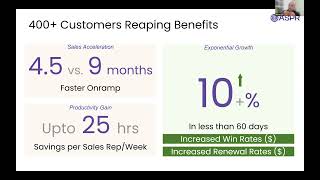
Ganesh, CEO of Aspire, presents an AI platform that frees sales reps from back-office work. Reps spend 72% of their time on non-selling tasks. Aspire's ten AI agents handle CRM updates, meeting prep, note-taking, and coaching, cutting time-to-quota from 9 months to 4.5 months and saving reps 6-8 hours per week.
Chapters
You. It's exciting to come here and share something that we have been passionately building for the past two years. My name is Ganesh, Founder and CEO of Aspire. ASPIRE stands for Automated Sales Performance Replicator. What we are building is primarily multiple sales assistants that can take care of the back office tasks so that every sales rep can focus more time in selling. And the goal for us is make every sales rep the best sales rep in the organization. So the journey for us was was basically starting with interviewing a bunch of Head of Sales, Chief Revenue Officer, Head of Growth officers, asking them two simple questions. When we started this venture we didn't want to just go out and build an application that doesn't mitigate the pain points. We wanted to first identify what is a pain point seen in the go to market strategy. And one of the key things that we heard again and again from all of these 150 plus interviews that we have done asking two simple questions. What is your pain point? What I do to mitigate the pain points. As consistently we heard up to 72% of their sales team members are spending time on non customer interactive activities which leads to 30% or up to 30% revenue loss. That was a big eye opener for us when we tried to peel the onion in terms of what those sell 72% meant it primarily focused. They focused on hey, my sales members are focusing on too many sales tools. Now we are focusing more on process versus connecting with the customers. The second biggest pain point that was called out again and again was CRM updates. How do you make sure that the CRM's data is hygienic? How do you make sure that it's up to date so that we can really project all the numbers right? The third thing that was called out was the lack of preparation when it comes to pre and post meeting. Especially before you get into the call. Know more about your customers stakeholders coming out of the call. Make sure that you can keep your customer, all your customers prospects as well as the stakeholders informed. If you don't do that right, everything just falls through the crack or many times. Many folks are just spending a lot of time just getting things right versus focusing on the right messaging to the prospect or to the customers. They also talked about searching for information is always a hassle. How do you get all of this in one place so that the sales guys are not just focusing on where does the data reside versus focusing on what can be sent to whom at what time. They also talked about lack of coaching and training interchangeably. There are A lot of good content that is available in the market. But what we heard was primarily all those content are not contextualized to the selling motion, which becomes harder for the sales reps to understand. What does it mean when I'm trying to sell to my prospect or customers? They also talked about lack of consistency in terms of creating winning documents. And also how do you avoid hallucinations when it comes to numbers. So when we heard this again and again, one of the key things that we focused on is how do you build a platform which is holistic in nature and working with large language model. One of the key aspect is context. Context is the most important thing. If you don't build the right context, everything just falls apart. So we focused quite a bit of time and attention in building this resident knowledge. What is resident knowledge? It's basically finding the patterns of wins and loss. How do we find that pattern of wins and loss? Looking at email exchange between the seller and the buyer. That's where we get trolls of good data. If you can add transcript to it, nothing like it. CRM data barely gets filled up, but it gives us a structure and calendar, gives us enough understanding of whom you're meeting for the day. With just those three sets of data we can really understand up to 80 to 85% of what's happening within your business. You can add more data sets like sales playbook, drive, confluence message web pages, but with those three sets of data we are able to really jumpstart the understanding of what's happening within your account so that we can put that brain on top of each of these agents. The first three agents are helping with the meeting workflow automation. You will see the demo of that. The fourth one is related to basically creating a bunch of documents aligning to the winning documents that you have within your playbook. The fifth and sixth are related to how do you get contextualized coaching and training in the movement so that it becomes very aligned to the opportunities that you're dealing with. The 7th and 8th are related to knowledge and how do you extract the knowledge? Especially not only the knowledge. We also create the digital twin of your ex employee so that you can talk to that ex employees so that the on ramping becomes easier for new reps coming into the role. And the eighth one is related to how do you ensure that you have the best sales reps mind sitting on your website talking to any of the prospects. And the goal of the AI seller chat is not to replace SDRs, but the goal is to ensure that it can augment the conversation to appropriate SDRs who can do the demo in the process. And the 9th and 10th we will be releasing by next week. It will be brand new agents. The ninth one would be taking notes for especially offline conversations that are happening. And the 10th one is going to to be helping send send a lot of emails based on all the information that it has captured over a period of time. So you can also use this as a means to augment your virtual csm, especially when you're dealing with low acv, low ARR opportunities. The goal of all of these agents is to not only help the organization but really avoid confluence. The way we are able to do that is we are able to create statistical tools that can couple with large language models to avoid these aspects of confabulations. Which literally means that the large language model is always trying to give you the best answer. If it doesn't have. It's always trying to please you with the right answer. Maybe the answer is not right, but it doesn't have the ill intention. It's just that it doesn't have the right context in place. And we try to avoid that by using statistical tools which coupled with language model which really removes that barrier. When it comes to dealing with numbers. The play that we are going after is on the left side. You have this traditional way where you have from the top to bottom. When you go from awareness to engagement and acquisition to success and growth, there are different sets of tools. All of these tools Pregen AI did a fantastic job in doing a point solution. But when it comes to stitching this end to end, it really breaks down. That's where we try to come in. We try to fill in the gaps and the goal is to consolidate smartly in the long run. What is interesting is because we are focusing on tactical brunt work, we are seeing great amount of traction. In just eight months we have crossed 400 plus mid market enterprise customers. And the reason is very simple. The customers are seeing faster on ramping of their sales members. Instead of nine months to get to a full quota, now they are seeing about four and a half months to get to their full quota. Four and a half to five months. The best part is we are able to save on an average 6 to 8 hours per sales rep per week which is we are giving one day back to every sales rep. And what we are seeing in that process is because their mind is taken out from the operational task now they are spending more time with the customers and the agents are also nudging the sales reps to do the right things at the right time. Which really helps you to start winning more conversations and also helping you to increase the renewal rates in the process in less than 60 days. So how does it work? The onboarding process is we kept it as light touch as possible. So from the admin perspective, say if the company decides to work with us, it takes roughly about 60 to 90 minutes for the admins to set it up, connect all the systems. It takes us on an average a week for the context to come to life. This is where the resident knowledge comes to life which is the brain that sits on top of each of these agents. The what it does, it finds the patterns between your wins and loss. And once it comes to life, we onboard the users. The onboarding of the users take less than 10 minutes. The moment the users are onboarded into the system, the first thing that happens is that the AI seller comes to life. It is interacting with all the prospect who is coming to your website. It not only does that, it also understands the pre qualification questions and tries to see which sales rep would be the best to connect with. And not only tries to identify that it routes it to the appropriate sales rep so that it's connecting the right prospect to the person who can do a good demo with respect to what their pain points are. Once that connection is made, the pre meeting agent comes to life. It understands that there is a customer that is going to meet with the sales rep. It goes and finds out who is this customer, what is their background, who is the stakeholder, what is their background. We work with multiple data providers. We are gdpr, ccpa, FERPA compliant, which means that we do not scrape any part of the Internet. We collect all these data sets, try to understand the interest and intent of every company, every stakeholder and we put together what would be the right discovery questions, what would be the right meeting objective and the agenda that the sales rep should be prepared. Getting into the call and not only we prepare that, we also send the nudge to the sales rep saying that through a slack, through a teams app or even through email notifications saying that hey, there is a meeting coming up in the next 30 minutes or next one hour depending on how you set up the notification and automatically it will tell you these are the talking points you should be aware of. So if you click on any of these, any of these links which basically it's an email with a link that is being shared. Hey, prepare for this meeting. When you click on the link it basically takes you to this page, this is how in reality the page would look like for a given replacement. They are looking at a meeting that they are going to go into and not only it shows the number of people who are attending what time it is being scheduled. They can quickly see what has been the recap for this particular conversation. When was the last time a communication happened? We go out and try to figure out what does this company do? Is this a private company? Is it a public company? If it is a public, look at their 10k forms. If it is a private, look at their LinkedIn profile. Crunchbase we have multiple data sources that we go after and we not only collect the data, we have the context of what the sales rep is trying to sell. So we create these cards which are very specific to that selling motion, understanding what stage this conversation is happening and we also try to understand what is the news that is relevant to the sales rep selling motion. Not only we do that, we also do the same for every participant coming into the call. We look at gdpr, ccpa, FERPA compliant data about every participant coming in and we try to identify what would be their role irrespective this is tagged into your CRM or not. We try to identify not only their roles but also try to to identify their interest and intent coming into the call. And this includes variety of data that we go after. LinkedIn, blogs, patents, any podcasts that they have attended recently and that really helps you to understand who is this person, what would be their interest and intent coming into this call. The same is done for every stakeholder that is associated to a given opportunity and we also pick up the coaching tips that will help you to improve yourself connecting with the stakeholder. Not only that, we put together the meeting objective, meeting agenda as well as the appropriate discovery question so that you are prepared getting into the call. Say if you are a really busy person, you don't have the time and luxury to read all of this. We also give you a different mechanism to absorb this content. You can even listen through this as a podcast. So we have two agents talking to each other. Joe is really good in asking questions. Megan is an amazing coach. They are talking to me. It's a two and a half minutes podcast so I can, if I don't have the time to read as I'm driving to work, I can just play this podcast. I'm just just going to show you an example of how this this sounds. Hey there, Quick prep for your meeting with ASPR AI. They're in the middle of their trial period with our platform and you've built good momentum. Your main objective today is to address their salesforce integration needs while reinforcing the ROI of our solution. Two key things from last time. First, they want pre meeting insights to be saved after meetings conclude. This is causing friction so you get the sense I can listen through the conversation, I can ask questions, I can even chat so that it's more conversational and interactive in nature. As soon as the call is done it automatically moves into the past meeting. We capture the transcript, we try to identify what has happened within the call and we create the overall sentiment. We understand the participant sentiment, we capture the key points, we also capture the action items and next steps. Not only that, we also capture the CRM updates that needs to be sent automatically back into your CRM. Coaching tips where we benchmark every salesperson aligned to the best selling motion in the past 12 months. This is where the resident knowledge tries to benchmark every closed one and close last it tries to benchmark the best selling motion and gives me what can be the score and how do I improve myself. Not only that, it also captures the follow up email. All of this is done in a flow so that it doesn't break where you are in your sales process. As soon as the post meeting is complete it sends the information to the CRM agent and this is a view that is created in HubSpot. The same view is created in Salesforce. We are also creating. We are also agnostic. We are agnostic to any CRM. So we are right now doing it for Salesforce, HubSpot, Sugar, CRM as well as Zoho. For us. We are adding more CRMs as we speak and we create a view within your salesforce so that you don't have to even come to aspro. We come to you where you're spending most of your time in the day. So we create a view where you can see what has happened so far, what what needs to be done next. We also create the metric capture and the good news about the metric capture is we not only create a summary. This not only has transcript but it also has insights about the information that is coming from your email. So it has best of both worlds. We can align to Medpick. We can align to Bant or Spice. Those are the three frameworks that we are aligning to currently. We also assign automatically the task with the owners and the due dates and the recaps are added back into your CRM. The best part in this process is we also enrich every contact back into your CRM not only we enrich with respect to what information we find online and their potential roles, but also we add the people who are not even added into a particular deal or opportunity. Say a given person who is part of that opportunity is coming into that call from the customer side and that person brings in four other people. Now the sales rep doesn't have to go back and add every contact back into your CRM. The system automatically recognizes who they are. It automatically tags them to a given opportunity or a deal and also enriches all of their contacts. So this really keeps your CRM up to date. As we are talking about, as we are talking about the next steps towards CRM, we not only help you with identifying the coaching tips per meeting, this is basically the focus area that is sharing to me as a part of looking at the sales performance and engagement effectiveness metrics, but it also is able to do it at an opportunity level. An opportunity may have multiple meetings and we are able to identify from all the meetings not only the overall score, but what can be the focus area and what can I do differently to win this conversation? All of this is again aligned to my past 12 months of willing motion within the company. And not only we tell the focus area where you can do well, but also we break down in areas where you're doing well and the impact of it in terms of closing the conversation, but also the areas where you can improve yourself. And if you don't pay attention to this, what would be the impact of it in closing the conversation and why you should pay attention to this? Right. As you see all of this happening from a meeting to opportunities, we actually abstract this up at an individual level. And at an individual level what we show is we create industries first dynamic and personalized 30, 60, 90 learning plan. And we come from the world of creating assessments. That's what we did in the previous company, especially for sales organization. And one of the key things that we learned in the sales part of the assessment is if you tell a salesperson focus on three things, you would see they may not be able to focus on all three at the same time, but if you tell them focus on one thing, there is 90% or more chance they not only focus but also they focus on changing the behavior. That's exactly what we are doing here. We basically build this as a part of the framework from medpix, PI store Bant. It also includes a big five Holland Occupational insight and Garden's learning style. All of this put together is where it basically tells what would be the one focus Area that would give me the biggest bang for the buck. And this is personalized to me as a part of the selling motion. And we track this on a continuous basis. Every conversation I'm having with the customer, it's telling me if I'm doing well or not. Because it tells me week over week how do I improve myself in the process. So not only we do this for every individual. If you are a manager, this is abstracted at an organization level. So as a manager, you can see for every person what can be the learning path that would really make them successful. As we're talking about coaching, we also augment the coaching with training. And this is the best part about the training. We do not bring any external content. We create the content based on your winning or losing opportunities. So as soon as a opportunity moves from in progress to closed lost or closed won automatically, we create a podcast, training podcast. And as an example, I'm just going to play this out for you. This is an opportunity that I recently lost. And in this case, there are two agents again talking to each other. Joe is really good in asking questions. Megan is an amazing coach. As they are talking about this deal, they're talking about me as a sales rep. How do I improve myself in the process? So the whole content is created out of the opportunity. So as I'm listening to this as a sales rep, these are generally seven minutes long, no more than seven minutes long. We try to keep it short, but we also try to keep it interactive in nature. So you not only can listen, but you can also interact with and understand the reasoning behind what they are saying. I'm just going to play this out just as an example. So I've been looking at this rafter 1 Early Adapter Program deal and there's something really interesting here. What do you think when you see a $5,000 deal like this?
You know, at first glance, $5,000 might seem modest compared to enterprise deals we typically discuss. But I'm actually intrigued. Early adopter programs are strategic gold mines.
When how do I win this account? So now Megan is not only having the full context of this specific deal, she has the full context of all the deals that have been closed. One with similar size of accounts. And now she will come back with a prescriptive way for me to win this account.
You need a complete reset on this one. The deal went cold after promising early discussions. I'd start by re establishing trust through targeted success stories. Send Tony a personalized case study showing how one of your 400 plus customers achieved double digit win rate improvements. Then address the pricing elephant in the room with a custom ROI calculator That translates your $25,000 $65,000 pricing tiers into concrete business outcomes. The transcript shows Tony never responded to pricing proposals, which is a classic pain point indicator in the MEDPIC framework. Also, you've been running a one person show with just Tony. Expand your stakeholder map by requesting a coffee chat to discuss those Salesforce partner connections he mentioned. Then pivot to a broader team demo. Finally, revamp that early adopter program with specific benefits around the AI chatbot functionality he showed interest in during your October call. The relationship deteriorated because you lacked a structured approach with clear milestones. Fix that with a defined three stage RE engagement plan.
So you get the sense basically I can have a conversation and get contextualized response and I can even bring in my static documents, my sales playbook. We can create podcasts out of it. And now you can make it more interactive in nature. As we are looking at all of this, we also create this resident knowledge engine. What is resident knowledge? This can also reside in your slack, it can also reside in your Teams app. And you don't have to be even in aspr. You can ask any questions which can be internal knowledge. You can even infuse the external knowledge into this. But the beauty about this is this is the first time to my knowledge in the industry we create the digital twin of your ex employee sales reps. Anybody who leaves the company, their data is generally sitting in it repository. We take that data and dump it into a folder and and we create the knowledge and Persona of that person. And now I can chat with that person as if that person is still in the company. I can ask questions like hey what happened in this deal? Or if this person was really good I can even ask I'm going to meet with this customer. What would be the best way to approach this customer? So we capture the knowledge as well as the experience as a part of helping new reps ramp into their role. And the same can be also extended towards your existing team members to make sure that they can chat with this person who is no longer in the company to understand their knowledge base. As you are looking at this, we also do the document creation. There are multiple documents that we create. So if it's a closed winning document, we basically create opportunity briefings. We create case studies, we create AE to CSM handover documents. If it is an existing account which is in progress, we also create SDR to AE handover documents. In the next 30 days we will be adding SOW proposal and RFP that can be created in one click of a button or you can even use chat to ask these questions and it will create the document for you. And we also create top reasons why accounts are getting lost or won in the past 30, 60, 96 months, 9 months, 12 months. And not only we create a pattern in understanding what's working, what's not, we also give you a prescriptive measure what you can do differently compared to your winning deals in the next seven days, 14 days, 30 days, 60 days, 90 days to bring some of these back to like. As you're seeing this and I'm just going back to the presentation now, as you're seeing this, what we covered so far, if I can go back here, what we have covered so far is how do you see the pre meeting coming to life, the post meeting as soon as it's done. It's sending not only the appropriate collaterals to the right stakeholders, it also sends the information to the CRM agent which automatically updates all the records in your CRM. The coaching agent helps you with the meetings, it helps you with the opportunities. It also helps you create the dynamic 30, 60, 90 learning plan. The podcast training agent is taking that data, creating content that can nudge you at the right time so that you can listen through the conversation and understand how do you win certain conversations back. The document agent helps you create the documents as you go through the pro process. The resident knowledge agent basically helps you to answer any questions that may be contextualized in nature. Right? So all of these agents are doing one thing. If you look at it, it's not here to replace a human. End of the day we still lean on the sales rep to take the actions. What they are doing is making the life of the sales rep easier so that they don't have to worry about the brunt work. And as we do that, one last thing to call out here is we also show for every account we show this view and this account view is basically telling anybody who's looking at this account, especially the managers, when they want to know hey, what's going on within the account. We create this view so that the managers don't have chase, the sales rep and the sales rep don't have to keep updating their managers in terms of what's happening within the account. We basically capture what is the high level status, what are the aspects of the sentiment seen from the conversation, what the key contacts and more importantly what are the challenges seen as a part of closing some of these conversations and based on the challenges, what can be the next steps that needs to be done right? All of this in one place, along with the coaching tips, along with the podcast and giving you insights that may be relevant to coaching, which can be relevant to meeting, which can be relevant to a doctor document in place. And last but not the least, we also create this dashboard view which gives you a quick understanding of the agents that are really helping you to close the deals. This is basically telling me all the agents that are helping me to close the deal and by doing that, how much time I'm able to save for a given month. We also are able to show how is my development plan over a period of time. And we also create this unique view where it's telling me for a given calendar year for all the customers that I'm meeting, what is the sentiment seen for every conversation that I'm having with the customer for a day? Green being positive, yellow being neutral and orange being negative. So this gives me a quick overview. It also tells me how I'm trending with respect to my sales coaching and it also is telling me what is the. What is the benchmark scene with the rest of the team members in one place. Right. The same view is then extended towards admins who are able to see it for their entire team. And for the admins, they primarily get a view in terms of not only the lay of the land, but also specific to a given individual. They also see what are the parameters that would help them to move the conversation forward. Especially the 30, 60, 90 learning plan is something that really helps them to understand who is doing well and who is not. Over a period of time. You can see we show the development plan seen for every person within the organization and they can click on this and they can see what they need to do next. Right. Just to close it out, what we are doing here is we are also offering 30 days, no strings, no cost or no, no cost and no strings attached for anybody who wants to try the solution out. The reason is end of the day, we have seen this having an enormous impact. In 30 days and 60 days, we start seeing the movement with respect to your renewal rates as well as your closing rates. Being on the positive side, and this is my contact on the left side, you see my LinkedIn profile, you can scan and connect with me. And on the right side you see my email address.
Wow.
A lot there. Yeah. That is incredible. I mean, I always make. Because you kept showing more and more and more. I mean, it really walks you through the Entire process. You really do unlock the sales rep to go, let them sell. I love it. Thank you.
So Ganesh, my question is, if a sales leader in our audience could only implement one AI agent capability in the next 90 days, what will give them the fastest and most meaningful return?
I think the CRM update agent. Yeah, I think that is the brunt of every pain point I have seen talking to every sales leader. If not anything that would really make their life easier to get clean data into their system.
So how do you get salespeople to trust the AI agent that's updating their CRM without them touching it? How long does it take to convert them that this is okay?
That's a good question. Really good question. So the way we, we give them a controller so we don't directly feed everything back into your CRM the first one week we ask them to review this to make sure that it's capturing all the right insights. And when they see the confidence being right is when they turn it on and automatically will start updating. Till that time they will review it and they have to push, hey, send this back to the CRM. Right. So we ask them to do it at least for a week to gain that trust.
So what about data governance and security? What should sales leaders insist before they're signing a contract with an AI agent? And there's also probably an AR issue because if the employee does not consent to having his or her knowledge being carried forward in the company, do they have the right to say no?
Good question. So definitely there is a consensus. There is definitely the users have to consent. They have to opt in. 3 We are SOC2 type 2 and HIPAA compliant, which means that we really take the data with utmost pristine and we also give the option to the customers to host everything on their side, which is the database hosted on their side, even the large language models being used on their site, which means that the data never leaves a premise. So that makes it a lot easier for them to start using the system at scale, especially the mid market enterprise. They do not want any third party vendors coming into their system.
So everybody knows that the, the knowledge that the AI agent is learning, you know, is the real question here, that is how is that institutional knowledge captured and how do you know it's accurate and how do you know that it doesn't replicate the habits of the average performer?
That's a good point. So when we go through the patterns of wins and loss, it keeps looking for the past 12 months, which has the highest ACV, ARR and shortest time to win. And we also look for the benchmarks with respect to the 10 parameters that we do as a part of benchmarking every sales rep. So we have three parameters that converge as a part of finding the best, I would say opportunities that we should benchmark and that is used towards basically replicating across the organization. So we try to. This is a dynamic process. So every 12, every month automatically shift towards the past 12 months and it readjusts itself in the process. And definitely that's the reason there has to be a human intervention. We are not here to basically directly send this collaterals to the stake to the customers. We request the sales rep to review this so that they see the value before they send it to the customers. We would never take that up. We would never take that step of directly connecting with the customer because it breaks the philosophy of what we are going after.
So Mark is the guru about integrity and selling because he wrote the book about it. And what I trying to tease out of you, Ganesh, is what is the one question that sales leaders should ask an AI vendor immediately to separate the real solution from the ones that just look good in a demo.
I think the most important thing is the data. One is basic thing is are they compliant to some of the stringent loss like Sock 2 Type 2 HIPAA, which is very important in my opinion. That's like the basic bare bone. But they should ask the question, are they able to host the data and also use the company's large language model? Because that really shows the ability for the companies like us to not use that data for our benefit. But it's been used for the benefit of the customers. We provide that option and that kind of gives you the understanding. And definitely there are contractual agreements that we get into play. But those two becomes like the litmus test for many of the companies to see if there's a real vendor or not. That's just my perspective.
Mark, your thoughts?
Yeah, absolute. I buy into it. It's the security of the data. That way it's going to give the salesperson confidence that the answers it's coming back out with they can take to the bank, they can take to their customers. So it's absolutely spot on. So thank you.
What does the realistic timeline look like for ROI on your tool?
We have seen 60 to 90 days before they start seeing the value coming out of the tool. Immediately right off the back there are anecdotal. We can show the time saved, we can show the processes that are automated. Those are all productivity improvement. That is Right off the back. Within a week you will start seeing those numbers showing in the dashboard, but moving the winning rates as well as renewal, assuming there are no bigger aspects of influence that happens within a given opportunity, you'll start seeing that movement in 60 to 90 days.
Can you put up the slide again where people can get in touch with you?
Of course. Let me do that.
Ganesh at AI. Oh, actually I. I love your mission. Take every sales rep. Take. Make every sales rep the best.
Actually, there is a typo. It's aspr.
Oh, I see.
Ah, there we go. Good. Glad we put it. Glad we put it back up there. Thank you. I'm glad you spelled it out because that's when I, I thought, oh, that doesn't sound right, like I misspelled it.
We have one attendee says looking forward to learning more about your solution. Ganesh. So awesome. I hope he will use the right email address to reach out to you.
Yeah, yeah, I hope so too. Thank you again for the opportunity.
Well, thank you for sharing what is possible today. So my final question is five years from now, what, what does selling going to look like?
I don't even know how it's going to look like in two years from now. Five years is very distinct forward, but I'm hoping, my hope is in five years, humans are able to leverage the true strength. As a seller, you have a strength which is connecting with people, making sure that you can always keep an eye on the revenue. They have utmost time to just focus on those two elements and they don't have to worry about anything which relates to the back office task in the next five years.
Yeah, the future becomes more unpredictable with every day.
Yeah, it is, it is.
One more question. What role does the AI tool play in setting call objectives and how does the tool ensure that the objectives are relevant to each customer?
Good question. So when it comes to call objective, we have three data sets that influence the call objective. One is an external data set which basically says who is this customer? What is the latest news? What is the latest news about the stakeholders that is relevant to my selling motion product and service that I'm trying to sell? That is one part of the influence. The other part of the influence is if that customer we had previous conversation, what were the tasks that were discussed, what are the next steps that are coming to play? And the third part is any framework that you're using, MedPix, spiced or banned. All of this put together along with the coaching insights where I can improve basically determines what would be the meeting objective that will help me to move forward with the deal. And the meeting objective becomes more tactical as you're trying to close the deal. It is very strategic when basically you're starting the conversation because it's having higher influence from outside versus having the internal knowledge. But as you progress through the deal, the internal knowledge starts influencing more than the external knowledge.
Interesting. One more comment which is AI explainability. How do you arrive at your input, your output?
Good question. So there are a couple of ways. Within the tool we allow every user to give thumbs up, thumbs down to all of these feedback that we provide, insights that we provide, documents that we provide. So that is a direct feedback that we get from the users and seeing how close or far it is to what the outcomes are. We have put very strict guardrails so that AI doesn't hallucinate. And we have put statistical tools so that we don't lean on large language models when it comes to numbers. So one part is technical, which is guardrails with statistical tools to avoid any off conversations. The second part is making sure that it's grounded to just the data, we are not influenced by something else in the process. And the third part is for sure, the users who give us a feedback looking at the insights that we provide, thumbs up, thumbs down, and they have the ability to comment on every insights that we provide.
Awesome. Well, we. Sorry, we ran a little bit over, but this was a fascinating topic and a very important topic because the future of agentic AI is here now and we need to learn more about it. And thank you, Ganesh, for educating us and sharing your wisdom.
Thank you. Appreciate this opportunity, guys.
More from Gerhard



What Selling Looks Like When Your AI Agents Have the Context Your Sellers Do

Better Conversations, Smarter Support: Wearable AI in Business






When Scarcity-Built Systems Meet Abundance - The Judgment Gap in AI-Powered Sales Leadership
