AI Won't Win Your Prospect's Trust – You Will
C. Lee Smith (CEO, Sales Fuel) argues that AI alone cannot earn prospects' trust — human credibility is essential. He frames credibility as the foundation for influence, cites Sales Fuel research (24% of Americans trust salespeople; 42% view AI content skeptically), and warns about AI risks (hallucinations, poor sourcing, legal consequences). Smith offers a formula: AI + BI (business intelligence) + EI (emotional intelligence) = ROI, and recommends transparency about AI use, creating/answering ethical AI policy questions, validating AI outputs with humans, and using proprietary BI and EI to differentiate sellers. He points to resources: the book Sales Cred, Cred Talk podcast, an ebook 'How Credible Is AI?', and training/assessments at salesfuel/salescred/seeleysmith.
Questions this video answers
24% (Sales Fuel 'State of Credibility in America' survey)
42% (Sales Fuel 'State of Credibility in America' survey, fall 2023, ~1,000 respondents)
Salesforce customer survey: 71% said it's important for a human to validate AI output (cited in the talk)
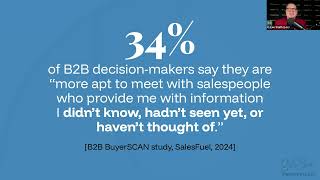
34% (stat cited about B2B decision makers)
68% of humans score higher on emotional intelligence tests than AI; AI scores higher than 99% of humans on IQ tests (presented as recent research in the talk)
Chapters
Yeah, let's go ahead and get started. So, obviously, the answer to the first question is that because AI won't win your prospects trust you will, because AI lacks certain human qualities then to make a human connection. So what I'm going to be sharing with you today, basically, is what to do about it. But before we really dive too much into this, what we have to really understand is, is, you know, this factor of trust. So as salespeople, we all want to make an impact. Obviously, we want to make an impact on our sales numbers, but we also. And we want to make an impact in our company, but we also want to make an impact on our clients, businesses, and also we want to impact people personally. Before we can, though, make an impact, though, we first have to influence people. And this is something that is the essence of the sales job, right? It's persuasion and. And, you know, not. And some people will say selling people. I would not say that. I would say influencing people. But before you can actually influence somebody, you then have to. You first have to win their trust. And so trust is a term that gets thrown around a lot in the sales world. We talk about wanting to be a trusted advisor and all these types of things. The thing is that there's one key component of trust that often gets overlooked.
And.
And I want to dive a little bit into that today because this is a key component about how to win trust, and that is first about establishing, building, maintaining, and not losing your credibility, particularly as a salesperson. So credibility is a prerequisite of trust. Or put another way, credibility is the foundation of trust and influence. And I am so jazzed about this particular topic so much that I wrote a book about it. Sales Credit Buyers Qualify Sellers. And, you know, I've made it really a mission of mine then to take a look about how salespeople are perceived in the world, you know, because good salespeople are often not given the respect that we're due. And it's because, like all industries, all professions, where we are all judged or prejudged by our lowest practitioners. And so the problem here is that only 24% of Americans believe that salespeople are credible sources of information that they can use in their everyday lives to make better decisions. So that's what we're starting off with. And when I. When I present about credibility and insight, selling and everything like that, sometimes I'll get, people come up to me and kind of say, oh, wow, Lee, that's great. I never really thought of it that way. But, you know, it's like, my clients love me. I really don't have a credibility problem to which I usually tell them. It's like, the fact is that the sales profession has a credibility problem or whatever. And by extension then you do too, initially with prospects who don't know who you are. So let's dive in, diving into that. Maybe AI can help. Right? So let's explore that topic. The issue here is that 42% of Americans don't believe that AI content is consistently credible. And both of these stats come from the state of credibility in America study that my firm, Sales Fuel, has done over 1,000Americans. We last did it in fall 2023. We'll be updating that later this year. But the problem remains is like, so salespeople have a problem with credibility before we even have a conversation and then use AI. Content is also viewed skeptically and for good reason. I think all of you will remember the story about Google's AI engine at one point telling users then that to put glue on pizza. And of course, this is an AI generated image here. The thing is that our studies also show that most people know about AI through what they see on tv. And so whenever a story like this happens or whatever, okay, it's sexy, juicy and everything like that, they're going to run it in the media and everything like that. And it's going to further erode the credibility of AI even further. So I want you to think about not in terms of can AI build the trust, but there's actually a formula, and Gerhard alluded to this a little bit yesterday, and that is AI plus B BI plus EI equals roi. So we can't rely on AI alone. We have to add business intelligence to it and emotional intelligence, our own emotional intelligence, to build the credibility and trust that's required to win sales. Let's start with AI. We want to be careful to use AI to build our credibility, but not call it into question by using it blindly. And this is one of my concerns about how salespeople can, if they're not careful, can get it on the wrong track. So many salespeople, for example, use their existing tech stack basically as a. As a crutch or as a shortcut, whether it be marketing automation or anything else like that. And if we do this, if they do the same thing with AI, you know, that's going to erode the credibility of the sales profession in general. It also creates an opportunity for us to stand out and differentiate ourselves by doing it the right way. But this is something that we have to take into consideration in doing that. The biggest risk is that AI chatbots currently do what good salespeople never do. We've learned, and sometimes learned the hard way, that when we're asked a difficult question that we can't answer, we now know basically not to try to BS our way through the answer. It's like we say, either I don't know the answer to that, but I've got a team of experts or whatever that can get you the information, or I'll research that and get back with you later. And so many times that AI chatbots always sound smart, right? But they're sort of like your blowhard brother in law, right? They always have to be the smartest person in the room, no matter what. But that doesn't mean that they're right. And so that is the biggest risk. And I was reminded of a story about a New York lawyer who got fined because he submitted bogus case law in a briefing to a judge. Judge didn't love that very much, but looking for this information. Then another story popped up of a lawyer in Canada that did the same thing. And then just a few days ago, one of the largest law firms in the country could be facing sanctions for doing the same thing by using case citations generated by AI that don't actually exist. So that's what I'm talking about here. So much to the point where hallucinations and bias and just plain factual inaccuracies have led 71% of the customers that were surveyed by Salesforce last year to say that they believe it's important, really important for a human to validate the output of AI. So again, even if you're using AI, there's where the human has to be part of this second biggest risk right now, that AI has trouble sourcing its information. So even if you use a deep research part of AI that perplexity has, that ChatGPT now has, it's like the problem of it is if you ask resources, it'll give you sources. But if you actually click down on it and actually research the sources, that content doesn't exist, the link doesn't work. Or if you go on the website and search it. So if you're called out by a client with AI generated content, where did that come from? Or I don't believe that's true, that's going to be a problem. Or worse yet, if they wait till you're gone and they try to find it themselves.
What are they going to think about your credibility when that happens? So those are some of the dangers that we face in doing that. But here's what to do about it. First thing, transparency is expected. So always disclose the use of AI on anything that is client facing. So if they're interfacing with an AI agent instead of a real human, disclose that. It's a great way to insulate yourself from hallucinations. Also is by labeling AI content with a proper disclaimer. So what we do at Sales Fuel, for example, we clearly talk about, we clearly show this is what our proprietary exclusive research you can't get anywhere else. That's this bucket. And then here's where license information, we clearly give you a citation about where that information came from. And then we put a little icon with a disclaimer showing you, okay, this is AI augmented information. So that way you always know the source and makes it easier for you to consider the source. And, and when you're deciding whether to use that as insight or not, you also have to be able to answer questions about your company's ethical AI policy. And here's some of the questions that I'm talking about here. If your company doesn't have an ethical AI policy, this is a leadership opportunity for you basically to start having that conversation internally. Then to help develop your company's AI policy. They might call it ethical AI, they might call it responsible AI, but those are just some of the questions then that go into a good ethical AI policy. So what you can do with that then is add BI to the equation. So business intelligence provides the accurate insight that I can't access from the open web. Because we all know that information on the Internet is always correct, right? So that's a problem. Even if AI is browsing the Internet for you and everything like that, it's limited by what it can find. That's not behind the paywall. So why this is important is that 34% of B2B decision makers say they are more apt to meet with a salesperson, take a call from a salesperson who provides them with information either that they didn't know, hadn't seen yet, or hadn't thought of. And so this is the essence of selling with insight. So you can use bi, then to stand above and apart every other salesperson that's using AI, because first thing, buyers have already used AI to help them solve problems they don't need, don't want AI generated content from you, because they can do that on their own and probably already have. Relying solely on AI for insights does nothing to separate you from competitors because they're using AI too. And in the age of AI differentiation, while it's always been important, it becomes even more important in the months and years going forward. Use intelligence that your competition and your prospect doesn't have to provide real value and insight. And so what I mean by that is the most insightful, useful and valued data is often password protected. As a matter of fact, we're actually seeing data and reports that used to be on the free Internet now going behind paywalls or going behind subscriptions. And AI has trouble getting a hold of that. So what I mean by that is proprietary research that your company has done. You might get a top line cursory overview of an industry, but if you want deep analysis and everything like that that your company has done, that's relevant then to your ICP that's behind a paywall. Usually license data from trusted partners. Case studies don't sleep on internal accounting systems and CRM system data. For example, one of the clients that I was consulting with and training recently, they're a large franchise group in the automotive sector. One of the things that they do is that they create benchmarks from internal accounting data about what parts are being sold, what service is being sold, at what price, at what profit margin. And they're actually able to do consult and some of their lower performing franchises then on where they're falling behind the top performers and what they can do then to elevate their performance and their profit margins and their revenue. So that kind of data is far more useful and far more valuable to a prospect than any generic thing that AiI is going to research for you. Lastly though, it's most important then to talk about AI because humanity is your sales superpower. It's what AI does not have, it's what BI does not have, but it's what all human beings have, at least to some extent.
To prove this point, here's another bit of research. Data is that 68% of humans score higher on emotional intelligence tests than AI does. By contrast, AI scores higher than 99% of humans on IQ tests. This is where Gerhard likes to say that AI has high IQ but comparatively lower EI or EQ. But I'm using the term EI for this for the presentation today. This is all latest research as well. The advantage here goes to you as the human being. Soft skills separate man, or in this case, human from machine. So the more you can develop the soft skills that you have, the more advantage you will have from people that are just using AI. AI has to fake emotions, it has to fake life experiences, so it doesn't know pain, it doesn't know joy, and it doesn't know the anxiety that a buyer might have. Oh my God. If I make the wrong decision, I might get fired because layoffs are looming. AI doesn't understand any of that. But you do. Using AI in sales though requires critical thinking. So much then that we created and I co wrote this ebook How Credible Is AI? A Critical Thinking Guide for Sales, Marketing and Leadership with our Senior Vice President of research and it goes all through everything. You need to take into consideration to use critical thinking then when you're evaluating the value of AI generated content. So you can get this ebook then at our virtual sponsor booth here. But also you can go to salesfield.com so remember, credibility is your currency. It takes a long time to build credibility, but it just takes one bad decision, one shortcut and one instant to lose. Or particularly if you go to Vegas. I mean that's a great example. Trust but verify AI always sounds smart, but isn't always right. You need to trust but verify. Garbage in, garbage out. Feeding AI better data allows it to serve you better. You are responsible for your own use of AI. Transparency will go a long way toward earning trust. And if AI screws up and everything like that, you've clearly disclosed that's AI, that's not you. Lastly, sell like a robot. Get replaced by a robot. If it can be scripted, it can be done by AI and sometimes actually done better. EI is your sales superpower. Don't relinquish that. So remember AI plus BI plus EI equals roi. Your sales team needs better AI skills, better business intelligence, better emotional intelligence to build the credibility and trust required to win sales. And so much time when we put a program in place based off the international bestseller Sales cred. Got an elearning app Cred Talk which are the we have well over 100 videos interviews with CEOs, business consultants on credibility, trust, executive presence. We do a psychometric assessment then based on your critical thinking skills. And of course I do live private training classes and everything like that. For your sales team you can use the QR code. You can go to salescred.com to learn more. I'm Celie Smith. I'm the Sales Fuel CEO. I am also proud to be every year since 2018 a selling power leading sales consultant. I invite you to ask me more to schedule a conversation on my website where you can use this QR code to ask me more or go to seeleysmith.com so Joe Gerhard, back to you.
Wow, I am impressed that was a high energy presentation, and it reminded me of a conversation I had with a Harvard Business School professor who talked about trust. And he developed a program for students on how to develop trust and credibility. And one of the things that I took away from that was that if you want to develop trust, you have to be able to put yourself in a position of vulnerability. And vulnerability is laying down your arms and.
And expose your chest to daggers.
Yes. It's also about being willing and able then to trust the other person and let them know that you trust them. I mean, it's just like, like, likes, like. So if you want people to like you, tell them that you like them first. And it's. And the same thing happens with trust.
Yeah.
Dr. Rob Peterson said, drinking from a great fire hose. That's awesome.
People love you.
Thank you, Garrett. I really appreciate that. And, and. And I love people right back. Or if not first.
Yeah, yeah, it is. What goes around comes around. And you are sending out really positive vibes. I encourage you to scan that QR code and go to salesfield. Salesfield.com and your assistant Audrey has shared a lot of links.
Where people can learn more. And I also recommend that you head over to Amazon.com and get C. Lee Smith's book. It's a great read. And also listen to the podcast.
Cred Talk.
Right? Yeah, we have Cred Talk and we also have the Manage Smarter podcast there, which is really about the psychology of management and leadership. And Garrett, you've been a guest on that show and we had a really great episode with you.
Thank you. That was fun. We have to do it again.
See, Lee, I really have to just share this trust. Oh, my gosh. To me, that's like the core of everything. And we've been hearing AI people working together, but it all comes down to trust. And once you have that trust, you can move mountains with people. So I love the fact that you hit upon that and you give this whole worldwide view of how AI is kind of interfacing with humans. So just a great presentation.
Thank you very much, Joe. It's been my pleasure.
More from Gerhard



What Selling Looks Like When Your AI Agents Have the Context Your Sellers Do

Better Conversations, Smarter Support: Wearable AI in Business






When Scarcity-Built Systems Meet Abundance - The Judgment Gap in AI-Powered Sales Leadership
