All Sales AI is Not Equal: Does Your Approach Pass the Six Tests?
Richard Barkey outlines six tests for effective sales AI: it must combine sales best practices, company-specific data, and coaching-led interaction to change seller behavior. He demos iCoach AI in Teams, which generates call summaries, competency assessments, and role-plays, and discusses why adoption fails when companies skip the coaching piece.
Questions this video answers
March 1, 2025.
About 1.5 million words of sales intellectual property.
Chapters
All sales AI is not equal. We've heard quite a few things over the last couple of days about AI solutions. And what I want to talk about today is, yes, some solutions, but more of an integrative view of how sales AI needs to evolve. And of course, many of you will know that OpenAI is about to live stream an announcement in a couple of hours time, which we think is going to be ChatGPT 4.5. So this is an area that's constantly evolving and we need to be on top of things the whole time. Right now I think we have an opportunity to really change the game in sales, as many people have said, but we've got to approach it the right way. So when I think about AI, and we've been very active in this space for a couple of years now, we are one of the world's leading trainers in sales.
Leader in the most recent Gartner Magic Quadrant, happy to be part of the selling power top 20. But I think the vision has to extend to include AI. So not just training humans, but training AI, including AI agents. And when I think about the AI solutions that are out there at the moment, I tend to look at them through the lens that Joe just mentioned, which is the 3D advantage. And this was so some research we did that unpicked all of the different sales skills that you might need around the customer buying cycle, broke them open almost with a hammer and went, what are the key components in each? And it turns out there are three. And some of our colleagues in the industry talk about one or more of these, but there are three that are super important. So the first is insight. Does the salesperson create value through a disruptive insight into the customer's needs, the barriers to achieving their objectives, possible solutions and their decision process? But then also influence, because if you just bring insight, you're an educator. Influence is needed to get people to act. So can you use ethically, use behavioural science, behavioural economics, psychology, decision strategy, to get people to change and to help them with their decision process. But even if you do those two things, you're not going to have access to the right conversations and people won't listen to you unless you also have trust. So building trusted relationships through credibility, reliability, what we call business intimacy and customer centricity. So those are the things that we identified as the fundamental building blocks of selling and actually also sales management and sales leadership. And the research showed that if you are balanced in all three of those dimensions, you will outperform somebody who is very strong in only one of them. So the question that we found interesting was what if you put AI on this? So if you take ChatGPT 4.0, which is about to be surpassed by 4.5, which will probably be a bit higher up, it's essentially insightful, but it generally gives you a list of bullet points and it doesn't influence people to take action. It's also not necessarily trusted because hallucinations are a thing. The amazing deep research function which is being rolled out to ChatGPT Pro I think in the last couple of days actually, sorry plus rather it's been on Pro for a while is much more insightful. It's really, really impressive. If you haven't tried it, please do. And it's more trusted because it gives sources, but it still is kind of prone to error. And also it almost doesn't have a motivation. So it's hard to trust something that doesn't necessarily maintain its intimacy with you. Memory and stuff in AI is going to help with that. On the other hand, we've got things like conversation intelligence tools which for the most part are influential. They'll tell you what you were speaking about, the kind of cadence, what the customer's reaction was, but they're not that insightful because they don't really understand the deep nuances of, of how we sell and what we've tried to build with what we call ICoach AI is something that is trusted, is influential. So it actually uses coaching and other techniques to get people to change their behavior and it brings deep insight because it understands how to sell. So that's the kind of the setup for all of this. And that's why I say all AI is not equal, because a generic gen AI will not perform as well as an AI that is equipped with all of that intellectual property and is tuned to influence seller behavior as well as to just provide bullet points. And I guess we've heard a few times over the last couple of days AI can essentially replace salespeople. It can augment them doing things that they can't currently do by themselves, but essentially it has to enhance them as well. It has to help them get better the human skills. So there are six tests that I've pulled together and my team has pulled together for effective sales AI. And I want to illustrate this with just a very simple initially AI deployment which I will then expand on. I know the BRELLA platform was, was creating a bit of granularity in some of the visuals I was looking at earlier, so hopefully you can read these, but if not, we will Send around some, some of the key slides from this later. So you have an AI engine that's talking to a salesperson. It's important as well that managers have access to that AI and also that other roles like customer experience and marketing are not kept in their silos, but they're integrated in the way that you work with the AI as well. So far, so good. So that could be chatgpt or another LLM like Claude or whatever. Now the first test, and I've kind of alluded to this, is that it has to be equipped with best practice. So if you ask chatgpt4 45 may do a better job when it comes out, but it's unlikely because O3 doesn't you go write me a prospecting email to Richard Barkey or to somebody else to try and get me a meeting to sell something relevant. And if you score that email against the dimensions of insight, does it bring new insight to the conversation influence? Does it get Richard to want to speak to me and to reach out and trust? Is it trusted or is it saying things like I'd love to meet you and love to spend time with you, which is essentially a self oriented thing to say. ChatGPT does really badly on those three dimensions and that's because although it's read a bunch of sales books, they're not at what I call front of mind, they're way back in the training. On the other hand, ICoach AI, which is equipped with about a million and a half words of sales IP that covers the whole range of sales skills from onboarding somebody straight out of university or college into an inside sales role, right up to training CROs at large global companies. ICoach AI does much, much better on those three scores. Now this is us assessing, so you might say we would say that, but in as objective a way as we can. And we're constantly tuning to try and get those scores up. And the way that works is it's equipped with all of this understanding of sales best practice, which isn't really tied to a particular methodology. It's just, you know, if a customer is going to make a decision and make it this year, you need to get them to recognize that there's some urgency and so on. So around the buying cycle we have this curriculum of 3D sales and there's a core ring which is prospecting, sort of opportunity management. We call that creating client value. Going right back to my work with Neil Rackham many years ago. Negotiation, customer success and renewals, account management. Then around the Outside is a more advanced layer. So business acumen and selling to the C suite, similar topics that we heard about earlier today, design thinking for sales, commercial acumen, super important, especially in a world of commercial uncertainty that we're moving into now and then, a supporting layer of 3D agility, product training, account coaching and deal coaching, forecasting and territory management, MEDPIC or some other tool, et cetera. So there's all that best practice which is fed into the AI using something called retrieval augmented generation rag. Now we've developed a very sophisticated multi tier rag with multi pass selection of the right content to inject at the right point in the conversation.
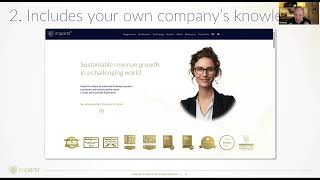
And so we're able to feed in stuff on management, on leadership, on sales, on customer experience, into the AI engine. So it's there at the front of mind when you're engaging with the AI. The reason we don't train the LLM or fine tune the LLM but instead use RAG is that things are changing incredibly fast and it takes too long to train the new engine. So tonight we would have to start training 4.5, whereas we can use it straight away as soon as it's available on the API and just feed in the rag to that. So that's the first test. Is your AI equipped genuinely with sales best practice? And there's a little offer here. If you send us a call transcript from one of your salespeople or a bunch of them subject to NDAs and all that kind of stuff, we can give you the output of our call assessment using this intelligence and compare that with what you get from your current call or conversation intelligence tools. And I think you'll be surprised to see how much more nuanced a true sales AI can be versus many of the platforms that are frankly developed by software engineers, not salespeople. So that's the first thing. The second thing is it has to include your own company's knowledge. Now, Mark Benioff, I won't say he stole my thunder because he's Mark Benioff, but he talked earlier about on the Salesforce site, there is a bot that basically has all of Salesforce's information. We have the same thing. So if you go to Imparter's website, you can see that the top of the home page here, scroll down a bit and there is an AI agent on the screen there that is equipped with all of our sales best practice and also a bunch of information about Imparter. And a lot of the work we're doing with organizations is around not having all of these disparate types of AI. But having as Mark again talked about the data cloud, having a single source of truth of data about your sales policies and products and processes and that feeding into the AI as well as this best practice. So that single source of truth rag which is pulled in from company data that might include your CRM data, products and policies, win loss reviews. Going back to what Tim was talking about earlier case studies, competitive intelligence, skill profiles and so on. So that's the second test. Does the AI tap into your own company's knowledge? The third test is that in order to influence AI has to be able to coach and AI out of the box doesn't coach. It's not built for that. So we have very fine tuned ways to get AI coaching. We developed our own version of the GROW framework which is mapped onto these three dimensions of insight, influence and trust. And you can see here how as you work through the process of immersion, which is the addition to growing, setting a goal for the coaching conversation, defining what they've done so far, what the reality is, the barriers to achieving their goal, what options do they have, not just telling them, which is what ChatGPT will do out of the box, but asking them as well, what do you think you could do? And then helping to define a way forward and what happens if you don't take action. That is how you get people to change their behaviour. So I would disagree a little bit with Tim earlier who talked about coaching as a learning process. The learning is there too, but coaching is about a structured questioning process to help people to work things out for themselves. So that feeds into the AI engine in the third way which is very finely tuned, use case prompts and in this case a use case prompt around coaching. So you can see this picture is starting to evolve. The fourth test and we'll speed up as we get towards the end but this is quite a big one is it really gets people to change their behavior. So most A.I. as I've said, is very low in influence and you need multiple use cases to get human beings to drive change. And going back to Tim's presentation, I did like the fact that there's a sequence there and what he called deficit learning. I completely agree with. So we think about change as a process that starts with assessing the need for learning in multiple ways, choosing the right approach to do the learning, doing the learning, applying it and then making it stick. So assess the gaps in knowledge, skill and critically by the way, mindset, map to your business priorities, choose the highest impact areas to learn right now for the Whole team, but also for the individual, then build skills through and it could be still good old instructor led training. We're still doing that manager led training and that could be virtual or face to face elearning and built into the eLearning is AI role plays, of course, because they're very effective at practicing skills, then supporting application with manager and AI coaching and planning tools and then finally making it all stick with nudge questions that again can be generated by AI to get people over what's known as the Ebbinghaus forgetting curve and making sure they keep applying this stuff. So if I just step back and I look at a lot of the AI solutions I'm seeing out in the marketplace, you've got organizations doing role plays, you've got organizations doing call assessments. They're sort of missing the point because really all of these different use cases have to tie together. They have to use the best practice, they have to use your data and they have to get people to change their behavior. So if I work around that change process, here's how we're using AI and AI to assess learning impact AI for contextual nuanced assessment of what's going on in a call and by the way, far more effective call summaries than you'll get without that AI knowledge of selling learning curation by AI contextualization of classrooms with AI role plays that are AI based within the eLearning but also AI classroom support as a kind of learning assistant in the classroom and running AI role plays with groups. AI coaching which I'll show you an example of in a minute. AI call simulators where you practice a call. You've just had to try and see if you can do it better or you practice the next call with that customer to see if you can prepare yourself better. Deep planning with inside Salesforce or Microsoft Dynamics using AI to figure out how to break this account open or pursue an opportunity. AI coaching of managers Coach the coach services using AI so they coach their people better as humans. And then in stick nudge questions I've mentioned more coach the coach and recognition and badging to drive behavior. So there's a huge amount of stuff there that AI needs to do that's joined up. Not everybody needs to do all of this, but it's all there as modular tools and of course it needs to link into the dashboards so that you can see the impact of AI how it's using, but also have a more holistic view of what's happening with personalized enablement at scale inside your organization. And that's really where we're going with this. So that's the fourth thing, which is getting people to change behavior. And that means using a bunch more use cases than just coaching and certainly than just assessment, but also using different AI engines for different purposes. So a standard LLM like 4.5 or 4.0, I should say, because 4.5 will do some engine switching, we think, or Claude, or a more reasoning based engine like O3 or deep research functions, etc. The other thing that you have to do, of course, is to take the data that you're generating through the AI and feed it back into the company data because it will need to populate things around skills and so forth. The fifth thing, and I'll speed up because I want to just show you some of this very quickly, is closing the loop with learning. So it doesn't make sense to have AI based performance or analytics or other kind of platforms that don't connect back through to the training that you're doing. And I liked again with Tim, the fact that that sort of pushed you through to doing learning at the point of need. So I agree with that. And a lot of platforms that are in revenue enablement don't tie back to lmss, for example, which is an issue for me. So we always want to link the best practices with learning and other resources. And then finally it's all very well having a platform that is your platform and that's great, but really salespeople want to access all of this stuff anywhere they want to at the point of need in the tech stack. So whether it's in a learning experience platform, that's iCoach platform, inside the CRM, inside Salesforce, or inside collaboration or conversation intelligence tools, what you can see there is teams. So just to finish off this diagram, I would actually put the tech stack in the middle there and say all of the different AI use cases need to be present pretty much everywhere and feeding into managers, salespeople, other roles and agents. Because there's a big difference between an agent that only knows your company's stuff and an agent that also understands how to sell so they can sell through service while engaging people or consumers, but even B2B buyers and helping them gradually to understand their own needs, to see that there's urgency to recognize that you're the best choice and so on.
So that then those are the six key tests that I see for AI to help you create personalized enablement to scale. That's the principles that we've built ours on. And What I'm going to show you very quickly is just a demo of this running in teams, just as one point of entry into the, into the tech stack. So here I'm in teams. I'm just going to launch the avatar. Others have done this with.
A recording, which is probably safer. I'm going to try doing this live just to see if it works. So forgive me if it doesn't because you know the thing about doing things live. So here is you can choose the avatar that you want. Here is one of our avatars and I'm just going to be a salesperson asking for some help.
Hi there. I am a sales rep and I'm really struggling to hit quota this year. I'm at half my quota in weighted pipeline, but there's a not long to go in the year. How do I. How do I fix that?
Is she going to talk to me? Come on.
Thanks for sharing your situation. It sounds like you're under some pressure to meet your quota. Let's work through this together. Could you tell me a bit more about your current approach to prospecting and pipeline management? For instance, how are you currently prioritizing your leads or managing your time?
I'm going to pause that for one second. So that is super smooth to me. I know on the BRELLA platform it won't appear it to you, but it's a pretty good sort of realistic animation. So I'm really only able to spend a couple of hours a week prospecting and even when I do that, I'm not getting much back from people. I don't think I've had any responses to my emails.
I was having a bit of an issue with this earlier today, so forgive me for that. Let's try one more thing so you can just see in the chat she was saying it seems like prospecting is an area to focus on. What do your emails look like? I'll just do one more round of this and then.
I'll just finish off quickly. So yeah, I mean, at the moment I'm not really tailoring the emails, particularly because I'm just so rushed for time. What would I do to get a better response rate, do you think?
To increase your response rate, consider focusing on three key. Insight, influence and trust. Insight. Share something that adds value or shows your understanding of their industry. Can you identify a common challenge your prospects face and offer a new perspective or solution? Influence. Use behavioral psychology to motivate.
So in the interest of time, I'm just going to stop there. But you can see, rather than just giving me A bunch of bullet points. It's going to lead me through a process to work out how I might actually hyper personalize something to a prospect. And it will, it will encourage me to focus on doing that rather than just spraying and praying. I can also look at an existing call. So CVI are looking at data from Win loss analysis and we're also looking at the data from specific calls. So here is a call summary of a call I did as a simulation actually with a customer. And you can see that the kind of depth of information I'm getting here because of the sales nuance I talked about is much greater. So it's giving me, for example, agreed next steps, but also the soft commitments that were made in that call and what the AI thinks I should do to move things forward based on the type of call. So this, this call was in the need stage, what we call the need stage of the buying cycle. I can also jump in and look at a call assessment. So this is a competency based assessment and the hard part is figuring out which skills I should be using at this point rather than just giving me a generic assessment. So this knows that it's in the need and therefore identifying customer needs, influencing the customer to think that the need is urgent and engaging effectively are all key things. And it's given me an evidence based score. It's also given me a style assessment based on the 3D advantage and importantly a mindset assessment looking at how much responsibility I took for my actions, how resilient I was and how rigorous I was in that call. And it's giving me areas for improvement that will link through to learning modules that I can do online. And then I have this option of replaying that conversation. So replaying the conversation I've just had. And if I do that, it will know the context, it will know the story of what's gone on and it will let me know if I've done better than I did the first time or I can pre play up in the top right there, the next conversation in the sequence for that customer. So that's just a super quick glimpse in a short time.
The cost of all of this is basically embedded in our training as a service. So it doesn't cost any more to have access. There's some token usage. And if I may super quickly, Gerhard, just a couple of things. In the booth we have a new course on selling with generative AI to help people get to grips with how to use all AI tools. There are a bunch of things including some good insights in our Booth that will hopefully be of interest to you. And we also have a number of upcoming webinars. I'm doing one next week on selling in a world of tariffs, which might be of relevance to some organizations. So there you are. Personalized enablements at scale. Thank you very much. Gerhard, over to you and to Joe.
One quick audience question. Martin is asking, what key shifts have you noticed in bias use of AI and what training would you recommend to a salesperson to respond to that?
So the impact of AI on buying is very, very interesting. It's actually a research piece that I and Michelle Vazana, our cio, sorry, Chief Strategy Officer, are working on at the moment together. And so clearly, AI is changing behavior at every stage in the buying cycle. The amount of research that people are doing before they talk to you is even greater than it was before. In terms of what I'm seeing in terms of AI adoption, it's still relatively low in organizations. I think there's a lot of people aware that they have to be adopting it now, but not enough adoption at the moment. But we really are genuinely, we are in an exponential world right now. And I think it's going to go from being, wow, that's interesting, maybe next year to, oh, God, we've fallen behind very, very quickly indeed. And I think you'll see that accelerating over the next few months, let alone years.
Final question. Louis is asking, what are the challenges of the adoption for your solution?
That's a great question, actually. So I think, look, adopting any sales training is the key. You know, sales training on its own, without change doesn't work. And it's the same with AI. So the key for us is to put AI in the places where people want it. And then you've got three hurdles to get over, right? The first is get people to try it once, and that's through communication. Managers, as always, are really critical to that process. You've got to have the managers engaged, not sidelined in the use of AI. And then you've got, that's the first hurdle. The second hurdle is do they like it? Which is all about the product design. And then the third hurdle is, do they come back for more? And that is partly driven by did they like it? But also driven by nudging people to go, have you thought about this? Have you asked about that? And using those opportunities to stimulate the need for learning and for, you know, regular use of AI. But fundamentally, it's about making it the right service that people actually will benefit from.
My answer is, if you don't adopt AI, you won't be able to adapt and you will be, will, will be crushed by the wave of change.
That's another way of looking at it. Gerhard. I like that. Yeah. If you, I mean, it's a self fixing problem because if you don't adopt it, you won't be a salesperson for very long.
Right.
Well, thank you, Richard, for joining us. That was a wonderful presentation. And we are recording this now. And I recommend that you, when you're done, go back to our website and view the recording because yours is worth viewing several times.
Thank you very much. Thank you to both of you and to everybody.
More from Gerhard



What Selling Looks Like When Your AI Agents Have the Context Your Sellers Do

Better Conversations, Smarter Support: Wearable AI in Business






When Scarcity-Built Systems Meet Abundance - The Judgment Gap in AI-Powered Sales Leadership
