Automation Doesn't Close Deals: The Hidden Persuasive Power of AI
Russell explains why automation can't close deals, focusing on buying enablement and the emotional connection that drives purchases. He breaks down the neuroscience of persuasion and the seven Triggers framework, showing how AI can sharpen sales messaging without replacing the human element that actually converts.
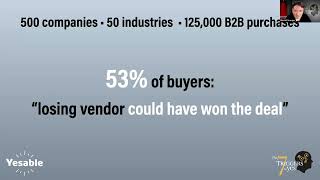
I want to start today with confession. I want to confess to being confused about something that everyone seems to take for granted, and that is the term sales enablement. In fact, I'm so confused about it that I'm going to risk making a fool of myself and say this sales enablement doesn't really enable sales. Let me explain and then you can decide if I'm onto something or if I've just got my head up my prospect pipeline. So I've been in and around selling for decades, developing courses for my father's sales training company, selling for my own as well as others agencies, and working with CRMs and eventually AI technologies. And yet, whenever I heard the term sales enablement, I assumed it referred to systems and resources that helped get the sale. More specifically, that helped secure a buying decision. But it wasn't until we started building our own AI technology, which is focused very specifically on the buying decision, that I took a closer look at this category and realized sales enablement doesn't really describe what these technologies do. They don't really increase the likelihood of a sale. What they do is increase and support, increase the productivity and the support of the sales team, the sales operation, speeding things up, streamlining workflows, boosting visibility. In other words, they enable selling, but not necessarily sales. Now, more selling does usually lead to more sales, but let's be honest, that's a numbers game. And the numbers game has limits. There's only so many opportunities in a quarter, so why not call it sales selling enablement instead of sales enablement? Semantic hair splitting maybe, right? But now imagine an AI system that actually does help facilitate a buying decision. What category would that belong to? So in the end, we made our own category and we call it buying enablement. Now, if that were a real category, who else would be in it? Well, probably tools promising to improve buyer facing, communication, playbook platforms, templates, coaching, resources. So we looked at all of those and they're great for speed, convenience, customization, accuracy, but all still missing one thing, actual influence on the buying decision. And if we're going to talk about buying enablement, that decision is the heart of it. And we should probably be asking, what does it really mean to impact a buying decision? Are sellers even in a position to do that? Or to paraphrase the old sales training truism, is it really the customer who closes the sale? Now, our answer to this, backed by both neuroscience and decades of field work, is both yes, sellers can influence the buying decision and yes, buying can happen without them. Now, how can both be true? Because the single central condition for a buying decision is an emotional connection with the offer. And that connection can happen on its own or as a result of influence and persuasion. Now, this is in theory, it's neuroscience, confirmed with live brain scan research and the basis of my father's book, the Seven Triggers. TS and after more than a decade of working with sales teams around this very premise, we've seen the same thing over and over again. The most reliable baseline of wins are from customers who make their own emotional connection with the offer. In other words, aside from the basics of competently conducting a sales process, most sellers have little or no influence on the buying decision. And what is that baseline? It's about 50%. Now, from a certain angle, that's good news, right? You're getting half of your possible sales pretty much no matter what. But the really good news is that if you do give sellers the ability to influence buying decisions deliberately, you've got a ton of opportunity. You could double your sales. Now, there's another angle, of course, the bad news angle, which is you're leaving up to 50% of winnable deals on the table. And you know what we also see over and over again? Giving sellers the ability to influence buying decisions by activating the emotional connections produces more wins. How many more wins? Well, in high performing sales teams where a 7 to 15% lift is celebrated, our clients have averaged a 30% boost extraordinary by any benchmark. And we help them do that entirely with within the existing systems and models they're already using. The seven Triggers to yes is not sales training. It's not a process. It's a persuasive communications framework that maps to any selling model or process and which is focused entirely on on the buying decision. And that is the essence of buying enablement. So we have the neuroscience foundations which you can read about in the book and which we delve into in full on Netflix style documentary type presentations in the courseware. And we have over a decade of on the ground in the field experience and results. But what about the broader market validation of this very unique approach to influencing the buying decision? Well, in our search for other apps and tools that might constitute buying enablement, we happened upon a system that appeared to be built entirely around the buying decision and which also had some pretty interesting research research behind it. So it's a company called Corporate Visions and they looked at over 500 companies across 50 industries and more than 125,000 B2B purchases. Their key finding was that about 50% of buyers said that a losing vendor could have won a deal. In other words, winnable deals lost. Now, does that number look familiar? It's two different perspectives. We looked at total possible wins and they looked at total possible at total losses. But the available opportunity losses that could have been wins is almost exactly the same. And there's more. When asked why the vendors lost what could have been won, the buyers said this things the seller did or didn't do to impact their buying decisions. So there's your missing 50% of winnable deals entirely within the hands of your sellers. Now of course, the buyers didn't say as a reason for the loss, no emotional connection to the offer, because why would they? They're only going to explain their experience, not the psychological or biological interpretations of that experience. But something very interesting happens when we take a closer look. When asked to define further what actually influences their buying decisions, buyers identified eight specific factors which you can see here. Now when I saw this list, it sure looked awfully familiar to me and would to anyone who knows the 7 triggers ts because aside from a few functional factors that have to do with fit or pricing, every one of these buying factors can be mapped to one or more of the seven triggers. The labels on some of them are even so close as to be almost identical. But aside from being a welcome validation between real world market analysis and our own neuroscience research, let's recognize what we're really looking at here. The entirety of the seven Triggers formula was created for one purpose, to create an emotional connection with the the offer. So the buyers in this study may not have had the scientific knowledge or vocabulary to articulate it, but they said that nevertheless, that's what was missing. Now, it's also important to recognize that despite their incredibly close alignment, buying factors and emotional triggers aren't the same thing. Factors are the things that buyers experience and can describe. They tell us what matters, right? Right. The triggers, on the other hand, tell us how to communicate so that those factors become real and experienced persuasive connections. Triggers are the underlying levers defined, delineated, structured and detailed in a way that can be taught and used as guidelines for messaging and communication. And that is precisely what makes them so uniquely suitable for playbook processing by AI. It's also the reason why Corporate Visions built a coaching app around their findings, to be used after engagement rather than a playbook builder to be used before and during. That messaging and communication piece also turned out to be the key factor for the phenomenal success stories we saw in in our corporate implementations. But of course, those cases. In those cases, the messaging work was done manually. So it's a little ironic actually that while this particular application of AI is so unique in overall sales enablement that it seems to warrant its own category, and yet in the same. And yet in the successful implementation of the seven trigger system, it's no different than it's always been, except for being so much faster and more economical. Now, what that means is that now anyone can experience the kind of results achieved by our most successful corporate implementations. Let's take a look at just one. So, at AbbVie, Humira was third to the market to Biologic. It was third to the market, and despite putting all of their top sales teams on it, looked like it would remain third in the market. Then a consultant came in waving a book and it was the seven triggers to yes. So with help from our company, AbbVie did a cross divisional implementation of seven triggers programming, which means both sales and marketing. And within a year, sales of Humira exceeded projections by 27%. In less than three years, Humira became the largest selling and most profitable prescription drug in the world. And as you might imagine, the ROI for that implementation was pretty much through the roof. So now I have another confession to make. We didn't actually realize how essential the redrafting piece was, the messaging piece, until we started bringing the program to smaller companies and solo professionals online during the pandemic. And though it's not like we didn't understand the need for that piece. And so we provided a lot of guidelines for producing the messaging redrafts, but too many clients either couldn't or wouldn't do it, and it showed in the results. So we were kind of in an impasse. And that is when AI burst onto the scene. Now, to say it felt distinctly like serendipity, to see how perfectly suited the seven triggers formula turned out to be for AI process for AI processing would be an understatement. When I saw the first tests of yesable from the development team, my jaw was on the floor. I mean, I know I'm biased, but, you know, it was astonishing. I was seeing messaging elements and communication tools generated in minutes that had taken corporate teams months to complete. So understand that the breakthrough that we've made in harnessing AI to enable persuasive power and impact, not just the selling operation, but the sale itself, is not the result of some exotic algorithm. Right? It's because we happen to have a persuasive communications framework that is uniquely suited to AI processing. And for those of you thinking holistically about revenue performance yes, it will both fits and augments. Revops approach. Revenue Operations is about unifying marketing, sales and customer success around shared systems, shared data and shared outcomes. But to truly optimize revenue, you should also think about shared messaging intelligence, something that guides communication across the customer journey. Yesable can close that gap by embedding the seven Triggers framework directly into workflows, the workflows you're marketing, sales and customer teams already use. And because it's a communications framework offering both consistency and flexibility, it gives the Revops team a collaborative way to communicate value, build emotional connection, and drive decisions at every stage of the revenue of the revenue cycle. So in other words, everyone can use the framework in their own way and do executions based on their own particular applications. And they're all drawing from the same well, okay, let's talk for just a moment about adoption. No one knows better than this group what a challenge it is to get salespeople to engage with anything administrative or operational, including apps and platforms that claim to make their lives easier or more successful. Salespeople are people people, and they'd much rather engage with people than with tools. Because we know this, we designed Yesable to be what we like to call simplicity itself. There's no prompting, there's no chats, there's no learning curve. It works in literally three steps. You upload and you upload your offer and customer information. From there, the system automatically creates talking points which are extracted and organized into the seven trigger categories. And then outputs are generated with just a few clicks for personalized, emotionally intelligent playbooks. That's it. Better messaging instantly at scale. Finally, there is training built into the app for sellers to learn about emotional triggers, what they are, why they work, how to activate them. But the seven Triggers to Yes is not, as I said earlier, fundamentally a training program. It is a communications framework to be put to use each and every day. And because yesable is designed to be an easy go to system for generating more effective messaging within those existing workflows, the system itself minimizes or even eliminates the usual fall off from initial training. So let me bring this full circle. Sales enablement is about shifting the equation. When opportunities are finite, changing outcomes isn't really about more selling, it's about more winning. And even though AI has made that opportunity with the seven Triggers more accessible and economical, the excitement here is not really about AI. It's about a simple, proven, and now turnkey way to give sales teams more influence over buying decisions. Many of you have already invested in sales enablement. Imagine pairing those opportunities with the power to, to close more of them. That's the promise of AI enablement. That's the promise of yesable. And then the link here you can, y' all can see a brief demo. It's just a few minutes, but it'll show you the entire system exactly how it works. If you want to book a demo with us, we can actually take your own materials, your information about your offer and information about your customer and process it through the system so you can literally see what the results would be using your own materials in the demo. We need a couple of days lead time, but that's all it takes. Then if you also go to this link, you'll get an opportunity to sign up for an ebook preview download of the long awaited second edition of the 7 Triggers TS which covers not only the material in the original book, but a lot of innovation that has happened over the past. Over 12, almost 15 years now since the original book was, was published. Everything that's happened in the field and in our case studies and a lot of innovations that have, that have developed since then, all included in the new second edition. How did I do? 20 minutes.
Absolutely incredible, Russell. And I think it's, it's one of those things where keeping the energy, keeping the excitement and conveying such powerful information and insights and I know that we're going to have all kinds of questions. Gerhardt was your first go to.
Well, I, it reminds me when I first read the book seven Triggers to. Yes. And there was a number of years ago how impactful that was because I felt that Russell's dad discovered the DNA to persuasion and made it really simple. And when I, you know, Russell and I talked about the merging of AI and I, I realized immediately that this is such a powerful tool that every salesperson, every sales leader can apply immediately and get results. The, the story with the pharmaceutical company is amazing. A 27 increase in the first year and then being, being number one in the world is.
Yeah, Gerhard, I've got, I've got probably over a dozen stories of very similar, very similar numbers. Our average is, is a 30% jump. And, and the, the differential from the mean is very close.
It is.
You know Gerhard, you kicked this off by sharing the importance of that immortality. And I'm, I'm, I love for you, Russell, to just close us out with what that means in terms of the impact not only that your father created, that you're extending, but also your own and how powerfully you own it.
I, I appreciate that. Is it, Was that Trisha?
Yes.
Thank You, Trisha, you know, you know, I, I'm gonna, I might take this in a slightly different direction. I think, I think the legacy, I think what my dad has left the world with the legacy of this formula and, and Gerhardt is absolutely right. Look, my dad didn't invent emotional triggers. If anybody, you know, deserves the, the sort of the, the, the credit for the, for the birth of the concept and then the, and then, and then, which was subsequently verified by neuroscience, it would be Robert Cialdini who really came up with the concept probably 15 or 20 years before. But what had not happened is that no one had really put this, put a set of triggers together that were a. Specifically oriented toward business and particularly sales, communications and biological that were simple enough and that provided enough of a framework that, you know, busy business people could actually follow and get results from. Right. You know, if you want to learn about emotional triggers in the most sort of academic possible way and really understand the depth and, and of, and the science of human communication based around what the emotional brain is doing, you know, spend time with Robert Cialdini. He's, he's a genius when it comes to this stuff. But if you want something really practical that's going to produce results, you know, quickly, reliably and dependably, that is this formula. But here's what I think the legacy is, I'm hoping is going to end up being. It is that it's a lot more about just getting a sale. Okay. Because it's about sort of pinging, triggering, connecting with, activating the emotional brain. What you're doing is you're creating more meaningful connections with people. And in a world where, you know, the barriers to human connection are becoming more and more challenging, whether it's from digital communications or lack of trust or skepticism in our news sources, whatever the case may be, this is a formula. And it's interesting because it's, it sort of runs counter to a lot of the assumptions about, or the reputation that persuasion has, which is, oh, you know, it's manipulative. It's like a scale scheme. It's like, it's like, you know, it's, it's a way to get people to do things that they otherwise don't do. That's not what this formula does at all. This formula literally puts people together in more meaningful ways and makes sure that what you're focusing on in terms of your solutions is what's most meaningful to the other person. And that has implications far beyond selling.
Yeah, I think there's a term for that. It's mutual regulation. I don't know exactly the term but when you use a formula like the seven triggers to yes. Then the alignment with two people turns into a bond.
Yeah. Which you, you kicked off with a, with a, with a very similar analogy. Gerhard.
Well I, I do a lot of events in a year and it is infrequent that you hear Norman Vincent Peale being, you know that was a beautiful thing. A beautiful thing.
Absolutely.
We are running out of time. We have Charlie waiting in the green green room. Russell, thank you so much And I encourage everybody do that test drive of his new solution and also get the book on Amazon. It is eye opening.
Yep. The second edition will be out soon.
All right.
Oh there we go. We all have our that list right. Of like it's coming. It's really coming.
Thanks everyone.
Thank you.
More from Gerhard



What Selling Looks Like When Your AI Agents Have the Context Your Sellers Do

Better Conversations, Smarter Support: Wearable AI in Business






When Scarcity-Built Systems Meet Abundance - The Judgment Gap in AI-Powered Sales Leadership
